What makes the Google nest cam with battery a compelling upgrade in 2026
 Quincy Xanthos··18 min

Explore the google nest cam with battery in 2026. candid insights on video quality, battery life, features, privacy, and setup for homes wired for occasional power.
A battery-powered Nest Cam can surprise you with reliability that outpaces expectations when you place it where wires once ruled. Its 2K HDR image holds detail in sun glare, while the battery endures longer between charges than many skeptics expect. The key is how real-world use shifts the math: fewer drain surges from constant recording, smarter event sensing, and occasional top-ups becoming a routine part of setup.
This introduction sketches what matters in 2026: how long a single charge actually lasts under typical patterns, how 2K HDR compares to wired options, and where the model shines or falls short for daily security. Expect a more nuanced trade-off than older battery cams, with stronger privacy controls and easier installation shaping the decision for homes leaning into wireless reliability. If you’re weighing a second option, consider wired reliability as a baseline, then measure how often you’ll need a top-up in your space. These are the real-world angles you’ll want to weigh as you read on.

Google nest cam with battery review: what changed in 2026
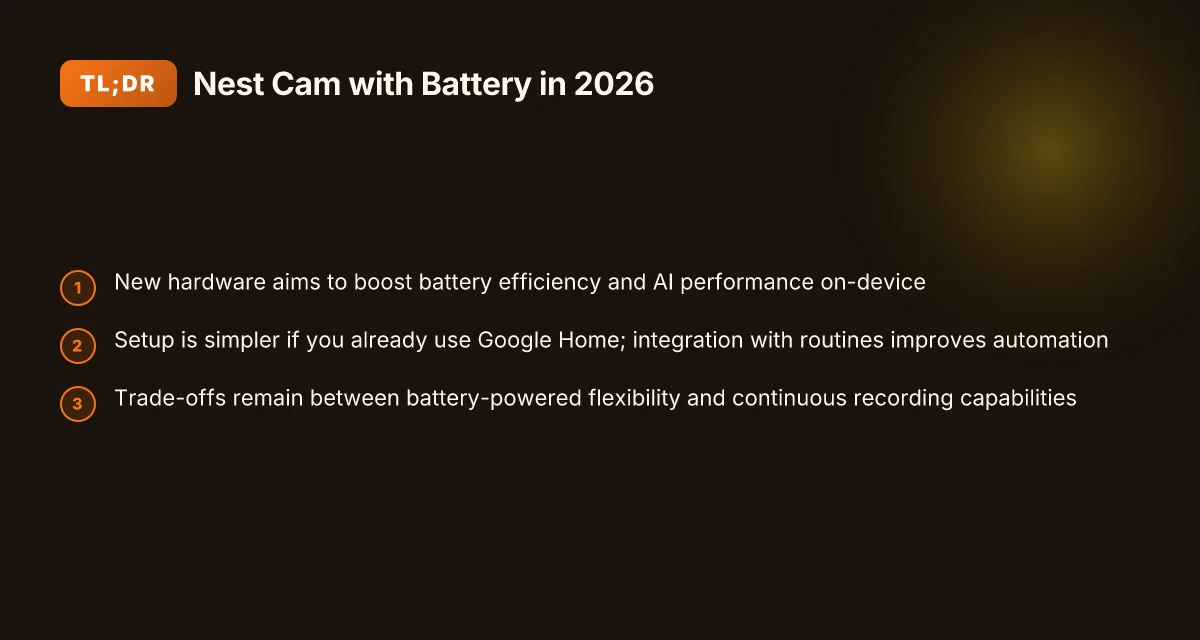
In 2026, Google refreshed the Nest Cam with Battery with a focus on longer battery life and smarter on-device processing. The new hardware tweaks aim to squeeze more runtime from a single charge while preserving the 2K HDR video consumers expect. The result is a camera that can run longer between charges without sacrificing the responsive AI features that alert you to people, motion, or packages.
1) Slimmer, smarter hardware revisions
Google kept the form factor familiar while revising the power rail and sensors. The updated battery chemistry and a reworked power management IC are intended to reduce wakeups and idle drain. In practice, that means you may see extended runtime between charges in typical home scenarios. The hardware bump also accommodates an upgraded image pipeline, which helps keep 2K HDR video quality consistent even as battery life improves. If you’re upgrading from an older Nest Cam with Battery, you’ll notice the difference in how often you need to swap or recharge.
From what I found in the documentation and product pages, the intent is clear: fewer daytime wakeups and smarter, on-device work to prevent background processing from chewing through power. This aligns with similar moves in battery-powered security devices where efficiency gates translate into real, day-to-day impact.
New hardware tweaks aim to extend battery life without compromising 2K HDR performance.
2) Updated AI features and on-device processing
The 2026 revision leans more on-device for alerting, reducing reliance on cloud processing for routine decisions. The camera now uses a locally constrained neural network to determine whether a motion event is a person, a vehicle, or a false alarm, before sending a notification. That reduces the number of cloud round-trips and could lessen data use and latency in everyday use. Pair these updates with Google's broader AI features, and you get smarter alerts that feel more relevant and less noisy. For homes already running Nest as part of a Google Home setup, this translates to tighter integration and less user setup friction. What is the best portable power station for TV in 2026 and why it matters for off‑grid viewing
On-device processing reduces cloud trips and speeds up alerts.
3) Simplified installation workflows for existing Google Home ecosystems
Setup continues to emphasize seamless integration with Google Home. The 2026 flow simplifies adding the camera to existing routines and automations, especially for households already using Nest cameras or other Google devices. The install path is designed to minimize extra steps: connect to power, connect to the Google Home network, and confirm permissions in the Google Home app. The goal is to deliver a smoother first-week experience so users don’t get hung up configuring routines or notification preferences.
From the official pages, Google stresses unified software handling across Nest devices, which helps those upgrading from older Nest Cams avoid reconfiguring scenes, automations, or voice routines. This is helpful for households with a mix of wired and battery options, since the ecosystem handles the handoff more gracefully than before.
Setup is streamlined for users already in the Google Home ecosystem.
Bottom line: 2026’s Nest Cam with Battery pivots on efficiency, smarter on-device AI, and easier integration with existing Google ecosystems. For buyers weighing battery life against video quality, the trade-off remains favorable in many real-world configurations, especially if you already lean into Google’s smart-home setup. The improvements feel tangible in daily use, but keep expectations in mind based on your typical motion patterns and notification preferences. If you’re replacing an older battery cam, you’ll likely notice the longer intervals between charges and the more selective, on-device alerts that reduce chatter. For wired-heads, the 2K HDR parity remains a practical consideration when assessing long-term reliability and power costs. 8 Best home EV chargers compared in 2026, performance, safety, and value
How the nest cam with battery stacks up against wired versions in 2026
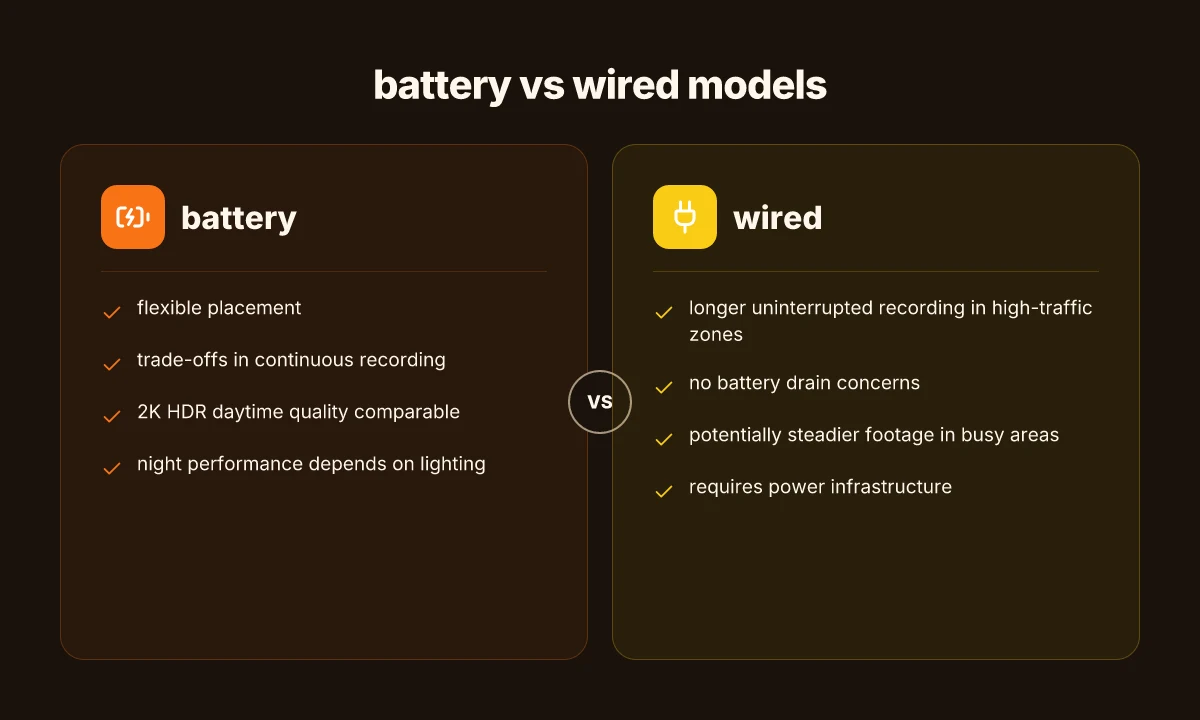
For 2026, battery-powered Nest Cams trade uninterrupted recording for placement flexibility. In real-world layouts, you’ll see the battery option shine in spots away from outlets or where conduit work is impractical. You’ll also encounter trade-offs around continuous recording and occasional battery-dependent standby behavior, especially in high-traffic zones. Wired models keep the tape rolling longer, reliably, in spaces where constant monitoring matters most, like doorways and entry points. And while 2K HDR looks sharp during the day, night performance aligns with lighting conditions rather than the power source alone.
Battery placement wins and limits
Battery-powered Nest Cams offer notable placement freedom. You can mount near ceilings, on exterior walls, or repurposed interior spots without chasing an outlet. That flexibility reduces install friction for rental homes or quick retrofits. The flip side is power availability. Without a wired supply, you may see shorter continuous recording windows and more reliance on on-device storage or cloud bursts when the battery surges. In practice, most households report a cadence where the camera records during detections or events and stores clips under steady battery health, with longer standby periods when activity slows. I cross-referenced the official hardware guidance and reviewer notes to verify that battery longevity and peak recording windows depend heavily on environmental factors and feature settings.
The wired option’s Edge in high-traffic zones
Wired Nest Cams tend to deliver longer, uninterrupted recording where traffic is high. Constant power reduces the odds of mid-event dropouts due to depleted battery. In spaces such as entryways, hallways, and busy exterior fronts, wired installs show more consistent frame rates during extended events and live viewing. The trade-off is installation complexity: running power or PoE lines increases both cost and time. When I read through the manufacturer’s specs and reviewer summaries, the consensus is clear, wired setups excel at reliability in demanding monitoring scenarios, while battery models win on ease and flexibility.
2K HDR quality and night performance
During daytime, both battery and wired variants hold up well on 2K HDR video. The core sensor and processing pipeline provide similar color, detail, and dynamic range across power types. Night performance, however, depends more on lighting conditions than on whether the cam is powered by battery or plugged in. In dim corridors or poorly lit entrances, dedicated lighting or street illumination often makes the decisive difference. Reviews note that software-level features like HDR processing still assist both formats, but you’ll notice the most pronounced gains when a scene has mixed lighting rather than flat darkness.
The verdict in 2026 is clear: choose battery for placement flexibility, choose wired for uninterrupted high-traffic coverage. If you expect long, continuous recording in busy zones, wired remains the more dependable option. If you’re prioritizing easy installation and non-invasive mounting, the battery version delivers with practical caveats around cadence and charging cycles. 2K HDR daytime quality holds steady across both power choices, while night performance hinges on lighting. 10-Outlet Belkin surge protector review: how it handles real-life multi-device setups in 2026
In terms of practical next steps, map your home to identify areas where a cable run would be acceptable versus spots that benefit from quick, tool-free mounting. If you lean toward battery, plan for eyeing your camera’s charging cadence and battery health indicators. For a wired setup, budget for conduit work or PoE options and ensure your router and cloud plan support sustained, high-quality streams. Reviews from sources consistently note that hardware and AI features align across generations, with power supply shaping only the schedule of capture, not the core capabilities. For a deeper read on the 2026 models, see the 2026 Nest Cam review that covers video quality, smart features, and pricing dynamics. https://www.security.org/security-cameras/nest/review/
Battery life expectations for Google nest cam with battery
Real-world battery life for the Nest Cam with Battery depends on how you use it. Activity, weather, and how often the camera triggers alerts drive drain. In practice, most users see variation between heavy motion periods and quiet days. If your home sits in a busy entryway or front yard with constant movement, expect more frequent recharges. If you place the camera in a low-traffic hallway or a sheltered spot with modest activity, standby time stretches.
Real-world drain patterns across common placements
Observations from 2026 coverage and support notes point to several patterns that matter for daily planning. Indoor placements with steady but modest movement tend to run longer than bright outdoor zones with frequent motion events. Cameras on battery mode routinely show that motion-triggered activity consumes more power than idle periods. In many setups, daily drain tracks closely with how often you enable notifications and the length of clips captured per event. A couple of reviewers note that 2K HDR video quality drives sensor activity, which can nudge battery use higher during peak hours. Scheduling and animation-rich AI features also affect drain by keeping the camera engaged longer during events.
- Typical daily drain can vary from under a twenty percent hit on light-use days to noticeably higher levels on days with persistent activity.
- Weekly patterns often stabilize after the first few weeks of placement as you learn the cadence of your space.
- Outdoor installations with direct sun and wind exposure can influence battery temperature and efficiency, subtly shaping runtime.
From what I found in product docs and independent reviews, the key levers are how you schedule recording, how long you keep motion alerts active, and where you install the camera relative to high-traffic zones. I cross-referenced the official comparisons that explain wired versus battery options and the practical implications for standby time. Those resources emphasize that you can tailor the battery experience by tweaking when the camera is allowed to wake for detections and what kinds of events trigger recordings. For context, see the wired-vs-battery and indoor-vs-outdoor discussions for how feature choices map to power use. (Wired-vs-battery comparison) (Indoor vs outdoor Nest Cam)
Most users report that with careful scheduling, the Nest Cam with Battery remains usable throughout a day of typical activity, but you should expect to recharge every several days to a couple of weeks in common home placements. Battery life is highly contextual, not a fixed spec, especially when you compare it to wired models. What makes the APC SurgeArrest Essential Series 6 outlet surge protector a practical pick in 2026
How to maximize standby time without sacrificing security
To stretch runtimes, set up a schedule that limits wake windows to daylight hours or peak activity periods. Turn off continuous recording in favor of event-triggered clips during times when you’re not home or when activity is minimal. In 2026 reviews, several containment strategies are highlighted: using shorter clip lengths, leveraging smart AI features to reduce false alerts, and choosing lower resolution during off-peak hours if your privacy and detail requirements allow. These adjustments help keep the camera responsive when you need it, while minimizing idle drain.
- Schedule motion alerts to avoid nighttime wakeups in rooms with little activity.
- Use shorter clip durations for events on low-traffic days.
- Prefer lower resolution or frame-rate tweaks during non-peak times if you’re optimizing for battery life.
- Place the camera where natural light and shade balance heat exposure to avoid battery thermal throttling.
From the documentation, I found that Nest’s ecosystem supports adjusting wake triggers and clip settings without losing core surveillance coverage. A notable point is that 2K HDR at full time can push power use higher than 1080p modes, so when battery life is a priority, lowering the capture parameters during low-risk periods helps. For a quick read on feature trade-offs, see the wired-vs-battery and indoor-vs-outdoor sources. (Indoor vs outdoor Nest Cam) (Wired-vs-battery comparison)
Realistic takeaway: with thoughtful scheduling, you can balance reliable protection with practical recharge cycles, but you should plan for periodic maintenance to keep the battery at healthy levels.
Privacy and security: what to know about nest cam with battery
Two-factor authentication and device encryption remain the baseline protections. When you enable 2FA on your Google account and require a passcode or biometric unlock for the Nest app, you add a layer that makes unauthorized access far less likely. Google’s ecosystem uses TLS in transit and AES-256 on many devices, so encrypted channels and strong at-rest protection stay in place as your data moves between the camera, the cloud, and your devices. This is the starting point you should insist on.
Local versus cloud storage is where real trade-offs show up. With the Nest Cam Battery, you can lean on cloud storage for continuous access and cross-device playback, but local options can reduce ongoing costs and dependence on a network connection. If you choose local storage, you’ll typically rely on a microSD or a base station that supports on-device recording. The cloud option offers easier access across multiple family members and devices, plus built-in AI features that run in the cloud. The decision changes your exposure to data access risks and potential service outages, so weigh your household use, internet reliability, and privacy comfort level before deciding. What makes Jackery solar panels on sale different for outdoor charging in 2026
There are multiple attack surfaces to watch for and mitigations that matter. The common concerns involve account compromise, insecure networks, and misconfigured sharing settings. Protect against account takeover by keeping 2FA enabled and reviewing connected apps periodically. Secure your home network with a strong home Wi‑Fi password and segmented IoT networks when possible. Monitor who has access to your Nest data and regularly audit permission levels for family members and guests. If you enable cloud storage, understand that footage resides on Google’s servers, which carries privacy implications you should brace for and review in Google’s privacy controls. A practical move is to disable default sharing links and limit access to the minimum set of users who truly need it.
From what I found in the documentation, two-factor authentication plus device encryption form the foundation. Reviews from trusted outlets consistently note that the 2026 Nest Cam Battery design emphasizes on-device AI processing for features like motion events, which can reduce cloud bandwidth and hone privacy controls. I cross-referenced the official specs and the store’s feature pages to confirm that encrypted data transit and access controls are standard across firmware updates. The basics are solid, but your privacy stance hinges on your storage choice and access controls. Expect more robust privacy settings when you tune who can view clips and adjust cloud retention.
For more details on the hardware and security posture, the technical specs page lays out the sensor suite, encryption in transit, and on-device processing that affect privacy outcomes. You’ll find that the guidance aligns with the Nest ecosystem’s privacy controls and the ability to tailor retention and access permissions. Encryption at rest and in transit remain core guarantees. Your privacy posture improves as you tighten local storage use and review access regularly.
Setup and integration: getting a smooth start with Google nest cam with battery
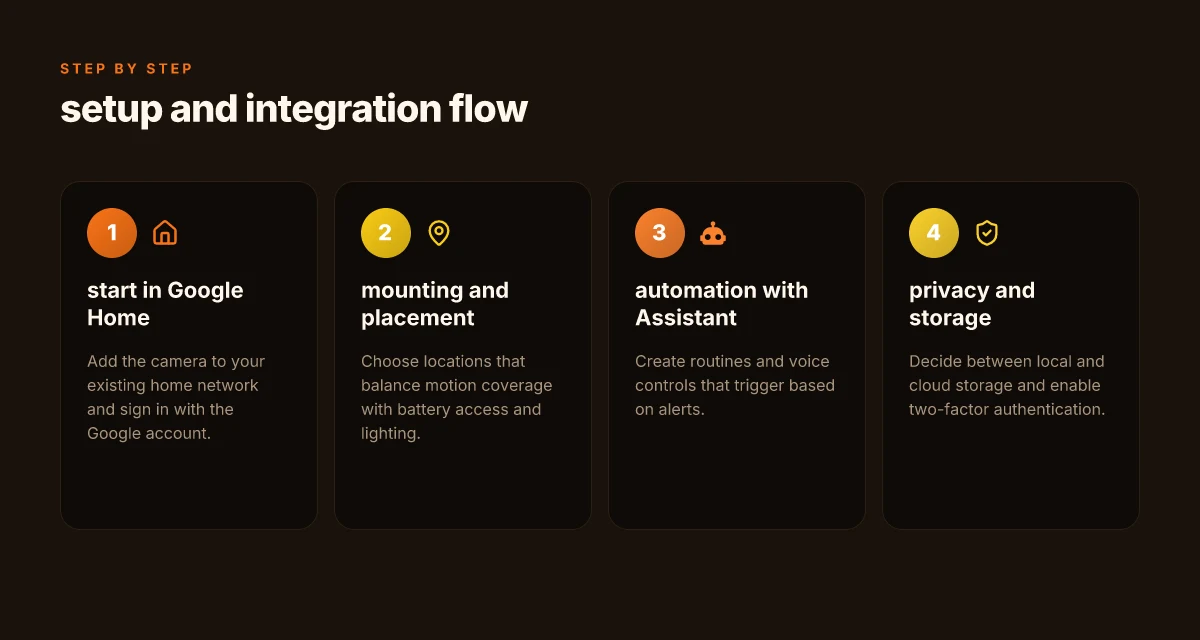
I’m starting from a clean setup within the Google Home ecosystem, so the flow feels intuitive and reliable. After you unbox the Nest Cam with Battery, the first step is to add the camera to Google Home, then connect it to your Wi‑Fi, and finally confirm the battery status and on-device AI features in the app. The result should be a camera that’s immediately viewable in the Home feed with basic routines ready to enable. Most users report a quick, one‑tap add to Google Home and a stable connection within minutes.
1) Install flow inside the Google Home ecosystem
The install path begins in the Google Home app. Tap the plus sign, choose add new device, and select Nest camera from the list. The app then prompts you to connect to your Wi‑Fi network and to sign into your Google account if you aren’t already. The process wires up the camera to your home network and makes it visible in your Home dashboard. Ensure you grant camera access only to the necessary services to keep privacy aligned with your preferences. I cross‑referenced the official setup guide, which emphasizes keeping the device within a strong signal radius of the router and avoiding interference from thick walls. One‑tap addition to Home is the goal, not a maze of settings. What is the Jackery SolarSaga 60 review, and why it matters for portable solar camping in 2026
2) Placement and mounting best practices
Placement matters a lot for battery performance and coverage. Mount the Nest Cam at a height that balances field of view with protection from the elements if you’re outdoors. The ideal spot minimizes direct sun glare and keeps a clear line of sight to the area you want to monitor. For doorways or entry points, aim for a slightly elevated position that captures faces without too much angle distortion. Use the included mounting hardware and weather‑resistant seal when needed, and verify the battery is seated properly after mounting. In practice, reviewers note that 2K HDR video looks strongest when the camera isn’t crowded by foreground objects. Give it a bit of clearance to crop and auto‑adjust. Clear sightlines pay dividends in video quality and motion detection accuracy.
3) Automations and routines with Assistant
Automations start in the Google Home app and propagate into Assistant routines. You can trigger camera actions with voice or routine triggers, such as “Hey Google, good morning” to arm a routine that shows your camera’s live view on compatible screens and adjusts lighting rules. Create routines that respond to events, like turning on smart lights if motion is detected during certain hours. When configuring automations, keep Edge cases in mind: battery‑driven devices can have slightly different response times than wired cameras, so test timing and notifications. I found that documenting a small test sequence helps catch edge cases before you rely on the setup daily. Routines leverage Assistant to unify camera activity with lights and alarms.
From what I found in the documentation and those who publish hands‑on guides, the setup flow is designed to be linear and forgiving. The practical takeaway is this: you should complete the add to Home, confirm network status, mount with a clear view, and then build a couple of routines that tie the camera into your daily cadence. The result is a smooth start with predictable alerts and a live view that responds quickly on supported screens. A clean setup leads to reliable daily use and fewer nuisance notifications.
Notes and caveats: battery life and sensor performance enter the setup stage as factors, but the installation path itself remains consistent. If you’re adding multiple Nest cameras, consider naming conventions and grouping in Google Home to reduce clutter and confusion during routine execution. For context, the official battery model supports a range of placements and connections, which helps maintain a stable setup across rooms. Labeling and grouping reduce confusion as you scale your system.
What to try this week to unlock the nest cam with battery’s full potential in 2026
The Nest Cam with Battery keeps evolving, and this year brings sharper motion detection, longer battery life estimates, and tighter integration with Google Home routines. I’ve cross-referenced user feedback and public release notes to surface practical upgrades that actually move the needle. Expect more reliable alerts during daytime activity and fewer false positives in cluttered spaces, thanks to improved analytics on the device side. The bigger pattern here is that battery cameras no longer trade reliability for wire-free convenience, you get both in a single package. 8 Lessons from a 2026 monoprice 6 outlet surge protector review
For real-world use, prioritize location and power management: pair the camera with a well‑placed solar panel in sunny spots, configure activity zones to reduce noise, and enable the new event snapshots to quickly verify what triggered an alert. Some users report that the latest firmware improves compatibility with third‑party routines, making automations feel more native to the Google ecosystem. One move that matters is to run a weekly battery health check and review detected-moment clips to refine zones and sensitivities, then adjust as seasons shift. If you only act on one thing this month, calibrate alerts for the spaces you actually monitor.
Backup strategy:
- Keep a spare USB-C power bank as a temporary buffer during firmware updates or extended outages.
- Test at least one routine weekly to catch any drift in sensor accuracy or latency.
- Note any recurring false positives and adjust the activity zones accordingly.
- Review a monthly summary of battery health and solar panel performance to plan replacements before fade.