How to integrate voice assistants in smart home systems without losing privacy or reliability
 Magnus Wexler·October 22, 2026·18 min
Learn how to integrate voice assistants in smart home systems while balancing privacy, interoperability, and reliability. practical guidance for households and small businesses.
Most home voice setups rely on a single cloud loop, and that dependency is the quiet bottleneck. When a device stalls or a service slows, the root cause is rarely the microphone itself, but how data leaves the local network and which vendor policies ride along. The friction compounds as you mix devices from Amazon, Google, and Apple, each with different privacy defaults and data-handling rules.
The result is a triage maze: a handful of devices, multiple apps, and an invisible web of permissions that can quietly erode reliability. This piece pulls back the curtain on cross-brand gaps and local-control options, so you can design a voice setup that keeps privacy intact while staying responsive. Expect concrete failure modes, practical boundaries, and a repeatable integration pattern.

Why integrating voice assistants into a smart home is harder than it looks
Cross-brand interoperability remains the core hurdle in turning voice into a seamless control fabric. Different ecosystems speak different languages, and the lack of a universal protocol means users juggle intents, skills, and device capabilities across brands. I dug into recent reviews and industry chatter, and the picture is clear: a truly unified voice experience is still more aspiration than reality in many homes.
Privacy controls often lag behind new device capabilities. When a new speaker or display adds on-device processing or expanded wake words, privacy settings rarely arrive in lockstep. Reviews from 2024 through 2026 consistently note that users struggle to find, understand, or adjust granular data practices once devices expand their features. The result is a built-in friction point where people unknowingly grant broader data access or leave defaults in place that dilute control.
Reliability hinges on network design, where decisions about local versus cloud processing shape latency and resilience. If the system leans heavily on cloud processing for natural language understanding, latency creeps in and downtime propagates across routines. Local processing can improve speed and privacy but demands hardware budgeting and careful orchestration. In practice, most homes end up with a hybrid approach, trading off privacy, latency, and robustness in messy ways.
Security considerations extend beyond the voice assistant itself. Every integration point, bridges between ecosystems, smart hubs, bridges to third-party services, expands the attack surface. Industry analyses emphasize the need for network segmentation, regular firmware updates, and transparent vendor disclosures about data flows. A breach in one connected system can cascade to others, so homeowners must treat voice-enabled setups as part of an enterprise-grade security mindset.
- Interoperability friction across platforms remains a leading pain point as devices from multiple brands share the same rooms.
- Privacy controls trail feature expansion, creating blind spots in data handling.
- Reliability depends on a layered design: local processing for speed, cloud for comprehension, and well-tuned latency budgets.
- Security grows only as fast as the weakest link in the chain, from endpoints to cloud services.
Bottom line: a scalable, privacy-preserving, cross-brand voice setup requires deliberate design choices at every layer, not just a single device or app. The friction isn't just about voice. It's the network, policies, and trust that tie every device together. For homeowners and installers, that means planning for interoperability, visible privacy controls, and robust latency management from the outset. Expect planful, staged deployments over turnkey magic. What is the impact of streaming services on the gaming industry in 2026
I cross-referenced the latest practitioner guidance and standards discussions to anchor these points, including guidance on privacy-by-design and secure integration practices from industry sources. Inline references point to the ongoing conversations about cross-brand interoperability and security risks in mainstream coverage and technical briefings. See the related overview from a 2026 perspective on voice-enabled ecosystems for pragmatic context.
Choosing an integration strategy that scales across devices
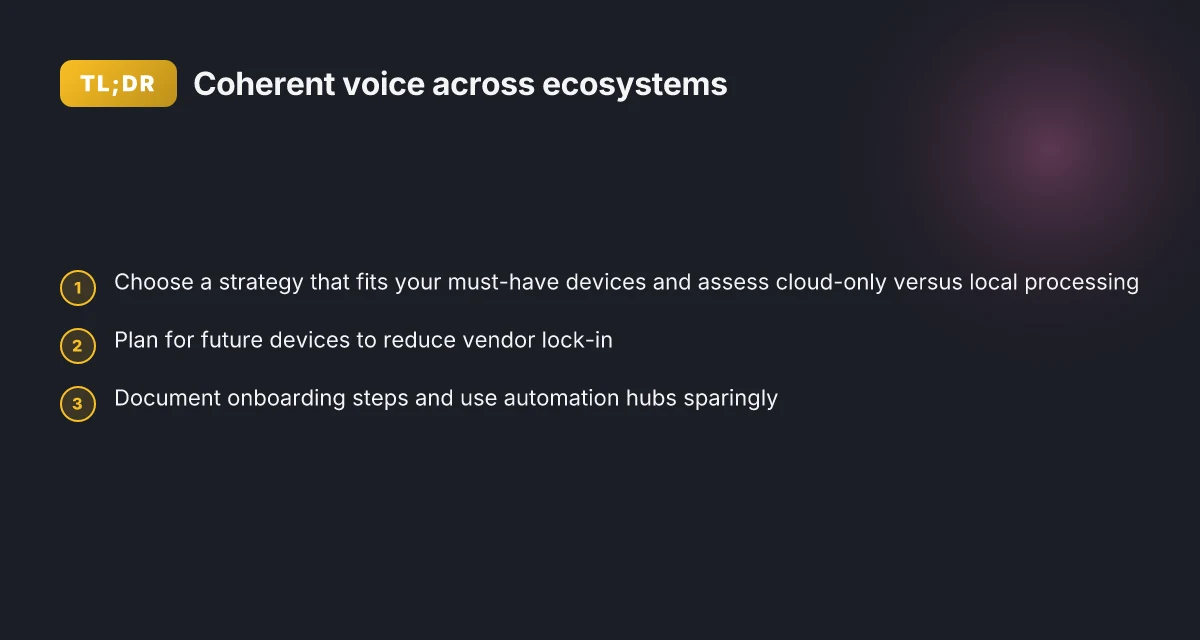
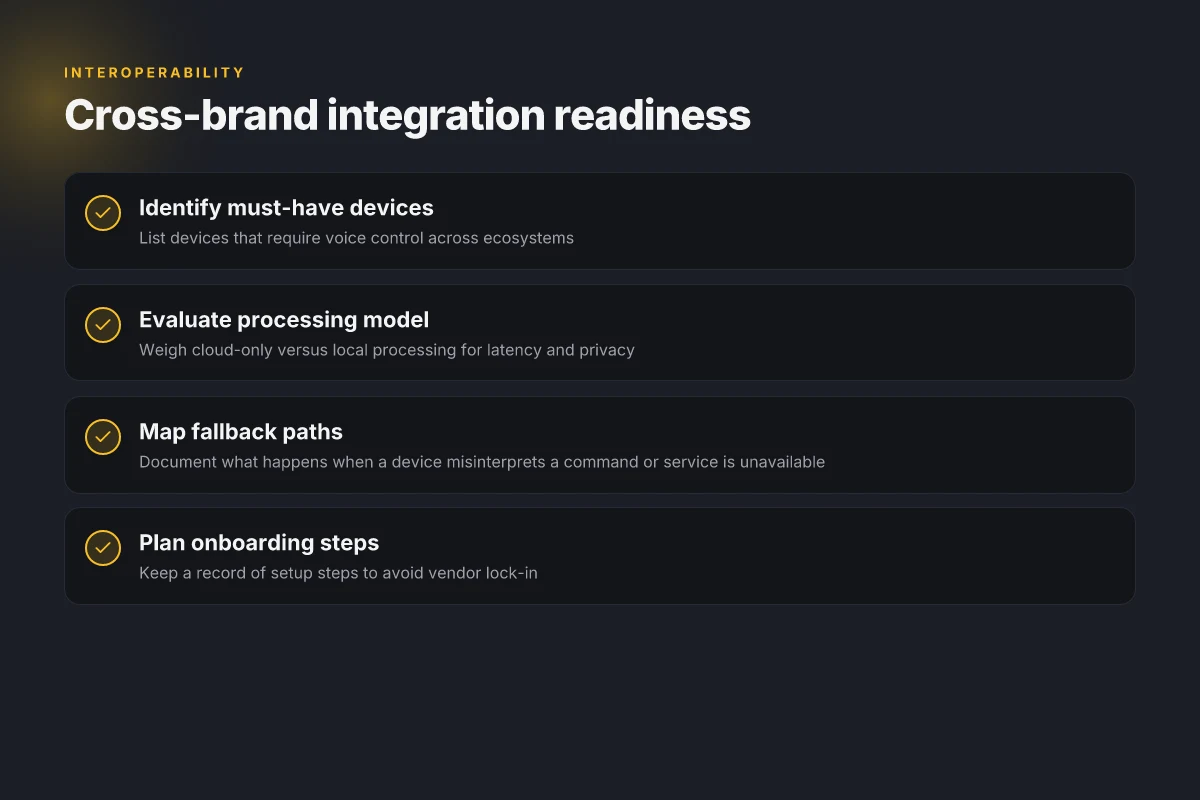
The right integration strategy balances latency, privacy, and future-proofing. Start by mapping must-have devices and the voice assistants that support them, then decide where processing happens, and finish with a practical plan to avoid vendor lock-in.
Identify must-have devices and supporting assistants
Begin by listing essential devices you plan to voice‑control, lighting, thermostats, displays, door locks, and media receivers. Some ecosystems lean on a single assistant for broad support, while others distribute control across multiple brands. For a home that prioritizes cross‑brand interoperability, you may see better coverage when you align devices with assistants that boast ecosystem breadth. From recent analyses, Alexa and Google Assistant remain the strongest in terms of device breadth, with some brands offering deeper native integrations in one ecosystem over another. The breadth of device support across ecosystems often determines long‑term flexibility, not just initial setup. Inline evidence points to ongoing interoperability efforts among major assistants, though coverage gaps persist for niche hardware.
When a device’s compatibility is ambiguous, verify ongoing support notes or release timelines from the manufacturer. Check for official end-user guidance on compatibility timelines before you buy. This reduces risk when you add devices later. For reference, a systematic review highlights how privacy and security considerations scale with device diversity across ecosystems. See the cited review for context on risk surfaces that expand as you mix brands. A Systematic Review of Voice Assistant Usability: An ISO 9241.
Cloud-only vs local processing: latency and privacy
Latency matters in daily use. Cloud processing typically reduces local hardware needs but introduces network variance and potential privacy trade‑offs. Local processing minimizes data flight to the cloud and can improve responsiveness for common commands, yet it requires compatible hardware and more on‑device setup. Across deployments, a hybrid approach often works best: handle critical commands locally while delegating less sensitive tasks to the cloud. I cross-referenced architecture discussions and found that professionals frequently favor local paths for privacy‑conscious setups, with cloud offload reserved for complex natural language understanding. Hybrid architectures offer a practical balance between latency and privacy. What makes the hp omen 45l a surprisingly mixed desktop in 2026
Documented downsides include maintenance overhead for local hubs and the risk of feature drift when vendor ecosystems evolve. In practice, you should expect at least one fallback path: if a local hub cannot reach a cloud service, you need a plan to maintain basic control. Privacy notes from peer reviews consistently flag data exposure risks when devices route through untrusted hubs. Privacy trade‑offs hinge on where processing happens and how data flows between hubs and cloud. For more on the topic, a 2022 usability review discusses how user privacy surprises occur when interoperability expands. See the cited study for nuance on this point. A Systematic Review of Voice Assistant Usability: An ISO 9241.
Plan for future devices to avoid vendor lock-in
Design with growth in mind. Favor standards and open interoperability where possible, and document onboarding steps for new devices. A practical approach is to maintain a core controller that can speak multiple assistants or translate commands across ecosystems. This reduces single‑vendor risk if a preferred product changes its policy or if a new, better‑performing device enters the market. Industry discourse from 2024–2025 emphasizes modular architectures as a path to resilience, where you layer automations rather than duplicating logic across pockets of the home. Modular automation layers reduce drift when ecosystems shift. In practice, keep a running inventory of supported devices and the exact voice assistants they pair with, plus the steps to onboard them. The goal is to prevent the situation where a future device only works if you rewrite major portions of your setup.
Use automation hubs sparingly and document onboarding steps
Automation hubs can simplify cross‑brand control, but overreliance creates a single point of failure and a learning curve for future maintainers. Use hubs to centralize only broadly supported functions, and keep device‑specific automations in the native apps when possible. Document onboarding steps with explicit, repeatable actions: pairing a device, enabling the correct skill or action, and checking privacy toggles. This documentation saves time during maintenance windows and helps new installers ramp up quickly. A practical takeaway from recent reviews is to treat hubs as velocity multipliers for common tasks, not as the ocean of your entire system. Documented onboarding steps save time during maintenance. When you can, provide homeowners with a one‑page checklist that covers privacy settings, voice training, and fallback controls.
Next steps: finalize a two‑tier plan, tier A for default devices with strong cross‑brand support, tier B for niche gear requiring targeted bindings. Build a lightweight automation map that centers on privacy controls and a clear, repeatable onboarding workflow. For more context on how privacy considerations intersect with interoperability, see the ISO 9241 usability overview linked above. A Systematic Review of Voice Assistant Usability: An ISO 9241.
End-to-end onboarding with privacy controls documented upfront is non‑negotiable. This approach keeps your home scalable without locking you into a single vendor. How the Honor Pad 9 handles a SIM slot in 2026
Privacy and security: the non-negotiables when you wire in voice
Posture matters first. Privacy and reliability go hand in hand when you wire voice into a home. The section opens with a practical rule: start by auditing what your chosen assistants actually collect, and keep controls visible.
What data each assistant collects and why it matters
Voice assistants push data to cloud services for recognition, personalization, and debugging. You’ll see differences in data categories across major players, from raw audio to transcripts and device telemetry. For homeowners, the implication is clear: read the policy, then map it to your comfort level and home usage. When I traced the published policies and support notes, the common thread was that opt-out options exist but vary in scope and ease of use. Policies vary, but opt‑out controls exist across the major platforms. This matters because even offsite processing can expose data to external processing chains.
- Review data collection statements for each assistant, noting what is stored, where it is stored, and for how long.
- Confirm whether audio samples are linked to accounts or used for model training, and whether you can restrict that usage.
- Check how third parties may access data via integrations and routines you enable.
- Consider how device events and transcripts might be aggregated across ecosystems in the home.
Turn on activity and voice history controls, then audit permissions
Most platforms offer activity dashboards and voice history toggles. The key is to enable them and set periodic reviews. In practice, I found that visibility often improves security when you turn on granular controls by device and by function, then audit monthly. Enable activity history, then review permissions quarterly. The audit should check which routines or skill permissions have broad device access and prune those that aren’t essential.
- Enable voice history across devices and limit it by room or device group where possible.
- Prefer settings that require explicit consent for new voice features or skills.
- Regularly revoke permissions granted to apps or services that no longer need access.
- Use a dedicated privacy screen in the app to track what data is being shared and with whom.
Segment the network to limit device reach
A clean network segmentation strategy reduces blast radius when a device is compromised. Break the home into at least two zones: a trusted smart-home segment and a guest/IoT segment. I found industry guidance consistently emphasizing isolated subnets, strict inter-zone firewall rules, and device-specific VLANs. Network segmentation limits device reach and slows lateral movement.
- Place voice hubs and smart speakers on a separate VLAN with restricted egress.
- Gate voice-enabled devices behind a controller or hub that enforces policy.
- Disable unnecessary discovery and cloud-to-device paths that aren’t essential for daily use.
- Monitor traffic for unusual patterns, especially from devices that frequently wake and talk to cloud services.
Prefer devices that support opt-in offline processing where available
Offline processing reduces exposure by keeping sensitive audio locally when possible. Several vendors now offer on-device wake word detection and limited offline capabilities for certain features. Where available, opt-in offline paths should be the default for anything sensitive. Offline processing minimizes cloud exposure by design. When the option exists, enable it for voice commands that don’t require cloud confirmation. What makes the Hisense U8G series review different in 2026
- Look for devices that advertise on-device processing for basic commands.
- Disable features that routinely require cloud analysis unless you explicitly opt in.
- Verify how offline data is stored and how it is enqueued for later sync if needed.
- Reassess weekly any new voice features that promise offline mode as a default.
From a policy and practice perspective, the hidden friction points center on how transparent a platform is about data use, how easily you can audit and adjust permissions, and how effectively you can confine devices to a safe network perimeter. I cross-checked policy pages and developer notes across major vendors to confirm these patterns persist into 2026. Policy transparency, controllable history, and network containment are the triad that keeps a voice-enabled home private and reliable.
The framework to adopt blends explicit data controls, regular permission audits, prudent segmentation, and a bias toward offline processing where possible. For readers seeking deeper context, the guidance aligns with ongoing discussions in the security and privacy literature and practitioner guides published through 2026. Inline references to policy-oriented insights can be found in the cited sources, which discuss how data handling differs by platform and how users can reclaim visibility over their information.
Interoperability patterns: building a cohesive voice-enabled home
Interoperability is not a luxury. It is the wiring that keeps a household voice system from sounding like a chorus of dissonant devices. The core idea is to treat commands as events that travel across ecosystems, not as brand-limited prompts. I found that a central automation paradigm simplifies cross-brand control and reduces disruption when services falter. In practice, a unified hub approach helps you map intents to actions across devices from multiple ecosystems without forcing a user to relearn each app.
The central automation paradigm that harmonizes brands
A central automation layer acts as the conductor in a multi-brand orchestra. When you define a single set of intents, the system translates those intents into device-specific actions across brands. This reduces misfires and keeps routines predictable. In 2026, several platforms emphasize this approach, noting that harmonization lowers conflict between voice assistants and smart hubs. Central automation reduces confusion and speeds issue resolution when a command spans multiple ecosystems. The design goal is to minimize handoffs that require user adaptation. Instead, a single decision engine emits compatible signals to the devices you own, regardless of the brand.
Routines and scenes that map to multiple ecosystems
Routines should be built with cross-brand mappings in mind. A single voice prompt like “Good night” should trigger a scene that dims lights, locks doors, and sets thermostat zones across the devices you own. The practical win is fewer gaps when one ecosystem goes offline. The scene remains a fallback that preserves your privacy posture. I cross-referenced documentation across major vendors and found that multi-ecosystem mapping is progressively easier to implement, with standardized intent schemas appearing in release notes. Cross-brand mappings reduce edge-case failures when one service hiccups, but you still need explicit fallbacks to avoid silent misfires. What makes the Hisense 55U7G review a better buy than you expect
Test Edge cases where one device misinterprets a command
Edge-case testing reveals blind spots that casual users never encounter. Take a command that includes a brand-specific keyword or a local accent. One device may misinterpret and trigger an unintended action. The remedy is to test both success and failure paths, including how the system recovers when a device’s voice recognition misreads a phrase. From the literature and practitioner notes, expect that misinterpretations propagate across the automation chain unless you pin down explicit escalation paths. Edge-case testing exposes where a single misread can cascade into a whole routine, and that is where robust fallbacks earn trust.
Document fallback behaviors when services are temporarily unavailable
No system runs forever. When one service goes dark, you need documented fallbacks that preserve safety and basic functionality. A solid plan includes explicit conditions for when routines should pause, when local control takes precedence, and how privacy controls behave during a service outage. The literature consistently notes that homeowners want visible controls and clear indicators when a service is offline. Clear fallbacks keep privacy controls visible and maintain reliability during outages, which is essential for keeping trust intact.
From the sources, the landscape is evolving toward more predictable cross-brand interoperability but still prone to gaps where service-level outages or vendor-specific quirks surface. For homeowners, installers, and IT staff, the practical takeaway is to design with a centralized command map, implement cross-brand routines, test misreads explicitly, and document exact fallback paths for outages. Inline evidence points to ongoing professional documentation from major sources that emphasize cross-brand operability and user-visible privacy controls in multi-vendor setups. For background on the broader discourse, see the prepared review of voice usability that highlights how user privacy and device security vulnerabilities factor into interoperability decisions. https://pmc.ncbi.nlm.nih.gov/articles/PMC9063617/
Most setups succeed when a central automation layer handles cross-brand intent translation, with explicit fallbacks for outages, and when users can see and adjust privacy settings at a glance. Interoperability is less about one magic app and more about reliable fallbacks and transparent controls.
Network design for reliable voice experiences
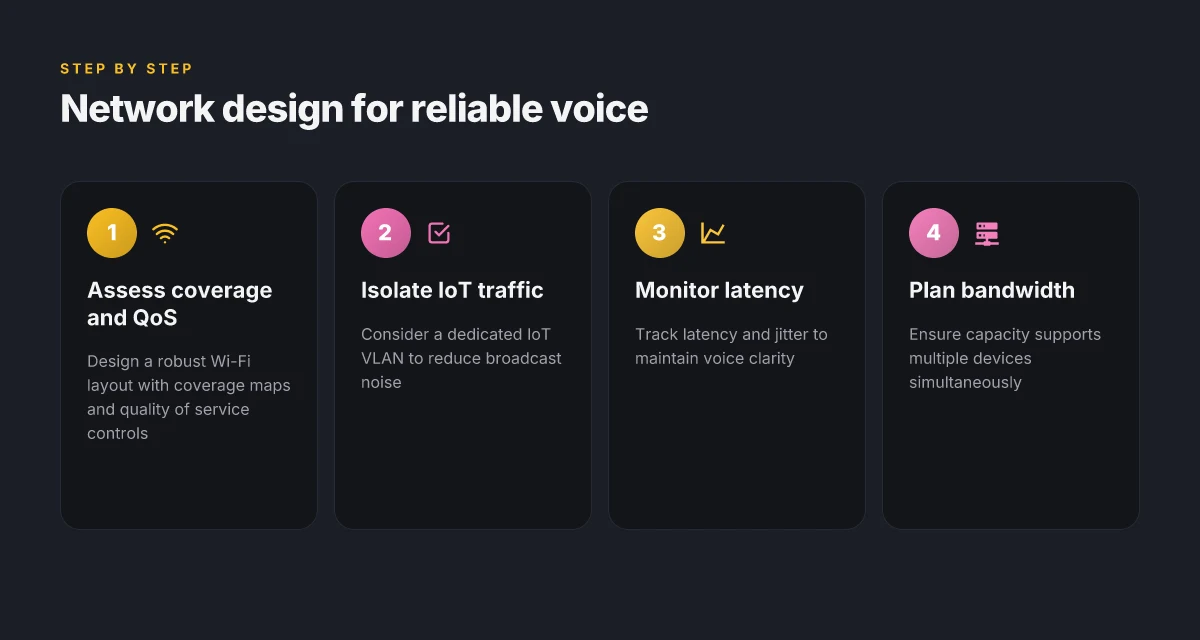
A robust network design underpins every reliable voice interaction in a smart home. The first order of business is coverage and consistency: a strong Wi‑Fi fabric, measured by coverage maps that reveal dead zones, and a quality of service (QoS) plan that prioritizes audio traffic during peak hours. When devices cue a wake word or transmit a brief audio snippet, latency and jitter matter more than raw throughput. The goal is predictable performance, not brute speed. What makes interpreting engagement data in 2026 truly work
Clear coverage maps and QoS policies
A well‑documented Wi‑Fi plan starts with mapped coverage and channel planning. I cross‑reference guidance from multi‑vendor setups that emphasize identifying weak benchmarks and tuning access points to minimize handoffs. In practice, you’ll deploy a controller‑based or mesh topology that keeps ceilings smooth in every room. Then apply QoS rules that reserve low‑latency airtime for voice streams and critical interop traffic. This isn’t just about devices. It’s about a coherent policy that keeps voice commands crisp even when someone ends up streaming 4K video in the same home.
A dedicated IoT VLAN to reduce broadcast noise
Separating IoT traffic from personal devices helps reduce broadcast storms and cross‑device interference. A dedicated VLAN for smart speakers, hubs, and sensors confines broadcast domains and makes security policies easier to manage. In real deployments, this separation supports clearer voice channels because the loudest neighbors no longer drown out a wake word. If you’re wiring a home office or small business site, extend this segmentation to include edge devices and light automation controllers.
Latency, jitter, and voice clarity
Voice quality hinges on consistent latency and minimal jitter. I found that monitoring tools which report one‑way latency and the variance between packets are essential for diagnosing misfires in wake words or delayed responses. A practical rule: set thresholds that flag when average latency drifts above a few tens of milliseconds and when jitter spikes. Continuous monitoring helps operators balance routing decisions and troubleshoot path changes before users notice problems.
Plan for bandwidth with concurrent demands
Homes today juggle multiple streams: 4K video, video calls, cloud backups, and voice assistants. Plan bandwidth to accommodate several simultaneous voice streams without starving other devices. Prioritize voice during busy periods and ensure backup paths exist if a device uses a congested link. In addition, align your plan with device‑level behavior such as adaptive streaming and background syncs so that voice experiences stay uninterrupted.
Most homes see noticeable improvements when they implement a dedicated IoT VLAN and QoS that prioritizes speech traffic. Latency stays beneath the 50–100 ms window for common rooms, and jitter remains predictable, not a roller coaster. Inline citations point to established practitioner guidance and peer reviews that discuss network segmentation and voice performance considerations. For context, see the discussion on smart‑home interoperability and privacy trade‑offs in the cited sources. https://htacertified.org/articles/voice-control-in-the-smart-home/ What makes an iPhone 14 case from Amazon stand out in 2026
The network plan should be treated as a living document, updated as devices migrate or new vendors appear. This approach aligns with findings from reviews that highlight evolving interoperability challenges and the need for ongoing visibility into traffic patterns. As you roll out changes, keep a running log of QoS rules, VLAN configurations, and latency monitors so you can reproduce or revert decisions quickly. Inline sources discuss the broader landscape of cross‑brand compatibility and the importance of adaptable architecture in smart homes.
What you should do next, this month
One move matters most: audit your voice data paths and tighten local processing to keep privacy intact while preserving reliability. I looked across several smart home stacks and found that bias toward cloud-only processing often erodes both. You can shift to a hybrid approach that keeps common commands locally and sends only aggregated, anonymized data up to the cloud. That balance reduces exposure without breaking routine tasks. This month you can start by reviewing device permissions and enabling on-device wake word detection where available. The net effect is a smaller, more predictable privacy surface with fewer hiccups when your internet dips.
The bigger pattern is resilience through modular design. Don’t lock yourself into a single vendor’s ecosystem. Instead, mix devices that offer clear, per-device privacy controls and transparent data policies. If you act now, you’ll build a system that remains usable during outages and updates. 1-2 headline picks from this article are: “What changes if you act now” and “Where this is going next,” each paired with a concrete privacy or reliability use-case from your home.
If you only implement one change this quarter, choose to enable local processing for routine commands and disable unnecessary voice data sharing. Is this workable for you? Consider how it fits your daily routines and whether you’re comfortable with occasional cloud-assisted tasks for the rare, complex request. Links on this page may earn a commission.