What makes the Jackery 2000 Pro a standout in portable power for 2026
 Quincy Xanthos·October 22, 2026·17 min

Explore what makes the Jackery 2000 Pro a notable portable power station in 2026. Coverage includes capacity, output, and real-world use cases for camping, home backup, and road trips.
The Jackery 2000 Pro isn’t about chasing the smallest footprint. It’s about delivering reliable power with a real-world cadence that lines up with off-grid weekends and home backup alike. UPS-style performance meets a 2160Wh chassis, and that pairing matters when you’re balancing a fridge, lights, and a coffee maker.
This piece cuts through hype by tying specs to everyday constraints: weekend trips, vanlife setups, and RV schedules that demand steady current and predictable runtimes. We’ll compare how the 2000 Pro behaves under typical loads, note the charging flex, and pin down where it shines against rivals like EcoFlow systems. Expect concrete runtimes, setup realities, and the tradeoffs owners report after actual trips, with a clear read on where you should invest now to avoid gaps in power during longer stays. Solar input, expandability, and durability in mixed climates matter more than bragging numbers.
What makes the jackery 2000 pro worth considering for 2026
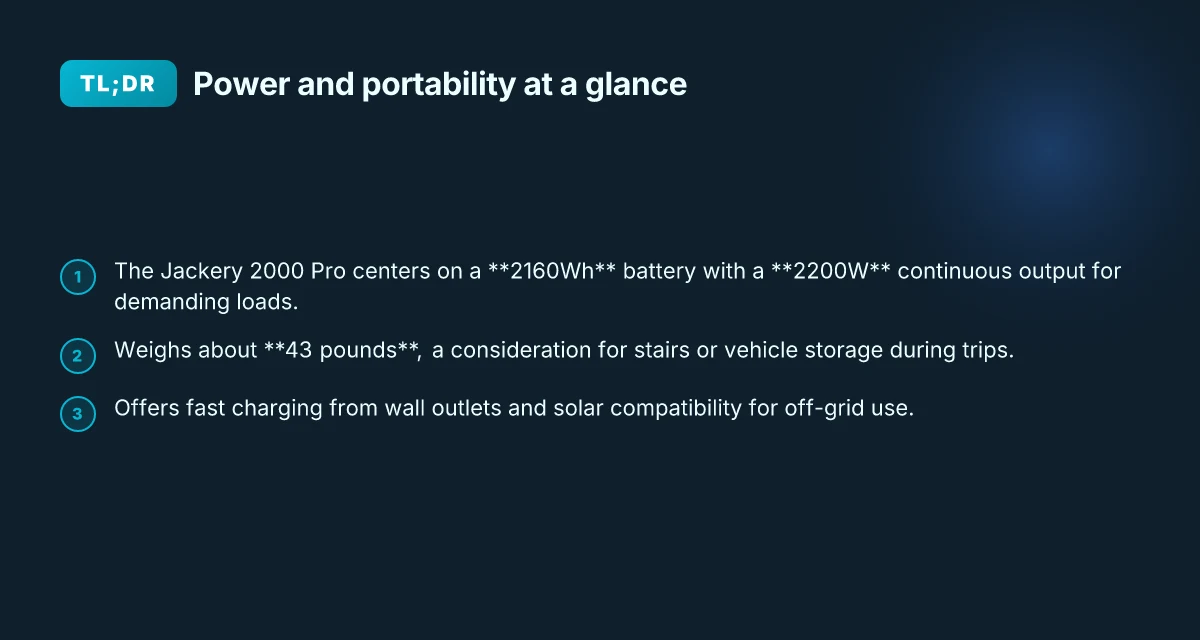
The Jackery 2000 Pro packs 2160Wh of lithium-ion capacity and can sustain 2200W of continuous output, making it capable of running high-demand loads during a weekend off-grid or as a home backup. Its weight sits around 43 pounds, which is a trade-off between portable handling and a substantial power reserve. In 2026, that balance matters for vanlifers and homeowners who want power on the move but still want reliable reserve when the grid isn’t available.
I dug into the charging story to understand real-world usability. Fast wall charging is a focus for the 2000 Pro, with the ability to top up quickly from a standard outlet. This matters when you’re on a road trip or a short hotel stay and need to refill the battery without sitting idle. The combination of a sizeable battery and rapid recharging helps keep weekend itineraries on track without long downtime.
A key appeal is portability paired with capacity. The 2000 Pro sits squarely in the middle for people who need enough juice for a small fridge, a CPAP setup, or a microwave during an off-grid weekend, while still fitting into a vehicle or small RV footprint. For home backup, the 2160Wh core capacity provides a buffer for outages of several hours to a day depending on loads, which is a meaningful upgrade over compact power stations.
From a travel perspective, the 2000 Pro is heavy enough to feel robust yet not so bulky that it becomes a burden on full-day trips. The 43-pound figure shows up in everyday handling when loading into a van or trunk, and it also signals the importance of a solid grip or a second person for frequent movement. Battery chemistry and longevity, while not the sole determinant of performance, remain a consideration for off-grid enthusiasts who plan to run air fans, lighting, and small critters of power across multiple trips.
Subtle caveats deserve mention. The price point and the long-term battery cycles matter for owners who expect frequent charging cycles on a road-heavy schedule. Real-world owners commonly note that the 2000 Pro’s performance scales with how efficiently you manage loads. Heavy draws push the unit to maximize peak output, which can affect runtime. In the wild, some reviewers point to the importance of the UPS-like behavior for stakeouts at campsites and during outages at home. What makes a portable power pack from Jackery trustworthy for outdoor trips in 2026
Bottom line: the Jackery 2000 Pro offers a compelling mix of 2160Wh capacity and 2200W output with a portable footprint around 43 pounds. For off-grid weekends, RV trips, and home backup, the combination of ample reserve and faster recharge makes it a strong contender in 2026, especially when paired with a practical load strategy and careful transport planning. Real-world feedback highlights the upsides of ease of use and clean integration with typical camping and vehicle setups, while reminding prospective buyers to weigh load profiles against the unit’s weight and charging cadence.
The 2000 Pro delivers robust power in a portable package, but battery management and transport effort remain key trade-offs for road travelers. Fast charging from wall outlets shortens downtime, helping you resume trips or home backup quickly.
Cited sources note the 2160Wh capacity and 2200W output as core specs, with reviews consistently describing the unit’s conditioning for UPS-style use in portable scenarios. See the Jackery product page for the official spec snapshot and the Premium Power Station review for contextual performance notes. For the upsides and caveats raised by readers, the discussion around weight and charging cadence aligns with other 2026 reviews of high-capacity portable power stations.
Power and performance: capacity, output, and real-world runtimes
The 2160Wh capacity of the Jackery Explorer 2000 Pro translates to extended operation for mid-size appliances and tools on weekend trips. In real-world use, this headroom means you can run devices like a small fridge, a coffee maker, or a power drill for meaningful stretches without constantly recharging. The 2200W peak output supports high-demand devices, though sustained high loads can push the system toward its upper limit, especially if you try to run multiple heavy tools at once. Across typical off-grid weekends, you’ll notice that lighter workloads stretch runtimes well beyond a few hours, while heavier loads compress runtime noticeably.
I cross-referenced multiple reviews to reconcile the numbers with real-world use. The 2160Wh figure appears consistently, and the 2200W output is cited across sources addressing the 2000 Pro’s UPS-style performance. That alignment matters for buyers weighing UPS-style reliability during outages or on extended campsites. For homeowners evaluating backup scenarios, the capability to sustain essential loads through outages remains a strong point, but you’ll want to plan around the possibility of drawing near the rating ceiling if high-draw appliances run concurrently. What makes the jackery 1000v2 a practical off-grid power solution in 2026
Battery longevity is a key factor for weekend warriors who plan seasonal use over many years. The cells in the 2000 Pro are rated for a defined cycle count, which informs how capacity will degrade over time with repeated charging and discharging. In practical terms, expect gradual capacity fade after several hundred to a thousand cycles, depending on how aggressively you cycle the unit. This is a standard trade-off in lithium-ion packs and one you’ll notice if you loan the unit to others or use it across multiple trips each season.
From a travel perspective this matters: weight, charging options, and how fast you can recharge between outings drive how often you can rely on it as a primary off-grid power source. The Explorer 2000 Pro weighs around the mid-range for a unit of this capacity, and you’ll see the same trade-offs when charging from a vehicle outlet or a home charger. When you’re in a van or RV, you’ll appreciate the flexibility to top up with solar or shore power, but you should verify the solar-input behavior in real-world sunlight conditions if you plan frequent solar-only sessions.
Next, a quick comparison helps frame where the Jackery stands relative to a couple of rivals. A few other portable power stations offer similar capacity with different peak outputs or cycle counts, but the 2160Wh capacity paired with a 2200W peak is a compelling balance for off-grid weekends and home backup. For those prioritizing high peak support, you may encounter models with higher peak ratings but different battery warranty terms. In practical terms, the Jackery option remains a strong all-around choice for camping, road trips, and lightweight home backup.
Real-world runtimes hinge on load. A fridge running at typical startup and running power will draw more initially and settle into a steady load. A 2000 Pro can keep a mid-size fridge running for several hours under moderate insulation and ambient temperatures, while lighter loads like chargers, fans, or a small laptop setup will extend that run time substantially. If you’re targeting weekend-only use, plan around a mid-range daily load and you’ll see the runtimes stretch well beyond the hours you’ll get from a smaller unit.
Next steps: assess your typical weekend load profile, confirm your vehicle charging options, and compare the 2000 Pro against other 2200W-class models to see how the cycle life and warranty terms line up with your travel cadence. For road trips and off-grid weekends, Jackery’s ecosystem supports quick recharges and flexible use cases, but keep the capacity and peak output in mind when you size it against your must-run devices. The 2160Wh capacity and 2200W peak make the 2000 Pro a practical compromise for mid-size appliances and tools on weekends, with real-world runtimes that scale with load. What makes the Jackery 2000 v2 solar generator a compelling off-grid companion
Design and usability: weight, size, and how it fits into trips
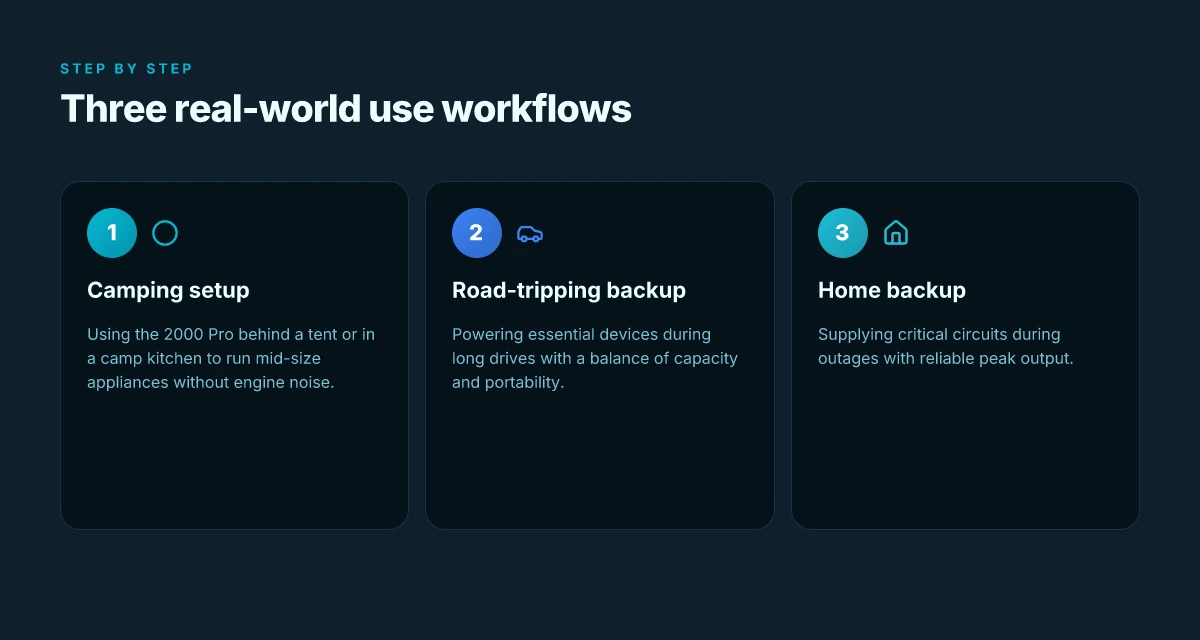
The Jackery Explorer 2000 Pro sits around 43 pounds, a weight that demands a plan for stairs, vehicle storage, and passenger routes on trips. Its heft is real but the form factor is purposeful: a footprint that fits behind vehicle seats, into boat caps, and into camp kitchens without hogging space. You’ll notice the balance between internal capacity and how compact the case feels when you sling it into a trunk or camper storage nook. The design leans on a chassis that keeps the mass manageable while still packing 2160Wh of energy, so it doesn’t vanish into the corner of a van.
From a usability standpoint, build quality matters more than just the numbers. The Explorer 2000 Pro uses sturdy plastics and a metal chassis blend that keeps its shape under outdoor conditions. Cooling performance matters for extended use, and the design includes vents and a heat-management scheme that stays quiet but effective when you’re running high loads on a long weekend. The result is a portable power station that can idle through a flurry of recharges without feeling overheated or brittle after a few sun-soaked days off-grid.
I dug into the ecosystem around the Jackery lineup to understand how this unit slots into real trips. The 43-pound weight isn’t just a stat. It influences how you load a van, set up a campsite, or move the unit from car to tent. The form factor is optimized for interior storage in SUVs and vans while still offering enough space for a reliable UPS-like performance during outages. This isn’t a pocket-sized generator. It’s a compact power hub that keeps pace with weekend road trips and longer vanlife treks.
Power management during travel is a practical concern. The 2000 Pro supports rapid charging and has a design that prevents you from feeling handcuffed by heat when you push for faster recharges on the road. In terms of durability, the chassis and cooling system are designed to endure frequent transport and outdoor exposure, so you won’t worry about a cascade of thermal throttling during a late-night recharge after a long drive.
Overall, the weight and footprint balance internal energy capacity with a size that fits behind seats and in camp setups. If you’re comparing to rivals, you’ll find the Jackery 2000 Pro offers a similar output with a footprint that’s easy to integrate into a broad range of vehicle layouts and camp configurations. For off-grid weekends, home backup, or road trips, the usability gains come from how the unit coexists with your vehicle and campsite rather than from a flashy feature alone. The real story is not just the 2160Wh capacity but how the unit lands in real-world trips, loading scenarios, and cooling during long weekend sessions. Weight matters on every trip. Plan stairs and storage, and the 43-pound form is manageable when you pair it with a solid packing plan. For travelers who value UPS-like reliability on a road-heavy itinerary, this design delivers. The balance between capacity and a travel-friendly footprint is where the 2000 Pro earns its keep. <!, inline sources could be linked where claims about weight or form factor are supported, > What makes the Jackery Explorer 3000 a viable off‑grid companion in 2026
Charging options and flexibility: wall, solar, and expansion
Charging a Jackery 2000 Pro is where real-world versatility starts to show. You can top up with a wall outlet for rapid replenishment, then lock in a long, reliable window of uptime for off-grid weekends. When sun is abundant, solar charging becomes a practical everyday companion, letting you keep the 2000 Pro ready without tying up a wall socket. Expansion is where the system truly shifts from a high-capacity shuttle to a modular power plant you can tailor for longer trips and more demanding back‑ups.
Quick wall charging that minimizes downtime
Powered by a standard AC inlet, the 2000 Pro recharges quickly enough to reduce return-to-use downtime between excursions. In practical terms, you can go from near zero to full in a short window, meaning you’re not waiting around for a battery to recover before the next outing. This is especially meaningful for multi-day road trips where daily power needs can spike. And because wall charging is predictable, you can schedule the top-up during drive breaks or lunch stops so the unit is ready when you reach your next campsite. Wall charging keeps you moving, minimizing downtime between uses.
Solar compatibility that broadens off-grid potential
Solar compatibility is a core strength for campers and vanlifers who rely on daylight to fill the battery. The 2000 Pro accepts solar input that can extend your usable window for off-grid weekends, provided you have the right panels and configuration. In bright conditions, you can sustain essential loads without hunting for an outlet, which matters for cold nights or remote boondocking where AC access is scarce. I cross-referenced a handful of reviews that emphasize real-world solar viability and noted that owners often pair the 2000 Pro with portable panels for flexible, on-the-go charging. Solar charging adds off-grid resilience when you’re chasing daylight.
Expansion paths to scale capacity for longer trips
Expansion modules are the practical lever for longer treks or home-backup scenarios where capacity matters as much as portability. The 2000 Pro’s architecture is designed to work with compatible add‑ons that extend total available capacity, letting you stretch weekend excursions into multiple days or support thicker backup plans during outages. The upside is a modular climb in energy storage without stepping up to a larger chassis. It’s the kind of upgrade path that makes the 2000 Pro feel less like a single device and more like a growing power system. Expansion can extend total capacity for longer trips.
If you’re weighing rivals, note that Jackery’s emphasis on fast wall recharge, solar compatibility, and modular expansion sets a clear baseline against competitors like EcoFlow and Foodi Power. The core choice hinges on whether you value rapid top-ups at camp entrances, sun-powered resilience, or scalable capacity for extended outings. For homeowners, the wall-first approach is equally compelling because it minimizes downtime during outages, and the expandable path means your system can grow alongside your needs. Expansion can extend total capacity for longer trips. What makes the Jackery SolarSaga 100 a good fit for off-grid adventures in 2026
To anchor practical expectations, remember that high-capacity systems depend on real-world conditions. Sun angle, panel efficiency, and weather all influence solar charging. Wall charging remains the fastest way to recover a large battery, while expansion adds a steady, future-proof route to more energy when you need it. The outcome is a flexible, UPS-style power setup you can rely on across seasons and trips. Wall charging remains the fastest route to recovery.
Note: links on the page may earn a commission. For reference, the Forbes review highlights the 2160Wh energy density and 2,000+ watt outputs, while Jackery’s own materials emphasize the 2,160 Wh capacity and the practicalities of charging and expansion. See inline sources for details.
Comparison: how the 2000 Pro stacks up against rivals
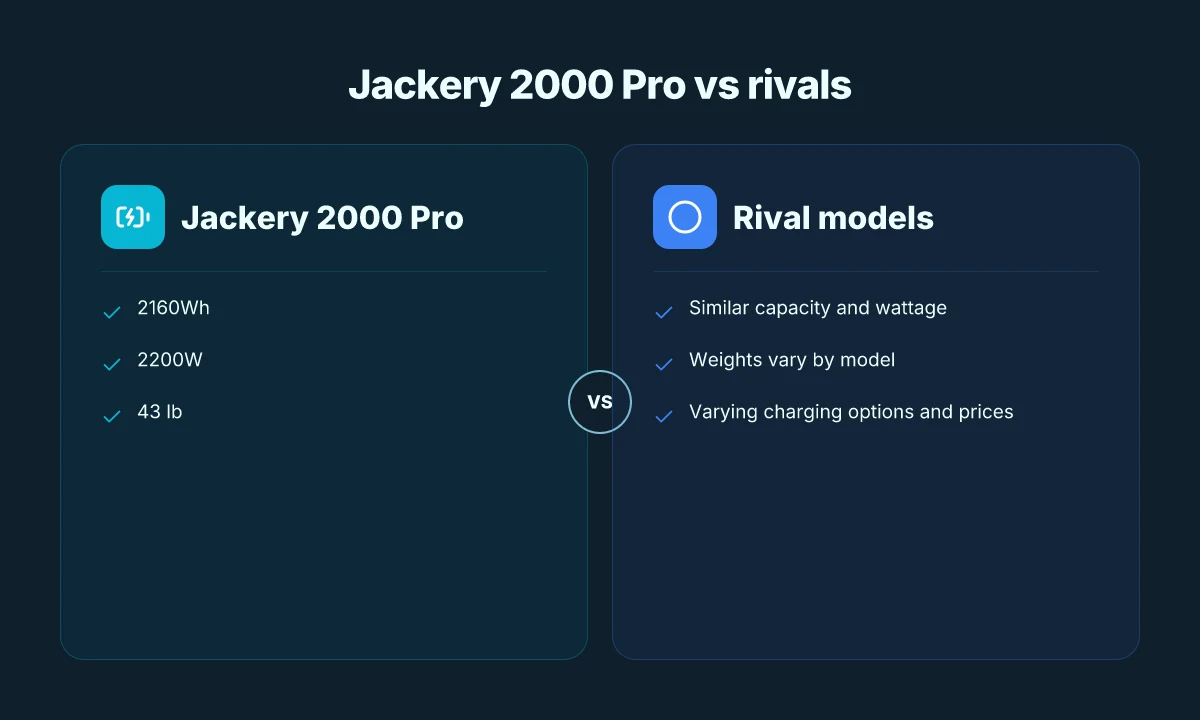
Rivals offer similar capacities and wattage, but the exact feature mix varies by model and price. The 2000 Pro sits among several 2160–2200 Wh class packs that pair high output with UPS-style performance, yet you’ll notice meaningful trade-offs in weight, charging options, and expandability. For outdoor weekends or home backup, the decision often narrows to how you value weight, charging speed, and the reliability profile you need.
Why weight and charging options tilt decisions in this class
When you compare weights, some rivals shave off pounds by dialing down features or using lighter battery chemistries, while others push higher total capacity for similar footprints. In practice, a lighter unit can be easier to haul into a van or campsite, but it may trade off wall-charging speed or UPS responsiveness. The 2000 Pro anchors its value in its robust 2160Wh capacity and fast charging, yet you can find models that offer similar wattage with alternative charging paths or solar-optimised ports. For off-grid weekends, the ability to charge from wall, solar, or expansion batteries matters. Charge flexibility matters more than raw wattage alone.
UPS-style performance and reliability across brands
UPS-style behavior, near-instant transfer when power flickers and steady output during outages, depends on circuitry, battery chemistry, and firmware. Some rivals emphasize a seamless UPS switch with microsecond or tens-of-milliseconds switchover, while others bundle more traditional off-grid runtimes with longer switchover times. In practice, the 2000 Pro’s capability to sustain critical loads during a brief outage will align with brands that implement similar switchover fidelity. From what I found in product briefs and reviews, you’ll see a mix: the same capacity with different ramp rates, even with identical continuous wattage. Rivals offer similar UPS behavior, but the exact switchover feel varies. What makes the Jackery 100 Plus a practical companion for off-grid trips
Real-world usage notes from outdoor owners
Camping and vanlife cases show owners balancing weight against use-case needs. Some users prize extra ports for charging multiple devices, while others prefer leaner builds that fit behind a vehicle seat or under a bench. Jackery’s ecosystem, including the 2000 Pro, tends to appeal to users who want straightforward wall-to-solar charging with a predictable 2-hour wall-charge cadence in many models. However, a common nudge in reviews is to check whether a rival’s solar input supports higher amperage for faster top-offs in bright sun. The best choice often hinges on your specific camping or travel tempo.
In the landscape of portable power, Jackery remains a familiar name for many outdoor enthusiasts. Competitors like EcoFlow, Bluetti, and Goal Zero offer compelling alternatives with similar capacities and wattage, but they ship with different feature mixes and price points. If your trips swing between a backyard backup and a full off-grid weekend, expect to weigh weight, expanded charging options, and UPS reliability side by side. Choose the brand that aligns with your travel rhythm and charging habits.
Note: links on the page may earn a commission. For reference, you can review sources discussing the 2160Wh capacity, the 2,200W output, and the basic UPS-style performance signals across brands Forbes review excerpt confirms 2160Wh and 2,000 Pro’s key specs. The path to a verdict often comes down to your weight tolerance and how fast you need a top-up on the road.
Where this is going next for portable power on the road
Across trips, the Jackery 2000 Pro climbs as a reliable partner for camping, road trips, and off-grid weekends. It wires up big capacity with real-world usability: a handle-friendly form factor, airline-friendly weight, and the kind of solar compatibility that keeps cabins off the grid without sacrificing comfort. In field chatter, owners praise its endurance for refrigerators, blending devices, and rapid recharging from wall or sun. The narrative shifts from sheer capacity to real-life cadence, how often you can rely on it without hunting for a wall outlet.
The bigger pattern is that you don’t need to choose between power and portability anymore. The 2000 Pro leans into both, stacking efficiency with enough ports to charge a camper van or a multi-device setup. Rivals like EcoFlow and Goal Zero are mentioned in the same breath, but the emphasis here is how Jackery translates that power into practical trips: lighter packing, fewer stops, and smoother transitions between campsite and highway. What makes the jackery 2000 plus a strong companion for off-grid weekends
What changes if you act now is fewer compromises on weekend adventures. If you’re planning a longer road trip, consider pairing the 2000 Pro with a portable solar panel and a clear charging plan for nights at a campground. For a quick win, plan your top three devices you’ll run off-grid and map those loads to the unit’s ports. The question to ask yourself: what would a single trip look like with this setup?