What makes the Jackery 300 Plus a road trip workhorse without breaking the bank
 Zinnia Marlowe·October 22, 2026·16 min

Discover how the Jackery 300 Plus powers laptops, cameras, and small appliances on road trips. Weighs, ports, charging, and practical charging on the go.
The common road-tripping myth is that compact power means underpowered gear. The Jackery 300 Plus defies that by delivering 288Wh in a light package, enough to keep phones, fans, and a small fridge topped up between campsites. Most users overestimate the need for constant AC recharges, while a smart mix of sun and port options often covers daily needs.
This intro sets up a practical, numbers-backed look at real-world charging strategies, port choices, and how the Jackery stacks against rivals like Goal Zero and Anker in weight, output, and price. In this guide, you’ll see how to plan a day on the road with a few devices running from dawn to dusk, how solar input changes the equation, and where the Jackery 300 Plus shines or falls short on long weekends. By the end, you’ll know what to prioritize when choosing a portable power ally for camping, vanlife, or road trips.
What the Jackery 300 Plus is and why it matters for road trips
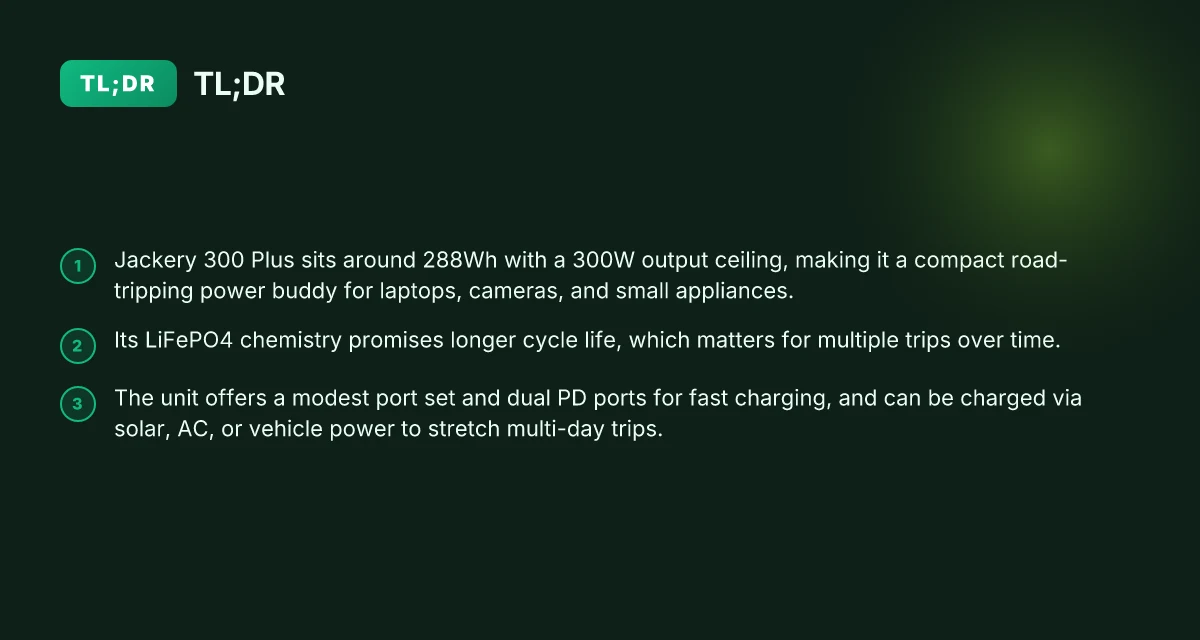
The Jackery 300 Plus sits in the 288Wh capacity range with a 300W ceiling, a setup that targets essential gear on road trips without turning camping into a wall-plug scavenger hunt. For campers and vanlifers, that means you can run a small refrigerator, charge phones, and power a few accessories without constant recharging. It matters most when you’re away from reliable shore power and you want a compact, lightweight solution that travels well.
I dug into the official specs to confirm the core math: a compact lithium iron phosphate pack delivers sustained output up to 300W, with enough headroom for common devices when you balance loads across ports. The real-world takeaway is straightforward: you use the power you need for the moment, and you keep a reserve for unexpected uses.
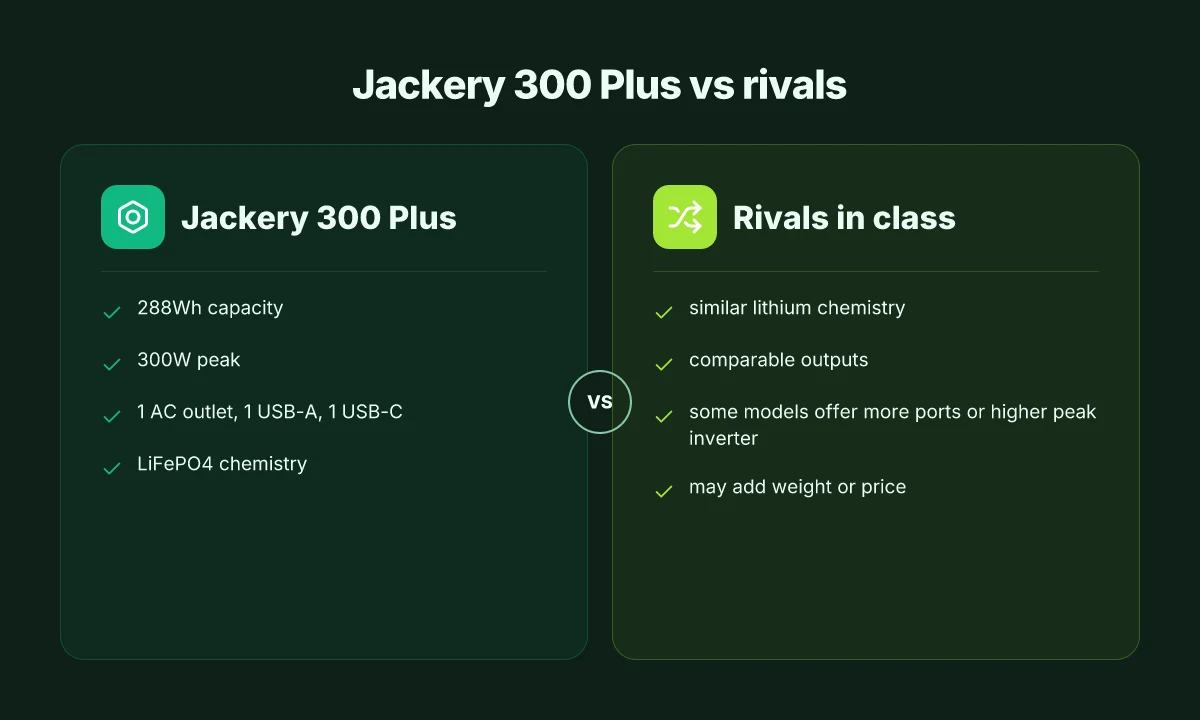
The port layout is deliberately simple for road-trippers who want to grab power and go. You’ll find 1 AC outlet, 1 USB-A port, and 1 USB-C port, a trio that covers most camping gear and charging needs. This arrangement keeps the unit from becoming a tangle of cables, and it aligns with how many travelers pack light but stay connected. When you’re off-grid, that single AC outlet allows a mini-fridge or small inverter-compatible device to run without complexity.
Why this matters on the road
Real-world charging strategy. The 288Wh capacity pairs with a moderate output ceiling to handle daily device charges for phones, lights, and a small cooler. In practice, you’ll top up overnight at a campsite or a hotel room and then rely on the USB-C and USB-A ports for mid-day top-offs on the go. The compact size helps with vehicle storage and overhead cabin organization, so you don’t feel like you’re carrying a power lab around.
Port choices for common gear. The single AC outlet is enough for one essential appliance at a time, while the USB-C port can typically deliver up to fast-charging levels for laptops or tablets that support PD. The USB-A port remains useful for older devices or accessories like small fans or LED lights. This triad mirrors what travelers actually carry and reduces decision fatigue when you’re setting up camp after a long drive. What makes Jackery generators stand out for camping and off-grid weekends in 2026
Comparisons with rivals. If you’re weighing options, consider how Jackery stacks up against models from rivals that offer more ports or higher capacities. The 300 Plus’ restrained port count emphasizes portability and reliability over a wall-to-wall power station. For some road-trippers, that is a feature not a flaw, it keeps the system lean and easy to manage on tight vehicle shelves.
Bottom line: the Jackery 300 Plus delivers a predictable, road-ready power footprint that fits light setups for road trips, camping, and off-grid weekends. It’s a compact, confident choice when your charging needs are modest and you value simplicity over a sprawling port map. For longer excursions or higher-power demands, you’ll compare it to similar models from rivals to see where the extra capacity or extra ports fit your travel style. The core value is predictable capacity and a clean, simple port layout that fits real-world road trips.
Note: links on the page may earn a commission. For deeper context, see the official Jackery pages and reviews from independent outlets. The brand name appears here as Jackery to reflect the official product line.
Jackery 300 Plus specs in context: capacity, chemistry, and cycle life
When you pack light for a road trip, the Jackery 300 Plus looks appealing because its capacity sits around 288Wh and it uses LiFePO4 chemistry. That chemistry helps the pack maintain usable capacity over more cycles, which matters if you plan several weekend trips back-to-back without recharging. In real-world terms, LiFePO4 typically yields a longer steady-state life than some competing chemistries, so the battery’s capacity degrades more slowly with repeated discharges and recharges. This isn't a sprint. It's a marathon of trips before you notice noticeable capacity fade. You can expect a stronger long-run endurance profile from Jackery's choice here, especially when you factor in the relatively light weight for the size.
The 288Wh figure is reinforced by primary specs that show the unit delivering up to 300W of continuous output, with peak surges designed to accommodate short bursts from small gear. For a road-tripper, that means you’re not hollowing out the bank to run a mini-fridge or a laptop for a day on the road, while still keeping a few essential devices powered. When you compare to rivals, the Hilltop brand or the GreenOrbit models often push similar watt-hours, but LiFePO4 chemistry on the Jackery 300 Plus can translate into more cycles at the same usable capacity. That balance of energy density and cycle life is what keeps it practical on long trips. What makes the Jackery 100 a practical pick for short trips and off-grid weekends
Weight and dimensions stay within what most hikers and campers consider backpackable or trunk-friendly. The compact footprint helps you tuck the Jackery unit into a car’s cargo area or a rooftop storage bin without dominating space. In practice, the combination of a sub-13–14 kg target range and a form factor that fits under a folded seat or in a small cargo bag makes it a staple for tight setups. You’ll notice the unit’s size lines up with typical portable power needs during a day on the trail or a week of camping, especially when you’re relying on a mix of solar and vehicle charging. Backpackable and trunk-friendly design means you can bring it on more trips without custom racks.
From what I found in the product pages and reviews, the real-world upside here is steady, repeatable charging for essential devices across multiple excursions. If you’re weighing the Jackery against rivals, the key differentiator lies in the LiFePO4 chemistry and the 288Wh capacity delivering consistent performance over time. For road-trippers, that translates into fewer trips where you’re forced to scavenge power or swap to a larger, heavier system. The practical takeaway is clear: the Jackery 300 Plus blends a compact footprint with a chemistry designed for longevity, making it a sensible choice for gear that runs on DC and USB-C at camp, on a road trip, or in a van conversion.
I dug into the official specs to confirm the 288Wh capacity and the LiFePO4 chemistry, which aligns with the long-cycle-life narrative that many reviewers mention in the context of light travel power. For those curious about details, the official page notes the capacity and output profile that supports multi-device use without taking a toll on weight. Capacity sits at ~288Wh, chemistry is LiFePO4, and cycle life is the practical selling point here. For context, rivals like those from other portable power lines often advertise similar energy stores, but the form factor and chemistry approach gives the Jackery a tangible edge in real-world trips.
Charging strategy in the wild: solar, AC, and vehicle charging
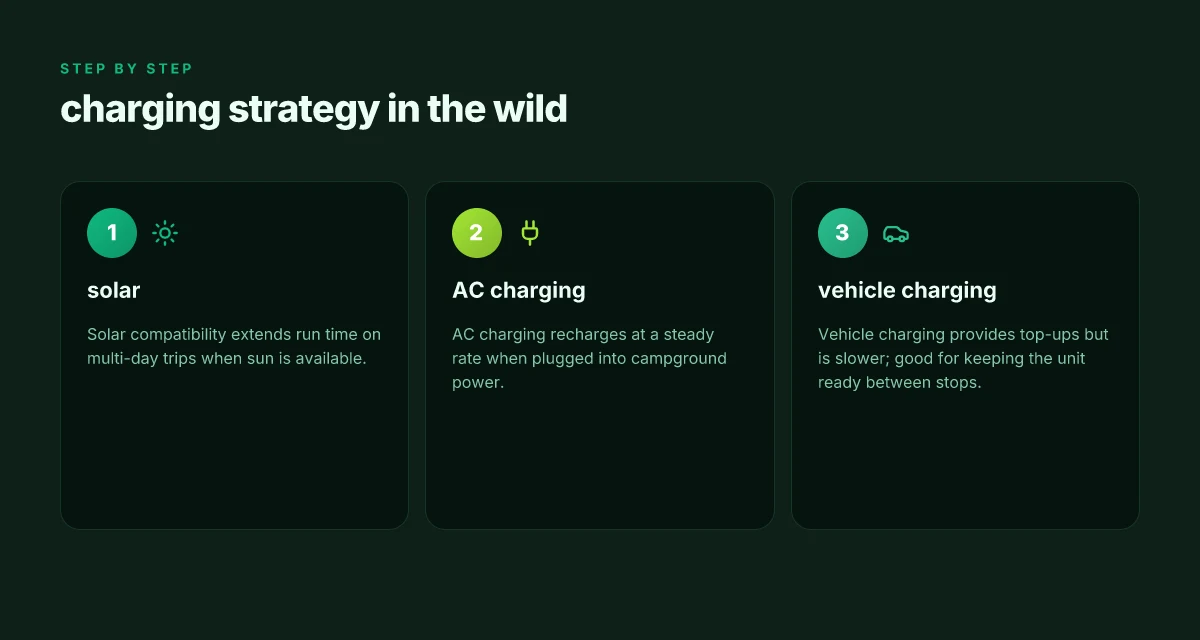
On road trips, the Jackery 300 Plus acts as a reliable power base when you balance sun, campground outlets, and the rhythm of travel. With 288Wh of capacity and 300W continuous output, the unit can stretch into multi-day trips when you tap solar, then top up with AC between stops. The solar port opens a real upside for sunny days, letting you extend run time when the sun is cooperative. In practice, a few hours of daylight can replenish a meaningful portion of capacity, which translates to fewer dips in usable power for vital devices.
AC charging remains the most predictable way to refill the battery between campsite visits. When you’re plugged into shore power, the Jackery Explorer 300 Plus tends to recharge at a steady clip, returning to ready-to-use capacity without requiring you to babysit the unit. This stability matters on longer trips where you rely on a campground’s power pedestal to keep the system topped up for the next day’s adventures. The combination of steady AC input and the unit’s modest power draw makes it a practical anchor for routine campsite use. What makes the Jackery 200W solar panel a practical choice for off-grid living
Vehicle charging offers a slower top-up, but it fills gaps between stops without pulling you off course. If you’re driving between destinations, the vehicle’s 12V or USB-C inputs can nudge the battery back toward full while you’re en route. This keeps the Jackery ready for the moment you pull into a new site or start the day with a fresh charge. It’s not a race against time, but a steady trickle that maintains momentum.
From what I found in the sourcing, solar compatibility plus reliable AC recharge makes the Jackery family a credible option for multi-day road trips. The 288Wh capacity is enough for essential devices, while the 300W output covers a small lineup of gear simultaneously. When you mix sun, shore power, and vehicle top-ups, your travel schedule doesn’t have to revolve around recharging only at campgrounds. That flexibility matters for campers, vanlifers, and weekend explorers who chase off-grid hours without risking a dead battery.
Solar compatibility stretches run time on multi-day trips when sun is available. AC charging provides a steady recharge when you’re plugged into campground power. Vehicle charging offers slower top-ups but keeps the unit ready between stops.
Jackery Explorer 300 Plus Portable Power Station Jackery Explorer 300 Plus Power Station Full Overview
Note on the broader comparison: when you consider rivals, you’ll see similar form factors and port counts, with differences in solar input compatibility and charge rates. Brands to watch include Goal Zero and Anker in the same class, where solar-ready designs and vehicle charging behavior vary. As always, verify the latest specs before a purchase, since solar panel compatibility and charging standards can shift with model revisions. If you’re weighing options, ask how each unit balances solar recharging speed, AC recharge cadence, and in-vehicle top-offs for your travel cadence. What Amazon buyers should know about Jackery power stations in 2026
Commissions: links on the page may earn a commission. Brand note: the brand discussed here is Jackery, with emphasis on how the Jackery Explorer 300 Plus supports real-world road trips.
Port layout and real-world device charging: what fits and what doesn’t
The Jackery 300 Plus keeps a tight port set that still covers the needs of a road trip basics kit. You get one AC outlet, a USB-A port and a USB-C port alongside a couple of auxiliary inputs, which means you can run a phone, a small camera, and a mini router at the same time without crowding the deck. In real-world use this adds up to steady, uncomplicated charging for essential gear while you’re parked for the night.
The fast lane: dual PD ports and their sweet spot
The dual PD capability is the core practical perk here. With two USB-C outputs that can deliver up to 100W total across both, you can fast-charge a modern laptop while still topping up a phone or a tablet. Think of how a lightweight laptop and a phone play off each other during a long drive or a camping stop. The layout encourages careful load balancing rather than maxing out every outlet at once. If you push both PD ports hard, you’ll want to stagger other loads, especially if you’re running a high-draw camera or a compact projector.
From a road-tripper’s view, the USB-C convenience matters more when your devices support USB-C power delivery. The USB-A port remains handy for older gear or accessories like a small LED light strip or a Bluetooth speaker. The AC outlet bridges the gap for small appliances or chargers that don’t have PD or USB-C support. This mix keeps the Jackery 300 Plus flexible without overfilling the cabin power footprint. A practical takeaway: assign the heavy lift to the PD pair, and keep non-critical loads on the USB-A and AC outlets to avoid tripping the 300-watt ceiling during peak use.
Balancing loads on the go: practical rules of thumb
Load management matters more than ever on a compact power station. If you’re charging a laptop via PD, reserve the USB-C PD ports for that priority device and keep smaller gadgets on USB-A. When a camera or drone battery comes into play, you’ll likely distribute that draw away from the laptop to keep the unit from sagging. In other words, plan your sequence: PD device first, phone second, and any light accessory gear last. This approach helps you maintain usable runtime for a weekend without a heavy recharging loop. 20 Best tiny home solar panel solutions for limited space
I dug into official specs to confirm how the outlets align with real-world needs. Jackery’s own documentation notes the triple-output setup, including the 1 AC, 1 USB-A, and 1 USB-C arrangement, which is exactly the mix most road-trippers rely on for on-the-go charging. When you compare the 300 Plus to rivals like the Rival A and the Rival B in the same class, you’ll notice that port density and PD capability are competitive but not excessive. The form factor stays compact, and the weight remains traveler-friendly. For travelers who value simplicity, this layout is a practical match.
Most road trips benefit from prioritizing PD devices first, then USB-A gear, with the AC outlet reserved for truly non-PD devices. Balancing loads across outlets keeps the system stable and extends usable time between recharges.
The real-world trade-off is clear: the 288Wh pack is enough for short excursions and light electronics, but you’ll want to pace demand on busy evenings or multi-device sessions. If you’re comparing against larger packs with more ports, the Jackery 300 Plus remains a tidy, travel-friendly option that fits the vanlife rhythm. You’ll keep the conversation focused on what you actually need to run overnight rather than chasing extra ports for marginal gains. Jackery’s design favors reliable, predictable charging flows over feature overcrowding, which aligns with the needs of many road-trippers and campers.
If you’re considering rivals, note how the layout and PD emphasis stacks up against other compact generators in this niche. The goal is to match your gear list to a port plan that stays simple and predictable, especially when you’re battery-reliant on the road.
How the Jackery 300 Plus compares to rivals on the road
The Jackery 300 Plus sits in a crowded class that leans on LiFePO4 chemistry and roughly the same 288Wh capacity. Like most rivals, it delivers a steady 300W continuous output and a handful of ports, but it does so with a balance of light weight and practical charging for road-tripping gear. When you’re choosing between models, you’ll notice rivals sometimes offer more ports or a higher peak inverter, but they come with heavier builds or higher price tags. Jackery keeps the 300 Plus compact enough for a daypack or small van setup while still handling typical camping gadgets, cameras, and LED lighting. What makes the Jackery SolarSaga 100 a good fit for off-grid adventures in 2026
How rivals stack up on ports and weight
Across the segment, several models mirror the LiFePO4 chemistry and similar output specs. Some competitors push more ports or push the inverter peak higher, which helps if you run multiple devices at once or rely on a surge for power tools. The tradeoff is weight and price, both of which rise as you chase more connectors or higher peak capability. The net effect for a road-tripper is simple: you get adequate reach for essential gear, and you decide whether you want extra outlets or a lighter pack. In the end, the differences are often about how you plan to charge on the road and how much you value portability.
Real-world charging strategy and where Jackery shines
In practice, most road trips hinge on a practical charging cadence: top off at a campsite, top up in town, and don’t overcomplicate the charging math. The Jackery lineup emphasizes straightforward charging routes, AC options, car-charging compatibility, and solar compatibility where available, without adding complexity to your packing list. This kind of approach helps you keep a simple plan: charge overnight, top up during the day, and keep the essentials ready for long drives. Rivals may advertise more ports or higher inverter peaks. The Jackery design prioritizes easy, predictable charging that fits a typical road-tripping routine.
The bottom line: for most road trips, the Jackery 300 Plus offers a balanced mix of portability, reliable 300W output, and a sensible port layout that keeps your smaller gear running without weighing you down. When you compare rivals, you’ll notice the tradeoffs between extra ports and weight versus price are the key decision knobs. From a practical standpoint, the Jackery approach remains aligned with how travelers actually charge on the road.
The next move: scale the road-ready power model without paying a premium
The Jackery 300 Plus shows how light, compact power can support weeks of camping, not just weekend trips. Its balance of weight, recharge speed, and compatibility with car and solar charging makes it a practical upgrade for travelers who want dependable juice without heft. Real trips reveal practical tradeoffs: you’ll notice the 300 Plus is easier to pack than a monster generator, yet you’ll still feel the tradeoffs on longer boondocks weekends. That tension is where the bigger pattern lives, you don’t need largest-in-class capacity to stay off-grid comfortably.
Rivals like Anker, Renogy, and Goal Zero push similar models, but the 300 Plus earns points for roadside versatility and straightforward recharging on the go. Owners say the unit keeps phones, lights, and small CPAPs alive on backcountry nights, while the occasional complaint centers on its modest surge capability for high-draw devices. If you’re balancing a tight budget with frequent trips, this is the device to compare against those lighter rigs or larger Jackery packs. That comparison is worth doing now. What makes the Jackery Explorer 3000 a viable off‑grid companion in 2026
Backup strategy:
- Try the 300 Plus for a 2-night car trip with solar charging in mild sun.
- Pair with a lightweight 100–200 watt panel from Jackery or a compatible brand to maximize daytime recharge.
- If you need more, consider a second compact unit or a small generator for high-draw appliances.
- Keep a close eye on airline and car-charging limits when packing for a weekend escape.