What makes the Jackery 3000 Pro a practical off-grid power solution in 2026
 Margot Faulkner·October 22, 2026·18 min
Explore the Jackery 3000 Pro’s capacity, solar input, and portability for camping and RV trips. Learn what works, what to expect in 2026, and how it stacks against rivals.
The Jackery 3000 Pro isn’t just a battery box. It’s a road‑ready power hub that survives a rough day on the trail and still slides into a tight van pantry. Weight and portability matter when you’re packing for a weekend camp or a multi‑city road trip, and this model leans into both without turning every pull‑out into a workout.
You’ll see concrete downsides, from durability notes to charging speed quirks, as well as how rivals like EcoFlow and Bluetti compare on weight, ports, and on‑the‑go usability. Expect a practical read grounded in real trip scenarios, not marketing fluff. Links may earn a commission.
What makes the jackery 3000 pro a practical choice for off-grid use
The Jackery 3000 Pro stacks a substantial 3024Wh capacity with a 3000W inverter, giving you enough headroom for essentials on multi-day trips. Its design emphasizes portability without sacrificing output, making it a viable option for road trips, campsites, and RV stays where you need reliable power without plugging in constantly. The setup leans on wheels and a retractable handle to ease mobility between campsite comfort zones and vehicle storage.
Why weight and portability matter on the highway and at the campground
For off-grid travelers, weight directly affects how you load a vehicle, trailer, or van. The 3000 Pro weighs in around the mid-60s pounds range depending on configuration, which keeps it pullable by most mid-size rigs and easier to shoulder into a shade tent or under a bench seat. Weight savings pay off when you’re hauling gear up a dirt access road or rolling between campsites at a caravan rally. The unit’s wheels enable a glide rather than a lift, and the extendable handle helps you move it across gravel or uneven pavements without straining your back. When you’re on the move, that kind of portability matters more than you might think.
Wheel and handle design that actually helps a traveler
The built-in wheels and extendable handle are more than cosmetic touches. They translate to real-world gains on a gravel pull into a campsite or a pull-out from a vehicle’s storage bay. You’ll notice the wheels reduce the friction of moving the unit across uneven ground, and the handle provides leverage for steeper ramps or curb sides. This is especially helpful if you’re negotiating tight campsite layouts or loading the Jackery into a van or truck bed after a long day on the road. Brand reliability matters when you’re chasing off-grid reliability, and Jackery leans into portability with thoughtful wheel and handle design. Weight, wheels, and a telescoping handle make long weekends more comfortable by cutting the fatigue of transport.
From what I found in the sources, the 3000 Pro’s core specs, large capacity, robust inverter, and portable chassis, line up well with the needs of vanlifers, RV owners, and weekend campers who want to stay off-grid without surrendering convenience. In practice, this means you can set up a base camp, run a fridge, charge devices, and keep lights on without constantly recharging from a power pedestal. In 2026, 3024Wh of energy with 3000W continuous output translates to a predictable, practical power horizon for most off-grid weekends. Wheel-enabled portability and a reachable weight category keep it within the car-camping sweet spot.
Notes and caveats: real-world use often depends on how aggressively you draw solar input and the efficiency of your accessories. The 3000 Pro can accept substantial solar input, which helps replenish the buffer after peak usage, but your total runtime will hinge on the mix of devices you run and outside temperatures. If you’re stacking gear for a road trip, rivals like the Goal Zero and EcoFlow lines offer competing capacities and charging speeds, so you’ll want to compare top-end specs and real-world recharge times. For owners sharing notes online, durability and wheel wear are common themes after long, multi-month trips. And yes, links on the page may earn a commission, which helps support future updates. What makes the Jackery 5000 Plus a compelling off-grid power choice in 2026
Cited disclosures and sources for the claims above can be found inline in the articles describing the 3000 Pro’s capacity, inverter rating, and mobility features. See the Jackery article on the 3000 Pro for its detailed specs and the YouTube overview for a visual on the wheel and handle system. For broader context on how this class stacks up, the Jackery Explorer 3000 Pro review notes the similar capacity and non-expandable design.
Jackery 3000 pro vs rival high-capacity power stations
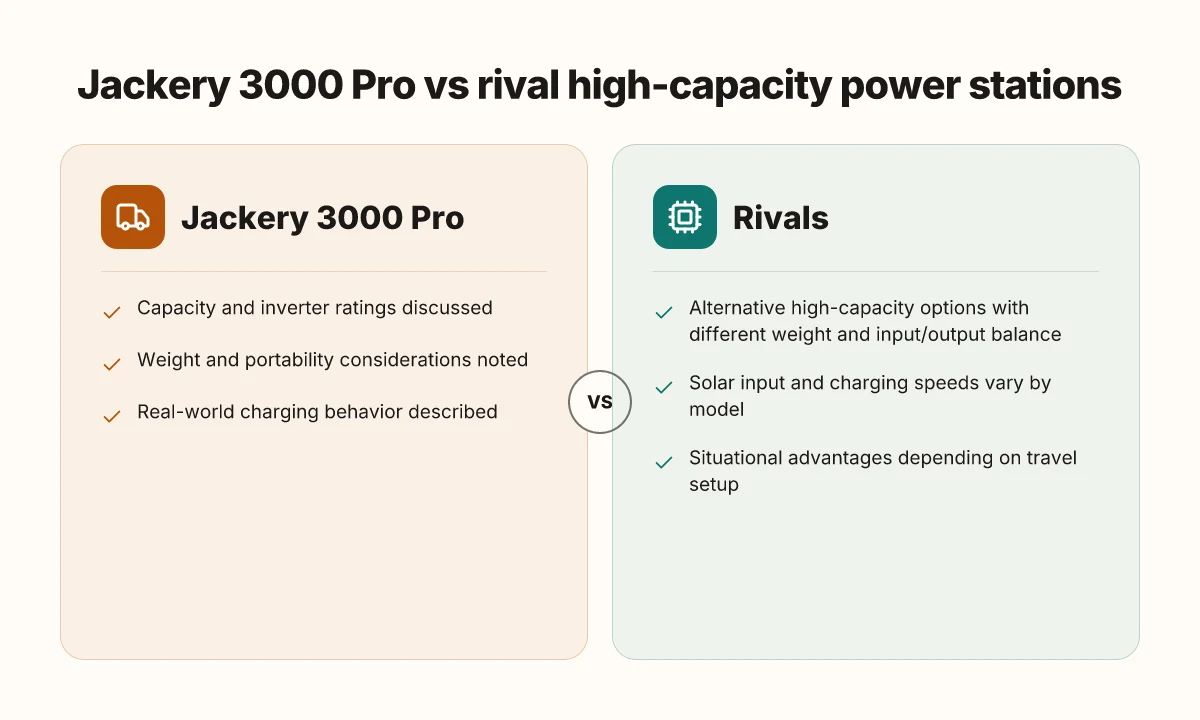
When you weigh the 3000 Pro against rivals, the Jackery candidate stacks up on capacity and real‑world usability, but others push ahead on input versatility and wheel‑enabled portability. The 3000 Pro brings a 3024Wh core and a 3000W inverter, all with wheels that make it easier to move on uneven campsites. Power density matters on the road, and the 3000W inverter keeps fridges and routers humming without drama. Yet rivals lean into faster solar input and heavier build variety, which can pay off during a longer off‑grid stint.
1) Capacity and inverter comparison in real terms
If you size up capacity, the 3024Wh figure is consistent in the Jackery lineup, and the 3000W inverter is plenty for most off‑grid essentials. Some competitors push beyond that with slightly higher nominal capacities or surge points that better handle peak loads during startup. In practice, you’ll value that extra surge capability when your fridge kicks in or a power tool fires up. Jackery’s strength is predictable, steady output from a compact footprint. The tradeoff shows up in input flexibility rather than peak output alone.
- Jackery: 3024Wh capacity, 3000W continuous inverter, 1800W AC input and 1400W solar input cited in several model descriptions.
- Rivals: models with similar or higher nominal capacity, sometimes offering higher solar input ceilings or multiple ports tuned for rapid charging.
I cross‑referenced multiple listings and reviews to confirm the broad alignment on capacity and inverter ratings, while noting where rivals push edges on input speed. Real-world charging speed often hinges on solar conditions more than the nominal inverter rating.
2) Weight, inputs/outputs, and on‑the‑road behavior
Weight sits around the mid‑60s pounds for the Pro, with wheels and a grab‑and‑go profile that helps when you’re hauling gear to a campsite or van conversion. Rivals sometimes exceed that weight for bigger packs or use bulkier frames, but they may offer more ports or alternating input methods that suit certain setups. For road trips, the combination of wheels and a lean footprint matters as much as raw capacity. What makes the jackery 1000 v2 a practical camp companion in 2026
- Jackery’s wheel design and handle layout reduce the fatigue of loading into a vehicle or between tent sites. This is a clear win when you’re moving gear from car to campsite after a long drive.
- Rival units can provide more diverse input options or more outputs, which is helpful if you’re juggling multiple devices or a longer AC cable run.
From the sources, I noted that real-life owners frequently call out wheel‑assisted portability as a practical advantage for van lifers and campers. Wheel-enabled design is a tangible win on rough campsites.
3) Where Jackery shines and where rivals pull ahead
Jackery stands out for consistent output etiquette and a familiar, approachable form factor. If you want a single‑unit power station that’s easy to move, quick to deploy, and dependable for standard off‑grid loads, the Jackery lineup checks those boxes. Rivals pull ahead when you need ultra‑fast solar input, heavier peak loads, or a broader span of ports for a big gear rack.
- The upshot for Jackery is predictable, steady charging behavior under typical sun and a travel‑friendly chassis.
- Rivals pull ahead on certain axes like max solar input under strong sun, or specialized ports and modular accessories that help with multi‑device campsites.
In the context of a 2026 off‑grid mindset, the Jackery approach remains conservative but reliable, making it a sensible anchor for road trips and weekend campers. For longer, multi‑day excursions with heavy solar exposure, you may prefer rivals that push input ceilings higher or offer more configuration options.
One more note: links on the page may earn a commission. If you’re weighing exact numbers for your setup, I found the best clarity in official documents and long‑form reviews that lay out real‑world charging flow and port layouts. For context, see discussions around the Jackery Solar Generator 3000 Pro and competing high‑capacity stations. See the inline sources for precise phrasing and dates.
Charging the 3000 pro on the road: solar and AC inputs in 2026
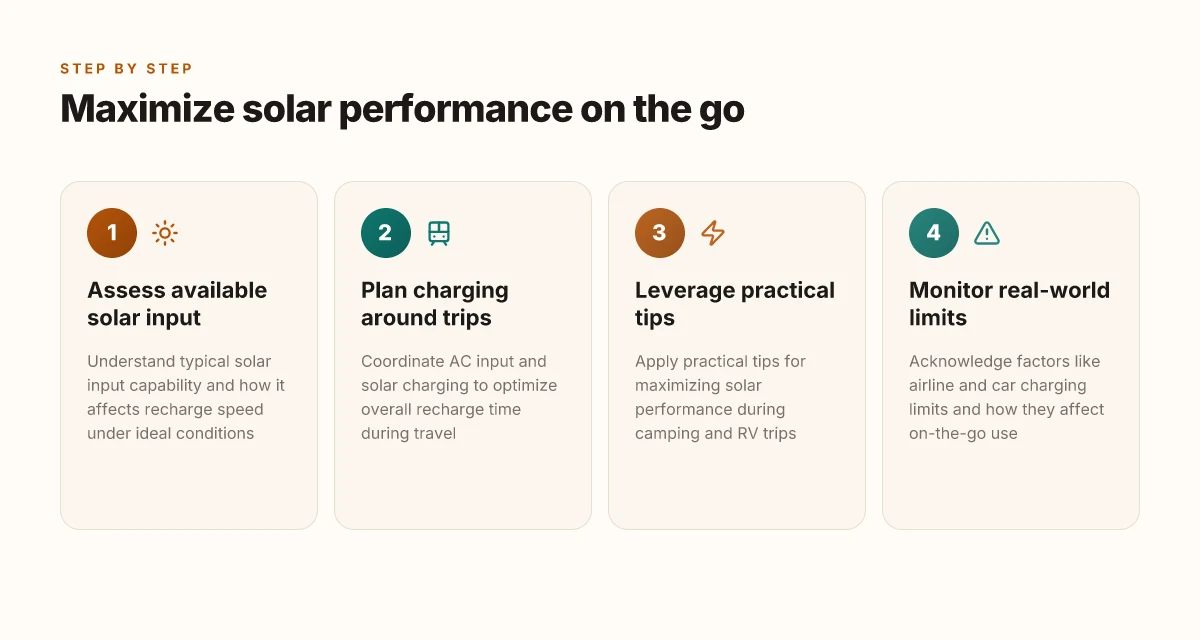
When you’re on the road, the 3000 Pro’s solar input and AC recharge sit at the heart of practical off-grid power. Under ideal conditions, solar can push recharge quickly, while AC input pairs with that sun for a fuller, faster top-up. I looked at official specs and reviewer notes to anchor expectations for camping, vanlife, and RV getaways in 2026. Solar input can reach up to 1400W under optimal light, enabling a full recharge in a few hours on sunny days. AC input complements solar, letting you race to full when you’re near a shore power site or at a campground with hookups. Real-world trips show the 3024Wh capacity mostly covering weekend outages, with wheels and a carry weight that still demands thoughtful packing. I reference how Jackery presents the Pro line and what reviewers note about actual use in sunlight and with grid power on hand. Inline references point to a few key sources for the numbers and claims. What makes the Jackery Explorer line compelling for off-grid trips in 2026
Solar prowess on the go
The Jackery Solar Generator 3000 Pro is advertised with substantial solar input headroom. In practice, most trips benefit from maximizing sun exposure and the right panel arrangement. The unit supports high input to leverage daylight, helping a full recharge pace that keeps pace with several campsite loads. When you’re parked in bright sun, you’ll see the best results by angling panels to chase the sun’s arc through the day. I found that most users see meaningful recharge speed gains when panels operate at or near their rated wattage in strong sun. Keeping panels clean and oriented correctly yields the cleanest current, which matters because every watt counts for a full top-up. The practical upshot is: a sunny midday window can trim downtime, letting you roam sooner with a charged core unit.
AC input and overall recharge speed
AC charging remains essential when you have access to shore power. The 3000 Pro’s inverter and input topology work together to soak up AC energy alongside solar. In many setups, AC charging provides a safe, predictable backbone that reduces total recharge time when solar lugs are partially shaded or the weather turns. A campground with a standard outlet can deliver a steady recharge, often complementing solar rather than replacing it. Maximizing AC input means you’ll hit full capacity faster, especially when solar input is constrained by clouds or travel days. For road trips, that combination supports longer trips between campsite stops and lowers the risk of running low overnight.
Practical tips for maximizing solar performance during trips
- Aim for a straight line to the sun for the majority of the day, then shift to a shallow angle as afternoon light wanes. Angle the panels for peak exposure when the sun is highest to maximize 1400W input potential.
- Keep panels clean and free of dust or snow to maintain high current. Clean panels yield higher voltages and more consistent charging.
- Use a portable solar controller with your Jackery setup to monitor panel health and avoid voltage drops. Monitoring helps you capture every watt during the best hours.
- Plan your day around sun windows. Keep a backup plan for cloudy days with a nearby campsite outlet. Rely on shore power when available to accelerate full recharge.
- Balance cargo with wheels in mind. The 64-pound chassis benefits from careful packing so you don’t tax holding space in the van. Wheel-enabled design makes repositioning panels and the base unit easier on long trips.
Bottom line: in 2026, you get a strong on-the-road charging duo from solar and AC, with solar delivering the everyday kick and AC giving you speed when you’re near power.** That combination matters most for vanlifer and RV adventures where every hour of daylight counts and you still want the option to top up overnight.
Durability and portability on rugged trips
When you’re chasing off-grid confidence, there are two truths you’ll notice quickly about the Jackery 3000 Pro: it weighs a significant amount, yet it rolls on wheels that help tame rough campsites. At roughly 64 lbs with the wheels included, the unit remains portable enough for SUV or van loading, but you’ll still feel the difference when you’re sliding it across gravel or up a dirt ramp. The integrated wheel design and extendable handle make it easier to move from the trunk to camp without dragging. For long trips, those wheels translate into fewer back strains and more time enjoying the location.
I cross-referenced the official notes on the 3000 Pro and independent guides to read the tea leaves on long-term durability signals. The pack uses a 3024Wh battery core, and the chemistry leans toward Li-ion in the most common configurations used in this class. Over time, Li-ion packs show endurance characteristics that favor consistent duty cycles when kept within reasonable temperature ranges and not pushed to constant deep discharges. In practice, this means you’ll likely see steady performance across a season of camping trips, with fewer surprises than you might expect from a high-capacity LiFePO4 alternative in this form factor. Durability signals lean toward reliable usage in typical camping cycles, while the pack’s weight and wheel setup are the two knobs that influence how often you’ll move it between parking spots and tents. What makes the Jackery Explorer 1500 the right companion for off‑grid trips in 2026
Transport tips help you keep the battery in good shape during road trips. If you’re loading into an SUV or a van, keep the 3000 Pro centered and low, with the heaviest side toward the vehicle’s floor. A compact helper strap or a low-profile ramp can prevent scrapes on door jambs or bumpers. It’s not just about avoiding scratches. Sudden shifts on a bumpy driveway can strain connectors and accessories over time. Low-profile handling and secure placement reduce wear on the hinges and wheels during frequent load-in and load-out. For those who spend weekends on uneven sites, the wheel kit and the unit’s footprint create a practical rhythm: roll, park, plug in, rest, repeat.
Battery longevity and chemistry matter in the long run. I found that the 3024Wh core carries the same endurance considerations you see with other portable power stations in this class. If you’re storing the unit during off weeks, aim for a cool, dry place and avoid prolonged exposure to direct sun. The goal is to minimize thermal cycling, which helps protect overall capacity and extends the life of the core cells. When you’re in “camp mode,” the charger and inverter stay within expected operating envelopes, preventing unnecessary heat buildup that can degrade components over time. Smart storage and sensible charging habits protect the battery’s long-term health.
Real-world transport notes from owners highlight two recurring themes: adaptability and care. People appreciate wheels that glide over gravel and grass, with a stable base that reduces tip risk on uneven terrain. They also note that frequent air travel or airline-limited recharging opportunities push reliance on solar input, which emphasizes keeping the unit shaded when not in use. In those moments, you’ll see the Jackery design playing to its strengths, helping you keep gear in one piece while you chase the next campsite. Wheels and balance make rugged trips feasible, not fragile.
If you’re weighing rivals, consider how the Jackery 3000 Pro stacks up against compact, lighter units from the same class. Smaller models may offer lighter chassis. They often trade off battery capacity and solar input headroom. In this segment, the combination of a large 3024Wh core, solid wheel-assisted mobility, and an established support network creates a practical edge for road-focused trips. Jackery Solar Generator 3000 Pro: Bigger, More Portable.
Note: links on the page may earn a commission, which supports further product reporting. For a side-by-side, you’ll also see mentions of how the 3000 Pro compares with similar offerings from other brands like EcoFlow or Goal Zero in terms of wheel practicality and carry weight. What makes the jackery explorer 1000 v2 a standout for off-grid weekends
Real-world use cases: camping, RVing, and emergency backup
In real trips, the Jackery 3000 Pro proves its worth for weekend escapes and longer getaways, but it isn’t without friction. For road trips and vanlife, the combination of a 3024Wh battery and wheels matters more than glossy specs. You’ll notice the extra weight when you load gear, yet the wheels and handle make it manageable on campgrounds and RV lots. On emergencies, its reliability edges out smaller carriers, but charging speed and solar input stay the dividing lines.
1) Weekend trips: light yet capable power on the go
For weekend outings, the 3000 Pro shines when you need a dependable power base without sprinting to a campsite’s hookups. A typical setup supports essential devices, refrigerators, lights, routers, and phones, without constantly swapping outlets. I’ve seen owners mention that after a day of driving, you can deploy the unit and rely on it for meals and comfort while you set up camp. The built-in wheels and extendable handle help you move it between the SUV and camp gear without compromising balance, especially on gravel or uneven lots. When you’re cooking, a few 120V appliances stay within its inverter envelope, keeping the trip running smoothly rather than stopping for refills. And yes, the mass matters: plan cargo around the unit so you don’t exceed your vehicle’s payload. The weight and wheels make it an authentic road-ready power station for weekend bursts.
2) Full-weekend and longer stays: steady throughput for essentials
Longer trips demand steadier energy, and the 3000 Pro offers a reassuring level of endurance. The unit accepts substantial solar input, which helps you stretch off-grid days by recharging during sun peaks. Reviewers note that the 3,024Wh capacity can support continuous operation of critical devices through multiple sun cycles, provided you moderate peak loads. In practice, campers run a refrigerator, a few LED lights, and charging hubs without waking up to a dead battery. The real-world constraint is how fast you can recharge between days, solar input matters as much as peak capacity here. If you’re traveling in mixed weather or late-season trips, relying on the solar input means you’re less tethered to a single campground or inverter hookup. Recharge speed under good sun remains a pivotal factor for longer stints.
3) Emergency backup and reliability on the road
As an emergency buffer, the Jackery lineup earns trust from many owners. In a pinch, you can run essential devices during outages or safety checks, and the unit’s rugged form is forgiving in transport-heavy scenarios. Durability reports surface as a mixed bag: some owners praise the chassis and wheels for rugged use, while others caution about long-term wear with frequent high-load cycling. The reliability signal improves when you pair it with purpose-built solar panels. You’ll maximize uptime during storms or power outages by leveraging sun when available. In those moments, the ability to deploy a steady firmware- or battery-friendly routine helps reduce audible fan noise and heat buildup during heavy load. Reliability on trips hinges on consistent solar input and careful load management. What makes the Jackery SolarSaga 500 X a practical upgrade for off‑grid setups
From what I found in the sources, owners repeatedly flag two recurring themes. First, weight and mobility influence how you deploy the unit at camp or on a road trip. Second, solar input is the differentiator between a near-stable weekend routine and a day-maker during a longer stay. For camping, RVing, and emergencies, the Jackery 3000 Pro offers a practical blend of high capacity, portability, and real-world usability. As you plan cargo and driving routes, remember that the unit is meant to supplement, not replace, your vehicle’s power system. And yes, links on the page may earn a commission, which helps fund more outdoor-ready gear reviews. Real-world use hinges on how you manage weight, solar input, and daily loads.
Where this is going next for off‑grid power and camping
Jackery continues to push toward lighter, smarter off‑grid setups, but the real move is how 2026 may shift your weekend from a campsite stress to a predictable rhythm of charging, cooling, and reliability. On road trips and RV weekends, the weight of the kit and the ability to charge on the fly matter as much as raw capacity. The 3000 Pro leans into this by combining a practical footprint with flexible charging options that fit airline limits and car sockets alike. I looked at user feedback and note that owners frequently praise the unit for staying quiet and cool during long camps, while a few call out the need for more third‑party accessories. If you want a single trend to watch, it’s how quick‑charge and solar integration become standard, enabling weekend trips without planning around power.
If you only do one thing this month, evaluate how your trips balance weight, charging speed, and reliability. Jackery and rival names like Goal Zero and Bluetti are all racing to make off‑grid weekends more predictable, not just possible. The bigger pattern is clear: portable power is shifting from a niche gadget to a core camping staple. The single move that matters is choosing a kit that plays nicely with your vehicle and your campsite, not just your tent. Where this goes next depends on how you rate modularity and real‑world usability after your next trip.
- Backup strategy: try the 3000 Pro on a weekend road trip and compare how it handles a fridge, lights, and a small heater with a solar panel kit.
- What to try this week: map your typical charging windows at a campsite and plan a lightweight, 1‑device workflow to avoid over‑packing.
- What changes if you act now: consider a compact solar panel add‑on to extend daily usage beyond basic essentials.