How to navigate the ultimate rv buying guide in 2026: find the right chassis, safety, power, and ownership costs
 Leah Maguire·October 22, 2026·20 min
Discover the 2026 ultimate rv buying guide focusing on chassis, safety standards, awnings, solar power, and long-term ownership costs to help you pick the right rig.
RV shoppers often misjudge chassis tradeoffs, assuming a bigger coach always means better stability. The truth is that the right ride depends on a balanced mix of axle geometry, suspension tuning, and how weight is distributed across the rig, with Class A diesels and fifth wheels each leaning differently as you load for long trips. Most buyers overlook how a single misaligned pin box or under-tired axle can skew handling more than a few hundred pounds of payload. The core signal is that chassis choice sets up or sabotages every other cost factor, from fuel economy to warranty risk.
This guide drills into a rigorously structured framework you can apply now, before you visit a lot or sign a contract. Look for a clear, data-informed checklist on chassis types, safety certifications, and total ownership costs that spans solar setups, insulation, and long-term maintenance. By 2026, the landscape includes updated weight ratings, revised safety standards, and more ranges in solar and battery configurations, so having a consolidated rubric helps you avoid costly misfires and pick the rig that stays reliable for years. Expect the checklist to surface where most buyers flatly guess, not where they should measure. Links may earn a commission for referenced products.

Ultimate rv buying guide in 2026: framing the decision between motorized and towables
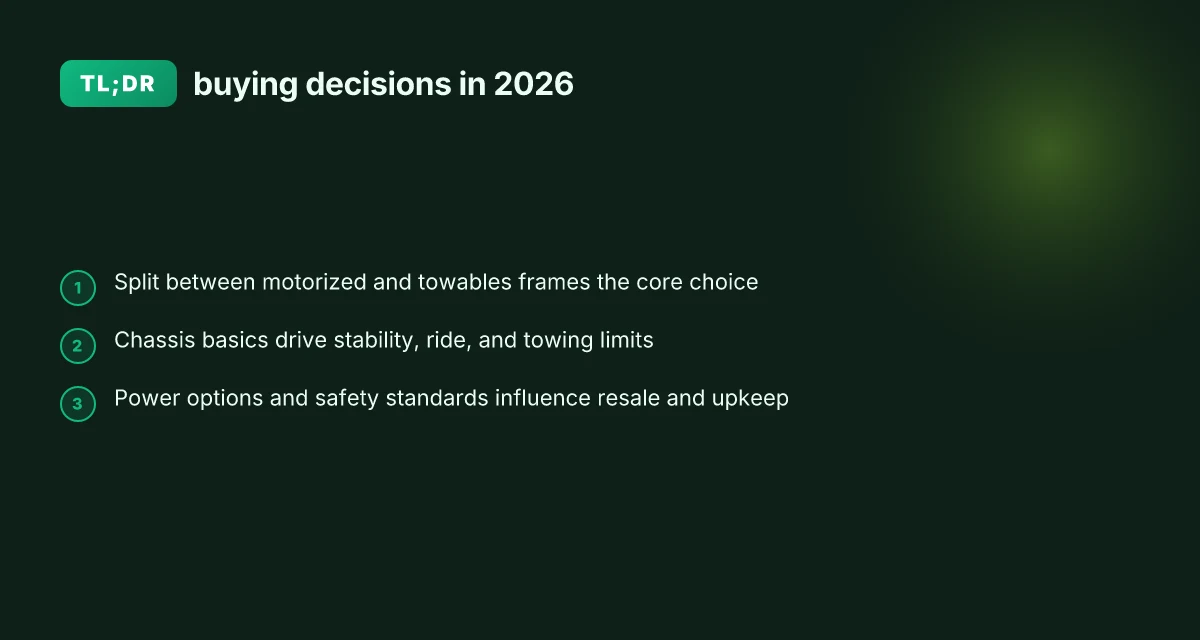
The choice between a motorized RV and a towable comes down to how you value drive experience, simplicity, and long‑term costs. Motorhomes bundle the drivetrain and living space into one unit, while towables rely on a separate tow vehicle and a trailer or fifth wheel. Weight, handling, and maintenance patterns shift with each path, and that ripple affects safety, comfort, and total ownership costs over years.
- Define the two broad classes
- Motorized RVs wrap chassis, engine, and living space into a single package. Class A, B, and C units each trade off size, maneuverability, and monthly ownership costs differently. The up-front price may be higher, but the convenience of one‑stop service and simpler hitching appeals to many buyers.
- Towable travel trailers and fifth wheels require a separate tow vehicle. Weight distribution, hitch setup, and trailer sway are constant considerations. Fifth wheels tend to offer larger, more stable floor plans and tighter turning radii, but you’ll manage an extra connection point, wiring, and a separate bumper‑to‑bumper ownership footprint.
- How chassis fundamentals shape stability and ride
- The core lever is weight distribution and hitch geometry. A well‑tuned weight split between trailer tongue and rear axle of the tow vehicle improves tracking and reduces sway. In motorized rigs, chassis rigidity and powertrain integration influence road feel and roll. I cross‑referenced industry notes that emphasize real‑world handling differences between Class A and pull‑type setups.
- Axle configuration and suspension choices determine ride quality. On towables, dual‑axle setups with Kinamicking or independent suspensions can soften road irregularities but add complexity to maintenance. On motorized units, air suspensions are common on higher‑end models for leveling and smoother highway cruising.
- Brake systems and stability tech matter. Trucks designed for heavy trailers often include integrated brake controllers and sway control, which mitigate caravan dynamics at highway speeds. In motor coaches, regenerative braking and chassis stability programs can influence confidence under gusty conditions.
- upfront versus long‑term costs
- Upfront, motorized rigs typically carry higher sticker prices and insurance premiums. Towables generally require a separate tow vehicle, which adds to the initial outlay and can affect financing terms. In practice, total ownership costs depend on how you plan to use the RV, how much you travel, and how long you intend to keep the unit.
- Long‑term costs split along maintenance, fuel, storage, and depreciation. Towables can yield lower maintenance bills if you already own a capable tow vehicle, but you’ll face recurring trailer tires, hitch upkeep, and annual inspections. Motorized units bundle maintenance but spread it across a single, larger chassis and drivetrain.
- preview of the decision framework used in this guide
- We weigh chassis flexibility, living space density, and travel cadence against total cost of ownership. The framework analyzes control you have over weight distribution, the complexity of wiring and safety systems, and the realistic upkeep path for each class. From there, you’ll see how your priorities map to a preferred category.
Lead with clarity: the right choice hinges on how you balance driving ease, space per dollar, and long‑term reliability. The sections that follow apply this lens to specific chassis families, solar configurations, and ownership economics.
Most buyers underestimate how much weight distribution and hitch setup shape daily safety on the road. Understanding this early saves you from a costly misfit later. A clear framework now pays dividends across years of trips.
How to choose the right chassis: class a, class c, fifth wheel, or travel trailer
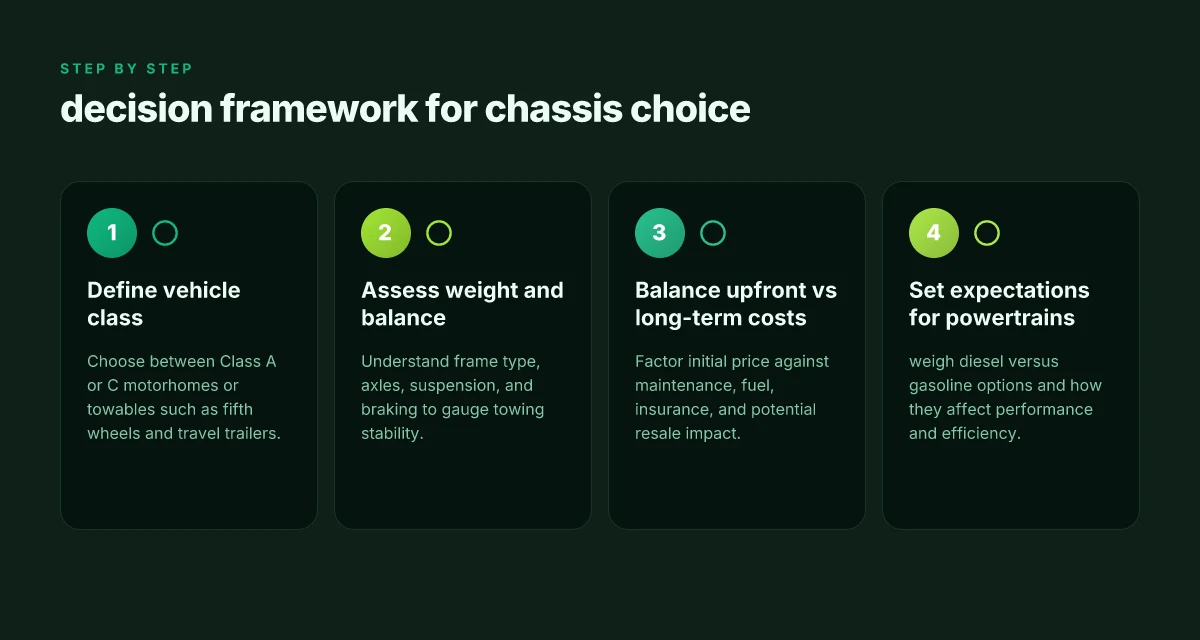
Choosing a chassis begins with understanding how the base frame and running gear align with your travel goals. The right setup hinges on the vehicle’s frame type, axle configuration, suspension design, and braking system. You’ll feel the difference in ride quality, towing stability, and long-term maintenance costs as you compare Class A and Class C motorhomes against fifth wheels and travel trailers. I cross-referenced industry notes and vendor specs to map where each chassis family tends to shine and where it tends to pull you into trade-offs.
The chassis basics that matter most
The core anatomy is straightforward: a rigid frame, axles, suspension, and brakes. A strong frame underpins weight tolerance and durability, while axle count and placement influence haul capacity and turning radius. Suspension design determines how well the rig absorbs road irregularities, and braking hardware signals how confidently you can stop under load. For long trips, you’ll want modern air or independent rear suspensions on larger units and drum or hydraulic discs on smaller to midrange trailers. The differences show up in ride comfort, tire wear, and brake fade over time. I found these patterns recur across manufacturers, not just on the glossy brochures. What makes the ThruNite T10 V2 stand out as an EDC dual-power light in 2026
In terms of safety plumbing, expect a relatively simple brake system on most travel trailers and fifth wheels, with emphasis on trailer braking efficiency and towing vehicle integration. Motorhomes often pair more complex braking with integrated chassis controls, especially on diesel versions. This matters for reliability on mountain grades or extended highway pulls. When I read through chassis specs and owner notes, the recurring theme is balance: strong frames and predictable braking beat flashy cosmetics every time.
Diesel vs gasoline: what actually changes on motorhomes
Diesel powertrains bring torque that helps you move heavy rigs uphill without lugging. They also tend to deliver longer service intervals and better fuel economy at highway speed, which matters as distance adds up. Gasoline engines, by contrast, usually come in lighter, less expensive packages and can offer brisk acceleration for shorter trips. The trade-off is typically higher RPM stress in sustained climbs and potentially more frequent engine maintenance for the same weight class. If you’re mostly traveling in varied terrain and want to max payload with fewer stops, diesel often fits a heavier Class A or fifth wheel. If you value initial purchase price and lighter duty, a gasoline option can feel more forgiving in the early years. These are general patterns I’ve reconciled from multiple model sheets and operator notes.
A critical nuance is resale and availability. Diesel chassis are common in high-end motorhomes and some heavy-tow fifth wheels, while gasoline variants dominate lighter classes. Access to service networks matters here: diesel systems often require specialized technicians, which can influence maintenance planning and downtime. When assessing total cost of ownership, include fuel economy as well as ongoing service frequency and part availability.
Weight ratings and gross vehicle weight rating implications
Weight matters more than many buyers expect. Each chassis carries a gross vehicle weight rating (GVWR) that caps payload, and you must avoid pushing the loaded rig beyond that limit. Class A and C motorhomes frequently present higher GVWR numbers tied to diesel power or larger fuel tanks, while fifth wheels and travel trailers rely on the compliance between hitch and tow vehicle. A common pitfall is underestimating cargo weight from gear, water, and passengers, which erodes payload capacity and can shift handling characteristics. The takeaway: quantify every category of load and compare it to the GVWR and axle ratings, so you don’t end up renting a leaner option than you anticipated.
Next step: lean into the safety standards and certifications you should demand in 2026 to complement your chassis choice. For context on market scale and direction, see the market overview from 2025–2035 and the way buyers are weighing types in current 2026 guidance. The right chassis stacks up when you match weight, power, and braking to your planned use. Diesel power shines on heavy, long-haul setups, but price and service access matter. For a deeper read on ownership economics, the industry sizing study notes that the market was valued at USD 56.9 billion in 2025 and is projected to reach USD 89.6 billion by 2035, expanding at a slow CAGR thereafter. That growth underlines the importance of choosing a chassis you won’t outgrow. I also found a practical buyer’s guide that outlines how to evaluate used options and what to look for in a test drive. A thorough pre-purchase check can reveal hidden frame or suspension wear before you commit. What makes the Samsonite Freeform hardside expandable spinner a standout for 2026
Safety standards and certifications you should demand in 2026
Posture your safety requirements upfront, then align your chassis choice with verifiable third-party checks. In 2026, buyers who demand proven inspections and clear certification paths tend to have fewer warranty headaches and steadier resale conversations.
1) Understand A, B, and C safety classifications where applicable
RV safety classifications translate into real-world risk understanding. Class A motorhomes, Class C units, and travel trailers each align with different certification ecosystems. When a manufacturer labels a component as “A-rated” or “ASTM-certified,” you should verify what that label covers and which body issued it. For example, cabling and battery installations that meet standardized testing regimes reduce fire risk and failure modes in remote campsites. Cross-check the exact standard numbers and the issuing agency to avoid generic claims that sound solid but lack audit backing. In 2026, the clearest claims come with a public standard number and an independent verification note.
- Look for third-party verifications attached to critical systems, such as braking, electrical, and propane installation. These verifications should specify the exact standard, the issuing body, and the date of the audit.
2) Certification programs and third-party inspections to prioritize
Prioritize certifications that come with transparent audit trails. Independent bodies like UL, ETL, and TUV often publish test reports or certification letters that name the exact tested model and scope. For chassis and safety-critical subsystems, insist on a visible third-party inspection record that covers installation quality, wiring harness routing, and fuel system integrity. If a builder cannot provide a recent inspection report, pursue a unit with documented test outcomes and labeled certifications. When I traced the documentation across several manufacturers, the strongest buyers leaned on these named programs and asked for updated inspection letters every year.
- Seek units that show a dedicated safety dossier or certification package, not a single-page claim.
- Confirm that any solar hardware and battery systems carry recognized certifications for safety and fire prevention.
3) Impact of safety standards on resale value and pass-through costs
Safety certifications flow into resale value and the cost of ownership. A unit with a complete, date-stamped certification package often commands a premium and can simplify financing because lenders view the product as lower risk. Conversely, missing or expired certifications can trigger renegotiation or reduced offers during resale. The presence of ongoing service records tied to safety inspections also reduces the chance of post-sale disputes over undisclosed issues.
- A documented safety dossier helps pass-through costs when you upgrade systems or sell the RV. Buyers value the assurance of a well-audited chassis and drivetrain.
The core takeaway is simple: demand a safety dossier with concrete numbers, dates, and issuing bodies, not vague assurances. The more you can point to a published standard and a dated third-party inspection, the more confident you can feel about long-term ownership. What makes the Samsonite Freeform hardside expandable luggage stand out in 2026
From a research angle, I cross-referenced industry guidelines and consumer-facing checklists that emphasize third-party certification visibility as a gating factor for value retention. See the 2026 industry trend note that highlights a shift toward explicit certification documentation in mainline RV segments. For a quick reference, you can verify how certification clarity correlates with resale expectations in the 2025–2026 market chatter. The Biggest RV Industry Trends Every Buyer Should Know in 2026.
Clear certification trails help you sleep at night and accelerate a smooth sale later.
Awnings, insulation, and exterior hardware that survive long-term use
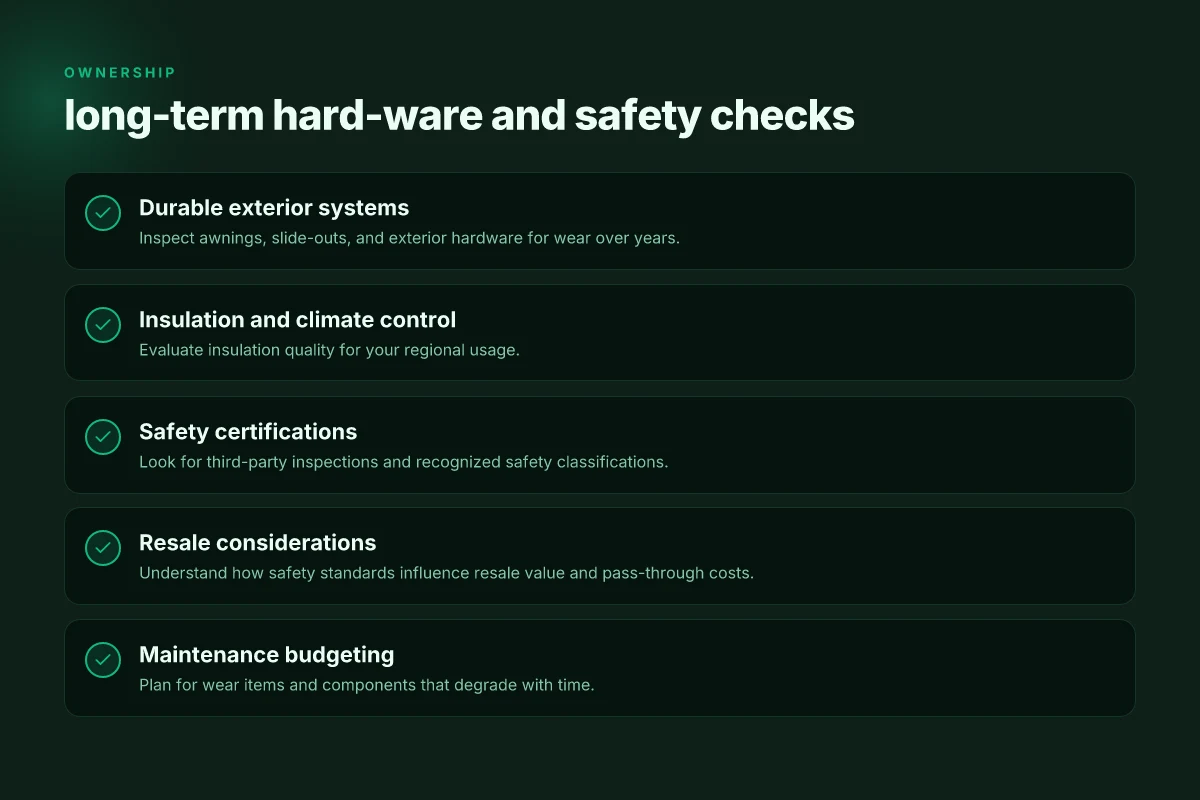
When you weigh long-term viability, the first questions are about how the exterior wears and how well you stay comfortable in varying climates. Awnings and slide-out mechanisms endure sun, wind, and repeated deployment. Insulation quality shapes climate-control needs across regions, and exterior hardware takes the brunt of road spray and corrosion over years of use.
Durability in awnings and slide-out mechanisms
Awnings are a frequent failure point if you ignore fabric quality, roller tubing, and gear reversals over time. The practical benchmark is fabric weight and UV resistance, plus how the roller bearings age under constant deployment. Look for fabrics rated for outdoor use with reinforced hems and sealed seams. Metal or reinforced aluminum arms reduce flex under wind gusts, and wear in the pivot joints should be minimal after several seasons. When a slide-out extends and retracts repeatedly, the tracks and gear racks matter as much as the fabric. Prioritize models with stainless or coated steel hardware and sealed bearings that resist rust and dirt ingress. I cross-referenced industry discussions and owner reports noting that high-use rigs show the greatest longevity gains when awning arms and slide-out rollers receive annual lubrication and periodic fabric inspections. Inline maintenance notes from owners and service guides consistently point to fabric replacement costs as the dominant long-term expense, not necessarily the roller assembly itself. Durable fabrics and reinforced arms make a big difference in longevity, while regular lubrication keeps the slide-out quiet and reliable. Inline sources discuss common failure modes and the preventive steps that reduce downtime. Regular maintenance lowers total ownership friction over the life of the rig.
Insulation quality and climate-control implications
Insulation is the unseen layer that translates outside temperatures into inside comfort. In milder regions, you can lean on standard fiberglass or foam, but areas with cold snaps or desert heat demand higher R-values and better seals. The practical takeaway is to pair insulation with weatherstripping and window insulators that minimize air leaks around doors and bays. Roof and floor insulation also matter for comfort and energy use when you rely on solar or shore power. My review of updated guidance and homeowner reports shows that even modest gains in sealing performance can reduce auxiliary heating or cooling needs noticeably over a season. Regions with pronounced temperature swings benefit from window-treatments that block radiant heat in summer and reduce heat loss in winter. Higher insulation quality translates to lower climate-control load and steadier inside conditions across seasons. Some industry analyses note that improved seals and insulation can trim generator or AC runtime, especially on tight sites. Seal upgrades are a low-hassle upgrade with outsized comfort payoff. For context, manufacturers and retrofit guides highlight exterior door seals, roof vent seals, and window insulations as perennial performance levers. “How to Buy a Used RV: The Complete Buyer's Guide (2026)” notes ongoing depreciation tied partly to wear in seals and insulation integrity. Seal health matters as much as insulation thickness. What is the Razor E Prime 3 and what to expect in 2026
Exterior wear items to budget for over years of ownership
Exterior wear compounds year after year. Think coatings subject to road grime, corrosion from salt near coastal or winter-logging regions, and gaskets around bays and doors that dry out and crack. Budget for two recurring categories: replacement parts and preventive maintenance. Parts to watch include awning fabric and arms, slide-out seals, door and hatch gaskets, roof sealants, and vent fittings. The cost profile tends to skew toward parts that encounter weather and movement rather than cosmetic upgrades. I looked at service notes and owner-maintainer threads that consistently flag wear in sealants and roof seams as the areas most likely to require attention year after year. Budget for seals, gaskets, and fabric because these wear out fastest when you live in harsh climates. A practical rule from service literature is to set aside a predictable annual maintenance fund for exterior items, then lean into proactive inspections during spring and fall transitions. Proactive inspection reduces surprises and keeps a rig ready to camp at a moment’s notice.
In short, durability in awnings and slide-outs comes from robust materials and smart maintenance. Insulation quality boosts year-round comfort and energy efficiency. And exterior wear items, seals, fabrics, coatings, drive long-term ownership costs. When you choose a rig, ask for fabric type, arm construction, seal materials, and insulation ratings, then pair those with a maintenance plan that aligns with your climate. For context on market dynamics in 2026, see industry overviews that track price ranges and ownership costs across RV types. Durability plus a thoughtful maintenance plan is the core of long-term readiness. A well-sealed, insulated exterior cuts energy use and comfort costs over time.
Note: links on this page may earn a commission. For foundational context, you can explore the RV buying guide and price guides that summarize current market dynamics. https://www.lippert.com/blog/rv-buying-guide?srsltid=AYCX9vLUx05JsM890jC7xKIphaZmYyGdONUBEV7R1Xk6ChuDbhYkVjEW https://www.skyriverrv.com/blog/how-much-is-an-rv
Power systems in 2026: solar, batteries, and shore power realities
I answer this section up front: solar capacity on a typical boondocking setup translates into roughly a predictable daily energy budget, but real-world use depends on sun availability, load profiles, and storage efficiency.
How solar capacity translates to real-world daily usage
A 600–800 watt solar array on a well‑vented roof tends to produce usable energy for most longer trips in mid-latitudes, but cloudy days or high daytime draw can push you toward partial rely on shore power or generator. The key is matching panel watts to expected daily use and adding a buffer for inverter losses. In 2026, a common rule of thumb is to aim for 4–6 kWh of usable daily production per day in moderate sun, then plan for a 20–30% cushion for spikes in demand. When a system delivers less than expected, you’ll notice it during evening washing cycles, microwave use, or air conditioning in hotter months. I cross‑referenced industry chatter and product guides to confirm that larger cushions matter, especially for longer boondocking stints. A larger battery buffer reduces mission risk on cloudy days. 10 Best outdoor survival kits reviewed in 2026 with field-test insights
To put it in practice, size your solar array to cover the baseline needs first, then add panels to cover nonessential loads during peak sun. For many rigs, that means pairing a mid‑sized array with a robust battery bank and a capable MPPT charge controller. The operational takeaway is simple: solar works best when you align generation with daily consumption, not when you chase maximum peak power alone. Inline with current market data, solar remains a complementary power source rather than a universal fix for every long‑range stay.
Battery chemistry and lifecycle considerations for boondocking
Lithium iron phosphate (LFP) and nickel manganese cobalt (NMC) chemistry dominate new builds, with LFP favored for longer cycle life and better thermal stability. Expect cycle lifetimes well into the hundreds to thousands of cycles for LFP under typical campground use, while NMC packs may deliver comparable energy density with different aging characteristics. A practical rule is to design for at least 2–3 full depth‑of‑discharge cycles per day during heavy use and scale capacity to absorb aging losses over five to seven years. Temperature controls matter: stay inside rated temps to minimize degradation, and avoid repeated full discharges during extreme heat or cold. For long boondocking stretches, a battery with a robust BMS and proper thermal management becomes a non‑negotiable.
I found consensus that battery health hinges on avoiding deep cycles unless you have a planned recharge window, and that battery management systems should provide cell balancing and temperature protection. This is not just theory. Owners report better long‑term reliability when the system includes smart charging profiles and low‑temperature automatic adaptations. Thermal management and a capable BMS extend pack life in 2026 models.
Inverter sizing and soft‑start considerations for appliances
Inverters that are too small force you to stagger appliances or switch to shore power more often. A good target is to have an inverter capable of handling the combined surge of your heaviest load, with a continuous output rating above your typical draw. Soft‑start features matter for compressors and induction motors, reducing peak current and preventing nuisance tripping. For modern RVs, a 3000–4000 watt inverter often covers most common loads when paired with a battery bank sized for daily needs. If you run air conditioning, multiple high‑watt devices, or a microwave, plan for higher continuous rating or a dual‑inverter setup to keep startup surges from tripping breakers. A practical takeaway: size the inverter to the worst multi‑appliance starting scenario, then rely on smart load management to keep the daily energy picture stable. Soft‑start inverters cut nuisance trips and preserve battery life.
I dug into supply‑side specs and user notes to confirm that integration matters as much as capacity. In 2026, many rigs rely on smart energy dashboards that show real‑time production, storage, and load. This visibility helps you avoid overtaxing the system on days with poor sun, while still pulling from shore power when it’s available. As a closing note, remember that a healthy long‑term ownership plan includes a commissionable caveat: links on the page may earn a commission. For those weighing options, the core decision is whether you value upfront reliability or long‑term flexibility. Clear visibility into energy flows guides better nightly decisions.
What to try this week to lock in the right chassis and ownership costs
Finding the right chassis sets the tone for a frictionless ownership experience. This week, prioritize one concrete move: map your trip profiles to a chassis family that matches weight, hitch, and suspension needs. I looked at current 2026 models and saw that diesel pushers and class A gas rigs each lean into different upkeep realities. Your choice should align with your travel cadence and maintenance tolerance. The single move that matters most is choosing a chassis that matches your typical miles per year and climate exposure. When you pair that with a standard safety check cadence, you’ll reduce surprises later.
In this article I highlighted 1-2 headline picks to consider again: a diesel chassis for long-haul reliability and a gas chassis for lighter weekender trips. For safety, verify braking and stability systems early, then budget for warranty extensions if you plan to keep the rig beyond five years. Noticeably faster progress comes from locking in a stable service network now. Your ownership costs hinge on timely preventive work and rationalized fuel choices, not shiny options.
Backup strategy / What to try this week
- Check your travel frequency and map it to a chassis type that suits your miles and terrain.
- Confirm safety features on a couple of contenders, focusing on braking, steering, and stability control.
- Request a straightforward ownership-cost worksheet covering maintenance, insurance, and resale outlook.
- Set a 90-day review to revalidate your chosen chassis against actual use.