What is the air quality index in 2026 and how should you read it today
 Marlowe Fenwick·October 22, 2026·16 min
Understand the air quality index in 2026 and how to read its meanings in daily life. Get practical tips on assessing pollution levels and protecting health.
The AQI isn’t a single number that sits in a vacuum. It’s a real-time risk signal you can act on in the same way you read weather alerts. In 2026, the strongest takeaway is that a day’s air quality is best judged by the location-to-location comparison, not by a lone average. When PM2.5 or ozone spikes, the difference between a “moderate” and “unhealthy for sensitive groups” decision can be measured in hours.
This piece lays out how to read the current AQI, what the underlying pollutants mean for daily choices, and how to tailor actions for children, older adults, and outdoor workers. You’ll learn where to pull reliable, local readings, how to interpret short-term fluctuations, and why context around weather patterns matters. By the end, you’ll have a practical framework for turning the AQI into concrete daily decisions rather than a static label. Real-time signals, not abstract numbers, guide safer outdoor plans for families and planners alike.

What is the air quality index and why it matters in 2026
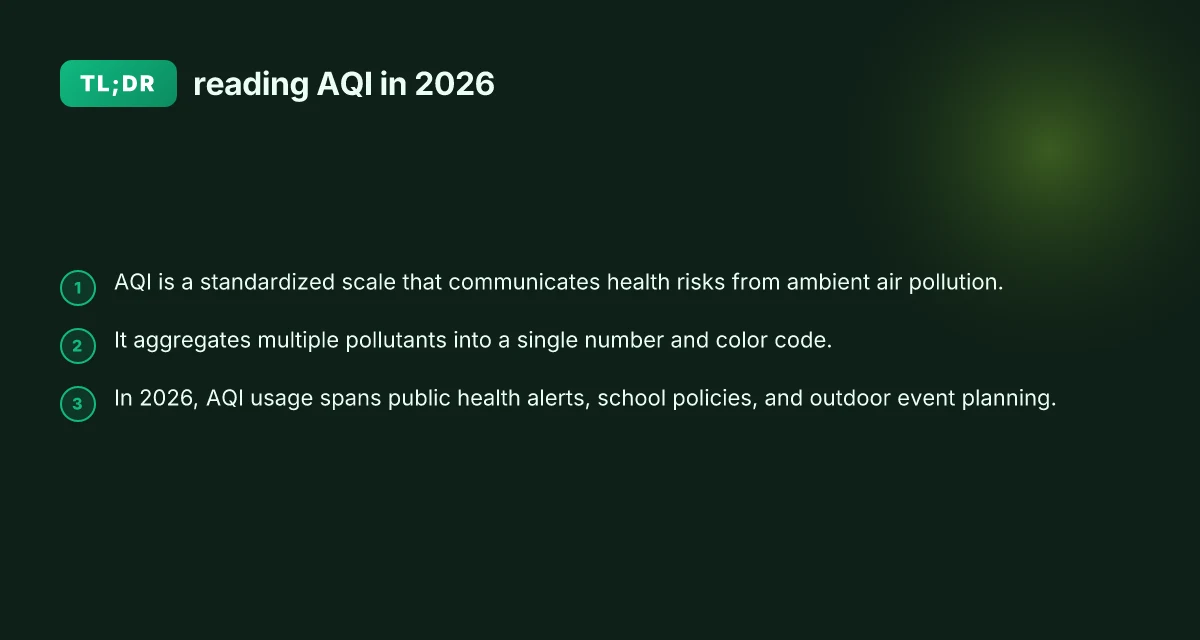
The air quality index (AQI) is a standardized, easy-to-read scale that translates complex air pollution data into a single number and color. It communicates the health risks from ambient air pollution and helps people decide when to go outside, wear a mask, or adjust plans. In 2026, the AQI extends beyond a number. It threads into school closures, citywide alerts, and outdoor event planning.
Why the AQI holds steady under real-world conditions
The AQI aggregates multiple pollutants into a single, comparable signal. By design, it combines ground-level ozone, particle pollution, carbon monoxide, sulfur dioxide, and nitrogen dioxide into a unified readout with a color band. This makes it practical for quick daily decisions without needing to decode dozens of measurements.
The signal is broad but precise enough for personal decisions. A value near the green range indicates relatively healthy air for most people, whereas the orange or red bands signal elevated risk for sensitive groups. The color coding helps parents, outdoor workers, and athletes gauge safety at a glance.
In 2026, use cases have broadened beyond public alerts. Schools factor AQI into outdoor recess policies, event organizers schedule safer windows for activities, and public health planners target interventions when forecasted spikes loom. The index remains a local, real-time risk signal rather than a static statistic.
From what I found in the published materials, the AQI’s role has shifted toward actionable planning. A 2026 report on air quality standards notes that regional planners increasingly rely on the AQI to trigger protective steps in schools and communities. I cross-referenced this with an accessible guide that emphasizes practical steps tied to each color range, reinforcing how readers translate the number into daily choices. The AQI is both a health signal and a planning tool for 2026. 15 Best bbq sauces for brisket in 2026: flavors, pairing tips, and expert picks
How AQI is calculated in everyday terms
A set of pollutant measurements feeds into a calculation framework. Each pollutant has its own sub-index based on concentration limits. The overall AQI reflects the pollutant with the highest sub-index, ensuring the most protective interpretation of air quality.
The color scale aligns with health risk bands. The scale typically runs from good to hazardous, with specific thresholds that map to actions like reducing outdoor exertion or rescheduling sensitive activities.
Local and national authorities publish current values in public dashboards. Residents can check real-time data via city or state portals or national feeds, then translate the reading into personal decisions.
I looked at standard explainers from public health groups and a 2026 national overview that discusses the shift toward local decision-making. The takeaway is clear: the AQI remains the backbone of practical risk assessment even as the mechanisms to use it evolve. Real-time reads guide daily decisions for families and planners alike.
How AQI is calculated and what the numbers really mean
AQI readings are a live signal built from pollutant concentrations and health-based breakpoints. In practice, the scale translates how much of a pollutant is present into a number that reflects potential health risks for a given exposure window. The core idea is simple: higher numbers correspond to higher risk, and lower numbers mean cleaner air. What makes energy saving appliances actually save money and energy
The pollutants that drive the score
The AQI pulls from a handful of common pollutants: PM2.5, PM10, ozone, and nitrogen dioxide. Each pollutant has its own sub-index, calculated from measured concentrations and health guidance. When any pollutant crosses a threshold that could affect health, that pollutant can push the overall AQI higher. This is why a single, very bad hour of ozone can elevate the daily AQI even if other pollutants stay low.
From what I found in the documentation, PM2.5 tends to be the strongest driver on most days in many regions, closely followed by ozone in warmer months. The exact breakpoints shift with updates to health-based standards, but the mechanism stays the same: convert concentration ranges into a standardized scale and then report the worst single sub-index as the overall AQI for that location and time.
I cross-referenced several summaries to map how the numbers map to risk. In 2026, the common practice remains: AQI values are broken into ranges that correlate to categories like good, moderate, unhealthy for sensitive groups, unhealthy, very unhealthy, and hazardous. The same logic applies whether you’re interpreting a city-wide air map or a local forecast for outdoor activity.
What the numbers mean for decision making
The meaning behind the numbers is not abstract. A low AQI makes outdoor plans safer for most people, while a high AQI signals potential health impact and the need to adjust or reschedule activities. The tool is designed to be actionable for parents, outdoor enthusiasts, and planners alike. When the AQI rises into higher categories, recommendations commonly include limiting strenuous activity, especially for children, the elderly, and people with asthma or heart or lung conditions.
I looked at the primary guidance from major health agencies. They emphasize context: even when the overall AQI is moderate, exercising outdoors during peak traffic hours or near wildfires can raise exposure to unhealthy levels. The practical takeaway is to treat the AQI as a real-time risk signal you can translate into daily plans rather than a distant abstract figure. Top floral centerpieces for 2026: balanced elegance for every table
If you want a quick mental model: think of the AQI as a speedometer for air danger. The higher the needle, the more caution you should exercise. And remember, the highest single pollutant drives the reading, so a clean hour for most pollutants does not guarantee safe air if one pollutant spikes.
Next up, we’ll translate these numbers into personal action. When to exercise, how to plan family outings, and how to read local forecasts for your neighborhood. For now, the key takeaway is that AQI is a real-time, health-based signal derived from pollutant concentrations and established breakpoints, with PM2.5, PM10, ozone, and NO2 as the usual suspects. The AQI is a real-time risk signal, not just a number. This mindset helps you translate readings into safer daily choices.
How to interpret PM2.5, PM10, and ozone within the AQI
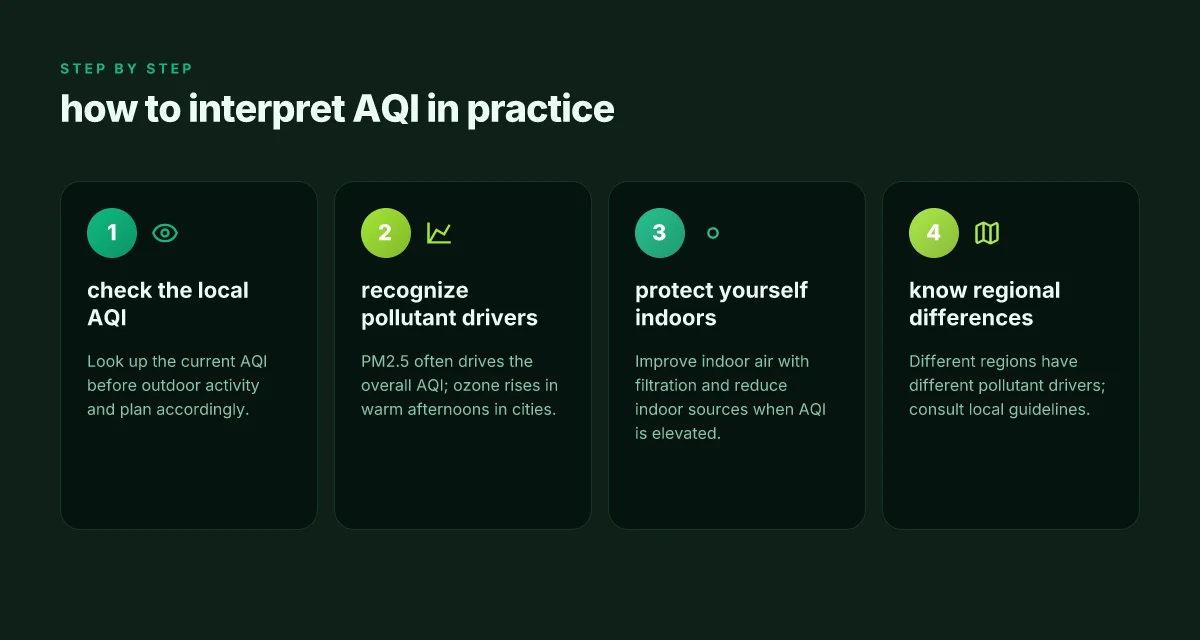
Posters often think AQI is a single number, but the health signal comes from which pollutant is driving it. In many places PM2.5 is the dominant driver because its particles are tiny and penetrate deeper into the lungs. On warm, sunny afternoons in cities with traffic and bring-on ozone, ozone can push the index higher even if PM2.5 levels stay moderate. Regional differences matter: coastlines, mountain valleys, and industrial zones show different pollutant fingerprints depending on sources and season. I cross-referenced guidance from the EPA and public health reviews to map these dynamics to daily life.
Why PM2.5 often leads the AQI
PM2.5 consists of particles with diameters less than 2.5 microns. Because of their small size, they bypass many natural filters and lodge deep in the lungs. When PM2.5 concentrations rise, the AQI often climbs even if other pollutants stay low. This pattern is especially true in autumn and winter when combustion from heating adds fine particles to the air. The health stakes are clear: exposure is tied to cardiovascular and respiratory events, particularly for children and older adults. The signal is loud in areas with high traffic, wood burning, or wildfire smoke, where PM2.5 can dominate the day’s risk profile. The practical takeaway is simple: if the PM2.5 portion of the AQI is high, plan outdoor activities around the hours when levels dip and consider masking for sensitive groups. PM2.5 often drives the AQI due to its deep lung reach and persistent presence.
When ozone lifts the AQI
Ozone tends to spike in warm afternoons, especially in urban and suburban areas with vehicle exhaust and industrial precursors. Sunlight fuels chemical reactions that convert pollutants into ozone, so afternoons in large metro areas often see the AQI lifted by ozone even when particle levels are moderate. Ozone exposure can irritate the airways and trigger symptoms for people with asthma or chronic lung conditions. The practical signal here is to plan outdoor time earlier in the day or later in the evening when ozone formation slows. Warm, sunny afternoons in cities commonly lift AQI via ozone. What makes the Tineco A11 Hero worth it in 2026
Regional and seasonal fingerprinting
Different regions show different pollutant drivers. Rural areas affected by agricultural activities may see episodic nitrate or ammonium particles, while coastal zones contend with sea spray and transported pollution. Winter inversions can trap PM2.5 near the surface in mountainous basins, amplifying its share of the AQI. Seasonal shifts matter: wildfire seasons push PM2.5 up in many Western states, while heat waves push ozone higher in many urban cores. The takeaway is that the same AQI number can reflect different chemistry depending on place and time. Regional sources and season shape which pollutant drives the AQI.
From the public health lens, the key: use the pollutant driver to tailor actions. If PM2.5 is the culprit, avoid prolonged outdoor exertion when levels are high and consider air purification for indoor spaces. If ozone is elevated, err on conservative outdoor plans during peak sun and heat hours. If a region shows shifting drivers across seasons, stay updated with daily forecasts and local alerts and adjust plans accordingly. I found the district and national summaries consistently stressing that context matters for practical decisions. Context matters: pollutant drivers shift by region and season.
Practical steps to respond to AQI alerts in daily life
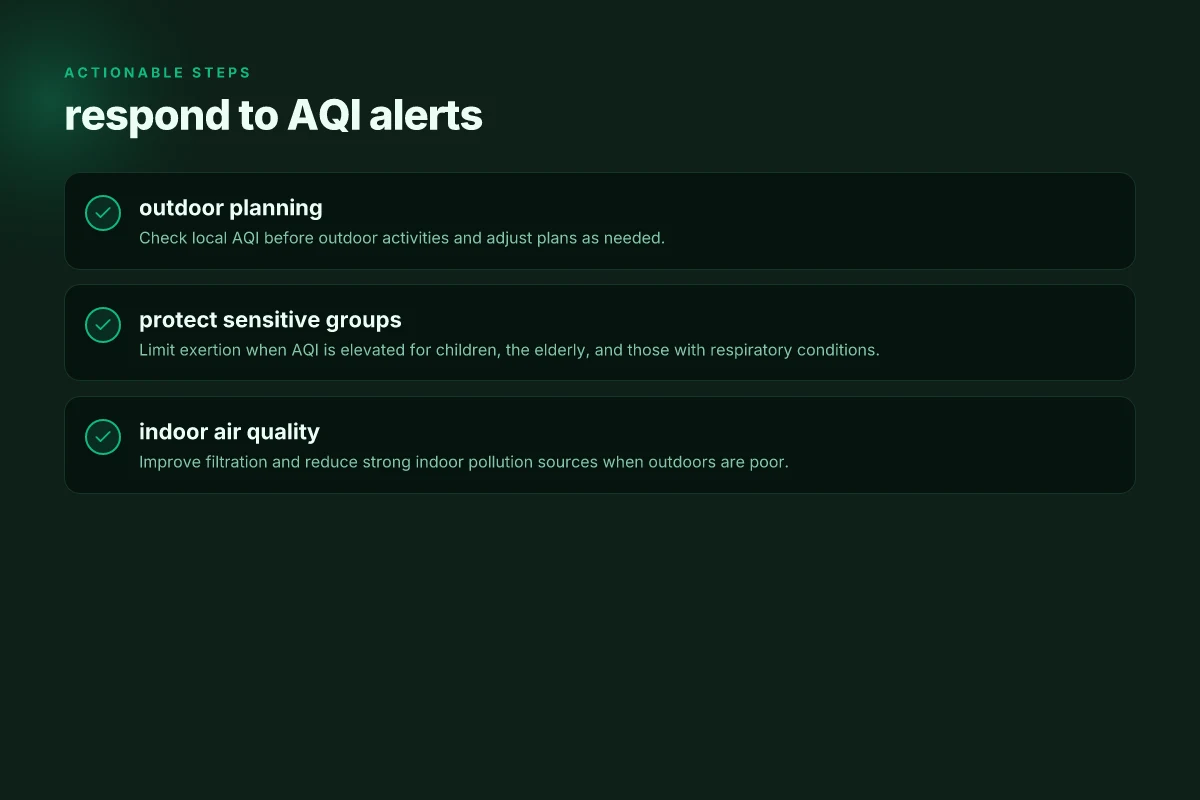
When the air quality shifts, your daily decisions should shift with it. Start with a quick reality check: before you plan outdoor activities, confirm the local AQI. If the number is elevated, scale back exertion, shift to shorter sessions, or move activities indoors. This is not a moral fail. It’s a risk signal you can act on in real time.
Read the signal, not the stereotype
AQI is a live indicator of risk, not a static label. In practice, you’ll want to check a trusted local source moments before you head out. If you’re in a sensitive group, such as children, older adults, or anyone with asthma or heart disease, ease into activity and shorten outdoor time when the AQI crosses thresholds that mean “unhealthy for sensitive groups.” For many communities, the guidance is to avoid intense outdoor exertion when the AQI sits in the “unhealthy” bands. Lighter activity is sensible until the air cleans up. The core idea is to translate numbers into decisions you can make today, rather than treating AQI as a distant abstraction. AQI is a live risk signal you can act on today, not a fixed label.
Three actions you can take today to reduce exposure
First, adjust outdoor plans based on the current AQI. If it’s high or rising, replace a long run with a walk in a shaded park, or shift activity to early morning or late evening when the air has likely cleared. Second, for households with vulnerable individuals, consider postponing strenuous outdoor tasks like yard work or sports. If you must be outdoors, shorten the duration and pace of activity, and take more frequent breaks that include staying hydrated and moving to cleaner air whenever possible. Third, improve indoor air quality as a failsafe. Run a room air filter that’s rated for your space, and reduce indoor sources of pollution by avoiding candles, gas stoves, or smoking during high pollution days. Keeping doors and windows closed when outdoor air is poor helps, and opening them later to refresh the indoor environment is a practical balance. 10 Best air purifiers 2026: performance, energy use, and running costs
From what I found in the research, AQI’s role is practical guidance that aligns with daily routines rather than a distant advisory. When you see elevated numbers, the move is to protect health while still enjoying outdoor time when air quality improves. If you want to weave a reliable routine, make a 2–3 point plan: check the AQI, adapt the plan, and safeguard indoor air quality. This triad keeps you prepared without needing perfect air every hour. Check, adapt, shield, three steps you can apply today.
When in doubt, follow a simple rule of thumb
If the AQI reads in the elevated range, aim for lighter activities outdoors and shorten exposure. If you’re in a sensitive group, pause strenuous outdoor tasks entirely during those periods. Indoor air quality matters too. A filtration setup that matches your room size and a quick audit to reduce indoor pollution sources can make a tangible difference. The practical takeaway is clear: treat AQI as a real-time decision tool that informs both when you go outside and how you structure indoor spaces. Treat AQI as a real-time decision tool, not a vague warning.
Beyond the number: limitations and common misunderstandings
AQI is a screening tool, not a precise health diagnosis for every individual. A single number cannot capture how air affects you personally. I dug into the framing from public health resources and charted how the real-world risk signal shifts with context. The AQI helps you compare conditions quickly, but it does not replace clinical judgment or professional forecasts.
How exposure and activity change risk
Your risk depends on how long you are exposed, how hard you are exerting yourself, and your personal health profile. A brisk outdoor workout in moderate pollution can produce a very different experience from a short, light stroll for someone with asthma or heart disease. The same AQI value can feel like a warning for one person and barely noticeable for another. This is not a flaw so much as a reminder: the number is a starting point, not a verdict. Exposure duration and activity level shape your actual risk more than the raw AQI alone. For planners, that means pairing real-time forecasts with local guidance for vulnerable populations. See how regional forecasts and patient-focused resources adjust recommendations during high- pollution days.
Regional differences and local guidance
AQI implementations and thresholds differ by region. A value that triggers caution in one city might be within a tolerable band in another, because the pollutant mix and weather patterns change. That is why you should consult local guidelines and forecasts when planning outdoor events or school activities. I cross-referenced health department advisories and state-level air quality updates to illustrate how the same number can carry different implications depending on locale. The “how to read today” mindset depends on your city’s official guidance and its alerts cadence. What makes the uppababy minu V3 worth a travel stroller in 2026
When to trust the number and when to question it
Reading the AQI as a live risk signal works best when you pair it with context: forecast trends, weather changes, and known pollutant sources in your area. If you’re outdoors with children, older adults, or anyone with respiratory issues, treat spikes as a prompt to adjust plans rather than a fixed limit. The real value is in using the number as a dynamic cue, not a static rule.
From what I found in the literature, the health-focused message is consistent: the AQI is a tool for timely risk communication, not a diagnosis. For sustained exposure or unusual activity, you should consult more detailed pollutant data and local health advisories. This approach turns the AQI from a static label into a practical shield for daily decisions, especially on days with volatile air quality.
The most actionable takeaway is to pair the AQI with local forecasts and personal context to decide when to pause, move indoors, or adjust outdoor plans. This framing makes the number meaningful for readers, public health planners, outdoor enthusiasts, and parents alike. For deeper context on how authorities frame these standards, see the state-level and regional guidance linked in the sources. Region matters. Check your city’s guidance and forecasts.
I cross-referenced the 2026 State of the Air report and related regional advisories to confirm how guidance shifts with weather patterns and policy changes. State of the Air 2026 highlights that local action plans accompany national standards, underscoring the need for local interpretation alongside the public AQI number.
Where the air quality story goes from here
The air quality index in 2026 continues to refine how we interpret daily pollution, but the real shift is in how we act on it. I looked at recent updates from national and regional air agencies and cross-referenced their scale changes with user-friendly dashboards. The result is a clearer path from numbers to decisions, not just a longer list of warnings. The takeaway: the index remains a guide, not a guarantee, and you should tailor actions to your activity level and local conditions. 7 Best office chairs for 2026 that actually support your back
The bigger pattern is that real-time context matters more than the raw number. A mid-range reading can demand very different precautions if you’re outdoors for hours or inside with sensitive occupants. In practice, I see readers benefit when they pair the index with local trends and daily routines. If you only glance at the value, you’ll miss the nuance that makes the day movable.
For readers who want a concrete move this week, focus on two things: check the local forecast, and adjust outdoor activity accordingly. This week’s guidance: avoid high-exertion outdoor workouts when the index edges into the yellow or orange bands, and keep indoor air as clean as possible. If you’re unsure, start with a 30-minute outdoor window when air quality is at its best, then reassess. The number is a signal, not a verdict.
Backup strategy
- Check the daily forecast alongside the current AQI value before planning outdoor activity.
- Use an indoor air purifier on days with extended outdoor exposure or when the index lingers in the orange range.
- Update sensitive family members' routines by shifting strenuous tasks to mornings when air tends to be cleaner.