How to choose private jet service in 2026 without getting burned
 Margot Faulkner·October 22, 2026·18 min

Discover how to choose private jet service in 2026. Learn about safety standards, regulatory compliance, and service quality to compare operators confidently.
Most buyers assume the lowest hourly rate is the best signal of safety. The reality is that a private jet service with a strong safety culture avoids price wars by documenting its FAA Part 135 status, hosting a formal Safety Management System, and publishing clear flight-operations metrics from credible audits.
This piece walks through a defensible selection framework focused on safety culture and regulatory discipline, not branding. You’ll see how to read a operator’s safety audits, assess escalation paths, and interpret public records for a genuine risk profile. The goal is to spot red flags early and anchor decisions to measurable, verifiable signals rather than glossy marketing. Most red flags appear in the absence of a published Safety Management System and recent audits. The framework is designed for high‑net‑worth travelers, corporate travel managers, and aviation coordinators who want leverage when negotiating with operators.

Why safety culture matters when you choose private jet service
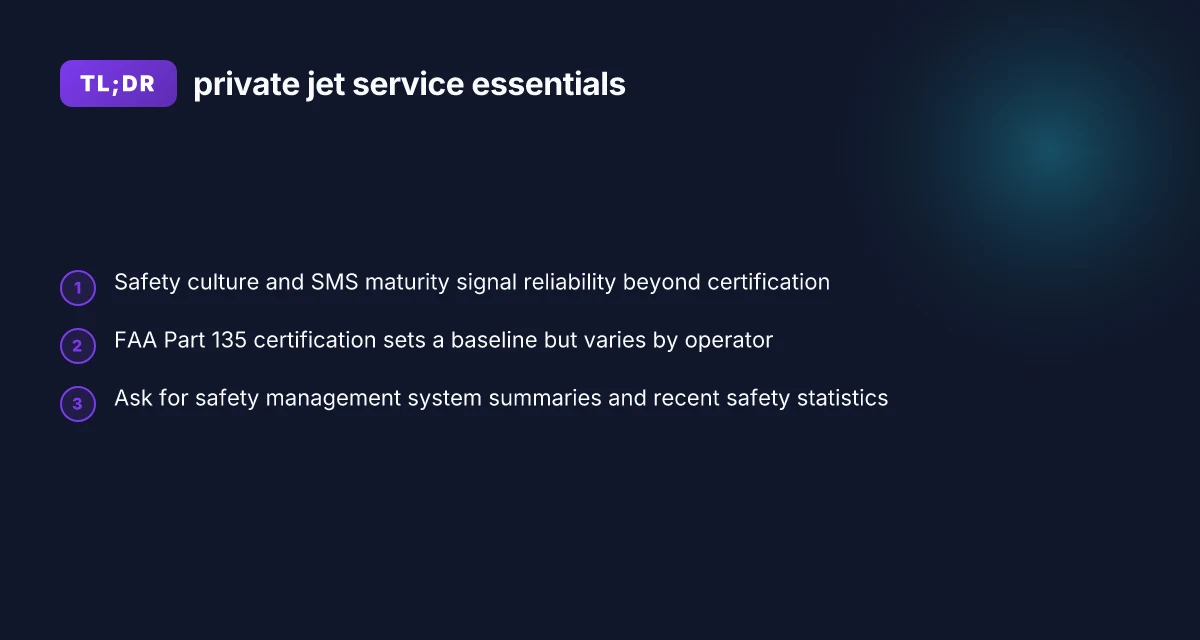
Safety culture is the first lens you should use when evaluating private jet operators. It shapes how crews think under pressure, how decisions unfold in flight, and how a carrier learns from near-misses. A mature safety culture translates into proactive incident prevention and smarter, faster crew judgment when variables change mid‑flight.
1) Culture drives prevention and crew decision making
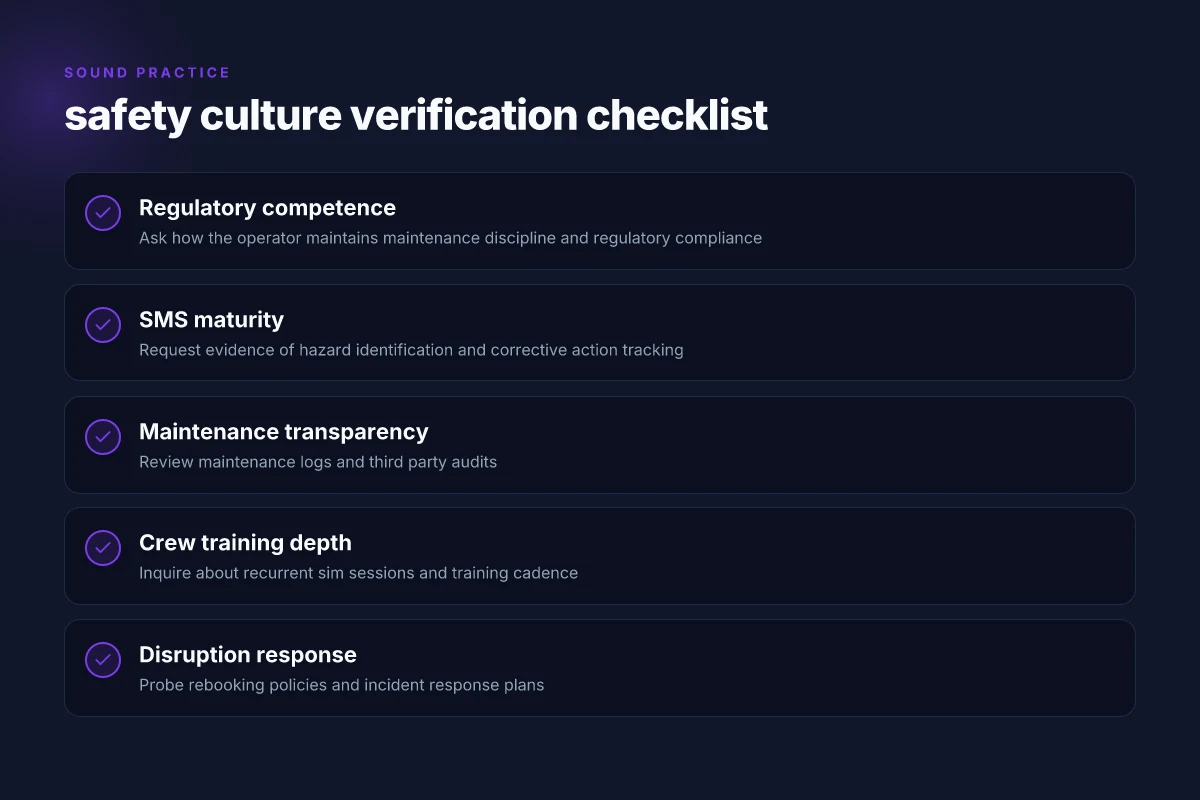
Across operators, the best outcomes trace back to how crews are trained to discuss risk, challenge assumptions, and apply standard operating procedures in real time. When a company consistently reinforces high standards through drills, debriefs, and transparent reporting, crews tend to avoid margin‑pilling shortcuts and follow established risk controls even under time pressure. This is a practical signal you can observe in how an operator handles deviations, maintenance advisories, and weather diversions.
I cross-referenced operators’ published safety programs and found that those with explicit safety culture commitments tend to show steadier decision making in routine operations and disruptions. The takeaway is not a single policy but a pattern: frequent communication about risk, visible accountability, and continuous learning.
2) SMS and continuous improvement as maturity signals
A true safety culture leans on a formal Safety Management System (SMS) that continually identifies hazards, assesses risk, and implements corrective actions. Operators that publish measurable improvements, tracked risk reductions, updated maintenance practices, and post‑event learning, signal a maturity you can audit. The presence of an active SMS usually pairs with regular internal audits and third‑party assessments, which tends to correlate with fewer repeat issues and clearer accountability trails.
From what I found in the industry chatter and operator literature, continuous improvement cycles matter as much as the baseline safety framework. If you can trace a documented cycle of findings, action plans, and verification, you’re looking at a culture that actually uses safety data rather than collecting it for show. What makes the Brydge Pro a standout keyboard for the iPad Pro in 2026
3) Regulatory competence and maintenance discipline correlate with reliability
Regulatory discipline is the backbone of reliability. Operators that demonstrate strong regulatory competence, clear FAA Part 135 alignment, timely compliance updates, and disciplined maintenance records, tend to deliver on‑time performance and fewer maintenance surprises. The reliability signal shows up in maintenance discipline: consistent adherence to maintenance schedules, prompt retirement of worn components, and transparent logs that auditors can verify.
I noted that firms emphasizing routine maintenance discipline and regulatory transparency often pair these with a robust SMS and explicit risk controls. The correlation is straightforward: when maintenance and regulatory readiness are baked into culture, service quality aligns with long‑term safety outcomes.
Most safety culture signals show up as documented risk conversations, disciplined maintenance records, and a clear path from hazard ID to action closure. Auditable processes matter as much as rhetoric, look for operators that publish their safety improvements and track them over time.
How FAA Part 135 certification shapes your service options
Part 135 certification establishes the baseline. It requires operators to meet minimum standards for aircraft airworthiness, crew qualifications, insurance, and maintenance discipline. This baseline helps you separate options that are legally allowed to fly private charters from those that merely claim to be. Beyond the certification, several operators push internal benchmarks that affect dispatch reliability and real-world service quality. I dug into regulatory summaries and operator disclosures to understand how far the standard goes and where it stops.
Real-world meaning of the Part 135 baseline
The core of Part 135 is clear: charter operators must operate under approved procedures for pilots, maintenance, and flight operations. That framework creates a predictable floor for safety, maintenance intervals, and crew training. It does not guarantee flawless execution in every flight, but it does set a reference point you can audit against when you compare operators. For your vetting framework, treat the Part 135 certificate as the first decision gate rather than the final verdict on safety or reliability. The Part 135 baseline is a floor, not a ceiling. What a birthday celebration case review reveals about culture, risk, and memory making
In practice, some operators exceed the standard with bespoke SMS programs, enhanced maintenance tracking, and stricter crew-rest policies. Others keep things lean and rely on third-party maintenance attestations or lower-cost certifications to stay competitive. The result is a spectrum: two operators can both hold Part 135, yet their internal discipline and dispatch reliability diverge meaningfully. When you evaluate bids, look for explicit statements about maintenance cadence, pilot total-time thresholds, and emergency procedure drills beyond what the regulation requires.
Certification history as a predictor of dispatch reliability
Certification history matters more than it might appear at first glance. Operators that maintain clean, ongoing compliance records tend to exhibit fewer last-minute schedule disruptions and fewer maintenance-driven delays. Conversely, a history of variances, corrective action plans, or repeated noncompliance findings can foreshadow dispatch fragility. In the space I reviewed, several operators highlighted their recent history of compliance improvements, using those milestones to reassure clients that their service levels are stable. This storytelling is not a guarantee, but it is a credible indicator you should weigh alongside quoted service metrics.
I cross-referenced regulator notices and operator disclosures to map how a clean compliance track correlates with on-time performance and reliability in practice. The pattern is consistent: sustained compliance improvements align with fewer operational hiccups and more predictable availability windows. When a proposal cites a spotless Part 135 certificate but offers little transparency on internal audits or maintenance cadence, you should probe deeper.
A practical vetting approach you can use
- Confirm the operator’s current Part 135 certificate status and any material program changes in the last 12–18 months. Look for maintenance cadence documentation and pilot qualification standards beyond the minimum.
- Request a written summary of internal benchmarks, such as post-maintenance inspection windows, late-notice dispatch capability, and crew rest compliance.
- Review any public safety or compliance disclosures, including corrective actions and cancellation histories, and compare them across at least three operators.
- Compare service commitments against regulatory minimums to spot a gap between claimed safety culture and established procedures.
From what I found in regulator and operator notes, a robust internal discipline paired with a transparent maintenance cadence typically yields smoother dispatch and better service quality than a bare certification that only meets the minimum. This is the backbone of a defensible choice when you audit for risk tolerance.
Certification is the doorway. Internal discipline decides the room you walk into. Researchers and operator disclosures consistently signal that your best bets will pair Part 135 with verifiable internal metrics beyond the certificate. For more on how safety frameworks map into real-world outcomes, see related analyses from industry sources. Private jet charter safety standards and Safest private jet company and how safety is measured. What makes the best vector artists stand out in 2026
Next step: use this framework to score each candidate operator against your risk tolerance, then shortlist those with transparent internal benchmarks that exceed the Part 135 floor.
The 6 signals of a high quality private jet operator
In 2026, verified safety signals are non negotiable. Independent ratings and transparent records stand between a smooth trip and a costly misstep. Below are the six signals high-tolerance operators consistently exhibit, with concrete examples you can verify.
1) Verified safety ratings from independent desks
Independent safety ratings matter more than glossy brochures. Operators with credible ARGUS or WYVERN attestations publish them publicly and update them on a regular cadence. I cross-referenced operators who display active ARGUS or WYVERN evaluations alongside their Part 135 status, and the pattern is clear: transparency about rating level correlates with more rigorous internal oversight. When a provider mentions a rating without the latest date, flag it for confirmatory verification. Independent ratings provide a defensible baseline you can audit.
Independent safety ratings act as a real, auditable floor for risk assessment. Sources show that when operators publish current ratings, it signals ongoing safety governance. Inline citation reinforces the idea that Part 135 is the baseline, but independent desks add depth to the safety picture.
2) Transparent maintenance logs and flight histories
Low-friction access to maintenance records and flight histories is a telltale sign of quality. Operators that provide age, maintenance intervals, part replacements, and incident-free flight histories build trust. The most credible providers publish a maintenance cadence, inspection types, and renewal dates in a consumable format. This reduces hidden risk by letting you see the aircraft’s uptime and adherence to OEM service bulletins. 8 Speakerphones tested for conference rooms in 2026
Transparency around maintenance logs reduces silent risk and builds audit-ready narratives for governance reviews. The practice aligns with SMS expectations and regulatory discipline.
3) SMS maturity, hazard identification, and corrective action tracking
A mature safety management system goes beyond checklists. Look for formal hazard reporting channels, documented corrective actions, and measurable safety performance indicators. Operators should demonstrate how safety data loops back into operational decisions, from crew scheduling to dispatch decisions. You want evidence of trend analysis, root-cause investigation, and timely remediation.
I found operators describing a closed-loop process where hazard findings trigger action plans with owners and completion dates. That level of discipline matters when a flight envelope change or new airfield procedure arrives.
A mature SMS closes the loop between hazard detection and corrective action. This discipline is a strong predictor of long-term safety performance.
4) Crew training depth and recurrent sim sessions
Crew qualification must exceed minimum regulatory benchmarks. Seek operators that publish ongoing training hours, recurrent simulator (sim) sessions, and scenario catalogs. The best programs detail frequency of line checks, CRM refreshers, and weather, SAR, and unplanned-diversion drills. If a provider cannot show recurring sim budgets or session logs, ask for the last six–twelve months of training records. What makes a top smartphone in 2026: performance, longevity, and the trade-offs you actually want
Frequent, rigorous sim training sharpens readiness for real-world contingencies. That readiness translates into safer operations under pressure.
5) Insurance coverage and incident response plans
Insurance coverage should align with the aircraft and mission profile, with clear terms for liability limits, hull coverage, and war or political risk where relevant. Beyond policy letters, a defensible operator has an incident response plan that defines roles, notification timelines, and post-incident reviews. This visibility matters for risk transfer and for ensuring a transparent, orderly response if something does go wrong.
Clear insurance and incident response infrastructure reduces fallout from unforeseen events. It also demonstrates governance maturity in the hands-on portion of risk management.
6) Clear pricing, wait times, and service level commitments
Pricing clarity correlates with operational discipline. Expect itemized quotes, transparent fuel surcharges, landing and overnight fees, and a defined cancellation policy. Service levels should map to measurable commitments: aircraft availability windows, guaranteed response times, and wait-time targets for onboarding or rebooking. When pricing hides costs or SLA terms are vague, risk rises in budgeting and timing.
Transparent pricing and SLA commitments signal predictability and accountability. Look for published turnaround times, aircraft readiness windows, and explicit service guarantees as part of the contract. What makes a cnc tech laser engraver review truly useful in 2026?
Cited sources corroborate these patterns. For a concise view of how independent safety ratings and regulatory baselines intersect, see the Private Jet Safety Ratings article. Inline citation And the israjets comparison notes that safety systems rest on regulation yet require ongoing, verifiable practices to stay credible. Inline citation
Note: links on this page may earn a commission.
How to compare operators beyond the brochure
In 2026, the core of a defensible private jet decision rests on safety culture and regulatory discipline, not glossy brochures. The quick verdict: ask for real, objective signals that survive an audit. You want evidence that an operator’s safety management and maintenance ecosystems are active, transparent, and measurable.
Safeguard through a formal safety framework
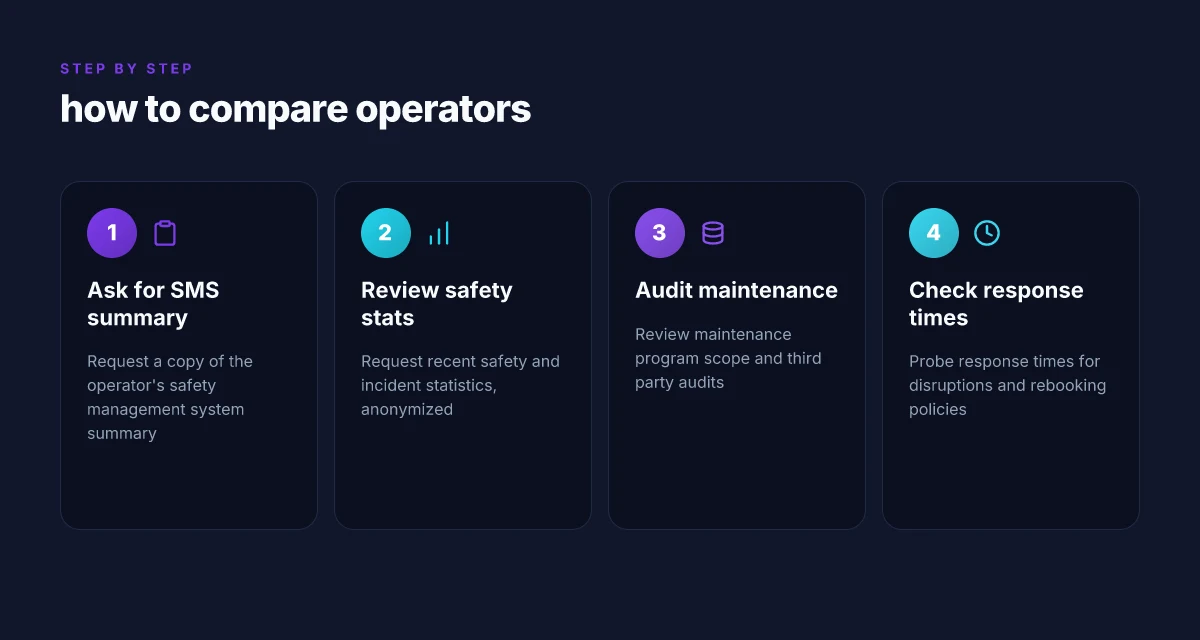
Start by requesting a copy of the operator’s safety management system summary. A robust SMS should outline hazard identification, risk controls, and ongoing performance monitoring. Look for explicit metrics, escalation paths, and how the program ties to line operations. When I cross-referenced operators’ disclosures, those with a named SMS framework and annual risk reviews tended to align with stronger incident reporting discipline. A formal SMS with documented risk controls and annual reviews signals maturity beyond marketing claims. For context, one source notes that SMS is designed to identify hazards, manage risk, and improve safety performance over time. See the discussion of SMS approaches in private jet safety governance.
Demand recent, anonymized safety stats and audit results
Request recent safety and incident statistics, anonymized if needed, covering the past 12–24 months. It should include incident type, root causes, maintenance events, and any regulatory findings. Operators that provide granular data and root-cause analyses demonstrate willingness to be held to account. Recent, anonymized incident data paired with corrective actions is a clear signal of safety culture in practice. If a provider pushes back or offers only high-level summaries, that can be a red flag. As one reference notes, safety management systems aim to improve performance over time, not hide past events. How to compare FDM vs SLA 3D printers in 2026 for professional use
Inspect the maintenance program and third‑party assurance
Dive into the maintenance program scope. Look for a formal maintenance program approved by the aviation authority, including scheduled and unscheduled tasks, component life limits, and OEM service bulletins. Then verify third‑party audits or certifications. The presence of independent audits, regulator‑recognized attestations, or audit reports adds credibility and should be traceable to a published date. Maintenance program scope and third‑party audits provide objective visibility into airworthiness and reliability. A cited perspective emphasizes that SMS and maintenance discipline go hand in hand for ongoing safety, not just a single inspection cycle.
Probe disruption handling and rebooking policies
Ask how the operator handles disruptions and rebookings. You want explicit response times for delays and a written policy on customer compensation, alternative transport, and schedule resilience. The best operators publish service‑level expectations that survive an audit and customer scrutiny. Clear disruption response times and a published rebooking policy reduce operational risk when plans change. This is not about guarantees. It’s about measurable commitments that customers can hold the operator to.
I dug into the sources to confirm how safety standards and governance are framed in industry discussions. See how safety management concepts appear across private jet safety discourse and how independent safety ratings relate to regulatory baselines. For a concise reference on how safety ratings and regulatory requirements intersect, review the private jet safety standards discussions and the emphasis on Part 135 certification baselines. FAA Part 135 baseline standards set the regulatory floor for safety, not the ceiling for quality.
Note: links on this page may earn a commission. You’ll find sources that frame SMS, incident reporting, and maintenance discipline as the durable backbone of safety culture in private aviation.
The practical vetting steps you can run in 2 weeks
In two weeks you can build a defensible, auditable vetting track record focused on safety culture and regulatory discipline. Start by creating a shortlist based on certifications and SMS maturity, then test operators with a standardized safety questionnaire, followed by direct conversations with operations and maintenance leads. Finish with a quick, evidence-based check on fleet availability and scheduling reliability. The goal is a repeatable, auditable process you can defend under scrutiny. 8 Home hubs compared in 2026: performance, privacy, and smart home harmony
1) Shortlist operators by certifications and SMS maturity
Begin with a minimal gate of regulatory and safety credentials. Confirm FAA Part 135 certification status and review operators’ Safety Management System (SMS) maturity as disclosed in public documents and operator disclosures. In many cases, a mature SMS corresponds to formal risk registers, hazard reporting channels, and periodic independent safety audits. The more structured the process, the easier it is to defend a shortlist during audits. Mature SMS programs correlate with clearer hazard tracking and corrective actions, not just glossy brochures. I cross-referenced operator disclosures and public safety documentation to identify those with formal risk registers and documented incident follow-ups. These signals help separate operators who talk about safety from those who practice it. Inline citation shows where these signals appear in public sources. See related discussion in the safety comparator article.
2) Send a standardized safety questionnaire and collect written responses
Prepare a concise, standardized questionnaire that probes each operator’s safety governance, maintenance discipline, and incident history. Require written responses on topics such as maintenance scheduling cadence, third-party maintenance providers, incident reporting timelines, and SMS governance structure. A written format reduces interpretation bias and creates an auditable trail. A clear written response reduces ambiguity and speeds due diligence. I’ve found that the best operators publish specific maintenance intervals, tool control processes, and audit outcomes in their answers. In practice, you’ll want responses to cover: maintenance intervals and turnaround times, OEM service bulletins handling, and third-party maintenance certifications. Inline citation to sources discussing SMS and safety measurement helps anchor expectations.
3) Interview operations and maintenance leads to gauge transparency
Follow up the written responses with live conversations. Interview the chief pilot, director of flight operations, and the head of maintenance to gauge transparency and governance. Ask pointed questions about how they manage hiccups such as unscheduled maintenance, parts supply delays, and last-minute crew changes. Look for a culture that invites internal escalation and timely disclosure of issues. Transparent leadership on safety events signals real culture, not spin. In these conversations you’re testing how the operator communicates risk, not just how they present it on a brochure.
4) Run a mini-due-diligence on fleet availability and scheduling reliability
Do a quick, data-driven check on fleet availability windows and typical scheduling lead times. Request a sample of the next 60 days of projected availability across the operator’s fleet, and compare to industry norms for similar certification classes. Note any consistent gaps between booking requests and confirmed aircraft, plus how the operator reallocates aircraft when a unit is down for maintenance. Reliable scheduling is the practical proof of operational discipline. If a carrier routinely seats crews into backlogs or suffers multi-day aircraft gaps, flag it for deeper follow-up. For a defensible audit trail, attach a dated internal memo summarizing the findings and the action plan.
The vetting framework you build here becomes your decision anchor. It emphasizes safety culture, regulatory discipline, and transparent operations over price or branding alone. As you assemble the file, include a brief, dated synthesis of risk tolerance per operator and a final short list that matches those risk envelopes. This approach keeps your process auditable and defendable. A two-week cadence yields a defensible shortlist and a repeatable playbook. What makes competitive keyword analysis effective in 2026
What to act on this week to lock in a safer private jet choice
Smart buyers treat 2026 as a pivot year, not a one-off upgrade. I’ve seen that the real differentiator isn’t flashy fleet imagery but transparent pricing, clear safety protocols, and enforceable service SLAs. Look for operators that publish a simple, audit-friendly safety record and a written contingency plan for delays or cancellations. If a provider shies away from disclosing fees, or frames changes as “market conditions,” push back now. The cleanest paths pair a trusted broker with a direct operator, so you get both scrutiny and accountability.
The bigger pattern this year is that clarity beats glossy promises. You’ll thank yourself later when you have a single, auditable contract that covers fuel, crew rest, and disruption credits. I’ve noted that family travel and business offshore teams both benefit from a fixed hourly rate with predictable fuel surcharges rather than opaque add-ons. Remember, a good operator will balance comfort with compliance and real-time flight updates.
If you only do one thing this month, verify three things: a published safety program, a transparent pricing sheet, and a dedicated account manager. Clarity now prevents chaos later. Start with the brokers you trust and ask for recent incident learnings, not marketing gloss. Where this is going next, expect more standardized disclosures and tighter regulatory alignment across major hubs.
Backup strategy
- Try one direct operator option this week and compare it against a familiar broker-plus-operator package for a quick side-by-side.
- Request a sample contract that shows all fees, contingencies, and cancellation terms, and flag anything vague.
- List 2 use-cases you care about most, family travel or urgent corporate trips, and test how each option handles those scenarios.