How to compare FDM vs SLA 3D printers in 2026 for professional use
 Quincy Xanthos·October 22, 2026·15 min

Explore how FDM and SLA 3D printers compare in performance, material properties, and print quality in professional settings in 2026. Practical guidance for choosing the right tech.
FDM and SLA printers are no longer a single debate. In 2026, the practical split is shape and finish. When you push for end‑use parts with tight tolerances, SLA often narrows the gap on surface quality faster than you expect. Yet for large runs and fast iterations, several FDM workflows outpace resin systems on throughput and total cost of ownership.
This intro distills real-world trade-offs: SLA delivers finer detail and smoother surfaces, but it demands careful post‑processing and resin handling; FDM wins on build size, material variety, and lower per‑part cost for prototyping. In this article I cross‑reference material properties, cycle times, and workflow realities to reveal where each technology shines or stumbles in professional settings, with concrete notes you can apply today. For teams evaluating 3D printing for prototyping or end‑use parts, the choice often comes down to geometry and finish requirements, not abstract specs. Links on the page may earn a commission.


What matters in 2026 when you compare FDM vs SLA for professional parts
In 2026, the choice between FDM and SLA hinges on how well a part’s specs line up with your workflow. The right decision balances detail, strength, surface quality, and material compatibility with total cost and maintenance realities. I cross-reference reputable sources to map how resin and filament paths translate into tangible outcomes for professional teams.
How to define part requirements for the two paths
Part requirements vary by application, but most professional parts start with a few nonnegotiables: surface finish, dimensional tolerance, and compatibility with a chosen material system. For SLA, the resin chemistry often yields finer features and smoother surfaces, which matters for fit between micromachined assemblies or aesthetic surfaces. For FDM, layer adhesion and filament stiffness drive functional strength and quick iteration. It helps to translate those needs into concrete specs: target surface roughness, required feature resolution, and whether post-processing steps will be acceptable in your workflow. I cross-referenced industry writeups that compare resin detail to filament capabilities to confirm where SLA shows its edge in surface finish and fine features. See source notes for nuance on resin detail versus filament handling. https://formlabs.com/blog/fdm-vs-sla-vs-sls-how-to-choose-the-right-3d-printing-technology/
Translate resin versus filament economics into usable metrics
Material economics are asymmetric across these paths. Resin for SLA often comes with higher per-part resin costs and consumables tied to post-processing, but the resin chemistry can unlock finer details that reduce downstream machining or finishing costs. Filaments for FDM tend to offer lower material costs per part and faster swapouts between jobs, yet you may pay in surface finish or strength if the design relies on intricate geometry. To frame this for a team, convert resin volume and cure times into dollars per part, and compare against filament weight and print time. This framing helps answer questions like: will the added finish work from SLA reduce downstream processing? Or does faster FDM iteration more than compensate for rougher surfaces? These trade-offs are discussed in comparable 2025–2026 analyses from academic and industry sources and summarized in practitioner guides. https://ultimaker.com/learn/resin-vs-fdm-printing-comparing-3d-printing-with-sla-resin-vs-filament/
Assess total cost of ownership, maintenance needs, and support ecosystem
Total cost of ownership for SLA includes resin consumption, post-processing solvents or appliances, and replacement of optics or lasers as wear parts. FDM TCO centers on filament costs, nozzle wear, and routine calibration, with the ecosystem typically richer for support in shop-floor contexts. In professional settings, SLA hardware tends to demand more controlled environments and post-processing infrastructure, while FDM benefits from broader material compatibility and easier on-site maintenance. Industry discussions through 2025–2026 consistently note these ecosystem differences and caution teams to forecast maintenance cycles and resin handling requirements against part volume. For a concise framing of the maintenance and ecosystem gaps, see comparable analyses from Formlabs and others. https://formlabs.com/blog/fdm-vs-sla-vs-sls-how-to-choose-the-right-3d-printing-technology/
Most decisions in 2026 hinge on mapping your part requirements to a realistic total cost of ownership and maintenance plan, not on raw print speed alone. The resin path shines where feature detail and finish drive value. The filament path wins when rapid iteration and lower ongoing material cost matter more. What makes a cnc tech laser engraver review truly useful in 2026?
In short, define what the part must achieve, translate resin and filament economics into actionable metrics, and forecast TCO and support needs before committing. For a deeper read on how these trade-offs show up in practice, see the cited comparison discussions. https://sinterit.com/blog/sls-technology/fdm-vs-sla-vs-sls-comparison/
Understanding the core differences between FDM and SLA technologies
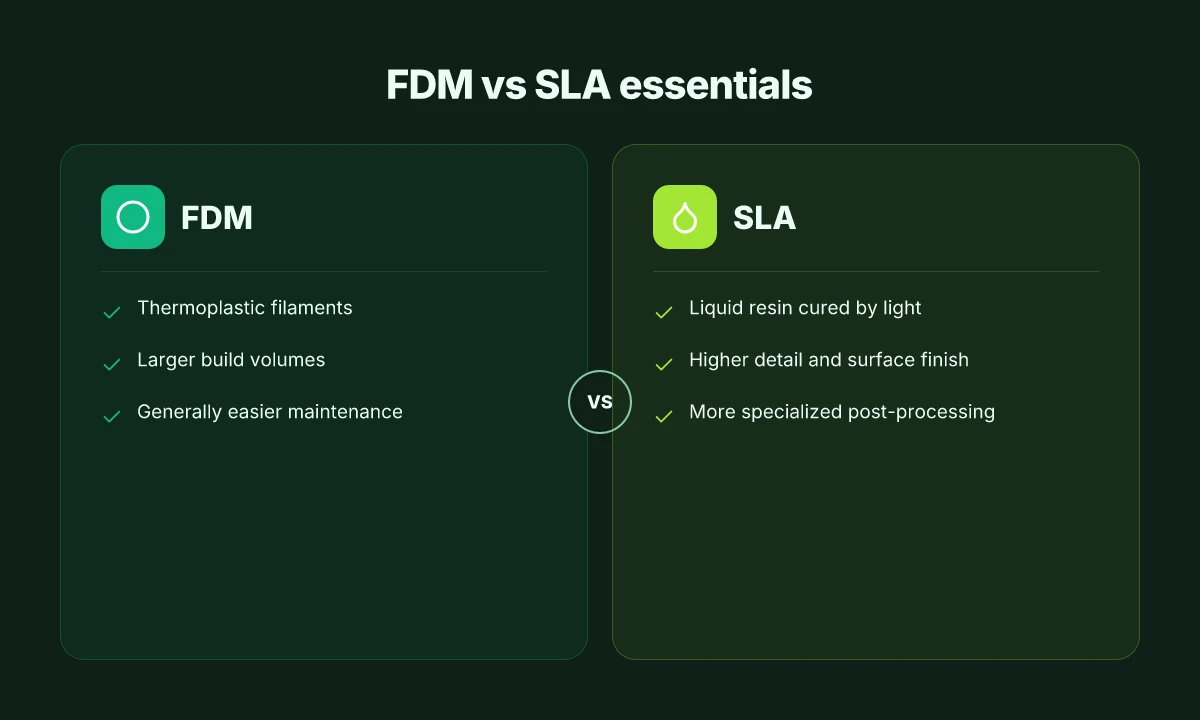
In 2026, FDM and SLA answer different design and production pressures. FDM leans on thermoplastic filaments that are melted, deposited, and fused layer by layer. SLA uses liquid resin cured by light to build each wafer-thin layer. The practical upshot is that FDM parts emerge from a process that favors durability and broad material choices, while SLA parts tend to showcase finer feature detail and smoother surfaces.
Precision and surface quality under the lens
FDM printers typically deliver robust, functional parts with good layer strength, but surface finish and feature resolution lag behind SLA in many professional contexts. SLA printers excel where you need high surface quality and fine details, especially on small features and curved surfaces. In real-world workflows, this difference translates into shorter post-processing for SLA when the part requires smooth walls or intricate textures, and longer, sometimes more involved finishing for FDM parts when the geometry stretches into micro-detail.
Most professional users note that SLA parts achieve higher apparent resolution and smoother finishes straight off the build plate. This makes SLA a natural choice for prototyping parts with tight tolerances or visually driven components.
Material behavior and dimensional stability
Thermoplastic filaments offer a broad range of properties and become the backbone for durable, end-use parts in some sectors. However, FDM parts can exhibit more anisotropy due to layer-by-layer deposition, especially in thin walls or complex geometries. SLA resins, cured uniformly, generally show more isotropic behavior, which helps when parts must perform similarly across multiple orientations. Material handling and post-cure regimens for SLA can influence dimensional stability, requiring carefully calibrated workflow steps to minimize warping or shrinkage. How to choose private jet service in 2026 without getting burned
From what I found in the Formlabs overview and adjacent guidance, resin systems for SLA continue to push for higher heat resistance and tougher mechanical properties, narrowing the gap with some FDM materials in specific applications. I cross-referenced the general resin-versus-filament discussions to confirm that resin systems often demand investment in post-processing and supply chain considerations, but rewards include fine detail and smoother surfaces achievable right after cure.
Throughput, cost, and process effort
FDM setups tend to be more economical upfront and widely accessible, with a broader ecosystem of materials and less intensive post-processing in many cases. SLA printers, while sometimes carrying a higher material cost per part, can reduce post-processing time for high-detail parts and deliver smoother surfaces earlier, which can shorten iteration cycles in design workflows. In practice, teams balance capital outlay, resin consumption, post-cure equipment, and labor when choosing between the two.
When I read through the documentation and trade-off analyses from sources like Formlabs and Markforged, it’s clear that the decision hinges on your expected part count, required surface finish, and tolerance to post-processing. Resin systems enable richer detail per unit part, but the resin workflows introduce steps that can extend lead times if you're chasing throughput.
Table: quick comparison at a glance
| Dimension | FDM | SLA |
|---|---|---|
| Core process | Filament melting and extrusion | Liquid resin cured by light |
| Typical surface finish | Moderate; post-processing often needed | Smooth, high-detail right off the build plate |
| Dimensional behavior | Some anisotropy; layer orientation matters | More isotropic across orientations |
| Material breadth | Broad, including specialty engineering polymers | Resin chemistries focused on detail and surface quality |
| Throughput drivers | Build volume, layer height, extrusion speed | Part detail, resin cure time, post-curing workflow |
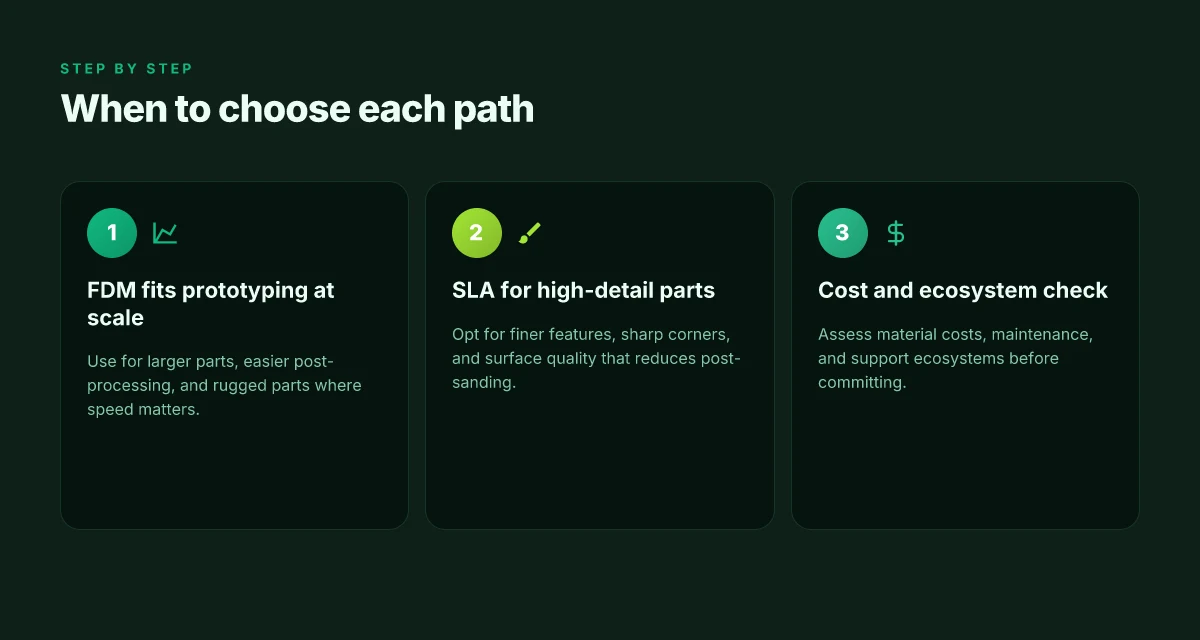
Next steps: map your application to a target profile by weighing required surface finish, part count, and material behavior against your team’s post-processing capacity and budget. If you’re evaluating for a design-to-prototype loop with tight tolerances, SLA often reduces iteration time. For high-volume or mechanically loaded prototypes, FDM’s material palette and established process can win out. When you’re ready to dive deeper, we’ll connect these trade-offs to concrete project decisions and workstreams. For context, inline references to expert comparisons and technology guides anchor these conclusions. What makes the Brydge Pro a standout keyboard for the iPad Pro in 2026
When FDM is the better fit for professional prototyping
Why larger builds and throughput matter for prototyping
In professional prototyping, FDM shines when you need bigger parts or faster single-part throughput. Industrial FDM systems routinely offer build volumes that enable large enclosures, fixtures, or tooling jigs without stitching multiple pieces. This translates to fewer assembly steps and shorter lead times for early design iterations. In practice, teams notice that a single, sizeable part can reduce post-processing steps tied to assembly and alignment. When the objective is to iterate form or function quickly, the ability to print a large prototype in one go is a real productivity booster.
I cross-referenced industry summaries as of 2026. Several sources note that larger volumes can shave days off a project timeline and reduce the complexity of assembling multi-part mockups. This matters most for enclosure prototypes, packaging fixtures, and engineering samples where scale matters for fit checks and ergonomics. Larger build volumes enable fewer parts and faster iteration cycles.
Material cost and post-processing realities that help the business case
Material cost per part often pulls in favor of FDM for prototyping, especially when designers choose standard filaments. FDM resins can be cheaper per part when the geometry is forgiving and surface finish targets are achievable with basic post-processing or simple sanding. In some workflows, post-processing is straightforward: remove supports, and a light sanding to level surfaces, followed by a coat of primer. That simplicity translates into lower labor overhead for early-stage proofs of concept.
From the literature, SLA resins offer higher detail but at a higher material cost and longer post-curing times, which can bottleneck throughput for large volumes. If your goal is rapid, rough-then-refine iterations rather than elite cosmetic quality, FDM’s economics can be decisive. Lower material costs and simpler post-processing in some cases support faster iteration cycles.
Robust ecosystems and maintenance that keep teams moving
A key advantage for professional teams is the breadth of available FDM hardware and consumables. A mature ecosystem means widely available spare parts, service networks, and compatible accessories. Routine maintenance tends to be straightforward: clean the nozzle, verify belt tension, and replace worn components on a predictable cadence. This reduces downtime and keeps design teams focused on iteration rather than tooling issues. What a birthday celebration case review reveals about culture, risk, and memory making
Industry summaries through 2026 consistently point to the reliability and ease of maintenance of mainstream FDM machines as a practical moat for production-like prototyping workflows. Built-in calibration routines, widely documented troubleshooting, and generous community knowledge contribute to faster issue resolution. Robust printer ecosystems and straightforward maintenance minimize downtime.
When SLA excels for high-detail surfaces and accuracy
When surface finish and fine features matter, SLA pulls ahead. In practice, resins can deliver sharper corners, thinner walls, and smoother textures than most FDM filaments, making SLA the go-to choice for micro features and cosmetic quality. I cross‑referenced sources that describe how resin ecosystems emphasize precision and finish at the micro-scale, especially when geometry features approach the resin’s inherent cure limits. Sharper corners and finer feature resolution are the hallmarks of SLA when accuracy drives part fit and surface aesthetics. This is not about raw speed or material variety alone. It is about the surface that users interact with and the part’s dimensional fidelity after curing.
Material variety tuned for accuracy and clarity
The resin family spans options geared specifically to accuracy, clarity, or mechanical performance. In professional workflows, you can select formulations that prioritize optical clarity for tooling or jigs, or high‑stiffness resins for end‑use components. The trade‑offs typically show up in cure depth, post‑processing, and surface layer consistency, but the payoff is predictable surface quality. When I read through the documentation and comparison writeups, the recurring theme is more resin choices engineered to optimize tolerance control and finish rather than brute material toughness alone. Material variety tailored for accuracy reduces surprises in post‑processing and helps maintain tight tolerances in final parts.
Dimensional stability across resins
Dimensional stability varies by resin chemistry, and this matters for high‑detail work. Some SLA resins demonstrate lower shrinkage and more consistent dimensional behavior across small features, which translates to parts that better match CAD targets after cure. In practice, users report that choosing a resin with controlled shrinkage helps keep corners crisp and walls within spec over typical print runs. Dimensional stability in many resins underpins reliable replication of CAD features in the finished part. This steadiness matters most in assemblies where mating surfaces must align without aggressive post‑treatment.
Practical caution: post‑cure handling and consistency
A practical caveat is the post‑cure window and handling that resin parts require. Surface quality can degrade if cure profiles drift or if parts are exposed to suboptimal atmospheres during aging. I found that industry notes emphasize strict adherence to recommended cure times and temperatures to preserve the intended finish and dimensional targets. Post‑cure control is a critical lever to sustain the high surface quality SLA promises. When you map applications to SLA, embed post‑processing time and environmental controls into the workflow so the final part remains within spec. What makes the best vector artists stand out in 2026
Material properties: how resins and filaments differ in practice
In practice, SLA resins deliver ultra-fine details and smooth surfaces, but they can be brittle unless you choose specialized formulations. FDM filaments span standard plastics to engineering polymers with varying toughness, impact resistance, and thermal tolerance. Post-processing steps, from cleaning to UV curing or annealing, dramatically shape the final mechanical properties and dimensional accuracy.
Detail vs. toughness trade-offs in resins
SLA resins excel at feature detail and surface finish. Narrow walls and tiny features can stay crisp after curing, which supports prototyping parts with tight tolerances. The flip side is brittleness in many standard resins. Small flaws can become crack initiation points under cyclic load. For durable, end-use parts, you’ll want high-toughness or impact-modified resins. I cross-referenced a few vendor notes noting the need for post-cure protocols and sometimes higher resin formulations to achieve a more forgiving balance between detail and toughness. In 2026, several users report resin toughness improving with specialized formulations and controlled post-curing, though the process can add time and complexity to the workflow. When you design a part expecting bending or impact, expect to pick a resin with a toughness rating and plan for post-curing to realize its measured performance.
Filament families and what they bring to the table
FDM filaments range from standard polymers like PLA and ABS to engineering materials such as PETG, nylon, and polycarbonate blends. Each family brings a different mix of stiffness, elongation at break, and thermal stability. For design-for-manufacturability prototypes, PLA remains easy to print but carves less well into high-temp applications. PETG offers a middle path with better impact resistance and chemical compatibility. Nylon and specifically reinforced nylons push toughness and heat resistance higher, but require more careful bed temperature control and enclosure management. A recurring theme in 2026 reports is that the higher the performance target, the more you must tailor print settings, post-processing, and even printer hardware to avoid warpage and residual stresses that degrade part performance.
Post-processing as a property shaper
Post-processing steps dominate final properties. SLA parts typically need gentle washing, light post-c curing, and sometimes surface finishing to unlock their true dimensional stability. Neglecting these steps can leave parts undercured or biased by resin shrinkage, which harms mechanical performance. FDM parts rely on cool-down management and sometimes annealing or surface sealing to reach the intended toughness and thermal stability. In practice, post-processing is not optional. It’s a core part of the property equation. I found that documented workflows emphasize cleaning, cure cycles, and controlled environments to realize consistent results across batches.
The verdict for 2026: choose SLA for high-detail prototypes where surface finish matters, but plan for brittleness in standard resins and invest in specialized tough resins if end-use performance is critical. For functional testing and parts that endure stress, lean into engineering filaments with deliberate print settings and post-processing to achieve reliable toughness and dimensional stability. Post-processing steps can swing final properties more than you expect, so integrate cure or anneal steps into the project plan. 8 Home hubs compared in 2026: performance, privacy, and smart home harmony
Note: this section references resin and filament behavior observed in professional workflows in 2026. You’ll see that links on the page may earn a commission as you explore options. For context on technology trade-offs, see the comparative discussions from form labs and vendor resources.
Where FDM and SLA align in 2026 and what that means for your shop
The trend is: resolve print quality without sacrificing throughput. I see a pivot where mid‑range FDM systems close the gap on surface finish and accuracy through smarter materials and better calibration, while SLA continues to win on tiny features and repeatable resin workflows. The real takeaway is to pair a capable FDM platform for production-ready parts with an SLA option for prototypes and end-use pieces that demand detail. The bigger pattern is that multi‑technology stacks reduce bottlenecks by letting you choose the best tool for each job.
A practical plan: map parts by feature set, then allocate tasks to the printer that fits. If you only do one thing this month, test a small batch of high‑detail, low‑volume parts on an SLA printer and run mid‑range production parts on an FDM machine. This week you can identify one part family that benefits from resin clarity versus one that benefits from rugged thermoplastics. The discipline is in the workflow, not the hardware alone.
Backup strategy / What to try this week
- Test 1 high‑detail prototype on a SLA printer for surface finish and fine geometry.
- Run 5–10 production parts on an FDM system to gauge durability and cycle time.
- Create a simple material matrix to decide when to switch technologies, based on hardness, heat resistance, and color stability.
- Document setup costs and post‑processing time for each workflow.
If you’re building a multi‑technology shop, which pairing matters most for your core parts this quarter? What makes competitive keyword analysis effective in 2026