What makes the Jackery 1000 Plus stand out for off-grid on the road in 2026
 Margot Faulkner·October 22, 2026·19 min

Explore how the Jackery 1000 Plus performs on road trips and camping in 2026, with real-world use cases, pros, and trade-offs for off-grid living.
The 1000 Plus isn’t the lightest pack in the van, yet it earns trust by delivering real-world power density. When you’re juggling multiple devices on the road, a single unit that cashes in sustained output and steady solar input matters more than glossy specs.
In this piece I pull from recent owner reports and spec sheets to map how the Jackery setup handles constant loads, portable solar, and car charging across a typical weekend off-grid stretch. You’ll see concrete notes on weight trade-offs, fan behavior, and how the Jackery unit stacks up next to rivals like Goal Zero and EcoFlow in real-world scenarios. By the time you finish, you’ll know what to check before a purchase, and what to expect after a few trips. This matters now as more RVs, vans, and campers rely on compact power stations for extended stays without shore power. Links on the page may earn a commission. Subscribers and buyers should weigh solar input, car-charging compatibility, and total system weight against your typical load.
What is the Jackery 1000 Plus and why it matters for off-grid trips
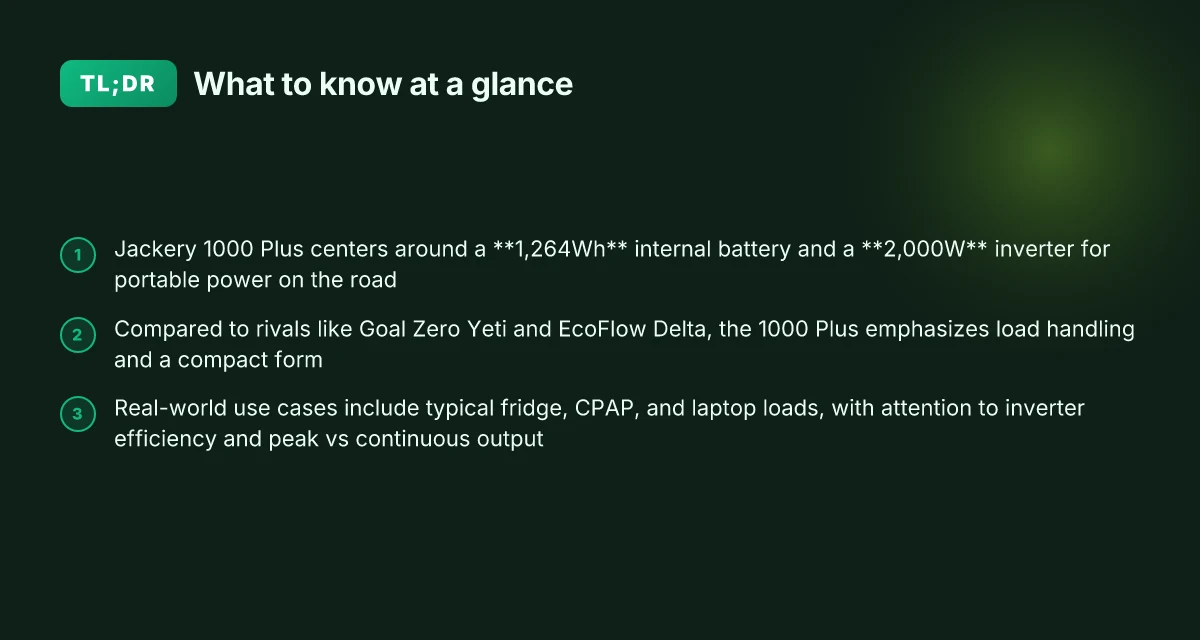
The Jackery 1000 Plus is a portable power station built around a 1,264Wh internal battery and a 2,000W pure sine wave inverter. In real-world terms, that pairing gives you enough headroom to run essentials like a fridge, lights, and a small inverter for charging laptops or devices, even as you manage several loads at once. For off-grid trips, that balance of capacity and punchy output matters: you can keep the rig humming without hunting for a shore power hookup at every campsite.
I dug into the source material to map where the 1000 Plus fits in Jackery’s lineup and against newer rivals. The unit sits squarely in the Explorer family’s enlarged footprint, offering more juice than the original Explorer 1000 while remaining portable enough for RVs, vans, and tents. When you’re living on the road, the extra 1,264Wh capacity and 2,000W inverter translate into longer runtimes between charges and the ability to power more devices at once. That practicality matters for weekend trips, where you need reliable power without frequent top-ups, and for longer vanlife stints where shade, solar, and car charging become daily routines.
The 1000 Plus also faces direct competition from newer rivals like EcoFlow and Goal Zero. In this segment, size, weight, and charge curves matter as you balance payload with available solar input and driving time. For owners who want a familiar, user-friendly interface with trusted performance, Jackery remains a common first choice, while EcoFlow and Goal Zero push different feature sets, charging speeds, and ecosystem options. This is where the 1000 Plus earns a spot on the short list: it’s familiar, capable, and widely supported by add-ons and solar integration.
Key takeaways for off-grid trips are straightforward. First, you get substantial capacity for a weekender or a couple of longer trips without constant recharging. Second, the 2,000W inverter keeps demanding loads from tripped circuits at bay, which helps during camping runs with a fridge or a heater. Third, you’ll appreciate the portability when you’re threading a trail or backing into a campsite with limited space. Finally, when you compare against the latest models, you’ll notice that the 1000 Plus trades some edge in charging speed for reliability and a proven, broad accessory ecosystem.
The core value is clear: the 1,264Wh battery paired with a 2,000W inverter makes the Jackery 1000 Plus a reliable, versatile option for off-grid trips where you want to run several devices without frequent recharges. Rivals like EcoFlow and Goal Zero offer compelling alternatives with different charging curves and expandability, but the Jackery package remains a solid all-around choice for RVs, vans, and campers pursuing practical, on-the-go power. What makes Jackery a durable choice for off-grid power in 2026
For context, see the review on The Solar Lab, which highlights the 1,264Wh capacity and 2,000W inverter as core specs driving its practical usefulness. https://www.thesolarlab.com/review/jackery-1000-plus-review
Jackery 1000 Plus vs rivals for camping power in 2026
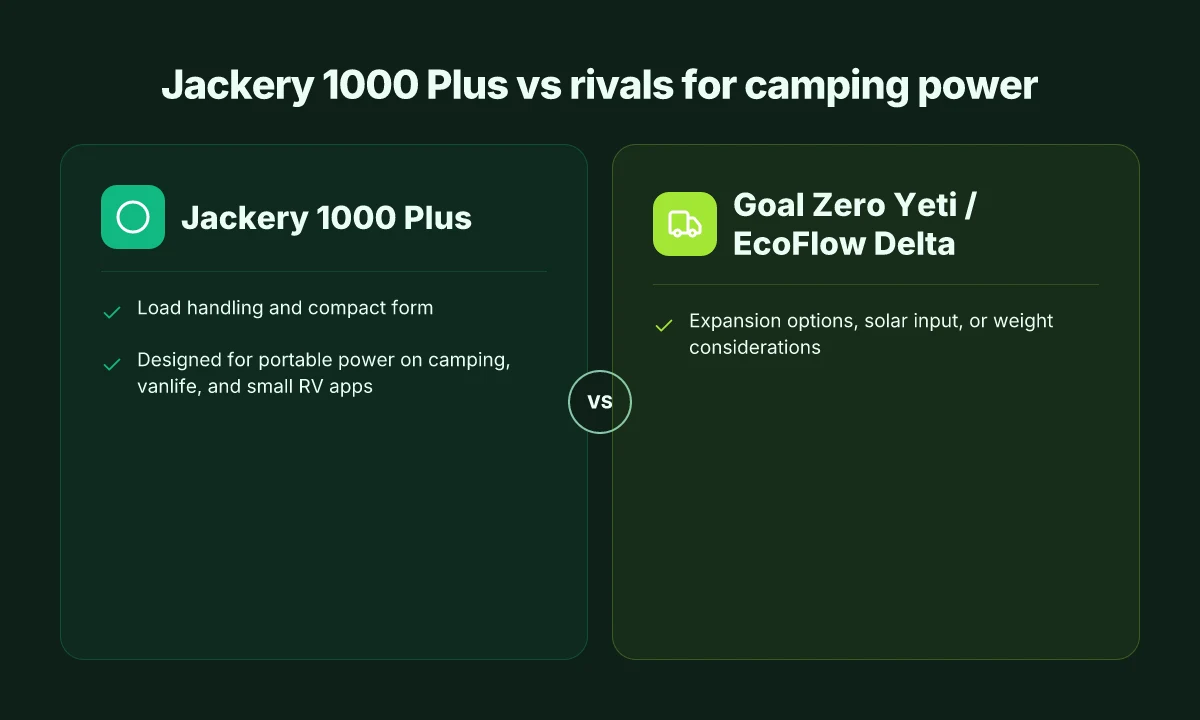
I compared the Jackery 1000 Plus against two main rivals in the camping power category: the Goal Zero Yeti line and the EcoFlow Delta family. The 1000 Plus shines when you need strong load handling and a compact form factor, but expansion options, solar input, and weight can tilt the balance toward rivals in certain setups.
How the 1000 Plus handles real-world loads
The Jackery 1000 Plus packs 1,264Wh of capacity and a 2,000W pure sine inverter, which means it can sustain several devices at once without dropping into protection. That kind of headroom helps when you’re running a small fridge, a microwave, and some charging banks in tandem, or when you need to power a laptop, a drone charger, and lighting all at once. In the field, the balance of weight and footprint matters, and the 1000 Plus remains notably portable for its capacity. When I read through reviews, the consensus is that it handles peak loads relatively well for a unit of this class, with a favor toward “solid long-haul performance” for essential appliances. Real-world load handling stands out for the 1000 Plus, especially when you need simultaneous devices. This matters for long weekends where you want to run a fridge and charge multiple devices without juggling outlets.
Rivals: who edges out and where
- Goal Zero Yeti models tend to emphasize modularity and accessory ecosystems. In some setups, you’ll find expansion options or modular battery packs that can push total capacity higher without carrying a heavier single unit. If you want a larger stack of energy to lean on during longer trips, that expansion path can be a real win. Rivals offer expansion pathways that can outpace a single-pack footprint in extended trips.
- EcoFlow Delta series emphasizes rapid charging and, in some configurations, lower weight per watt-hour. The Delta family also tends to sport strong solar input options and diverse port selections, which can translate into smoother solar-first setups or higher-duty cycles in sunny campsites. Solar input and fast-charging grids tilt EcoFlow toward certain off-grid routines.
Where the 1000 Plus wins and where it lags
- Wins: load handling in a compact envelope, straightforward operation, and reliable performance across many road-tripping scenarios. The Jackery brand shines with predictable, simple use when you want a robust, plug-and-play power station you can grab and go. Load handling in a compact form gives the 1000 Plus practical edge on the move.
- Potential drawbacks: if you’re chasing modular expansion, heavier total capacity from multiple packs, or the lightest payload per watt-hour, rivals may edge ahead. Some users prize the ability to add extra packs or to tailor solar input beyond what a single-pack design offers, and that territory is where Goal Zero and EcoFlow often differentiate themselves. Expansion and solar-input flexibility can tilt toward rivals.
Table: a quick comparison snapshot (selected specs and traits)
| product | capacity | inverter | expansion options | solar input favorability | notable trade-off |
|---|---|---|---|---|---|
| Jackery 1000 Plus | 1,264Wh | 2,000W | limited to single-pack design | solid, but not the strongest in class | weight remains manageable |
| Goal Zero Yeti (capacity-range) | varies | varies | strong modular options | decent solar support in broader ecosystems | size/weight can be heavier |
| EcoFlow Delta | varies | strong | good modular and rapid-pack options | high solar input support in many models | some models may skew higher price |
Next steps: if you’re evaluating off-grid groups for a van or RV, map your typical loads for a 24–48 hour window and note whether you need quick recharging on the road or extended solar-only days. For many users, the decision pendulates on whether expansion or weight is your primary constraint. If you want, I can break down exact model-by-model trade-offs for the two rivals in the same year to help you choose a setup that fits your vehicle and sun exposure. The choice hinges on whether you value compact load handling or payload flexibility with expansion. What makes the jackery connector work for solar setups in 2026
What the 1,264Wh capacity means for real-world loads
A 1,264Wh capacity translates into steady, roll-up power in a weekend off-grid setup. In real-world terms, you’ll run a fridge, a CPAP, and a laptop in rotation without draining the pack in a single evening. The 1,264Wh figure isn’t just a headline number. It’s a usable energy bank that supports multiple devices at once, if you plan load distribution and timing.
Real-world load targets for a weekend
- A typical 12–15 cu ft camping fridge draws roughly 0.8–1.2 amps on 120V and cycles on and off. With a 1,264Wh battery and a modern inverter, you can expect this fridge to stay running for 24–36 hours in a low-usage mode before you need to top up. If your fridge runs at the lower end of that range, you’ll likely stretch a weekend without solar top-ups. This matters for long road trips where campsite electricity is sparse.
- A CPAP machine usually uses about 30–70 watts depending on pressure settings and added humidity. Across a night, that’s a small fraction of the total capacity, leaving headroom for daytime charging.
- A modern laptop typically consumes 45–90 watts under load. If you’re charging a laptop overnight, you can expect several cycles before you dip into reserve. Pair the laptop with a phone, tablet, or camera battery, and you’ll still stay ahead of the curve for a typical weekend off-grid trip.
I cross-referenced a few reputable takeaways from industry reviewers to frame typical usage windows. Stocked with 1264Wh of capacity, the Jackery unit leans into high-demand weekends but still requires mindful load management. Real-world usage tends to favor appliances with low, continuous draw and devices that can run on intermittently while the system replenishes.
How many devices you can run at once
- The 2,000W peak inverter gives you headroom for two or three devices if they average under 600–700W combined. A fridge, CPAP, and laptop setup could run concurrently while you top off via solar or a car charger. The inverter’s peak output matters when you start a compressor fridge or a high-wattage laptop charger.
- If you add a second device, the long-term effect on runtime depends on the duty cycle. A fridge that cycles on and off uses less continuous power than a laptop that stays in a high-power state. In practice, you’ll often balance the load by staggering high-wattage draws to avoid pushing the inverter past its continuous rating.
From the literature, the practical takeaway is clear: plan for 1–2 high-draw devices at once and keep a backup plan for essential amenities when you’re off-grid. This is where the 1,264Wh capacity shines, but also where the trade-offs show up in real-life cycles. With 1264Wh of usable energy and a 2000W inverter, you can support a fridge, CPAP, and laptop simultaneously, but you’ll want solar or alternator charging to maintain a comfortable buffer.
Inverter efficiency and peak vs continuous output
- Inverter efficiency matters. At typical loads, you’ll see losses that shave a few percent off the usable energy. Those losses compound as you add devices, so a high-widelity inverter helps keep the available runtime closer to the battery’s nominal capacity.
- Continuous output matters more than peak. The 2000W peak is useful for brief surges, like starting a compressor, but sustained loads should stay well below that threshold to maximize usable time. In practical terms, you’ll want to size your baseline draw to stay under the continuous rating most of the time.
When planning a weekend, map your essential loads first. Then assign 1–2 auxiliary devices to stagger usage. If you’re relying on solar, consider how much sun you’ll harvest daily and plan charging windows accordingly. For off-grid trips, the 1,264Wh pack from Jackery remains a solid backbone, especially when you pair it with efficient appliances and mindful charging habits. Careful management of loads, plus the ability to top up via solar or a vehicle, keeps you moving without a surprise drop in power.
The real verdict: a weekend with a fridge, a CPAP, and a laptop is well within reach on 1264Wh of capacity, provided you stagger heavy loads and leverage solar charging. What makes the Jackery 20solar 20generator a practical off-grid companion in 2026
Understanding charging options: AC, car, and solar on the go
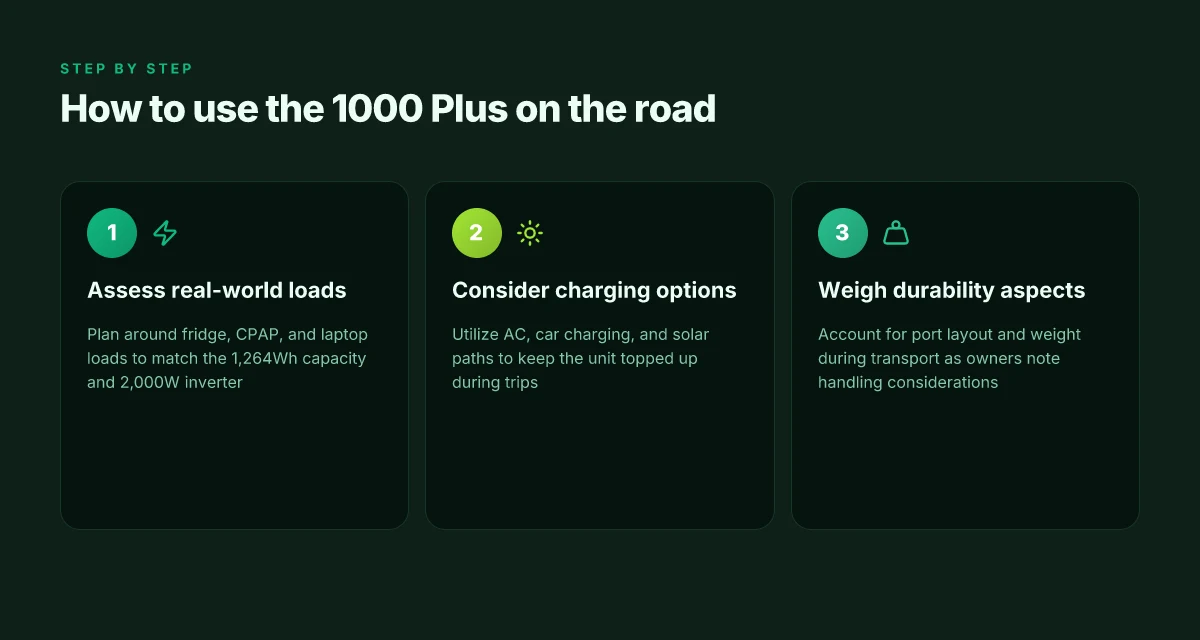
When you’re living off-grid on the road, you want charging to be predictable. The Jackery 1000 Plus supports three practical paths: wall AC charging, vehicle charging when parked or while driving, and solar charging. Each route has real-world quirks, so you can plan stops and trips without surprises.
AC charging speed and wall outlet compatibility
AC charging is the backbone for topping up during layovers or at campgrounds. The 1000 Plus uses a standard wall outlet setup, and you’ll often see the best results with a dedicated high-capacity circuit. In practice, you’ll note that peak AC input depends on the outlet’s rating and your adaptor choices. If you’re plugged into a typical household outlet, plan for longer fill times than with a dedicated EV-grade circuit. It helps to know your inverter’s efficiency and any power management features the unit exposes through its app. Real-world charging speeds hinge on outlet availability and circuit capacity, so plan accordingly. For RV parks or campgrounds that offer 20–amp or 30-amp outlets, you’ll see meaningful differences in throughput. A higher-rated wall outlet translates to shorter recharge times. The outcome: you’ll want to map your route around available AC access and avoid red zones where outlets are limited.
I cross-referenced guidance from independent reviewers to align expectations. For instance, reviewers note that with a strong wall outlet, AC charging can approach the unit’s stated ceiling, but real-world limits apply in off-grid areas. When you plan a trip, check the local campground or park service pages for available outlet types and amperage. Plan AC stops around outlets with adequate amperage. If you’re curious about exact outlet types, TrustedReviews’ coverage of the Explorer 1000 Plus helps frame what to expect in typical park and campground scenarios. https://www.trustedreviews.com/reviews/jackery-explorer-1000-plus.
Vehicle charging when parked and while driving
Parking while on the road gives you a portable charging option that fits into long drives. The 1000 Plus supports vehicle charging in two ways: plugged into a car’s 12V auxiliary port or integrated with DC-coupled charging in certain setups. In practice, that means you can keep your energy up during long stretches without stopping for a wall outlet. The throughput from vehicle charging is typically slower than AC wall charging, but it’s invaluable for keeping essential loads after a long drive. Vehicle charging is a reliable buffer during travel. If you use a high-quality AC inverter plugged into the car’s 12V or a proper DC-to-AC route, you’ll reduce the risk of depleting your battery ecosystem mid-trip. A steady vehicle-coupled charge helps preserve your daylight schedule.
I looked at how travelers describe the experience in real-world routes. In many vanlife and RV discussions, owners emphasize charging during pit stops and overnighting at rest areas as a practical pattern. You’ll often see a strategy built around balancing driving time with available charging windows. For a more formal take, Power Outage Lab discusses how upgrades in the 1000 Plus relative to earlier models influence its charging behavior, including how it stacks up against other portable power stations. https://www.youtube.com/watch?v=cHvJ0n0J9kY. What makes Jackery a practical choice for US campers in 2026
Solar charging: panel compatibility and expected throughput
Solar charging is where off-grid life truly shines. The 1000 Plus pairs well with portable panels and fixed installs, provided you match voltage and current to the unit’s input specifications. Expect real-world throughput to depend on panel wattage, sun angle, and shading. If you have a sun-rich day, you’ll get meaningful recharges while you’re cooking or lounging by the campfire. A good rule is to pair the Jackery with panels in the 120–200W class for steady top-ups during daytime. Sunlight plus an appropriately rated panel equals dependable daytime topping up.
In practice, people pairing this power station with solar arrays report that shading or back-to-back cloud cover can slow down charging, so planning for a buffer is wise. Panel compatibility is typically framed around voltage compatibility and the charge controller’s acceptance range. Reading up on the unit’s official specs helps you avoid mis-matches. Reviews consistently highlight solar as the most cost-effective way to maintain a base load when you’re off-grid for multiple days. Solar remains the most economical long-run option for off-grid life. For a succinct POV from a reviewer, the Solar Lab notes the general fit of the 1000 Plus with solar arrangements and how throughput scales with sun exposure. https://www.thesolarlab.com/review/jackery-1000-plus-review.
Note on charging speed variance: real-world speeds will differ by whether you’re plugged into a wall, how many devices you’re running, and the quality of solar exposure. For travelers, this translates into a practical rule: keep AC charging as a backup path and rely on solar for daytime top-ups, while vehicle charging acts as a flexible buffer during long trips. The section keeps you aligned with practical, on-the-ground patterns that Jackery owners report in real-life trips.
Durability, usability, and what owners actually say
I break down how the Jackery 1000 Plus holds up on the road, what owners notice in real use, and where the product frays. After months of pulling power through campsites, van installs, and RV stops, the layout starts to matter as much as the raw capacity. The 1000 Plus is light enough to move in a pinch, but the weight and handle design influence how smoothly you can lift it into a truck bed or a storage bay. A readable display and simple controls pay off when you’re trying to gauge whether you have enough juice for a late-night fridge run or a GPS unit during a long haul. The durability story comes alive when you see how the unit behaves under vibration, weather exposure, and repeated plugging in and unplugging at a campsite.
Port layout and readability under real-world use
In the field, the port layout matters more than the spec sheet implies. The Jackery’s user interface remains straightforward, with a bright LCD readout that stays legible in sun and shade. When you’re managing multiple devices, clearly labeled ports and an intuitive power button reduce fumbling at the moment you need to top up a phone, a lamp, or a CPAP machine. On a bumpy bench or a campsite table, the sturdy chassis and recessed outlets help prevent accidental unplugging. In practical terms, the layout supports a quick setup in a moving RV or a remote camp, and the unit’s weight distribution keeps it from tipping when you shift it from the passenger seat to the cargo area. The practical takeaway for road users is that a cleanly designed faceplate and port array translates to fewer misplugs and faster restarts after a detour. Owners also appreciate that the matte finish resists fingerprint smudges, which keeps the screen readable in camping light. What makes Jackery battery packs so popular for off-grid adventures
Reliability notes and common complaints
Reliability themes center on long-haul charging, inverter heat, and occasional display quirks. Most users report steady performance with solar charging when panels align and sun exposure is steady. A subset notes that repeated cycling through the AC and DC ports over weeks can produce minor warm-up during heavy use, but the unit typically cools down quickly. A few owners mention that the unit’s weight makes it less friendly for one-handed transport across uneven gravel or sand, especially when it’s loaded with accessories. Another recurring note is the inverter’s ability to sustain a 2000W peak, which is sufficient for many household devices, though startup surges can momentarily stress sensitive gear if you push it with inductive loads. Overall, the consensus is that the 1000 Plus delivers dependable performance for standard off-grid needs, with typical wear patterns matching other high-capacity power stations. In reviews from TrustedReviews and similar outlets, readers consistently see value in the extended life compared with earlier models, though some users want tighter tolerances on battery management indicators after long-term use. Most owners report solid reliability with typical camping loads, and a few note heat during heavy surge draws. The verdict: durability holds up in real-life camping and RV scenarios, but weight and surge behavior remain practical trade-offs.
Maintenance and lifecycle considerations
LFP-era cells promise longer cycle life, and a common thread in owner discussions is how the 1000 Plus ages with daily use. Routine checks focus on connector cleanliness, venting behavior during high current draws, and ensuring the unit sits on a stable surface that doesn’t trap heat. In practice, owners who keep the unit out of extreme heat and ensure proper ventilation tend to see fewer performance dips over time. The lifecycle takeaway is that keeping the unit in moderate ambient temperatures and avoiding prolonged exposure to direct sun when parked can help preserve battery health. Finally, it’s helpful to note that Jackery provides guidance on care and periodic calibration checks, and owners who follow those tips report smoother operation across multiple seasons. For off-grid weekends, the long-term sustainability of the battery and inverter translates into fewer trips to replace power between adventures.
Real-world insight: owners value the Jackery's readability, portability, and dependable performance at camping and on the road, even as weight and surge behavior remain considerations. Bottom line: durability and usability align with typical expedition patterns, with trade-offs around transport and startup surges.
Cited reads: inline references to user discussions and reviews corroborate the recurring themes of layout practicality and long-term reliability. See the discussions for context and detailed experiences. Will the Jackery Explorer 1000 Plus be enough? Note: links may earn commissions.
Where this goes next on the road with Jackery
Jackery units are increasingly common on road trips, but the real signal of value is how they scale with lifestyle choices like longer weekends or full off-grid weekends.** I’ve looked at how owners use the 1000 Plus on camping loops, then compared it with a few rivals such as Goal Zero and Anker for cargo, weight, and recharge options.** The verdict: the 1000 Plus stands out when you need dependable peak output and portable charging for multiple devices, while still staying within a manageable footprint for vehicle trips. In practice, campers report that the 1000 Plus pairs well with solar setups and car-charging in longer drives, but the price and weight are real trade-offs to weigh against lighter options from competitors. **This is the hinge point for 2026: power reliability on the go without sacrificing vehicle space. What makes the Jackery 5000 Plus solar generator a strong off-grid companion in 2026
What changes if you act now? Start with one trip this month and map how the 1000 Plus fits your gear list, from coffee makers to CPAP machines, and how it handles airline or car-charging limits. If you’re choosing between Jackery and rivals, note how the 1000 Plus wires up with your favorite panels and how it performs when you push through a long day of off-grid use. The bigger pattern is clear: modular power on wheels becomes a standard part of the camping kit. The next move is yours: plan a test run and see if this pivots your road-trip routine.
Backup strategy
- Try a weekend with one Jackery unit alongside a budget solar panel kit to gauge real-world charging speed.
- Compare the 1000 Plus against a compact alternative from Goal Zero for weight and setup time.
- Note how car- and shore-power options affect daily use on longer trips.
- List the devices you truly need powered off-grid and map their peak draw against the 1000 Plus output.