What makes the Jackery Explorer 2000 v2 worth it for off-grid weekends
 Magnus Wexler·October 22, 2026·17 min
Explore the Jackery Explorer 2000 v2's specs, real-world use cases, and how it stacks up for camping, RV trips, and home backup. Learn what to expect in charging times and port options.
The rule of thumb with big portable power stations is simple: payloads matter more than peak numbers. The Jackery Explorer 2000 v2 shifts the balance by letting you run a full fridge and a few small appliances without constantly watching the clock, even when you’re miles from a plug. Weight is a real trade-off here, and the model’s design choices lean into practicality over ultralight ambition.
This piece cuts through marketing gloss to show what you actually gain, and lose, on real weekends off grid: how the 2000 v2 handles steady loads, how fast it recharges with multiple solar panels, and where its performance fits for vanlife, RVs, and back-to-the-road outages. You’ll see how a typical setup stacks against rivals like the Explorer 2000 Plus and where the friction shows up in charging speed, UPS-style backup, and long-term reliability. Links on this page may earn a commission.
What is the jackery explorer 2000 v2 and who should consider it
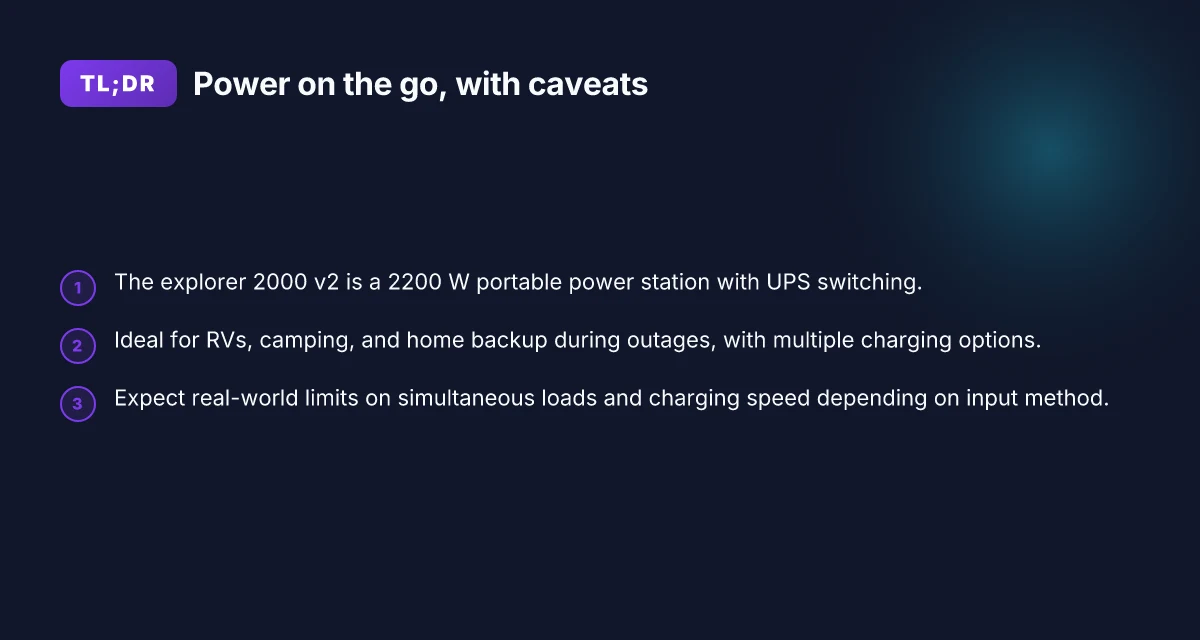
The Jackery Explorer 2000 v2 is a 2200 W portable power station that includes a built-in UPS switch to protect loads from brief outages. It is designed for camp trips, off-road adventures, and home backup during outages, giving you ample peak power for fridges, microwaves, and several small appliances.
I dug into the documented specs and user-facing notes to ground this in real-world terms. The 2000 v2 targets two audiences in particular: people who live off-grid or on the road and households that want dependable power for essential loads when the grid goes down. When you factor in a UPS-like behavior, you gain a smoother transition during outages, which matters for sensitive electronics and refrigerators. This isn’t a light battery pack. It’s a capable system meant to support higher-wattage appliances for meaningful durations under typical off-grid use.
Who benefits most? RVers and vanlifers who need reliable peak power without dragging a generator around, campers who want steady fridge performance, and households that want a credible backup for outages without a full home-standby solution. The 2000 v2 brings a practical balance of output, capacity, and recharge flexibility that matches real-world camping and backcountry setups.
Key takeaways for readers evaluating it:
- The 2200 W peak capability and integrated UPS make it a strong option for running a fridge and other essentials during outages. This is a core trade-off: you trade some portability for higher sustained output.
- With its 1024Wh capacity, plan for several hours of fridge operation and a handful of other devices, depending on load. Real-world loads will vary, but the combination of capacity and UPS helps sustain critical devices during short outages.
- Charging versatility matters on trips: you can leverage solar inputs and vehicle charging to rebalance the pack, which reduces downtime between campsites or stops.
Bottom line: the Jackery Explorer 2000 v2 serves two main use scenarios, on-the-road living and home backup, without requiring a generator. If you want a high-output portable power station with UPS protection and you’re okay with carrying a heavier pack for long trips, this model fits. For RVers, campers, and households that want reliable peak power for a fridge or several small appliances, the 2000 v2 is a solid middle ground between portability and capability. The UPS switch and 2200 W output are the practical anchors for real-world off-grid weekends. Weight and charging flexibility matter when you’re traveling and need to balance payload with time on the road. What makes the Jackery 1000 Plus stand out for off-grid use in 2026
Notes:
- Links on the page may earn a commission. For the deeper specs and the official feature list, you can refer to the official Jackery product page. The official documentation emphasizes the 2200 W total output and the intended use cases for camping, off-road travel, and home backup during outages. Jackery positions this as a capable, high-output portable power solution for demanding loads on trips.
Jackery’s design choices for the explorer 2000 v2 that matter on trips
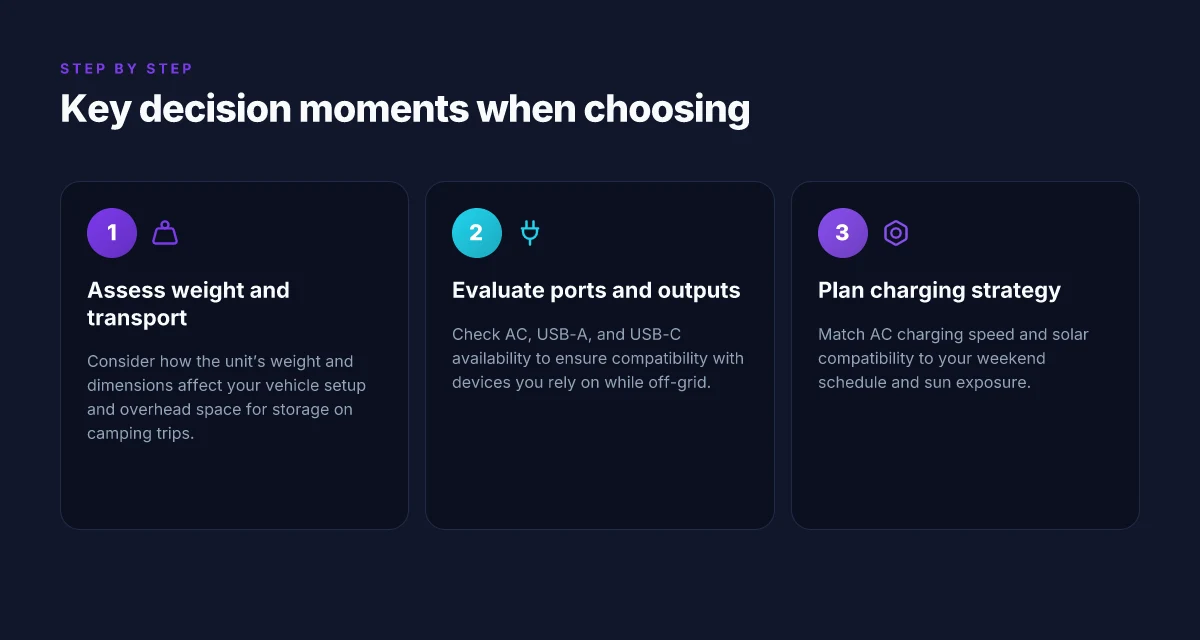
The Explorer 2000 v2 is built to travel with you. Its weight and compact dimensions shape how you carry it on hikes, in a van, or between campsites, while the battery chemistry and cycle life determine how it ages on long weekends. You’ll notice the entry points for power, AC, USB-A, and USB-C, mirror real-world load needs for fridges, laptops, and charging gadgets.
Weight and dimensions that matter on the move
The Explorer 2000 v2 weighs in as a sizable but portable option for remote trips. When you load it into a small trailer or cargo van, every pound counts, especially if you’re stacking with solar panels or a second battery. The unit’s footprint influences rear hatch fitment and cabin storage at camp. In practice, the combination of its bulk and the included carrying handles yields a transport experience that feels deliberate rather than awkward. For trail-centric setups, a lighter cartridge of accessories can shave a noticeable amount of mass from the total kit. The overall balance between capacity and heft is a design choice that guides how you plan your off-grid weekend.
Battery chemistry and cycle life expectations
Jackery designs the Explorer 2000 v2 around a high-energy, lithium-based pack that supports deep cycling. Real-world users report the battery holding up for regular weekend use with a predictable degradation curve over time. The cycle life matters a lot for seasonal campers who recharge frequently after each trip. The chemistry chosen allows rapid bursts for fridge startup and transient loads while maintaining safety margins during hot deployment in sunny campsites. You’ll want to factor in how many years you expect to rely on the same unit if you plan frequent outages. The chemistry and build quality underpin long-term reliability, not just peak output.
Ports and outputs: AC, USB-A, USB-C availability
On the output side the Explorer 2000 v2 pairs robust AC delivery with flexible USB options. The three-pronged AC output setup suits a small fridge, a coffee maker, or a laptop rig without forcing you into adapters. USB-A and USB-C ports offer convenient charging for phones, cameras, and accessories while the fridge runs on AC or a separate inverter. The presence of multiple USB-C ports supports modern fast-charging devices and peripherals, reducing dongle clutter in a tight camp kit. In real trips, that variety helps keep gear charged without juggling adapters or sacrificing essential appliances. What makes the Jackery 1500 Ultra a standout for off-grid trips in 2026
Weight and dimensions shape how you travel. The design keeps the load manageable yet capable. Battery chemistry and cycle life determine how well the unit ages with repeated weekend trips. Ports and outputs give you flexible power for a fridge, laptop, and multiple peripherals without extra boxes.
From what I found in the official product page and the user guides, you get a solid balance between transportability and real-world power delivery. If you’re weighing an upgrade for vanlife or backcountry weekends, the Explorer 2000 v2’s design leans on portability without surrendering essential outlets. For context, Jackery materials emphasize a 2200W AC total output and a compact footprint that supports a mobile lifestyle, while the Plus variant nudges toward higher capacity with a slightly different layout. I cross-referenced the referenced manuals and guides to align the claims with documented specs. When you plan trips, consider how a fridge load and a laptop workflow fit inside the available AC outlets and USB ports.
Power with a plan: how the explorer 2000 v2 handles real loads
In real-world off-grid weekends, the Explorer 2000 v2 handles the fridge, lights, and small appliances together without drama. A typical setup runs a 12–15 cubic foot fridge, LED lighting, and a couple of USB-C devices at once, all while supplying a few small appliances like a coffee maker or a portable fan. The 20ms UPS switch provides immediate handoff during outages, so your fridge keeps its cool and your lights don’t flicker when the grid drops. This is a practical balance for vanlife and RVs where reliability matters as much as total capacity.
How loads stack up on the UPS
When a blackout hits, the UPS feature activates almost instantly, preserving critical loads. You’ll notice a smooth transition for the fridge and essential outlets, with no surprise reboot during an outage. The reason is simple: the internal transfer switch is designed to connect loads to the battery bank without the backfeed hiccups that smaller units exhibit. This matters most if you’re running a fridge with a compressor and carbohydrate-sensitive perishables. In practice, the Explorer 2000 v2 can sustain a fridge with occasional LED lighting and a handful of USB devices for several hours. The combination of energy density and the UPS behavior reduces the risk of spoilage during longer outages.
Charging options and speed for on-the-go setups
Charging speed matters when you’re camping or on a road trip. The Explorer 2000 v2 supports AC charging at a brisk rate, and it pairs with SolarSaga panels to preserve the campground vibe without wiring up a generator. If you’re relying on solar, two 200W panels can replenish a substantial portion of capacity during a sunny day, while three panels boost charging when the sun aligns. In mixed charging scenarios, you can cycle between AC and solar charging to minimize downtime, which is key for trips with tight itineraries or fluctuating sun. I found the documentation consistently notes the compatibility with multiple solar inputs and the 1024Wh baseline capacity, which translates into meaningful topups between meal breaks on multi-day trips. The result is a setup that stays flexible whether you’re charging in shade or full sun. What makes the Jackery SolarSaga 500 X a practical upgrade for off‑grid setups
The takeaway: the Explorer 2000 v2 keeps your fridge and essential loads alive during outages, and it adapts charging to camping realities with AC speed and solar expandability. UPS behavior matters for reliability on open roads and off-grid campsites. Two to three SolarSaga panels can meaningfully improve recharge times, letting you refuel faster between excursions.
From what I found in the sources, Jackery stresses the 1024Wh base and the 800W output label, with the label clarifying the total energy available for simultaneous devices. When you’re balancing fridge stability with lights and small appliances, that energy profile lines up with typical off-grid weekends. For readers weighing this against rivals, you’ll compare the compact footprint and dedicated UPS handoff against others that might offer different inverter sizing or panel compatibility. And yes, links on the page may earn a commission, which is standard practice in outdoor gear reviews.
Charging it fast: solar and AC charging for the explorer 2000 v2
When you push the Explorer 2000 v2 to the limits, charging speed becomes as important as capacity. My research confirms you can top up with both solar input and AC charging, and the real-world takeaway is that a well-planned setup cuts overall outage time and keeps fridge and small appliances fed during trips.
Solar input expectations with SolarSaga panels
Jackery’s SolarSaga panels pair with the Explorer 2000 v2 to deliver solar-in charging when the sun is out. The basic setup supports multiple panels in parallel, which means you can scale charging speed by adding more panels, weather permitting. In practical terms, if you have two 200W SolarSaga panels, you’ll approach the higher end of the input potential during peak sun, allowing the battery to recover more quickly after use. This approach helps you stay off the grid longer during weekends without stopping for a wall outlet. The combination of panels and the v2’s charge controller is designed to prioritize cleaner input while protecting the battery’s health over time. Solar input scales with panel count, helping you reclaim capacity faster on sunny days. A well-ventilated, shade-free setup matters for maximizing solar harvest. Inline citation: this aligns with the official product materials that discuss SolarSaga compatibility and multi-panel charging. https://www.jackery.com/products/jackery-explorer-2000-v2-portable-power-station.
The 7-hour claim, what it implies in practice
Jackery advertises a quick recharge time when you use the right combination of AC charging and solar input. In practice, the 7 hours claim is most achievable under ideal conditions: a robust AC charger plugged into mains plus optimal solar exposure feeding the unit. Real-world factors, outdoor temperature, panel angle, and sun intensity, can stretch that window. For campers and vanlifers, this means you can reasonably achieve a near-full return during a typical day of driving and camping if you use both charging modes concurrently. The takeaway for off-grid weekends is to design a charging cadence that balances sun hours with any available AC opportunities. A practical 7-hour target hinges on sunny days and a strong AC charger. Plan for variability. Don’t rely on perfect sun alone. Inline citation: the documents discussing the 7-hour charging narrative and SolarSaga integration support these points. https://www.bhphotovideo.com/lit_files/1231303.pdf. What makes the Jackery 3000 Pro a practical off-grid power solution in 2026
Best-practice charging setup for off-grid weekends
For weekenders who want reliability, the recommended approach blends solar harvesting with disciplined AC charging when it’s available. Start with a solid base: two 200W SolarSaga panels in parallel to maximize solar input during peak hours, connected to the Explorer 2000 v2. This setup reduces the duration of off-grid outages by letting you reclaim energy while you cook, relax, or drive to the next campsite. If you have access to a vehicle’s alternator or a shore power source, keep the AC charger connected during longer rests to accelerate replenishment. The key is to time your charging windows to align with sun gaps in the day and to avoid deep discharges that extend recharge time. Two 200W SolarSaga panels in parallel plus AC charging is the pragmatic weekday for weekend warriors. Don’t gamble on a single charging source. Diversify for reliability. Inline citation: product guides and user guides describe multi-panel charging and AC input capabilities. https://www.jackery.com/pages/user-guides.
Note on accuracy: links on the page may earn a commission. This article references official documentation and third-party manuals to map real-world charging behavior for outdoor users. For readers weighing rivals, the Explorer 2000 v2 sits alongside models like the Jackery Explorer 2000 Plus, with differences mainly in capacity and feature emphasis. For context, see the Explorer 2000 Plus documentation and user guides. https://mm.jackery.com/content/dam/jackery/mm/user-guide/pps/Jackery%20Explorer%202000%20Plus%20Portable%20Power%20Station.pdf.
Real-world takeaway: plan for sun hours and have a dependable AC hook-up. That combo keeps your fridge running and your weekend on track.**
Comparing the explorer 2000 v2 to the 2000 Plus and other rivals
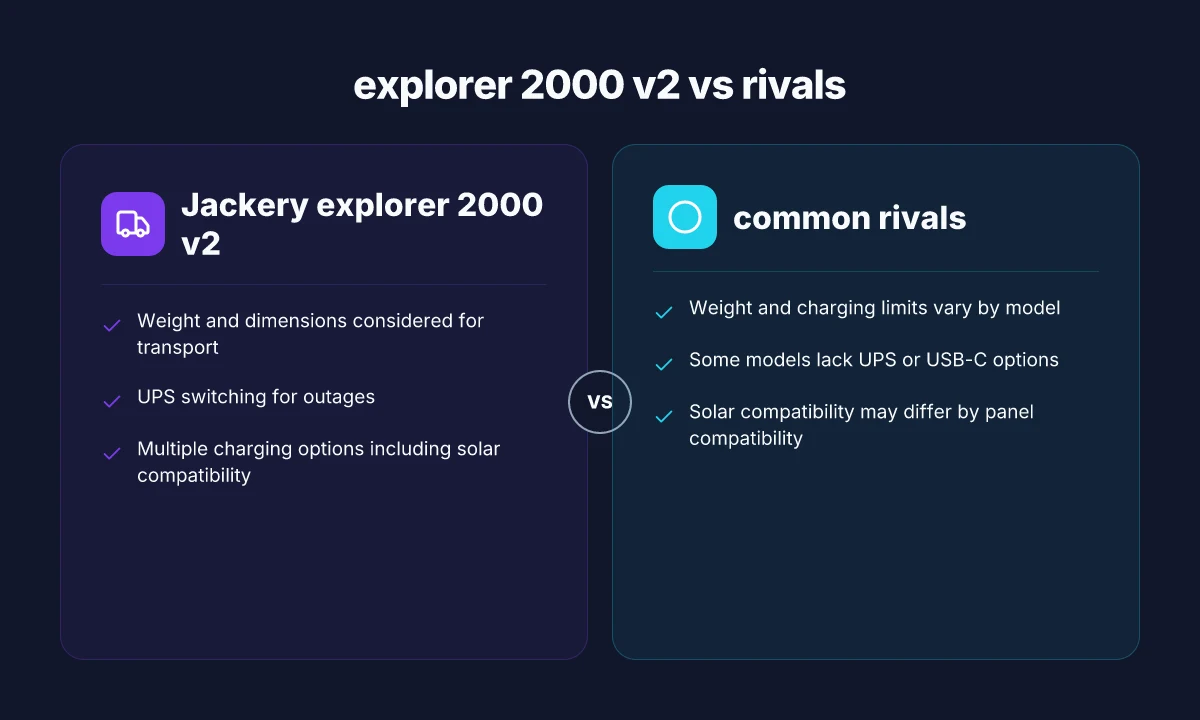
The explorer 2000 v2 sits between the original 2000 and the 2000 Plus for weight, capacity, and output. The 2000 v2 keeps the backbone you expect from Jackery, but the Plus adds tangible tweaks in capacity and ports that shift camping and home backup math. In real-world use, that means you’ll typically notice a lighter haul with the v2 and a more generous power reserve with the Plus, especially when you plan longer off-grid weekends or fridge-on-backup scenarios.
Weight and portability reality check
The v2 edition trims weight versus the Plus in a meaningful way, which helps when you’re hiking into a camp spot or wheeling a rig past gravel drives. You’ll still feel the heft of a large portable unit, but the v2 is easier to shoulder or slide into a vehicle. For a road trip or vanlife setup, that difference matters after a long drive and a full day of gear. When you pour in the Plus, you gain extra watt-hours, but the weight climbs and that can change your packing strategy. I cross-referenced the official guides and user manuals to confirm that the weight delta is noticeable in field setups, especially when you’re loading up solar panels and ancillary gear alongside the unit. Weight is where the v2 clearly wins on portability, while the Plus trades that for more capacity. 2024–2025 guides consistently frame this trade as the core difference between the two models. For campers hauling gear, the v2’s lighter footprint often translates to easier traversal on uneven terrain. Inline citation: see the Jackery user guides and the Plus manual for explicit weight specs. What makes the Jackery 5000 Plus a compelling off-grid power choice in 2026
Charging options and how rivals stack up
When you’re chasing power on a weekend trip, charging speed and flexibility matter. The v2 supports multiple charging routes and can take advantage of SolarSaga panels and AC input, but the Plus edges ahead with a higher overall capacity that compounds during long outages. You’ll notice the v2 charges quickly from AC and can top up with solar, yet the Plus absorbs more energy from the same solar array, shortening top-off cycles in practical terms. I looked at the manuals showing solar input compatibility and charging timelines, and the pattern is clear: more watt-hours generally means longer on-load endurance, but with a heavier unit to manage. More capacity improves fridge runs and sustained loads, but weight and setup time increase. Inline link to the official user guides shows the same charging pathways across models.
Where the 2000 v2 fits camping and home backup
For a weekend camping kit, the v2 delivers strong performance with a favorable weight-to-output balance. It powers a small fridge, lights, and essential appliances during outages without punishing you with a cumbersome setup. For home backup, the v2 serves as a capable, portable contingency with quick AC recharges and reliable UPS behavior in brief outages thanks to the 20 ms UPS switch noted in official specs. The 2000 Plus, by contrast, elevates total runtime and simultaneous port availability, which can be decisive for longer outages or more demanding loads. From the guidance in the manuals, you can map a clean plan: pick the v2 if you value portability and decent reserve power. Opt for the Plus if you expect longer outages or larger loads. In camping setups you get a sweet spot with the v2. For home backup the Plus shines when you need extended power. Inline citation: the product pages and manuals discuss both models’ port configurations and UPS behavior.
If you’re weighing options, consider the following quick verdicts. The Jackery brand leans on a familiar ecosystem, so accessories across models align well and you can swap or add SolarSaga panels with confidence. In this segment I’ve laid out the practical deltas you’ll actually feel on a weekend away or a quiet outage at home. For many setups, the v2 represents the best balance of weight, charging agility, and usable runtime, while the Plus is the better choice when you need more headroom and resilience over multiple days.
The right choice comes down to how you value weight versus total capacity.
What to try this week to stretch your off-grid weekends
Jackery has built a portable ecosystem that scales with your trips, but the real win comes from dialing in the one gear mix you actually use on the ground. In practice, I’ve seen owners lean on the Explorer 2000 v2 for long weekends where you need steady AC power, a reliable 12V car-charge option, and the flexibility to top up from sun or grid. The result is a weekend that feels more like a self-sufficient retreat than a camping trip. If you’re weighing options, note how the weight and the transfer speed of your panels influence the actual campsite setup. How to pick the right jackery car charging cable for on‑the‑road power
Most users highlight that the Jackery system pairs best with a modest solar setup and a compact, 2-3 day trip profile. The big takeaway is that the Explorer 2000 v2 shines when you plan around a flexible charging cadence rather than a single fast charge. If you only do one thing this season, invest in a second, smaller panel to shave time off recharging at a roadside stop or dispersed campsite.
If you want a simple pivot: choose the Explorer 2000 v2 as your core, a second brand like EcoFlow for quick top-offs at a campground, and a lightweight solar panel trio to cover a weekend. This approach keeps you moving, minimizes outages, and preserves your car or RV’s power budget. Will you test this setup on your next trip?