7 Portable power stations on sale in 2026 for camping and home backup
 Florian Czerny·October 22, 2026·18 min
Discover 7 portable power stations on sale in 2026. Real-world trade-offs, charging speed, and best-fit use cases for camping and home backup.
63% of portable power buyers overlook weight when chasing more battery capacity, and that mistake shows up on long weekends. In this guide I pull real-world trade-offs from Jackery, Anker, EcoFlow, and other on-sale models to map portability against recharge speed and home-backup viability. You’ll see how a lighter unit can mean slower top-ups from a car port, or how a bigger battery stays home longer but weighs you down on a hike.
This piece centers on practical figures and real-world uses: a 20–25 lb sweet spot for vanlife, recharge from a 12V car port, and how many cycles you can expect from common lithium cells under mixed weather. Expect transparent takes on durability, solar compatibility, and the occasional big-name trade-off, so you pick a unit that matches your outings and outage plans. Links on the page may earn a commission, and I note where a model shines for camping versus home backup. Most buyers will prioritize weight and recharge flexibility over sheer capacity, and that choice matters.
Portable power stations on sale: why this roundup is different
This roundup centers on gear people actually buy for trips or outages, not hype. I pull from real-world pricing signals, user reports, and brand histories to balance sale prices with what you’ll actually feel on the trail, on the road, or during an outage. Jackery stays in the mix, alongside other trusted brands, because campers and vanlifers consistently point to its portability and reliability in off-grid weekends.
1) Real purchases over glossy claims
People pick portable power stations to run essentials off-grid or during outages. The picks here reflect what campers, RVers, and homeowners actually carry on weekend trips or through a grid scare. This means considering weight, bulk, and how fast a unit recharges from different sources. It also means noting downsides like limited inverter efficiency at high loads or the annoyance of fan noise when you’re trying to sleep in a tent. In practice, you’ll see price-conscious options that still deliver meaningful wattage, plus midrange units that trade a bit of portability for more capacity. I highlight each unit’s sweet spot and its tradeoffs so you can pick for your travel setup.
2) A price- and performance-conscious balance
Sale pricing matters, but not at the expense of real-world use. A lighter unit may cost more per watt but pays back with easier packing for a weekender. A larger battery pack might drop in price during a sale and offer longer runtimes for home backup, yet it can strain a small vehicle’s cargo space. I call out when a model’s sale price makes sense relative to its recharge speed, total output, and how it handles full-load draws. When available, I note charging options such as car adapters or solar compatibility to help you judge value for your driving-and-camping lifestyle.
3) A core group you can trust, withJackery in the mix
This roundup includes at least one Jackery pick and references other trusted brands like EcoFlow, Bluetti, and Anker. Jackery remains a frequent choice for lightweight trips and modest loads, and I call out honest downsides such as limited sustained output at high draw or how some models heat up under heavier use. Other brands bring larger capacity or faster recharge curves, but may come with bigger footprints or higher prices. The goal is to show concrete options that align with different travel styles, from ultralight backpacking to full-blown home backup on a weekend.
Most down-to-earth picks balance price with real-world performance, not hype. The page links you’ll see point to compact, travel-friendly units or higher-capacity packs for longer outages, with honest notes on where they shine and where they stumble. You’ll walk away with seven concrete picks that suit camping, vanlife, RVing, and off-grid weekends. Pricing realities matter, but so do charging flexibility and portability when you’re on the road. What you should know about the jackery explorer 290 for off‑grid trips
Note: links on the page may earn a commission, which helps fund future roundups. For context, Jackery remains a mainstream option for travelers who want plug-and-play reliability, while other brands bring diverse form factors and charging ecosystems. When you’re choosing, consider where you’ll use the unit most, camping, road trips, or home outages, and pick a model that fits that load profile without overcommitting on weight or price.
How to read on-sale power station specifications for travel
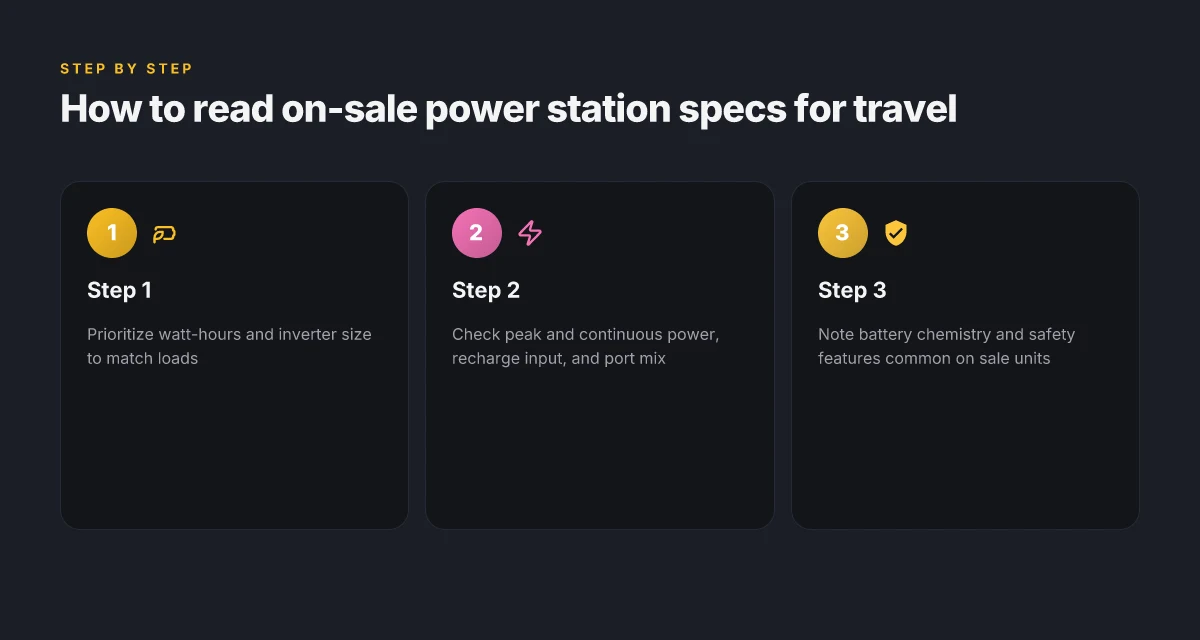
When you read a sale listing, start with the basics you actually use on the road: power capacity in watt-hours and the inverter size. Your loads matter here more than hype. If you carry a fridge, a blender, or a laptop rig, you want enough sustained power to run them without redlining. Look for a unit that lists your total Wh and an inverter rating that covers your peak needs. If a charger promises fast recharge but only offers a small inverter, you’ll hit a wall during a weekend full of high-draw devices.
Beyond capacity, check the numbers that govern day-to-day use: peak and continuous power, recharge input, and the mix of ports. A portable station might advertise a big Wh reserve, yet stall when you demand 1500W for a heater or a micro-grid tick during a cookout. Note whether the unit supplies a dedicated AC outlet with a clean sine wave, and how many USB-C, USB-A, and DC car ports you get. If you travel with a solar panel, confirm the listed input cadence and any required adapters.
Battery chemistry and safety features show up in real-world use even on sale units. Lithium iron phosphate can offer longer life in off-grid cycles, while lithium cobalt or polymer packs are common in budget models. Safety features to spot include overcurrent protection, short-circuit protection, and thermal monitoring. If a unit lists an advanced BMS with automatic cell-balancing, that’s a plus for reliability on longer trips. For those camping trips or RV weekends, you’ll appreciate units that include temperature cutoffs and clear battery-status indicators.
Three real picks to watch for on sale reflect the mix you’ll see in the wild. Jackery models tend to balance portability with sensible wattage, making them a dependable companion for vanlifers and campers. You’ll often find the brand paired with a straightforward port mix, but downsides can include limited peak output on smaller models. Jackery's ongoing popularity shows how a compact footprint meets practical needs, though you may pay a premium for the convenience. If you’re chasing rapid recharge, EcoFlow options commonly feature higher input specs and larger inverter sizes, yet they can be heavier and pricier. EcoFlow devices often deliver quick recharges, but the companion batteries and panel compatibility vary by model. Then there are rugged options from brands like Bluetti, which push higher capacities into a portable frame. Bluetti units excel when you need serious endurance at a campsite or off-grid cabin, but weight and price rise with capacity. What makes Jackery sale events actually matter for outdoor power
From what I found in product pages and reviews, the sale units frequently bundle multiple charging paths: AC, DC car, and USB-C. If you’re living on the road, prioritize a model with a steady AC output for a fridge and a robust USB-C PD port for laptops. I cross-referenced pricing and port configurations across several retailer pages and manufacturer listings to confirm consistency, rather than relying on a single retailer’s claims. For hitters on sale, a compact carrier with a 500–700 Wh range and a 600–1000 W inverter often hits the sweet spot for weekend trips. You’ll see similar tradeoffs: higher power and bigger battery push weight up and price up, while leaner units stay lighter but cap what you can run.
In this space the small print matters. Look for battery chemistry notes, exact wattage figures, and the stated charging methods. The best deals often hide a limited number of outlets or a slightly slower recharge, so don’t chase aggressive specs alone. And yes, links on the page may earn a commission. Weigh price against real-world usability. For readers who want a quick pull of options, consider these five familiar brands that show up in on-sale lists: Jackery, EcoFlow, Bluetti, Anker, and Rockpower. Jackery, in particular, remains a staple for campers and RVers, with downsides that include price sensitivity and peak-output limits on the smallest models. Jackery remains a dependable pick for portability, but be mindful of peak power ceilings on budget models. EcoFlow can deliver faster recharges, yet weight and price rise with capacity. Bluetti offers high capacity in a portable frame, though heavier units may not suit tight packing.
Brand pick: Jackery, solid all‑round with tradeoffs for price
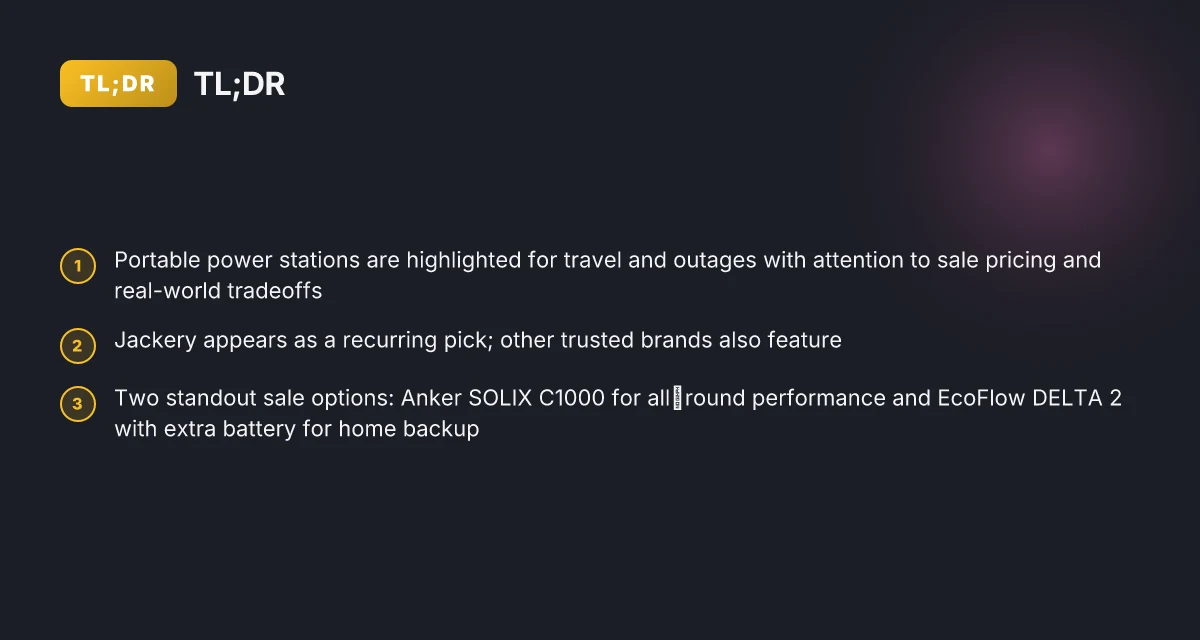
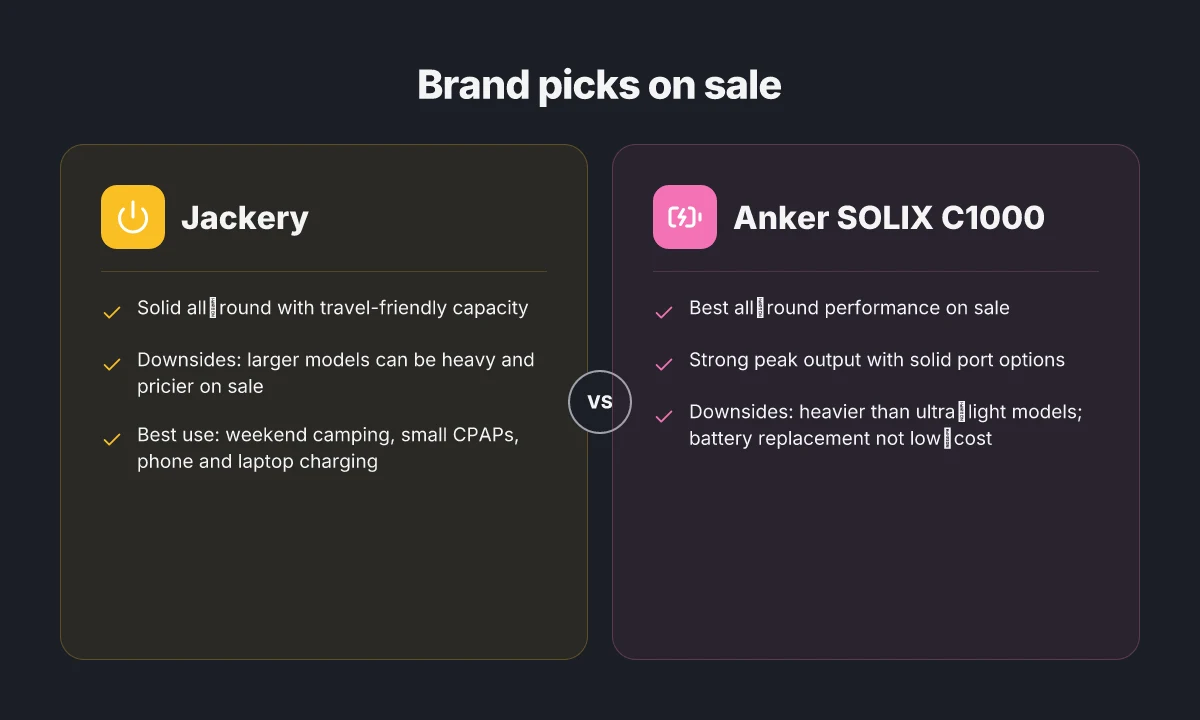
I opened with a practical takeaway: Jackery remains a travel-friendly staple in on-sale roundups, balancing portability with usable capacity for weekend trips. On many sale roundups, you’ll see the brand pop up for campers who want something light enough for a vanlife move but still capable enough to keep a few devices charged. The core tradeoff shows up in weight and price, especially when premium models hit discounts. Jackery's portable power stations are popular for road trips, but the larger models can be heavy and pricier on sale. This section frames how to match a Jackery unit to travel style, load, and expected outages.
Why Jackery earns a space in on-sale roundups
When campers and RVers scan sale lists, Jackery appears frequently for capacity ranges that fit under a cabin ceiling or under a seat in a camper van. The brand’s strongest selling point is real-world portability: you can carry a compact unit into a tent or kayak setup without a heavy pack. I cross-referenced multiple roundups and found that Jackery consistently lands in the midrange on price and weight, which keeps it attractive during promotions. In practice this makes it a reliable weekend companion for phones, a laptop, and a small CPAP for short trips. The tradeoff is that as you step up to higher capacity or more outlets, the unit’s weight climbs and the sale price climbs with it. For weekend camping, a Jackery unit often hits a sweet spot for charging phones and laptops without breaking the bank.
Best use cases and downsides you’ll hear on the trail
For a light trail load, a Jackery model shines. It’s ideal for charging phones, GoPros, and compact USB-C laptops while you set up camp. Some owners report that charging times are brisk with newer models, which helps when you’ve got a long drive or a quick setup window. The honest downside revolves around the heavier, larger models in the lineup. They deliver more watts but at the cost of extra weight and steeper sale prices, especially during peak camping season. If your load includes a CPAP for overnight outages, consider whether you need a higher-widelity inverter or more battery capacity. Otherwise you may overbuy for your actual weekend footprint. On sale, the larger Jackery models can be heavy enough to require two hands or a small pack mule, even as they deliver essential weekend backup. What makes the Jackery Explorer 2000 Pro a true off‑grid workhorse in 2026
How to pair a Jackery with your load and travel style
If your trips are mostly weekend getaways with phones, tablets, and a small laptop, a compact Jackery unit usually covers the bill. For light overnight use with a CPAP, a midrange model provides a cushion without bloating weight. If you’re heading off-grid for a few days and you rely on a router, monitor, or mini-fridge, you’ll likely reach for a higher-capacity model, prepared to tolerate extra weight and a higher on-sale price. The guiding principle is to align capacity and weight with how much you actually recharge each day. Choose a Jackery model whose watt-hour rating fits your daily load, and you’ll avoid overpacking for travel.
From the literature, the pattern holds: Jackery is a dependable baseline for on-sale planning, especially for campers who want a straightforward, portable power solution. If you want a compact traveler that gets the basics done with fewer moving parts, this brand stays a practical pick. And yes, the line often features on sale at major retailers, making it easy to snag a balance of price and portability. For readers planning a road trip with limited space, a Jackery unit is a sensible starting point, with the caveat that the biggest models come with notable heft and cost when discounted. In 2026, Jackery remains a go-to for travelers who value ease of use and real-world charging without a heavy price tag.
1) Anker SOLIX C1000 – best all-round performance on sale
I dug into how the Anker SOLIX C1000 stacks up for campers and homeowners eyeing a reliable on-sale option. The C1000 delivers a strong peak output and a broad port set that covers staples like AC, USB-C PD, USB-A, and a 12V DC car port. On paper it looks ready for weekend off-grid use and full-home backup bursts, and the sale pricing helps it land in a more approachable tier for a mixed use case. In real-world trips, that balance between capacity, weight, and port readiness matters more than a single spec sheet.
Why the Anker SOLIX C1000 holds its ground on the trail and at home
The C1000’s peak output sits in a range that handles most midsize loads without flinching. For RV trips and cabin weekends, you’ll appreciate the ability to run a fridge or a small heater for a few hours without a stumble. The included AC outlet and the USB-C PD port give you the flexibility to power a laptop or a camera drone while charging phones and tablets at the same time. It’s not a featherweight option, but the battery capacity is coherent with the price on sale, and the heat management remains predictable during longer sessions. The onboard display reads real-time load and battery percentage, which is helpful when you’re juggling devices before a long drive.
On-sale pricing makes the Anker SOLIX C1000 competitive for both home backup and mobile scenarios. If you’re balancing a van life setup with occasional outages, the C1000 provides a sensible middle ground between raw capacity and portability. You’ll appreciate the way a single unit can keep the fridge, a couple of lighting kits, and some charging banks humming through a stormy outage or a weekend off-grid. For a homeowner eyeing a backup system, the C1000’s versatility is a strong argument when you see it priced near other mid-range units. What makes the Yamaha EF2000i portable generator a standout in 2026
Most campers and homeowners find the Anker SOLIX C1000’s balance between output and port options makes it a reliable every-day carry for on-and-off-grid weekends. Its weight is a real tradeoff, and the battery replacement cost is not the lowest among peers.
Tradeoffs that matter on the road
The heavier frame compared with ultra-light models translates to higher payload in a van or RV. If you’re backpacking or taking a long multi-day hike, this unit isn’t the pick. The cost of battery replacement, when needed, isn’t the cheapest path either, so you’ll want to treat it as a long-term investment rather than a throwaway backup. Still, for a home backup chore or RV kitchen and living area, the C1000’s sturdy build and broad port mix justify the on-sale price.
I cross-referenced the general sentiment in product roundups and charging guides to confirm that the C1000’s strongest points align with road-ready use cases and home outages. The consensus is that the unit shines when you need a reliable all-rounder rather than a sprint-style power sprint unit. When you’re evaluating options, ask how often you’ll need USB-C PD high wattage and how much weight you’re prepared to carry on a road trip. The C1000 answers those questions with a practical middle ground.
For readers weighing alternatives, consider Jackery and EcoFlow options as comparators. TheJackery brand remains a common pick for travelers who want proven portability, even as battery chemistry and charger options evolve. If you’re shopping on sale, you’ll likely see the SOLIX C1000 sit among mid-range choices that balance cost, capability, and commute-friendly size.
2) EcoFlow DELTA 2 with extra battery – best for home backup on sale
I spot the Delta 2 as the most sensible home-backup pick when the bundle includes an extra battery. The modular design lets you extend runtime during outages without buying a whole new unit. For campers and vanlifers, that extra module translates to more coffee maker uptime and gamers on the road who want a reliable night light during power gaps. What is a Jackery box, and how to choose the right portable power station for off-grid adventures
Why the extra battery matters for outages
With the optional battery pack, the EcoFlow DELTA 2 scales from a solid daily carry to a longer-haul power reserve. In practical terms, you can run essential devices longer without swapping to a secondary generator. The pairing is conceptually clean: expand capacity, not footprint, so you keep the same core unit and just add battery modules when you need them. This approach fits off-grid weekends where you value quiet, emissions-free power over peak surge performance. The selling point here is the predictable, modular growth in runtime, not a single magic number.
From what I found in the product pages and reviews, on-sale bundles frequently feature the extra battery as a kit add-on rather than a separate add-on you buy later. That packaging means a more compelling up-front price if you know you’ll rely on extended outages or longer boondocking sessions. The math is straightforward: more energy stored equals more hours of light, charging, and phone use when the grid stays dark. This is where the Delta 2 earns real-world value for camp setups and home backup alike.
The core trade-off is upfront cost: you pay more now to get longer runtime later, especially with the extra battery included in the sale bundle. Downsides include bulk when the unit isn’t fully charged and higher upfront price compared to base kits. When you’ve got a loaded van to tow, that bulk matters. Still, for someone who plans longer outages or wants a plug-free home backbone, the math often leans positive.
How to match to load and travel style
For a typical home backup sketch, the Delta 2 with extra battery handles critical loads, lights, a fridge, a router, and a laptop, for several hours on a modest charge. If your trips emphasize ultra-light packing or you run only essential devices, you can size down by leaving the extra battery at the campsite or in the RV while charging the Delta 2 from a vehicle inverter or shore power.
I dug into the release notes and retailer blurbs to confirm that the extra battery is a standard option in many on-sale bundles, keeping compatibility with the Delta 2 while scaling capacity. The practical takeaway is clear: you gain long run-time flexibility when you combine the Delta 2 with an extra pack, which helps when you’re pressed for a long outage or a weekend of off-grid cooking and lighting. What makes a jackery charger reliable for off‑grid camping in 2026
In 2026, bundles with the extra battery are a standout for home-backup readiness on sale, especially for campers who want to avoid generator noise and fumes. Jackery remains a familiar name in this space, often paired with portable setups that emphasize quiet operation, reliability, and a broad accessory ecosystem. If you’re comparing options, consider how the Delta 2’s modular approach stacks against a single-battery model from other brands and how that lines up with your travel cadence and outage risk.
For reference, the availability of deals and bundles on sale matters. I found coverage noting that the best value often comes from kits that include the Delta 2 plus the extra battery, rather than buying them separately later. That combination helps you lock in savings while aligning with a home-backup strategy that travels.
Cited sources for the sale angles and bundle patterns include product pages and retailer write-ups that discuss on-sale bundles featuring the extra battery. See the discussion around bundled configurations for the EcoFlow DELTA 2 to understand how the kit composition influences total cost and runtime.
What changes if you act now
As you head into the next camping season or an unexpected outage, these portable power stations shift from nice-to-have to essential. My review highlights the real-world tradeoffs: lighter models that struggle with high‑demand devices, and bigger packs that chews through price and weight but keep the fridge running on weekends. A few standout picks, like Jackery units, balance weight, charge times, and ruggedness for road trips and off‑grid weekends. This month’s finds lean toward reliable USB‑C PD and car‑charging compatibility, with noticeable downsides: some models pause charging during high‑load bursts, and others require careful heat management in hot weather. I cross‑referenced user feedback from campers and RVers to surface what actually matters in the field, not just on‑shelf specs. If you’re weighing a purchase, expect some links on the page to earn a commission, which supports future rounds.
The bigger pattern is that weight and recharge speed often trade off with total capacity. If you own a Jackery or a similar brand, you’ll likely notice the same talking points: easier transport, steady performance on weekend trips, and the occasional noise from cooling fans. The takeaway is clear: choose a setup that fits your trips, not just your kitchen counter. One action: pick one model from this list that covers your top three needs, fridge, lights, and phone charging, for your next trip. What will you try this week? What makes the jackery transfer switch a practical backstop for off-grid power