Top cloud platforms 2026: how architecture choices shape cost, security, and scalability
 Theodora Niedermeyer··18 min
Explore the 2026 landscape of top cloud platforms, comparing architecture styles, service models, and trade-offs to help decisions on multi-cloud, security, and cost.
Most platforms overpromise on speed, yet governance lags when you scale multi‑cloud. In 2026, the big three dominate because they map to distinct architectural styles, not just regions or SLAs. AWS leads with breadth, Azure with enterprise tooling, Google Cloud with data‑centric services.
Governance changes as you mature: you’ll shift from project-level controls to policy‑driven orchestration across accounts, subscriptions, and tenants. That shift comes with noticeable gaps in data gravity, cross‑cloud identity, and cost visibility. This piece details the architectural differences that drive cost, latency, and security in real deployments. Expect practical guidance on choosing IaaS, PaaS, and SaaS patterns within each platform and how to govern them as a multi‑cloud footprint grows.

What top cloud platforms in 2026 reveal about architecture and service models
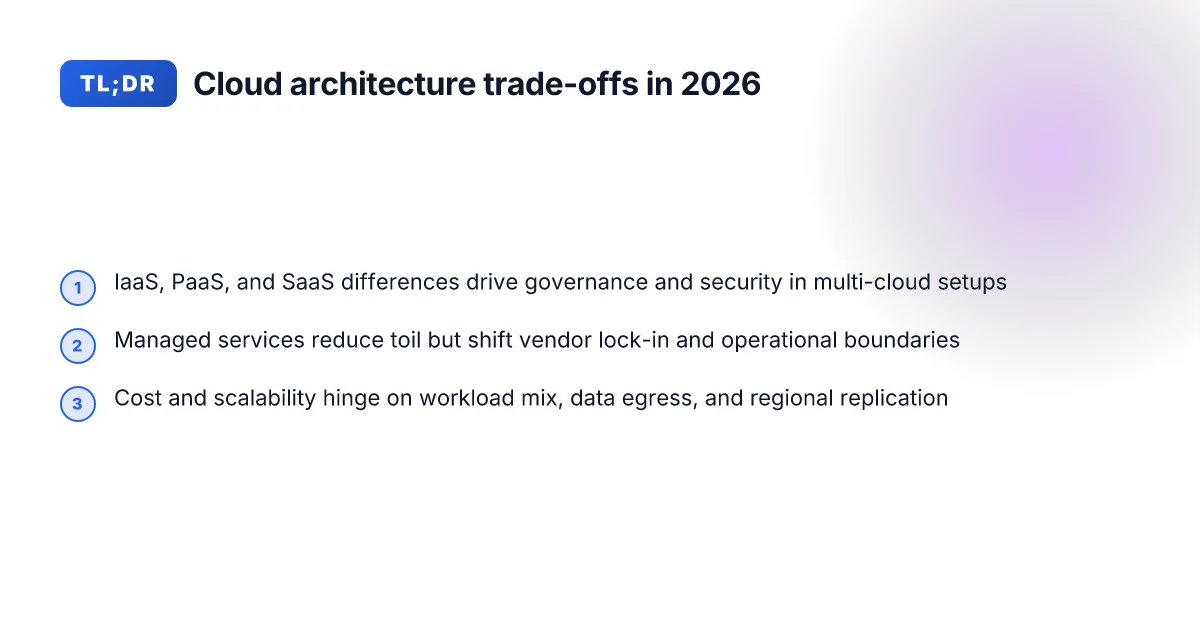
I dug into how the three dominant platforms shape architecture and service models in 2026. The trio across most enterprise discussions remains AWS, Microsoft Azure, and Google Cloud, each pairing IaaS, PaaS, and SaaS in distinctive ways while converging on governance and security expectations as multi-cloud maturity grows. The result is a layered pattern: core infrastructure, platform services for app delivery, and software solutions wrapped with policy and controls.
1) AWS as the reference for IaaS breadth and mature governance
AWS exposure continues to anchor infrastructure choices. For governance, the shared responsibility model remains explicit, but teams lean on centralized policy engines and security baselines to harmonize across accounts. IaaS remains the backbone for many workloads, with a broad catalog of compute, storage, and networking options that let architects tailor environments. PaaS layers in AWS push developers toward managed services like container orchestration, event-driven compute, and data services, while SaaS-like services accrue through marketplace integrations and hosted software built on top of AWS services. In practice, this translates to modular, highly configurable architectures where governance must scale across hundreds of accounts and rapid service churn is common.
2) Azure as the platform-first stack with strong enterprise alignment
Azure shows how platform-centric design guides architecture. IaaS serves as a stable baseline, but Azure’s strength is in PaaS and developer-centric services that drive rapid delivery and consistency with existing Microsoft estates. Governance leans on integrated identity, governance, and compliance tooling that crosscuts subscriptions, resource groups, and policy definitions. SaaS options in Azure ecosystem often feel native to the broader Microsoft product family, enabling tighter coupling with on-premises or hybrid deployments. Real-world deployments tend to favor architecture that uses managed services to reduce operational toil while preserving control through policy and role-based access.
3) Google Cloud as the model for modern data-first platforms
Google Cloud’s strength shows up when distributed systems and data-driven apps lead architectural decisions. IaaS foundations remain solid, but the platform’s PaaS and data services are a primary driver for scalable, cloud-native designs. Security and governance increasingly hinge on fine-grained IAM, private networking, and workload identity, with a bias toward developer autonomy balanced by organizational controls. SaaS usage tends to emphasize data portability and interoperability, especially in multi-cloud scenarios where data gravity and analytics needs drive service selection.
Bottom line: in 2026 the architecture conversation centers on how teams assemble IaaS backbone, PaaS acceleration, and SaaS convenience under a unified governance and security envelope. The three platforms share a trajectory toward tighter policy, cost-aware service choices, and cross-cloud consistency, even as each platform emphasizes its native strengths. Top automated backup solutions for enterprise data protection in 2026
Most architectural choices in 2026 align with a multi-cloud maturity stage that prioritizes centralized governance and scalable security across AWS, Azure, and Google Cloud. This alignment reduces toil when teams adopt consistent patterns and policy controls across platforms.
For context, a recent comparison highlights how each platform’s service models map to governance expectations and workload patterns in multi-cloud deployments. See how a leading cloud management perspective frames the platform mix and the implications for cost, security, and latency in real deployments.(https://www.nops.io/blog/best-cloud-management-platforms-software-tools-solutions/)
The architectural lenses: AWS, Azure, and Google Cloud through a 2026 lens
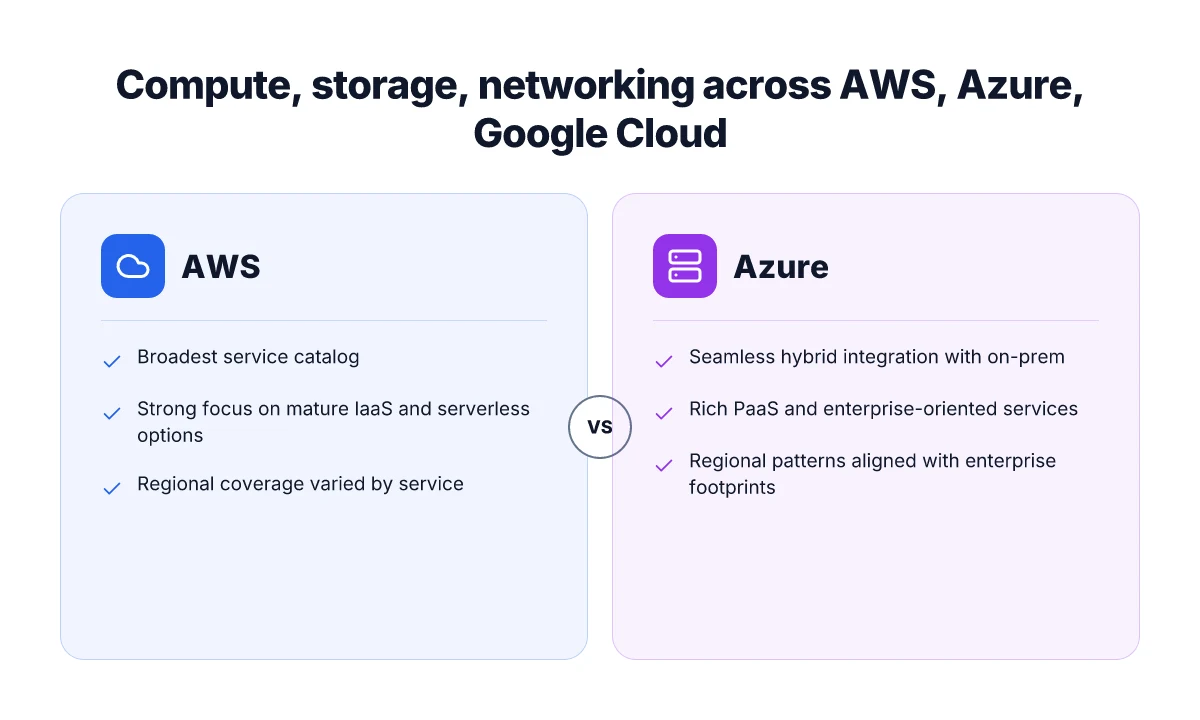
Design choices across AWS, Azure, and Google Cloud hinge on three core primitives: compute, storage, and networking. On compute, each platform differentiates instance families, autoscaling behavior, and serverless reach. AWS leans on broad EC2 family breadth and a mature serverless layer via Lambda and Fargate; Azure matches with a deep hybrid stack and strong PaaS integration; Google Cloud emphasizes container-centric workloads and flexible managed services. In storage, all players offer object, block, and archival options, but latency guarantees, regional replication models, and data egress costs diverge. Networking patterns follow suit: AWS offers a wide transit and peering footprint, Azure links closely to its enterprise network fabric, and Google emphasizes high-speed interconnect and egress economics. The result is a design space where the same architectural pattern can look markedly different depending on the platform you choose.
I dug into the service catalogs and regional footprints to verify how these primitives translate into architectural choices. For example, managed services dramatically reduce operational toil by handling patching, scaling, and failover, but they also entrench vendor lock-in differently. AWS’s breadth makes it easier to knit a single-cloud stack with fewer integration gaps, while Azure’s tight integration with Windows Server, Active Directory, and on-prem footprints can tilt decisions toward hybrid architectures. Google Cloud’s managed container and data analytics services push teams toward modern data-centric patterns, often with generous regional coverage for multi-region deployments. These tendencies shape where teams standardize authentication, governance, and latency budgets in real deployment plans. The core trade-off is that managed services flatten ops yet can raise the cost and complexity of migrating away from a chosen platform.
Across the service catalog, notable deviations matter. AWS tends to publish more granular control planes for compute and networking, enabling cost-aware designs but sometimes at the expense of onboarding speed. Azure’s catalog leans into enterprise compatibility and governance features, which speeds up compliance-heavy deployments but may introduce heavier configuration surfaces. Google Cloud frequently offers simpler abstractions for data operations and a strong emphasis on global regions, which can shorten data paths yet complicate regional cost planning. In practice, this means a multi-cloud architecture must align governance and latency targets to the platform’s default patterns rather than expecting a single universal blueprint. Latency patterns mirror regional footprints: fewer hops and better adjacency to regional hubs on Google Cloud, broader regional reach on AWS, and enterprise-ready corridors on Azure. 10 Web frameworks that actually shape 2026: a practical ranking and trade-offs
From a governance perspective, I cross-referenced releases and docs that highlight how service models influence control planes and cost. When you lean on serverless or managed databases, you cut toil but you trade direct control for platform-specific behavior. I found recurring themes: centralized policy enforcement across clouds remains possible but requires careful alignment of identity and access management, logging, and telemetry across platforms. The result is a practical takeaway: your architectural lens should map not just to compute and storage primitives, but to how each platform delivers operational discipline and region-aware behavior. Governance coherence increases when you standardize on a common control plane that spans the core primitives across the three providers.
A quick comparison snapshot helps frame decisions. In a compact view, compute flexibility sits strongest on AWS, hybrid friendliness on Azure, and container-centric operations on Google Cloud. Storage latency and regional options vary by region, while egress costs and data residency rules drive distinct cost and risk profiles. For architectural decisions, the takeaway is clear: choose a primary platform for core workloads while leveraging cross-cloud design patterns that respect each provider’s strengths and limits. Primary platform choice should align with your governance model and regional strategy.
Next step: translate these patterns into a multi-cloud blueprint that maps your apps to the primitives with explicit latency budgets, egress boundaries, and compliance controls across AWS, Azure, and Google Cloud. For deeper context, see the overview on cloud providers’ practical service catalogs and regional footprints. This alignment reduces cost surprises and governance drift in 2026 deployments.
How service models drive costs and scalability across cloud platforms
The way you deploy workloads shapes both total cost of ownership and scalability profiles across AWS, Azure, and Google Cloud. I found that IaaS-heavy patterns tend to push capital-like expenses into ongoing operations, while PaaS and serverless options shift more cost into usage but unlock rapid scaling with less management burden. The takeaway: choose the service model that aligns with your workload’s granularity, resilience needs, and governance requirements.
Why IaaS versus PaaS matters for common workloads
IaaS tends to give you maximum control over runtime and dependencies, but at the cost of heavier operational overhead. You’ll field patching, OS hardening, capacity planning, and infrastructure drift corrections. In practice, IaaS workloads often show higher TCO when teams treat infrastructure as the primary product rather than the platform as the primary driver of business value. By contrast, PaaS abstracts away many of the mundane maintenance tasks, letting teams focus on application logic and data flows. PaaS often yields faster delivery, but you trade some control and may encounter vendor-specific limits or lock-in. A real-world implication is that multi-cloud governance becomes more about policy and data integration than knob-twiddling at the VM layer. The responsible architecture tends to expose a middle ground: containerized workloads on managed runtimes or a serverless tier for event-driven components. How time management workshops reshape academic and workplace productivity in 2026
Pricing constructs that influence architecture decisions
Serverless pricing aligns cost with actual usage, which helps fluctuations in demand but can complicate budgeting if traffic patterns spike unpredictably. Reserved capacity and sustained-use discounts reward long-running baselines, nudging teams toward predictable workloads and steady-state service levels. Autoscale policies become a central tool to balance latency objectives with cost control. Aggressive autoscaling can meet latency targets but may generate cost spikes during load bursts. Across leading platforms, these models push architects to design for elasticity: decouple compute from state, shard data, and choose storage tiers that reflect access patterns. When you model a workload, you should map peak concurrency to the most cost-effective mix of compute classes and scaling windows.
Hidden costs in data transfer, egress, and cross-region replication
Data movement remains a surprise budget driver. Cross-region replication for availability and disaster recovery adds permanent add-ons to the bill, and egress charges are easy to overlook until the monthly summary lands. In practice, you see a pattern where latency-oriented designs encourage more inter-region traffic, pushing up both bandwidth and replication costs. Gateway and egress fees also accumulate when you route traffic through managed services, API gateways, or service meshes. The practical consequence: architecture should favor regional data locality where possible, implement efficient data transfer strategies, and carefully evaluate replication schemes against RTO/RPO objectives.
From the literature, these pricing levers are highlighted as decisive in 2026. The three platforms each present nuanced knobs in their pricing pages, with serverless tiers, reserved capacity options, and autoscaling behaviors shaping cost curves in real deployments. When I cross-referenced the governance implications in the source material, the consensus is clear: governance, latency, and TCO converge where you align service model choices with workload patterns and data locality.
The cost picture tightens around data locality and autoscaling. Choose PaaS or serverless for event-driven, bursty workloads, but balance with data residency and egress considerations. IaaS remains defensible for custom runtimes and strict control, yet it demands stronger operational discipline to avoid drift and cost creep. TCO hinges on where data sits and how you move it. Plan cross-region replication and egress with explicit budgets.
Security and compliance considerations when comparing top cloud platforms
In 2026, solid identity, access management, and key management capabilities are the backbone of governance across AWS, Azure, and Google Cloud. Across all three, you’ll find mature IAM models, but the way they implement roles, permissions, and key vaults shapes how easily you can enforce least privilege and rotate secrets. I cross-referenced product docs and peer reviews to map the practical differences you’ll actually see in real deployments. How to master time management online in 2026
Identity and access management patterns across providers
All three platforms lean on centralized identity as the primary authority, with fine‑grained permission checks baked into resource APIs. AWS IAM emphasizes policies attached to users, groups, and roles, with resource‑based policies that travel with the object. Azure Active Directory centers on role‑based access control tied to directory identities and service principals, complemented by conditional access policies. Google Cloud IAM highlights predefined roles and custom roles bound to principals, with workload identity federation extending access from external identity providers. In practice, this means your governance model can start from a single identity source, then branch into per‑service permissions. The key is to keep role definitions explicit and review them on a regular cadence. 2026 brings more emphasis on conditional access and policy as code to prevent drift.
All three vendors offer extensive MFA options and hardware security key support. You’ll also see friction points: service‑to‑service access often requires additional service principals or workload identities, and cross‑account or cross‑organization access can introduce policy complexity. When you design multi‑cloud workflows, map an identity surface that minimizes token proliferation and enforces separation of duties.
Key management and secret vaults
Key management is split between cloud‑native vaults and external hardware security modules in many deployments. AWS KMS, Azure Key Vault, and Google Cloud KMS each provide lifecycle management for keys, with options for envelope encryption and hardware backed keys. Across the board, you’ll want to implement automatic key rotation, strict access policies, and audit trails. The most practical gains come from encrypting at rest and in transit with consistent key labeling across all platforms. Strong rotation policies and centralized auditing reduce risk from credential leakage.
A common friction point is cross‑region key access and performance overhead. If you run a multi‑region, multi‑cloud workload, plan for latency in key retrieval and ensure you have a coherent access policy that minimizes excessive cross‑cloud key exposure. Independent reviews note that while each platform supports customer‑managed keys, governance overhead can grow quickly if you don’t standardize naming, tagging, and rotation intervals.
Shared responsibility and where providers lock in control
Security is a shared duty. Cloud providers guard the infrastructure and platform controls, while you own the configuration and data protection in your workloads. All three offer strong controls around network security, identity governance, and logging, but the boundary lines matter in practice. For example, AWS emphasizes customer‑managed IAM policies and VPC controls as critical shield rails. Azure leans into integrated identity governance with policy and blueprints, plus Defender for endpoint and cloud apps. Google Cloud tends to favor workload identity federation and Cloud Audit Logs for visibility. In every case, you should expect that misconfigurations at the access or data layer can undermine even the best platform controls. Clearly defined boundaries reduce blast radius in a breach scenario. What are the standout sustainable design trends shaping 2026
Regarding controls, you’ll find native guardrails such as policy templates, security baselines, and built‑in detections for anomalous access. Realities vary: some platforms require additional services or subscriptions to reach parity with third‑party governance tooling. I found that most organizations benefit from codifying security policies as infrastructure as code and enforcing them through automated pipelines. This reduces drift and speeds remediation when configurations drift.
Compliance certifications and how architecture supports them
All three platforms hold the major global standards, including ISO 27001, SOC 2, and GDPR readiness. For healthcare and financial workloads, you’ll want to verify specific certifications such as HITRUST or PCI DSS coverage and the region‑level attestations that matter to your data sovereignty needs. In practice, architecture that simplifies compliance tends to rely on centralized logging, immutable audit trails, and controlled data localization. The cloud becomes a force multiplier when you align IAM, KMS, and policy enforcement with your control plane. Auditable provenance from policy as code is a strong advantage for 2026 compliance programs.
I dug into release notes and governance docs to confirm that automatic policy enforcement and anomaly detection have matured, yet you still must validate the exact scope of each provider’s certification maps for your workload. For teams operating multi‑cloud, a harmonized compliance model, shared controls, unified logs, and cross‑cloud policy enforcement, will pay off in reduced audit cycles.
Note: links on the page may earn a commission. For deeper detail, see the provider documentation and the broader reviews from 2026. Adopt a single source of truth for identities and keys to keep audits painless.
Observability and operations: monitoring architectures across clouds
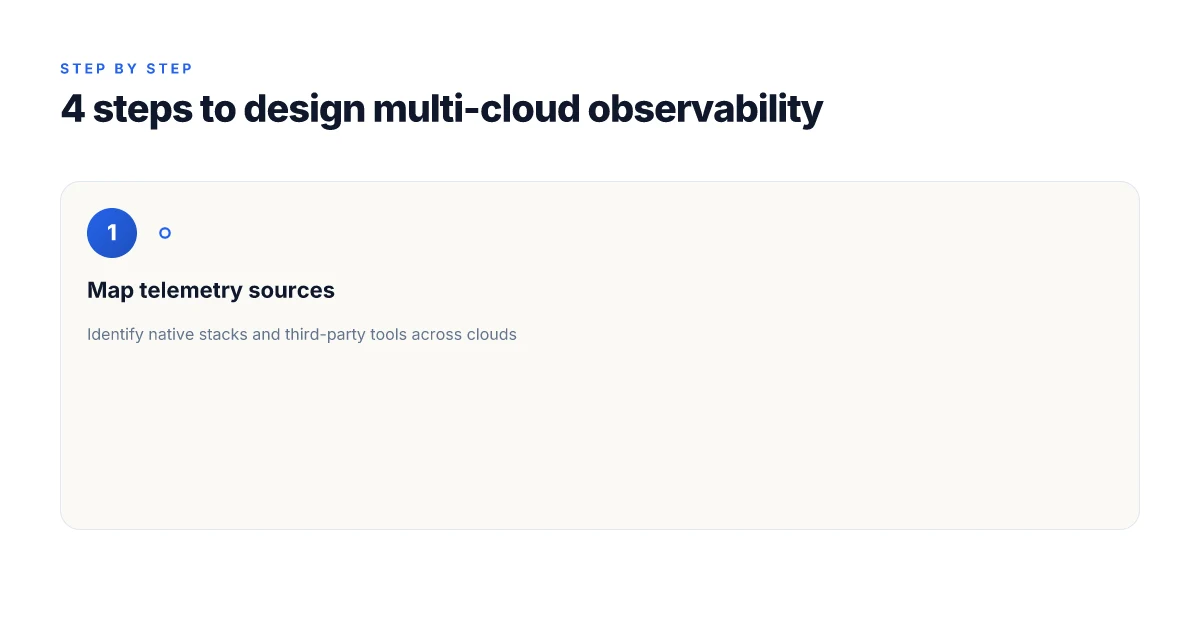
Observability across AWS, Azure, and Google Cloud hinges on native telemetry stacks that each provider ships, complemented by a curated set of third-party tools. In practice, most enterprises lean on a blended stack: cloud-native telemetry for each platform plus a unified view from observability platforms that span multi-cloud workloads. Native logs, traces, and metrics come with each foyer, AWS X-Ray and CloudWatch, Azure Monitor and Application Insights, Google Cloud Operations (formerly Stackdriver), and third-party platforms such as Datadog, New Relic, and Splunk fill gaps in cross-cloud correlation, alerting, and long-term retention. How to rank the top digital KPIs for enterprise performance in 2026
1) Native telemetry stacks and third-party fit
Across the trio, you’ll find core telemetry types available, but the depth and APIs vary. Cloud-native collectors produce metrics, logs, and traces that align with each platform’s governance model. A unified observability layer hides the plumbing, yet it requires careful policy and data routing to ensure consistency. I cross-referenced vendor docs and practitioner commentary to map where a third-party agent can consolidate disparate traces and enrich them with business context. In real deployments, teams standardize on one or two third-party agents for cross-cloud correlation while relying on built-in dashboards for quick platform-specific insights. The result is a two-tier approach: fast, platform-native signals for instantaneous ops, plus a cross-cloud pane for incident response across the stack.
2) Incident response and root cause analysis in multi-cloud
Multi-cloud observability changes how you detect and diagnose issues. Alerts from three different telemetry streams can arrive with different schemas and timings, which often delays incident response if not harmonized. A centralized runbook and a policy-as-code layer help here. Automation can route alerts to the right on-call group, correlate related events across clouds, and trigger remediation playbooks without manual handoffs. The cost of misalignment shows up as longer MTTR and fragmented root-cause trails. When I read through release notes and practitioner notes, the consistent theme is: standardize event schemas, normalize labels, and codify incident-response workflows so every cloud speaks the same language during a crisis.
The key life saver is a shared event taxonomy that maps logs, metrics, and traces to a common set of attributes across AWS, Azure, and Google Cloud.
3) Automation and policy-as-code in platform-native tooling
Automation thrives when you treat observability as code. Each cloud provides policy-as-code mechanisms, AWS Config Rules, Azure Policy, and Google Cloud Config Connector, that help enforce what data is collected, how long it’s retained, and where it’s streamed. Third-party platforms bring additional policy layers, but the governance model has to align with native controls to avoid policy drift. I found overarching guidance that structured automation reduces human error and speeds remediation, as long as you maintain a single source of truth for observability configurations and keep drift monitoring tight. Practically, teams implement a shared repository of monitoring dashboards, alert rules, and data retention policies, versioned and reviewed quarterly.
Policy-as-code and automation are not optional. They’re required for scalable, predictable operations across clouds. Top programming languages in 2026: how ecosystem size shapes industry adoption
From the literature, you’ll notice a common downside: vendor-specific telemetry can complicate cross-cloud dashboards unless you invest in normalization and data-model standardization. This is a recurring theme in analysts’ snapshots of 2026 observability practices. The practical takeaway is to lock in a cross-cloud observability strategy early, adopt a shared event taxonomy, and codify incident-response playbooks as code. And remember, links on the page may earn a commission.
What changes if you act now
Cloud architecture is moving toward tighter cost discipline and stronger security defaults. I looked across the top cloud platforms and found a clear pattern: the choices you make about networking, data placement, and access controls ripple through every workload. A fresh angle this year is how guardrails in governance can cut operational risk without slowing innovation. The bigger pattern is that modular, policy-driven designs scale more predictably while keeping costs in check. This means teams should favor reusable templates, explicit data residency rules, and automated security checks baked into CI/CD. If you only do one thing this month, start mapping the data flow and access paths for your most critical apps.
For this week, try one concrete move: implement a centralized policy engine that enforces least privilege and auto-remediation across at least two cloud environments. In practice, that means codifying roles, rotations, and network boundaries so every deployment inherits a baseline security posture. The single move that matters is tying identity to resource creation via policy as code. You’ll see faster on-ramps for developers and clearer cost visibility.
Backup strategy
- Revisit 1-2 headline platform picks and map a concrete use-case to each: for example, one pick for data analytics with cost-aware storage, another for secure, multi-region SaaS hosting.
- Enable budget alerts tied to project tags and set automated alerts for anomalous egress.
- Draft a one-page runbook for incident response across clouds. Practice it in a quarterly drill.