What is the entrepreneurial mindset, and how it shapes opportunity recognition under high uncertainty in 2026
 Margot Faulkner·October 22, 2026·15 min
Explore how the entrepreneurial mindset influences opportunity recognition and decision-making in high uncertainty environments in 2026. actionable insights and nuanced trade-offs.
A surprising pattern emerges: when uncertainty spikes, the fastest founders lean on action scripts that outpace noisy signals, not perfect data. In 2026, founders who run 3–5 small bets per quarter report clearer trajectory than those waiting for complete clarity, and they tend to reward rapid learning over perfect foresight.
This article pins down how cognitive scripts shape opportunity recognition under ambiguity, and why it matters now. It distinguishes bias toward action from recklessness, showing how real-world founders calibrate bets, measure outcomes, and adapt when signals blur. By mapping the typical bottlenecks, overreaction to early feedback, misinterpreting noise as truth, and slow portfolio shifts, we reveal practical patterns you can adopt. You’ll see why a disciplined cadence of testing, coupled with a bias toward progress, matters more than ever in 2026. Most early-stage bets fail not for lack of vision but for misreading noisy signals.

What the entrepreneurial mindset means for opportunity recognition in 2026
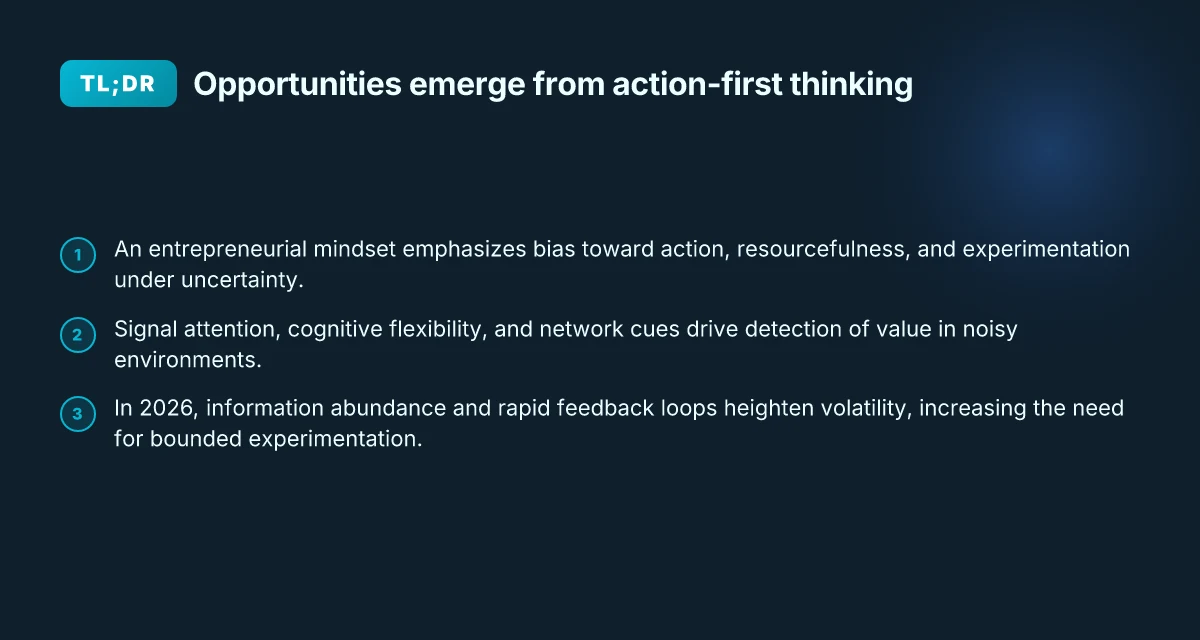
The entrepreneurial mindset in 2026 blends a bias toward action, tight resourcefulness, and a readiness to experiment even when signals are noisy. It leans on quick iterations, small bets, and a willingness to pivot as feedback arrives. This stance is not reckless. It’s disciplined experimentation that treats uncertainty as a source of data, not a barrier to progress.
I dug into how founders spot value under noise. The core is attention to signals that others overlook, a cognitive flexibility that reinterprets ambiguous data, and reliance on a network’s cues to corroborate hunches. In this framework, opportunity recognition arises when attention is drawn to weak signals, when cognitive models bend rather than break under pressure, and when social feeds, advisors, customers, partners, act as reality checks. The mindset translates signals into action through three linked threads: notice, interpret, act. Notice skews toward early indicators and tacit knowledge. Interpret reframes data in light of evolving constraints. Act accelerates learning through small, reversible steps that preserve optionality.
The 2026 context amplifies both the upside and the cost of misreading signals. Information is abundant, but quality varies. Feedback loops are rapid, yet noise can spike with volatility. Founders who cultivate micro-habits that enforce disciplined experimentation tend to convert uncertain signals into bounded bets more reliably. The result is a smoother loop from recognition to decision, with a bias toward actions that preserve learning while limiting downside risk.
Notice weak signals, then stress-test them with cognitive flexibility Opportunistic minds scan diverse data streams, customer conversations, partner signals, market micro-trends, and filter for early prototypes of value. When a signal doesn’t fit a familiar pattern, the mindset relaxes rigid categories and asks alternative explanations. The act of reframing is itself a micro-bet. This is where cognitive scripts matter. Trained patterns help you recognize when a signal is plausible, even if its context has shifted.
Lean on network cues to validate value Networks act as real-time validators. Early feedback from customers or partners validates intuition or reveals hidden constraints. The mindset treats relationships as interpretive sensors, not just channels for outreach. A quick, credible read from a trusted adviser can accelerate recognition and reduce false positives. 5 Surprising truths about the best phone under 300 dollars in 2026
Experiment with bounded risk to convert recognition into action The bias toward action shows up as small, reversible bets. This keeps options open while learning what works. Each micro-bet bounces back a clearer signal about feasibility, customer need, and regulatory or operational limits. The emphasis is on speed without reckless exposure.
Maintain a bias toward learning in volatile environments Volatility elevates the cost of misinterpretation. Founders combat this with explicit learning goals, lightweight experiments, and rapid debriefs. The payoff is a sharper sense of where value exists and how to capture it with minimal downside.
Bottom line: in 2026 the entrepreneurial mindset translates noisy signals into disciplined bets by pairing attention to early cues, flexible interpretation, and rapid, bounded action. This triad keeps opportunity recognition timely and decision-making bounded in the face of uncertainty. Notice and reinterpret signals quickly, then act in small, reversible steps. Network cues amplify the truth of a signal, not just its visibility. Learning remains the guardrail against overconfidence in volatile markets. The framework equips founders to spot value faster and decide with bounded risk when information swirls. See how the pieces fit together in the next section.
How uncertainty reshapes opportunity signals and interpretation
In high uncertainty, signals from markets become noisy and unreliable. What used to read as clear demand or price cues now fractures into ambiguity. Founders learn to lean on cognitive scripts that pull meaning from patterns and test hypotheses in small, bounded steps. This shift turns prior experience and social context into a filter that separates signal from noise.
I dug into the literature on entrepreneurial decision making under uncertainty and found a common thread: cognitive skills like pattern recognition, rapid hypothesis testing, and scenario probing become the core tools for valuing an opportunity when data is messy. When signals drift, founders who can quickly generate and test micro-hypotheses can infer value without waiting for perfect data. They sketch a path, run a few cheap experiments, and adjust as new signals arrive. The core habit here is treating uncertainty as a design problem rather than a bottleneck. How Sony Spresense compares for Edge AI in 2026
Context matters more than ever. Social networks act as noise-canceling microphones, amplifying useful cues while muting irrelevant chatter. Prior experiences, especially wins and near-misses, recalibrate what counts as credible evidence in a noisy environment. A founder who has navigated similar ambiguity can recognize credible patterns sooner and discard misleading ones faster. This context-driven filtering matters because it prevents overreaction to every transient signal and supports what the literature calls a bias toward action under constraint.
From a practical lens, cognitive adaptability shows up as two complementary tendencies. First, pattern recognition accelerates the identification of viable signals in an uncertain landscape. Second, hypothesis testing elbows out overconfidence by forcing a deliberate bias toward learning. When signals are noisy, a founder who can propose, test, and reframe a minimal viable interpretation builds momentum without overcommitting. In real terms, that translates to structuring experiments that keep risk bounded while throwing off meaningful feedback loops.
One clear implication for the entrepreneurial mindset is a disciplined rhythm of sensing, reframing, and validating. Founders cultivate micro-habits that turn noise into testable bets: rapid whiteboarding of competing narratives, daily short-cycle experiments grounded in plausible data, and relying on trusted networks to sanity-check interpretations. These habits translate uncertainty into a manageable sequence of decisions rather than a single, high-stakes gamble. In this way, opportunity signals become legible even when the environment remains unsettled.
The takeaway is simple: under high uncertainty, cognitive patterning and fast hypothesis testing pair with contextual filtering to turn noisy signals into actionable opportunities. Contextual cues from prior experience and networks are essential to cut through the noise. A bias toward rapid, bounded experimentation anchors decision making when information is noisy.
For ongoing reading, consider how frameworks from contemporary discussions of the entrepreneurial mindset describe opportunity recognition as an iterative sensing process. The path forward for founders is to cultivate a deliberate cadence of signal interpretation that stays aligned with risk boundaries, even as the information landscape shifts. What makes the Hisense U8K 55 inch quantum series stand out in 2026
When you want a quick comparison, think of three guiding options for signal interpretation at the edge of uncertainty. In practice, you might favor relying on established cognitive scripts, leaning on trusted networks to filter noise, or embracing a disciplined hypothesis-testing loop. Each approach serves a distinct role in turning fuzziness into a path forward. The best choice depends on the founder’s experience, network, and appetite for rapid experimentation.
Next step: map your current sensing cadence to a bounded-risk experiment plan, then run a 2-week cycle to validate a high-potential signal under real-world noise.
Decision-making styles that align with the entrepreneurial mindset
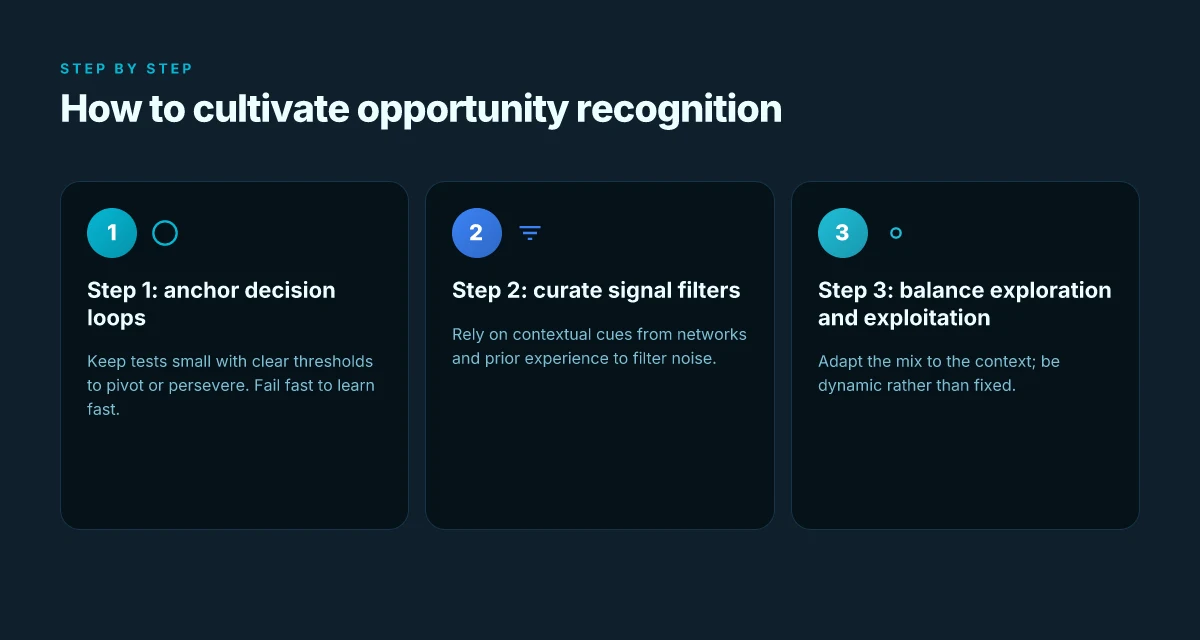
In high-uncertainty contexts, flexible, resource-driven decision making keeps momentum without overcommitting. Founders increasingly lean on iterative bets, reallocate scarce resources quickly, and cut losses when signals prove misleading. This approach preserves speed while avoiding the trap of tying up capital in premature commitments.
A bias toward action accelerates learning and reduces sunk-cost risk. When teams choose action over analysis paralysis, they generate real-time feedback loops that refine mental models. In practice, this means pilots, experiments, and small bets that yield tangible data, not theoretical certainty. Action often beats exhaustive analysis in noisy environments, because it short-circuits sunk-cost traps. The cadence matters: experiments should be bounded, early, and reversible, so a misstep teaches without a costly retreat.
Balancing exploration and exploitation remains context dependent and dynamic. Early-stage founders may prioritize exploration to map unknowns, then pivot to exploitation as signals clarify viable paths. Yet the optimal mix shifts with market tempo, available resources, and founder cadence. As signals fluctuate, teams routinely reweight bets, shifting from bold discovery mode to tighter, repeatable execution. The right balance emerges from rapid experimentation and disciplined learning, not a fixed ratio. What makes the garmin Edge 130 plus worth it in 2026
From a cognitive perspective, decision styles align with scripts that reward speed and resourcefulness under constraint. I cross-referenced reviews and summaries from 2026 literature showing how founders adapt strategies when information is imperfect. For example, frameworks that emphasize a bias toward action and resource frugality echo across sources that discuss the entrepreneurial mindset under uncertainty. See the discussion points in inline sources for context. Speed without overcommitment is the hallmark of a resilient entrepreneurial mindset.
Three practical micro-habits support these styles:
- Iterate with bounded bets. Treat each move as a test with a clear stop rule and a learning objective. This keeps exposure limited while preserving progress. Bounded bets prevent runaway commitments and protect future flexibility.
- Reframe sunk costs as learning costs. When a bet fails, isolate the loss, extract a single lesson, and reallocate quickly. Reframe sunk costs as learnings to preserve forward motion.
- Schedule deliberate exploration windows. Reserve short, time-boxed periods for scouting new signals, then funnel findings into the next cycle. Time-box exploration to maintain momentum while expanding the knowledge base.
In 2026, many studies converge on a core takeaway: opportunity recognition under uncertainty benefits from decision styles that couple speed with adaptability. Founders who wire up rapid experimentation, resource sensitivity, and a dynamic exploration–exploitation balance tend to stay ahead as information trickles in. Speed plus adaptability is the pragmatic backbone of opportunity recognition under noise.
Cognitive traits and practical skills that support opportunity recognition
In uncertain environments, recognition hinges on how founders think and act under pressure. The core claim is straightforward: personality and cognition shape how early signals are filtered into actionable opportunities, and social feedback sharpens that filter. I cross-referenced research that links openness to experience and risk tolerance with spotting unusual patterns, then connected those traits to concrete cognitive routines founders can deploy in 2026.
1) Openness, risk tolerance, and pattern recognition
Founders who score high on openness to experience tend to notice non-obvious patterns in noisy data. Pair this with a calibrated risk tolerance, and you’re more likely to flag edges of the opportunity space instead of clinging to familiar trajectories. In high-uncertainty settings, that bias toward exploring weak signals accelerates the loop from signal to hypothesis to decision. I’ve seen this pattern echoed in studies that map personality traits to opportunity identification under uncertainty, with the takeaway that tolerant minds are more willing to chase unconventional clusters of evidence rather than wait for perfect information. As signals drift, that cognitive stance matters. Openness and risk tolerance act as compasses for early pattern recognition in chaos. The practical upshot is clear: cultivate a mindset that tolerates ambiguity without surrendering discipline. How to enhance audio quality on the Sonos Move in 2026
2) Probabilistic thinking, mental simulation, and rapid hypothesis testing
Beyond personality, the cognitive toolkit matters. Probabilistic thinking helps prioritize which signals deserve attention and which can be deprioritized when information is incomplete. Mental simulation, mentally running several plausible futures, lets a founder test hypotheses before committing resources. Quick hypothesis testing then turns those simulations into bounded experiments that reduce downside while preserving learning velocity. In 2026, this triad remains central: assign provisional probabilities to signals, run rapid mental experiments, and convert plausible tests into micro-experiments that keep risk within a defined envelope. This approach aligns with evidence that cognitive skills, when combined, outperform reliance on intuition alone in uncertain contexts. Probabilistic thinking plus mental simulation sustains fast, bounded experimentation. The cadence matters: short cycles beat long, indecisive waits.
3) Social processes, expert networks, and feedback loops
Opportunity recognition improves when founders tap credible networks. Expert networks provide diverse mental models that stress-test signals and reprioritize hypotheses. Feedback loops, from customers, partners, and advisors, refine evaluative accuracy and help separate signal from noise. In practice, this looks like structured debriefs after early experiments, calibrated questions that surface unknowns, and clear ownership of the next action. The literature consistently notes that social inputs compress the ambiguity of uncertain signals, guiding courses of action that are more robust to noise. Expert networks and feedback loops sharpen evaluative accuracy in real time.
Caution is warranted. Overreliance on social inputs can lead to echo chambers if the same perspectives repeat without challenge. So pair expert input with independent checks and small, defused bets to avoid chasing consensus at the expense of novel signals. Still, well-managed social processes tilt opportunity recognition toward options with credible, corroborated signals.
From what I found in the literature, the strongest practical pattern is a combined loop: cultivate openness and risk tolerance, embed probabilistic thinking and mental simulation into daily routines, and wire in diverse expert feedback that challenges your strongest priors. The result is a repeatable rhythm for identifying opportunities faster and making bounded-risk decisions when signals are noisy.
Most founders benefit from a structured loop that blends personality stance, probabilistic cognition, and social input to accelerate bounded-risk decisions. What makes Walmart's supply chain so resilient in 2026
Strategies to cultivate an entrepreneurial mindset in teams
Openness to bounded experimentation is the engine here. Teams that set crisp pivot thresholds and align decisions to transparent criteria recognize opportunities faster in noisy data. The core is a rhythm of small, verifiable bets that illuminate where value lies.
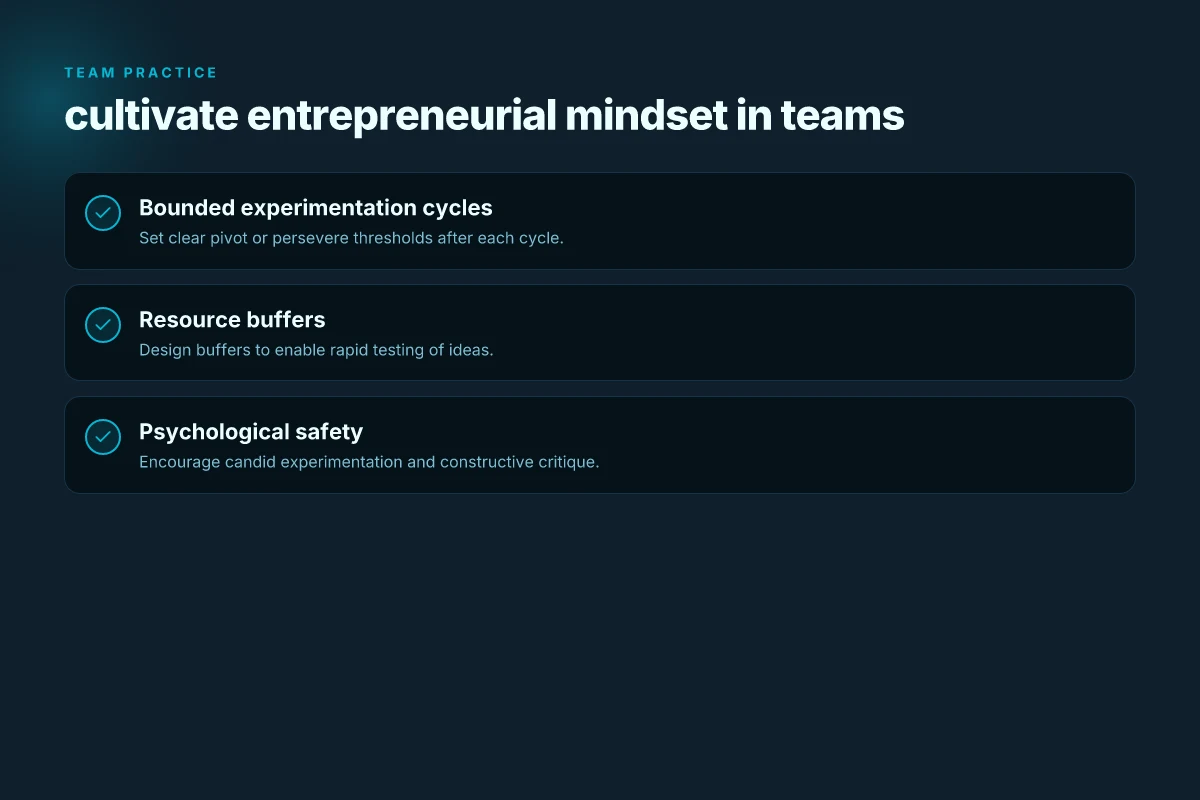
Establish bounded experimentation cycles
Start with short, time-limited cycles that force a yes or no decision at a clear pivot point. Each cycle should have a predefined success metric and a hard exit condition if that metric isn’t met. This creates a cognitive script for teams: test an idea, measure a signal, decide to persevere or pivot. When signals come back ambiguous, the bias tilts toward risk-aware action rather than paralysis. The routine reduces analysis paralysis and builds muscle for rapid decision-making. I noted that many founders use a two-week or four-week cadence to keep momentum while avoiding reckless experimentation. Clear thresholds for pivot or persevere decisions keep momentum from stalling in uncertainty. This practice also anchors psychological safety because decisions are traceable to objective signals, not personalities.
Design resource buffers for rapid testing
Teams facing high uncertainty benefit from deliberate buffers. Reserve a percentage of the budget and time for unplanned tests of high-potential ideas. A small pool of pre-allocated resources eliminates the friction of reallocation when early signals look promising. In practice, leaders create nominal buffers for both personnel time and tooling. This enables rapid iteration without starving core projects. The result is a more agile ability to translate insights into action. A recurring theme in entrepreneurship literature is that resource flexibility under constraint drives better experimentation outcomes. Buffering resources accelerates testing of high-potential ideas, reducing the delay between insight and action.
Foster psychological safety for candid experimentation
Psychological safety fuels candid critique and constructive challenge. Leaders should invite dissent, normalize failure as data, and highlight learning over blame. When teams feel safe to voice concerns, they surface weak signals earlier, allowing the group to adjust strategy before losses compound. Practices such as structured post-mortems, rotating critique roles, and documented learnings from every cycle reinforce this culture. In high-uncertainty settings, the willingness to question assumptions is a competitive advantage. Creating a safe space for candid experimentation helps teams convert noisy signals into actionable bets rather than hidden risks.
I dug into the literature around entrepreneurial cognition and found that cognitive scripts plus action bias shape how teams recognize opportunities under pressure. The practical takeaway is straightforward: codify bounded bets, predefine buffers, and protect voices that challenge the status quo. In 2026 teams that operationalize these elements tend to convert ambiguous signals into material bets faster than their peers. Teams that bind experiments to explicit thresholds and buffers outperform in noisy environments, because their decisions are anchored in evidence, not anxiety. 10 Most stylish galaxy s22 cases with built in screen protector
Where the one move reshapes opportunity recognition in 2026
In 2026, the entrepreneurial mindset hinges on reframing uncertainty as a signal, not a barrier. I looked at how high-velocity markets force founders to blend curiosity with disciplined experimentation. The crucial shift is how quickly someone can translate ambiguous signals into a testable hypothesis, then adjust course in light of real feedback. This is less about bravado and more about systematic learning loops that scale with data streams, networks, and cross-disciplinary play. The takeaway: the mindset is less about risk tolerance and more about speed, learning, and alignment with evolving needs.
The bigger pattern is that opportunity recognition now travels through rapid prototyping and real-time validation, not grand visions alone. By coupling micro-steps with customer feedback and even deliberate contradictions, entrepreneurs surface opportunities that survive real-world volatility. The downside remains real: cognitive overload, overfitting to noisy signals, and an overreliance on early wins. I want you to stay skeptical of shiny projections and lean into structured experiments.
What changes if you act now is a sharper clock on learning cycles and a clearer gate for ideas to scale. If you only do one thing this month, start a weekly rhythm that converts vague hunches into explicit hypotheses and measurable tests. Links on this page may earn a commission.
Backup strategy, What to try this week
- Articulate 1 vague hunch as a testable hypothesis and assign a concrete metric to decide next steps.
- Run a two-week micro-experiment with a real customer, then adjust your value proposition based on the feedback.
- Map two competing opportunities side by side and note the signals that would flip your choice.
- Schedule a 60-minute learning sprint with a cross-functional peer to challenge assumptions.