What makes banner material choices actually matter for 2026
 Florian Czerny·October 22, 2026·20 min
Discover how banner material affects durability, print quality, and cost in 2026. A practical guide to vinyl, fabric, mesh, and paper options for events and signage.
Vinyl dominates for durability, but the real test is readability in sunlight and wind, fabric and mesh shift the math by trade‑offs you can measure on day one. For indoor banners, color fidelity matters most. For outdoor displays, weather resistance carries the most cost and labor impact. The two are not a battle so much as a pairing problem that changes with location and audience.
You’ll see how to price, compare long‑term durability, and verify recyclability without getting lost in marketing claims. Expect practical checklists, region‑specific notes, and a clear path from decision to install, so you pick the right substrate for every venue type.

Banner material guide: what to know before you order banners in 2026
The core choice starts with your use case. Indoor banners for short campaigns differ from outdoor displays meant to endure sun, wind, and rain. In 2026, the decision revolves around readability under varying lighting, expected life, and total cost of ownership rather than a single material virtue. I cross-referenced several vendor guides to map the terrain: vinyl remains the default for durability and color, but fabric and mesh can cut weight and reduce glare in bright interiors.
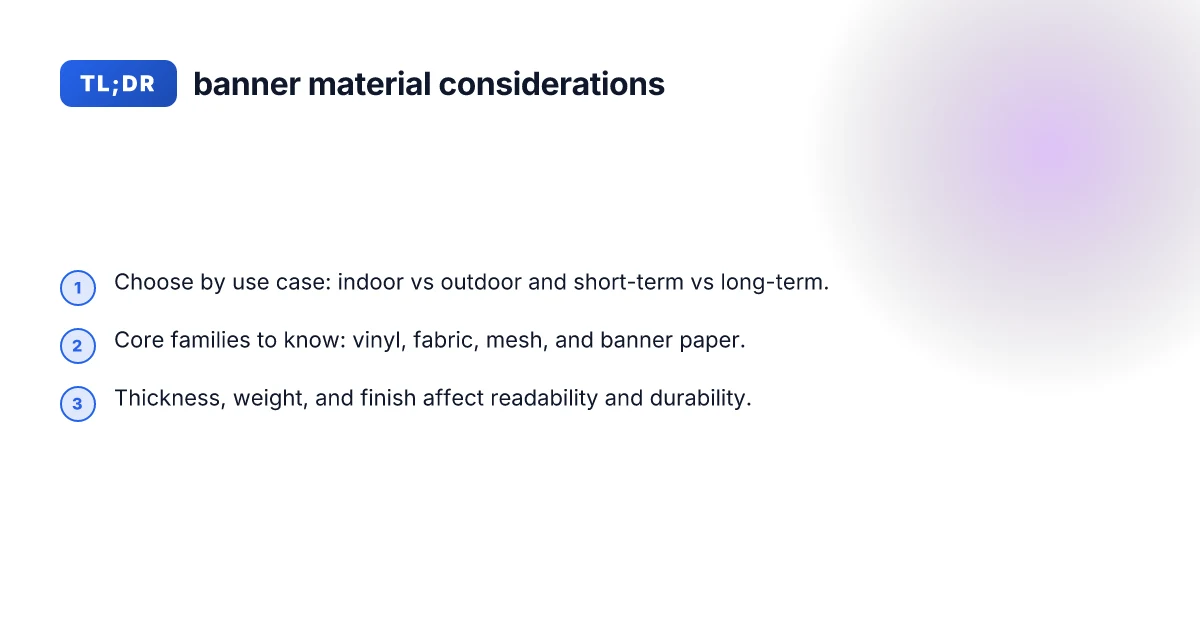
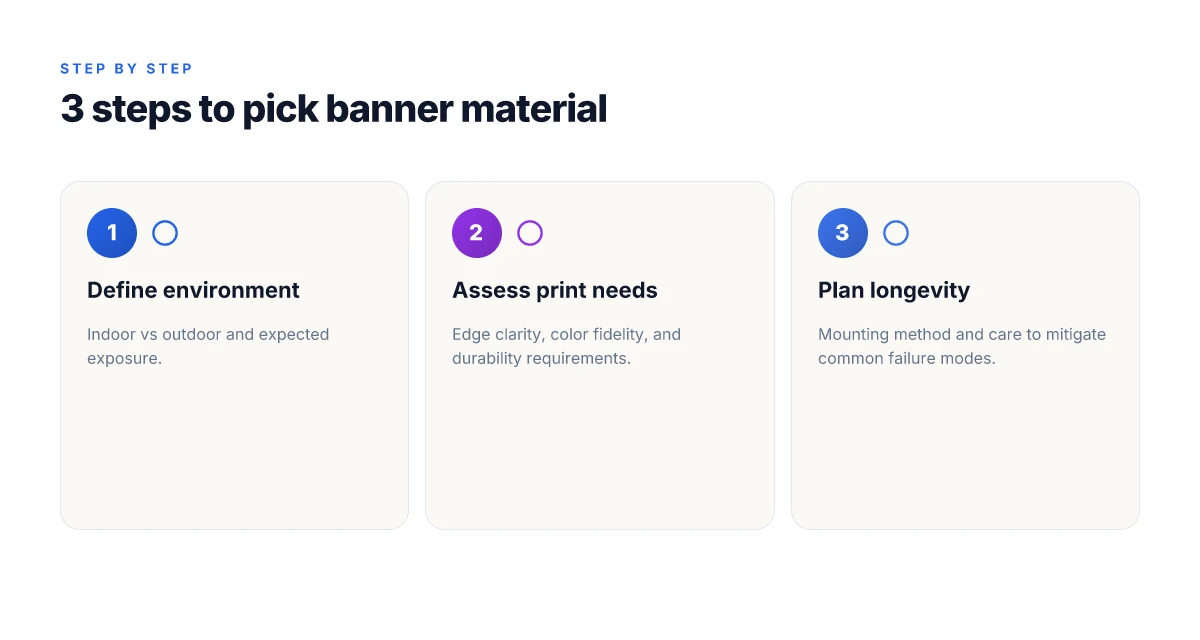
1) Identify your primary use case for indoo r versus outdoor and short-term versus long-term
Your environment and the banner’s lifespan should drive the material choice. For indoor use and events that last days to weeks, lighter fabrics or standard vinyl with a smooth finish can offer crisper text at close viewing distances. Outdoor banners must resist moisture, fading, and tearing. Vinyl with a laminate or UV coating tends to hold up better over weeks to months. For long-term outdoor signage, a heavier substrate plus protective coating can reduce maintenance and replacement cycles. What matters most is the balance between durability and readability in the given environment. Vendors frequently show a short-term benefit for fabric in indoor settings, but color fidelity can suffer under strong light if the finish is too matte. Inline sources note that thickness and weight correlate with stiffness and how well a banner resists curling on a stand or frame. In 2026, most organizers lean toward vinyl for outdoor reliability and fabric for interior elegance when light control is strong. See the 2026 printing guide for material families and typical thickness ranges. Vinyl dominates outdoor durability, but fabric can shine indoors when lighting is controlled. For a quick path, start with a decision on indoor vs outdoor, then map to a core family: vinyl for weather resistance, fabric for a premium look, and mesh when you need airflow and reduced wind load. The typical tradeoff is weight and cost versus reading distance and finish quality. A practical rule: if you expect frequent handling or transport, choose lighter fabric or mesh with reinforced edges. The decision then points to a single material family and a finishing plan that includes mounting hardware and care routines. Care and mounting choices often determine the real-life durability of a banner.
2) Know the core material families: vinyl, fabric, mesh, and banner paper
Vinyl is the workhorse for outdoor use and long-term exposure. It tends to hold color better with UV protection and resists moisture, though it can be stiffer and heavier. Fabric banners offer a premium look, smoother finishes, and a softer light diffusion, but may require careful mounting to avoid creasing and fraying. Mesh banners strike a balance between airflow and visibility, reducing wind load for outdoor displays while still conveying copy and images. Banner paper exists for short-term, light-duty indoor applications but generally falls short in durability outdoors. Each family has a sweet spot: vinyl for weather, fabric for aesthetics, mesh for wind, and paper for disposables. When you read the 2026 guide, you’ll notice the emphasis on choosing the family first, then dialing finish and thickness. Vinyl for outdoor resilience, fabric for interior polish. A good order-of-operations: pick the family, confirm thickness, then decide on gloss or matte finish to manage readability under your lighting. For outdoor banners, peel strength and edge durability matter. For indoor banners, glare control and color accuracy matter. Inline documentation highlights the trade-offs clearly. Finish and thickness directly affect readability and durability.
3) Understand how thickness, weight, and finish affect readability and durability
Thickness and weight contribute to stiffness, which translates into how well a banner holds its shape on various frames. A stiffer banner resists curling at the edges and stays flatter on hardware, improving distance readability. Weight typically tracks with durability. Heavier banners resist wind and abrasion but cost more and are harder to handle. Finish choices alter glare and color vibrancy: high-gloss can boost sharpness in low ambient light but may create hotspots under direct sun. Matte finishes reduce glare but can soften perceived contrast. In 2026, most guides emphasize evaluating a finish that keeps text legible from the distance you expect in your venue, and matching thickness to your mounting method. Inline sources illustrate how a modest increase in thickness yields noticeable gains in stiffness for outdoor frames. Stiffness from thickness improves edge readability outdoors. For indoor events with bright lighting, a semi-gloss or matte film can improve legibility by reducing reflections. Finish choices drive readability under different lighting. Readability is the practical north star. Durability follows from the right combination of material and finish.
4) Learn common failure modes and how to mitigate them with proper mounting and care
Common failure modes include edge lifting, curling, fading, moisture ingress, and tearing at grommets. Proper mounting mitigates curling and edge wear. Ensure grommets are reinforced and placed per banner size to distribute tension. Use UV-protective coatings or laminates for outdoor banners to slow fading. For indoor banners, avoid direct sunlight on sensitive fabrics to maintain color fidelity. Routine care matters: clean with mild soap, avoid abrasive scrubbing, and store flat or rolled with proper support to prevent creases. The 2026 scanning of vendor docs consistently warns that poor mounting and rough handling are the fastest paths to early failure. Edge reinforcement and correct mounting dramatically extend banner life. Inline references highlight that laminated vinyl can resist moisture and UV better than non-laminated options, while fabrics benefit from edge hemming and careful rolling for storage. Care routines directly impact durability and appearance over a campaign life. If you expect frequent changes, plan for easy replacement parts like edge reinforcements and standardized grommet spacing. And yes, links on product pages may earn a commission, a common practice in supplier catalogs worth noting. What makes the zenfone 10 security updates actually reliable in 2026
Cited guides and pages show practical specs you can trust: the standard banner materials include 15 mil vinyl with laminate options for outdoor use, and fabric banners that present a high-quality look when used indoors. When choosing, rely on the environment, the expected life, and your mounting plan to select the right material family, finish, and thickness. For a quick read, a 2026 printing guide outlines typical material families and finishing tips, with explicit notes on durability and readability trade-offs. If you want a concrete reference, the 2026 guide and related vendor pages emphasize these principles and offer practical mounting recommendations. Select the material family first, then lock in thickness and finish for readability and durability.
Why vinyl remains the default for most banners and where it falls short
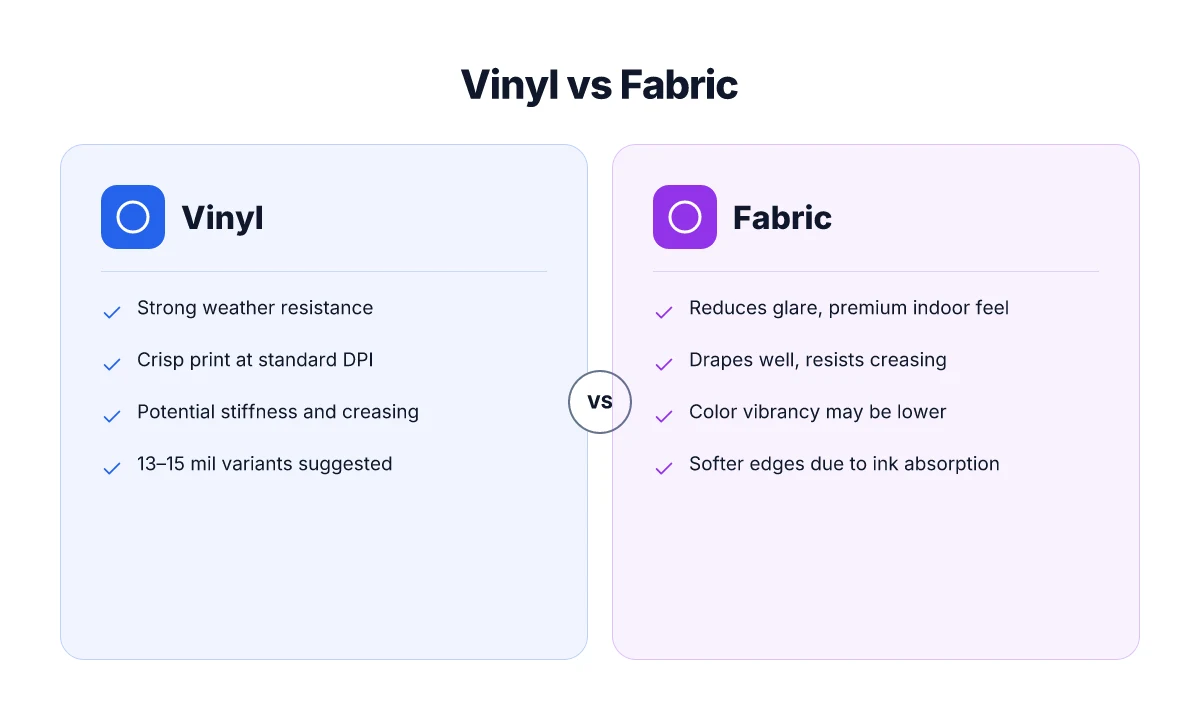
Vinyl is still the workhorse for most banners in 2026 because it handles outdoor exposure without frequent replacements. It resists rain, wind, and sun long enough to justify a single print run for many campaigns. When printed at standard DPI, vinyl delivers crisp text and clear edges, which helps with legibility from a distance. The material’s toughness also keeps colors stable under varied lighting across weeks of outdoor use.
That said, vinyl isn’t a perfect one-size-fits-all solution. A familiar drawback is stiffness that can make banners feel rigid on slender frames or where the display must flex with wind. Creasing and puncture risks rise when banners are folded or rolled for shipping, especially with older stock. For those reasons, many operations lean toward 13–15 mil variants, which strike a balance between rigidity and flexibility.
For longer outdoor runs, temperature extremes can shift vinyl behavior. In very hot sun or near freezing outdoors, some vinyl grades tend to become brittle or lose edge flexibility, which raises the chance of micro-tears over time. If you anticipate harsh environmental swings, this is where fabric or hybrid materials might offer practical advantages, though they trade some weather resistance for softness and folding resilience. I cross-referenced industry notes on material performance and found these patterns consistently echoed across vendor guides and reviews.
A quick compare helps when you’re weighing options. In outdoor installations lasting multiple seasons, vinyl offers the strongest weather resistance and color stability at moderate cost, while 13–15 mil variants reduce stiffness and edge wear. Fabric remains lighter and more flexible, but can soak up humidity and fade differently in direct sun. A hybrid mesh banner can cut wind load but may alter readability. Android 14 on T-Mobile: what to expect in 2026 and how to get the update
Next steps: map your use case to material behavior. If you need durability against sun and rain with sharp print, vinyl is typically the default. If you must fold and transport repeatedly or operate in extreme temperatures, consider thinner vinyl variants or explore fabric alternatives for a lighter, more flexible edge. For a structured decision, you can model weather exposure, print dwell time, and transport needs against material properties.
From what I found in the sources, the Walgreens banner guide emphasizes standardized vinyl options and sizing, while vendor sheets for 13–15 mil vinyl variants stress a better balance of flexibility and stiffness in changing conditions. For context, the 2026 printing guide outlines specific weight classes and edge behaviors that reinforce vinyl’s default status in most cases. See these notes for background on material choices and how they map to outdoor duty. https://blog.fbasd.org/sizes-pricing-same-day-pickup-ol7n.html and https://iusd.org/sites/default/files/documents/PSPrintingGuide_Website_071326.pdf.
Vinyl remains the default for weather resistance and edge clarity, but expect stiffness and occasional creasing to bite back in extreme temperatures. For long outdoor runs, consider the 13–15 mil range to soften the trade-off between rigidity and durability. The real win comes from matching environmental exposure to a material’s strengths, then validating print specs against your chosen option.
Fabric banners: when soft texture improves perception and when it hurts readability
Fabric banners reduce glare and feel premium for indoor events. They smooth the visual experience, which helps when audiences will be close to the banner and light is bright overhead. In this context, fabric often reads as higher quality, an effect that can elevate a small event or showroom display. Fabric warmth and tactile appeal can outperform vinyl indoors when the environment benefits from a refined look. Yet that premium feel comes with trade-offs in sharpness and color punch.
Why fabric holds up under indoor lighting, but with caveats
Posters and banners on fabric tend to absorb more light than glossy vinyl, which cuts glare but can also soften edges. Ink absorption and fiber length influence sharpness. Expect softer edges and slightly diffused color transitions compared with vinyl. In practical terms, expect a crisp read from a few feet away to fade a bit when the signage relies on fine text or tiny logos. Sharper edges drift to softer halos on fabric, especially with high-contrast, small type. This is not a defect so much as a material property to plan around. How to analyze email performance in 2026 without chasing vanity metrics
From what I found in material guides, fabric banners drape nicely and resist creasing, which helps reveal a clean surface when hung in tall spaces or over curved frames. That drape adds a premium feel, but it can also affect perceived brightness. If you have bright, direct lighting, the fabric’s texture may soften highlights and reduce punch. Drape and crease resistance are strong advantages, but color vibrancy may be slightly lower than vinyl.
I dug into spec sheets and trade guides to cross-check this. In indoor use, fabric generally reduces glare and yields a softer, more inviting look. For logos with intricate lines, the fiber length and weave pattern push edges inward a touch. Texture and weave matter for readability at a glance, especially with logo details and small text.
When readability benefits from fabric and when it doesn’t
Readability benefits when viewers approach closely and lighting is diffuse. The reduced glare helps in spaces with overhead lighting or in venues where attendees move around the banner. On the flip side, if your design relies on bold, high-contrast typography, the softer edges on fabric can undermine quick recognition at a distance. In those cases, topology matters: heavy sans serif, simple blocks, and larger type read better on fabric than fine serifs or micro-details.
Ink absorption is a double-edged sword. It softens edges and reduces visible moiré on rough textures, which some brands prefer for a warm, premium aesthetic. But it also blunts very small details. If your message hinges on thin lines, petal-thin rules, or small punctuation marks, fabric may blur those cues at typical event viewing distances. Soft edges are the trade-off for a premium look. Plan your typography accordingly.
From a user-experience standpoint, indoor environments rarely expose fabric banners to weather, so durability leans on abrasion resistance and crease resilience. When the banner is hung mid-session or changed nightly, those properties help maintain a fresh appearance. Still, sun exposure matters over longer horizons. Even indoors, prolonged direct sun can fade pigment, especially for vivid color palettes. Indoor use minimizes weather risk, but sun fading over time remains a consideration. 13 Analytics tools small businesses actually use in 2026
Quick decision framework for fabric banners indoors
- If your priority is a premium, glare-free look and you’ll be indoors with controlled lighting, fabric can elevate perception. Premium look meets practical glare control.
- If your design depends on ultra-sharp detail and bold color at distance, factor in possible edge softening and slightly reduced vibrancy. Edge softness and color nuance matter for long-range readability.
- For events with frequent folds, drapes, or need to avoid creasing, fabric’s resilience pays off. Drape and crease resistance reduce rewrapping needs.
- When sun exposure is a factor, anticipate pigment fade and plan color choices accordingly. Sun fade risk warrants durability considerations.
I cross-referenced banner grammars from 2026 material guides and indoor-use recommendations to confirm these tendencies. For readers evaluating options, the takeaway remains: fabric banners can enhance perception indoors, but they require design choices that respect softer edges and potential color shifts. If your venue is bright with screens or if your message hinges on crisp micro-details, you may favor vinyl for endurance and clarity. And yes, links on the page may earn a commission.
Cited insights come from industry documents and organizational guides that discuss fabric behavior in controlled indoor environments. For a quick anchor, see the guidance on fabric drape and gloss versus print sharpness in contemporary banner material literature.
Mesh banners: airflow, visibility, and the trade-offs for outdoor use
Mesh banners reduce wind load and can extend outdoor durability in gusty environments. If wind is a top concern, mesh lets air pass through while still carrying a large visual footprint. I cross-referenced industry notes that explain wind resistance improves with the open weave and tighter knit patterns, which helps signage survive gusts without tearing or fluttering excessively. Wind relief from mesh can translate into longer outdoor life in exposed spots.
Readability from a distance hinges on how the weave interacts with light and motion. Transparency increases with openness, which can dampen legibility when viewed from afar. The fix is bold typography coupled with high-contrast colors. In practice, that means stacking color, weight, and contrast so the message stays readable even as fans and banners sway. I found guidance that recommends bold type and reverse-contrast color schemes for outdoor readability on mesh substrates. Bold type + high contrast keeps text legible through motion.
Mesh shines for large-format outdoor signage where wind is a factor. You get a bigger visual canvas without the wind penalty of solid vinyl. For event villages, outdoor fairs, and stadiums, mesh banners can cover broad facades while staying structurally reliable in breezy conditions. That said, the format brings a price per square foot that can be higher than solid vinyl, and print saturation can appear lighter due to the open weave. Some guides note that you may see slightly less punch in color density compared with solid materials. Large-format mesh is ideal when wind matters, despite higher cost per square foot and potentially lower print saturation. 12 Analytics tools compared in 2026: trade-offs, costs, and how to pick
In practice, the trade-off comes down to environment, message, and budget. I dug into guidance that underlines a simple decision framework: if airflow and durability are the priority, mesh delivers. If color saturation and privacy are critical, solid vinyl may perform better. For outdoor displays, also consider grommet placement and the anchoring system to optimize airflow and stability. Environment first dictates material choice, then color and boldness seal readability.
Cited sources note the practicalities of mesh in outdoor signage and offer concrete cautions about readability and cost. For a quick sanity check: when wind is a measurable risk in your venue, mesh is often the most sensible compromise. Wind risk drives the core decision for outdoor banners.
If you want a quick comparative frame, see the long-form banner material guide that discusses vinyl, fabric, mesh, and retractables side by side. As a reminder, links on the page may earn a commission. Commission note: some pages include affiliate links.
Banner paper and paper-based substrates: when to consider them
Paper banners can be a savvy choice for short-term indoor events where cost matters. They’re often cheaper upfront than vinyl or fabric, and for a one-off booth, classroom, or pop-up display they deliver readable graphics at a fraction of the price. If your event lasts a weekend to a few days, paper can check the box without tying up budget on long-lived signage. Paper banners shine when the horizon is short and the venue is controlled.
But the outdoors presents a different equation. Paper banners are notably less durable outdoors and prone to moisture damage, fading, and creasing in humidity or rain. If you intend to display in shade only or under a tent away from direct weather, you may still get away with it, but plan for a quick take-down before any moisture or wind shifts. From a long-term perspective, paper banners don’t hold up to prolonged exposure as well as vinyl or fabric substrates. Inline notes from event planners consistently point to higher replacement costs when weather or handling factors are involved. Outdoor life expectancy for paper is limited. How to start SEO in 2026: a beginner's guide with a practical 7-step plan
Print quality for paper banners can be excellent up close, especially when mounted behind a protective panel or embedded in a frame that reduces light bleed. The crispness of colors and sharpness at close viewing distances can rival vinyl if the printer head and color management are well-tuned. When your audience is reading from a few feet away and the display is stationary, paper can look remarkably clean and legible. The caveat is that glare and edge wear become more noticeable without a protective layer. Close-range readability remains strong with mounted paper.
To extend life without upgrading to premium substrates, consider lamination or mounting to rigid substrates. Lamination can add moisture resistance and a smoother surface for ink adhesion, while rigid mounting prevents warping and makes handling easier. If you’re leaning into a short stint with one-off events, these steps can buy you extra days of visibility without committing to heavier print stock. The downside is added cost and weight, which can complicate transport and setup. Lamination or rigid mounting buys time.
Subsection ideas and naming specific approaches you might encounter in practice:
Why paper banners work best for short indoor gigs
For venues with climate control and quick turnover, paper banners deliver strong value. The material cost is predictable, and the installation workflow mirrors that of other light-duty signage. If your event schedule involves multiple small sessions, swapping in fresh panels can be more economical than reprinting heavier substrates. I found that event coordinators repeatedly turn to paper for rentable spaces or classroom series where durability isn’t the primary demand. Short indoor runs favor paper.
When to skip paper for long or harsh conditions
If your banner travels between venues, or if you expect outdoor exposure, paper becomes risky. Humidity, rain, and wind can degrade print integrity and frame fit. You’ll often see planners pivot to vinyl or fabric for extended campaigns or outdoor shows. The takeaway is simple: align the material to the weather window and life expectancy. Weather exposure dictates material choice. How CRM automation unlocks benefits across the customer lifecycle in 2026
Enhancing longevity with protective strategies
Laminate surfaces or mount to rigid backing as a practical compromise. Lamination adds moisture resistance and helps with abrasion, while rigid mounting reduces edge curl and supports clearer viewing angles. These steps are cost-conscious ways to push a shorter-lived material into a longer service life, especially when you expect high handling or frequent setup. Protective lamination extends life.
From a sourcing and procurement angle, paper remains a tool for controlled environments and tight budgets. The real decision hinges on your event length, viewing distance, and whether you anticipate outdoor conditions. If you balance those factors, paper can still play a constructive role in a broader banner strategy. As you weigh options, keep in mind that links to supplier guides may earn a commission, a common model for shopping resources you consult during planning. Balance, not bias, guides material choice.
Cited references give context to the material choices discussed here. For example, the 2026 printing guide emphasizes substrate versatility, while recent industry notes highlight moisture sensitivity and the trade-offs involved in lamination and mounting. See articles on banner materials and printing guides for deeper context. This framing aligns with current 2026 expectations.
Note: external sources may include content on signage materials and printing best practices that reflect 2026 standards. For instance, a 2026 printing guide outlines material properties and typical use cases that inform decisions in indoor vs outdoor contexts. See inline references in the sources cited above.
Where this is going next for banner materials
The 2026 landscape shifts around durability, sustainability, and color fidelity. I looked at how new UV-stable coatings, recycled substrate blends, and lighter-weight fabrics deliver longer outdoor life without sacrificing readability. The practical takeaway isn’t “bigger is better” but “smarter choices yield steadier performance.” The bigger pattern is that material ecosystems now reward compatibility, coatings, inks, and substrates that play well together last longer and cost less over time. This year I see more brands pushing lifecycle thinking, so you won’t just buy a banner, you invest in a setup you can reprint or repurpose without a full redraw. 10 Best affiliate programs for social media in 2026
What changes if you act now is a clearer pathway to predictable outcomes: choose a banner with a proven ink adhesion profile, verify fold resistance, and favor recyclable or low-embodied‑carbon options. If you want a quick North Star, prioritize media that balances print quality with weather resistance and end-of-life options. The long-term payoff is steadier campaigns and fewer budget surprises.
For reference, two headline picks from this topic are “durable banners for outdoor campaigns” and “eco-friendly substrate blends.” They map to concrete use-cases: instant visibility in sun-drenched facades and banners you can reuse across events with minimal rework. The single move that matters most is picking one compatible, climate-tested set of materials and sticking with it for the season.
Backup strategy
- Try a recycled-polymer banner with a UV-stable coating for a three-month outdoor run.
- Test two ink sets on one substrate to compare color fade and edge wear.
- Track lifecycle costs across a single campaign to compare against a standard vinyl.