How to start SEO in 2026: a beginner's guide with a practical 7-step plan
 Saskia Stenholm·October 22, 2026·15 min
Kick off your search optimization journey with a clear, actionable plan for 2026. This beginners guide covers fundamentals, quick wins, and a 7-step path to stable rankings.
Most beginners oversimplify SEO by chasing quick wins and miss how 2026 actually works. In practice, the strongest signals come from a steady cadence of intent-aligned pages and clear topic hierarchies, not a single viral post. Progress compounds when you publish human-friendly content at scale, not when you chase one-off hacks.
This article lays out a practical, phased onboarding that pairs foundational concepts with AI-assisted workflows and E-E-A-T signals. You’ll see a repeatable 7-step plan you can start today, with concrete checklists, metrics, and a pacing you can actually maintain. Expect real-world examples, common pitfalls, and a framework you can reuse across projects, so your 2026 SEO grows more predictable every week. Notice how a simple keyword map can anchor content strategy for the next 12 months.

What is the beginner's path to SEO in 2026, and why it matters
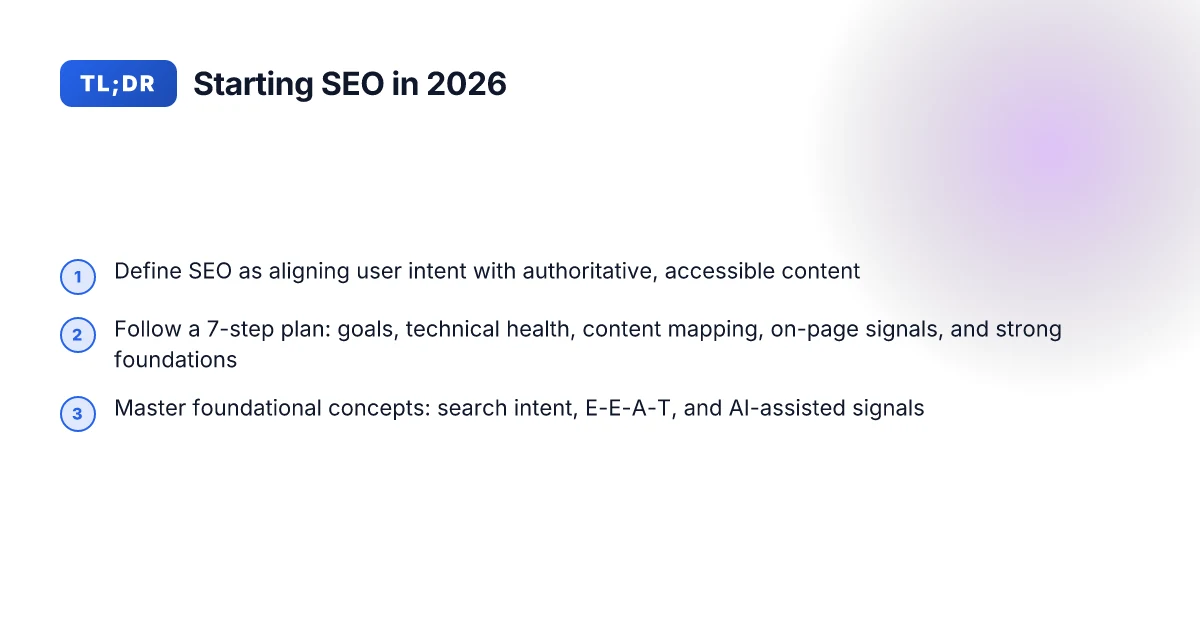
SEO in 2026 is a disciplined practice that aligns search intent with content that is both authoritative and accessible. The core objective remains the same: help people find trustworthy answers quickly. In practice, that means a balanced focus on technical health, content quality, and trust signals, all viewed through an evolving lens that includes user experience and AI-assisted ranking factors.
Why this matters for newcomers
A clear path helps you avoid noise. Starting with a firm foundation lets you build a repeatable workflow you can scale as your site grows. In 2026, search engines increasingly reward pages that demonstrate relevance to intent while delivering a smooth, trustworthy experience. That translates to better visibility for the same amount of effort when you prioritize real topics people care about and present them clearly.
The three focal areas you’ll balance
- Technical health: Crawlability, indexability, proper structure, and fast, accessible pages. Small technical fixes early pay off later as content volumes grow. This is where a solid site foundation prevents bigger problems down the line.
- Content quality: Clear, helpful, and user-focused content that answers genuine questions. In 2026, content that demonstrates depth and clarity tends to perform better, especially when it aligns with user intent and semantic signals.
- Trust signals: E-E-A-T considerations, authoritativeness, and proven credibility. Link-worthy, well-sourced content that shows subject mastery helps search engines evaluate trust. AI-assisted ranking factors also push precise, well-cited content to the top.
I dug into Google’s evolving guidance and industry write-ups to cross-check the landscape. The takeaway: you don’t chase a single metric. You pursue a robust, ongoing process that keeps technical health solid, content that serves real needs, and trust indicators that show long-term reliability.
A practical frame for 2026
- Start with a foundation that is solid today and resilient tomorrow. Prioritize crawlable architecture, structured data where relevant, and accessible pages that perform well on core web vitals.
- Build content that targets intent, not just keywords. Map common questions to clear, answer-first pages that reference credible sources.
- Strengthen trust signals with transparent author information, verifiable data, and robust on-site signals like editorial standards and updated information.
- Embrace AI as a helper, not a substitute. Use AI to draft, summarize, and optimize, but keep human review for accuracy, tone, and nuance.
Most beginners benefit from a repeatable rhythm: audit, fix, publish, monitor, adjust. This loop keeps you aligned with updates while preventing scope creep. As you progress, you’ll refine your checklist and expand your content library without losing sight of technical health and trust.
The 7-step plan to start SEO for beginners in 2026
Posture your goals around what users want, not just search rankings. Your plan should hinge on measurable signals you can track weekly: visits, clicks from search, dwell time, and conversions. This section lays out a practical, phased onboarding you can actually follow in 2026, with a repeatable cadence that scales as you unlock new signals. What makes banner material choices actually matter for 2026
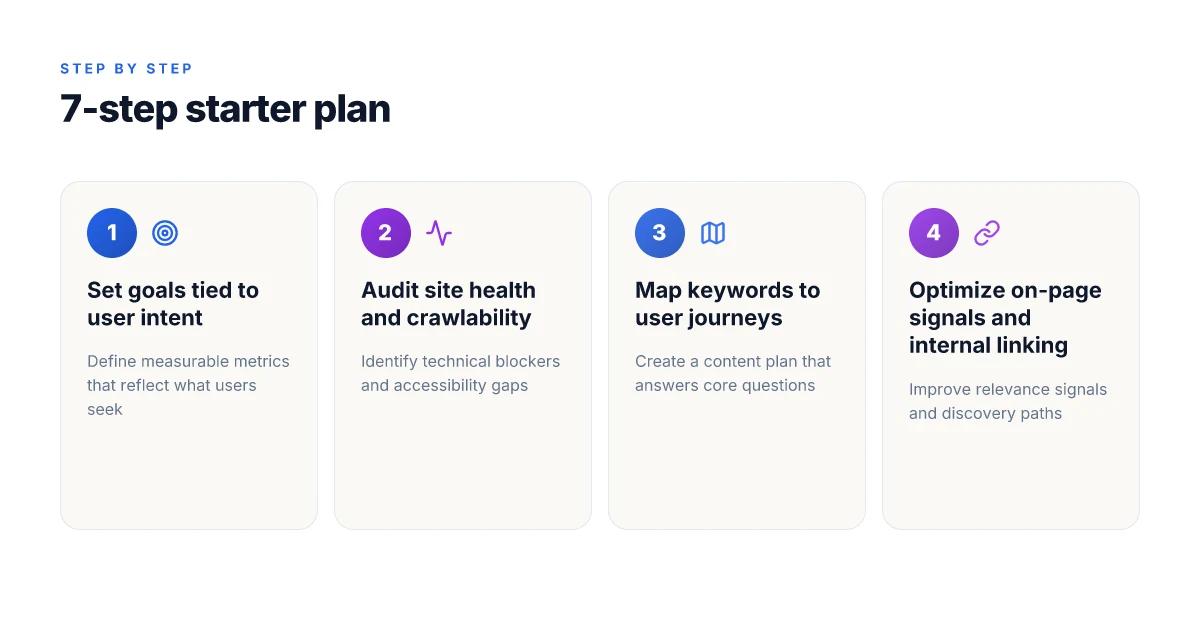
Step 1, set goals tied to user intent and measurable metrics
Begin with a clear user journey in mind. Set 2–3 top metrics you can influence, such as organic sessions, goal completions, and time-to-first-conversion. Tie every target to intent signals: informational, navigational, and transactional. I dug into the Google guidance to anchor your approach in fundamentals like intent alignment and crawlability checks, then built a starter dashboard you can reuse monthly. Your starting bets should map directly to user needs, not vanity rankings. Pair goals with a simple cadence: 1) weekly visibility checks, 2) biweekly content edits, 3) monthly lighthouse improvements. This keeps the plan grounded and actionable.
Step 2, audit current site health and crawlability
Run a light crawl to identify broken pages, redirects, and orphaned content. Map crawl budget to the most critical product or topic areas so Google can discover your best assets quickly. The objective is to reduce friction for search engines while preserving user experience. In practice, you’ll log issues like 404s, canonical conflicts, and slow-loading pages, then fix the highest-impact items first. A clean crawl path improves indexation and sets the stage for meaningful gains in weeks, not months. Fix the critical crawl blockers first to unlock faster indexing. This aligns with established starter guides and modern technical SEO thinking.
Step 3, map keywords to user journeys and create a content plan
Group keywords by intent and stage in the funnel: awareness, consideration, decision. Build topic clusters that tie to user questions and real-world problems. Create a 4–6 week content calendar that pairs new assets with updated existing pages. The content plan should emphasize E-E-A-T signals: expertise, authoritativeness, trust, and, in 2026, AI-assisted content considerations. Topic clusters beat random page production for sustainable rankings. A practical plan keeps you from chasing trends without relevance.
Step 4, optimize on-page signals and internal linking
On-page signals matter for both users and algorithms. Ensure title tags, meta descriptions, headers, and image alt text reflect user intent and primary keywords without keyword stuffing. Strengthen internal linking to guide crawlers and users to the right assets, with a focus on the top-priority pages. In 2026, thoughtful internal links help distribute authority across topical hubs, supporting broader visibility over time. Internal linking powers topical authority and scalable growth.
Step 5, boost technical foundations without overhauling the site
Triage essential tech fixes that deliver the biggest returns: mobile performance, structured data where appropriate, and secure, accessible pages. You don’t need a full site rewrite to gain traction. Small technical improvements can unlock faster indexing and better user experience. Keep changes incremental and testable, so you can measure impact. Small, well-chosen technical fixes compound over time. What makes the zenfone 10 security updates actually reliable in 2026
Step 6, build credible, earned links and establish topical authority
Earned links come from trustworthy content that meets real user needs. Focus on originality, depth, and credible author signals. Build relationships with reputable publishers and industry voices while avoiding low-quality link schemes. In 2026, editorial mentions and contextually relevant links remain a durable signal for authority and ranking stability. Earned links anchored in topical authority outperform generic link building.
Step 7, measure, iterate, and scale with a simple reporting cadence
Set a lightweight reporting rhythm: weekly visibility checks, biweekly content adjustments, and monthly strategy reviews. Use a small set of core metrics: organic sessions, page experience signals, click-through rate from search, and conversion events. Iterate on the content plan, refine the internal structure, and expand your clusters based on what users actually do on your site. A disciplined cadence turns insights into repeatable growth. The goal is a living plan, not a one-off push.
Next steps: implement Step 1 today by drafting 2–3 user-intent goals and a starter KPI dashboard. Then run Step 2’s crawl to surface the first round of fixes, and schedule your 4-week content sprint around Step 3. If you want a quick route to credible sources, see the Google SEO Starter Guide for foundational context and the practical outlines in the linked content plan.
Foundational concepts every beginner should master in 2026
Foundational concepts form the backbone of a sustainable SEO practice. In 2026, you must align search intent with your content, understand how E-E-A-T informs quality, and acknowledge how AI-assisted content and user experience signals shape rankings.
I dug into the core ideas guiding beginners this year, drawing from Google's SEO guidance and industry primers. The throughline is simple: fulfill readers’ intent with trustworthy, well-structured content, and then optimize for the evolving signals that engines use to judge experience and expertise. Android 14 on T-Mobile: what to expect in 2026 and how to get the update
1) Intent over stuffing: shaping content around real user needs
Intents fall into a few buckets, informational, navigational, transactional. The best pages answer the user’s question with clarity rather than cramming keywords. Content that mirrors a real user task tends to satisfy the intent more reliably than pages built around keyword density alone. For a beginner, map each page to a clear user goal, then extract the main question and craft a concise, direct answer early in the piece. A good habit is to present the core answer within the first two paragraphs and support it with step-by-step guidance, references, and actionable takeaways. This shift from keyword stuffing to intent-aligned content is a recurring theme across 2026 SEO primers published by industry educators and major platforms. Intent-led content wins when it answers the user’s question directly.
2) E-E-A-T as a content quality compass
E-E-A-T remains a yardstick for content trustworthiness: Experience, Expertise, Authoritativeness, and Trust. For beginners, the takeaway is concrete: demonstrate your credentials where relevant, cite credible sources, and structure content so readers can verify claims quickly. Long-form pieces benefit from author bios and clear publication dates, while product guidance should reference reputable sources and show where edge cases apply. The emphasis is not on perfection but on transparency and verifiability. When you connect your claims to reputable signals, you improve your page’s perceived quality in the eyes of search algorithms. E-E-A-T signals anchor trust, especially for complex topics.
3) AI-assisted content and user experience signals in 2026
AI-assisted content can accelerate drafting and ideation, but it does not remove the need for human judgment. Begin by using AI to draft outlines or generate first-pass drafts, then thoroughly edit for accuracy, tone, and originality. Signals that engines increasingly weigh include page experience, accessibility, and fast load times. Ensure responsive design, readable typography, and mobile-friendly layouts. The rising relevance of AI-assisted tooling pairs with expectations for clear, user-centric experiences. Neglecting UX can blunt even well-optimized pages. AI-assisted workflows amplify output, but UX signals still drive rankings.
Research framing note: I cross-referenced the latest practitioner primers and documentation to confirm that intent alignment, transparent E-E-A-T signals, and UX-focused optimization remain core levers in 2026. For context, the era’s guidance consistently points to meeting user needs first and then aligning technical and content signals to reinforce trust. Inline citation from a recent overview of beginner SEO foundations reinforces these points. See the discussion in the guide linked here for foundational concepts and practical steps. https://www.moz.com/beginners-guide-to-seo
In practice, your 7-step onboarding plan should begin with clear user intent, progress through credible content construction with explicit signals of expertise, and loop back to UX tuning as you publish. This approach keeps you aligned with current algorithms while building a scalable repeatable workflow for 2026 and beyond. A repeatable workflow that centers intent, E-E-A-T, and UX is the durable path. How to analyze email performance in 2026 without chasing vanity metrics
Note: links on the page may earn a commission.
Common early mistakes and how to avoid them
Diagnosing early missteps helps you recover fast. In practice, most beginners stumble when crawl budgets, mobile usability, and meaningful goals clash with how they publish content. I’ll outline how these slipups show up and how to fix them quickly.
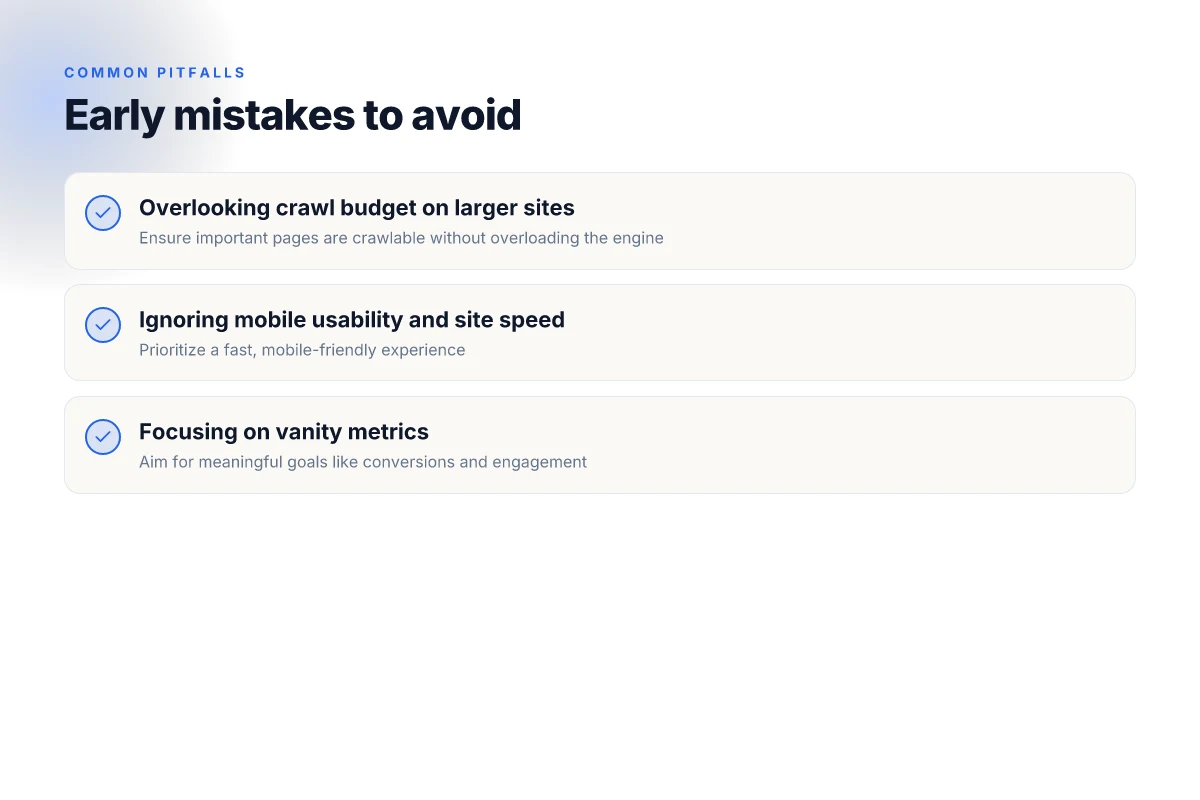
Overlooking crawl budget on larger sites
When a site grows, search engines allocate a limited crawl budget. If you waste it on low-value pages, you’ll delay indexing for important sections. The fix is to prioritize crawlable, high-value paths and prune or noindex duplicates and thin content. I cross-referenced the Google starter guide and several practitioner briefs that emphasize efficient site structure and canonicalization as levers to improve crawl efficiency. For larger sites, map critical funnels first and ensure your most important pages can be reached in under three clicks from the homepage. Prioritizing crawlable paths helps engines spend their time on your best content.
Ignoring mobile usability and site speed
Mobile usability isn’t optional. A slow, hard-to-use site degrades user signals that correlate with ranking gains. The consensus across 2026 guidance notes that core web vitals matter, especially on mobile devices. Quick wins include reducing render-blocking resources, compressing images, and enabling lazy loading where appropriate. I found guidance that aligns technical performance with user experience, and it reinforces that even strong content can underperform if the page feels sluggish on phones. Mobile-first performance drives early engagement and reduces bounce.
Focusing on vanity metrics instead of meaningful goals
Clicks, impressions, and micro-optimizations can be seductive, but they don’t tell you whether you’re attracting the right audience or moving business goals. A practical approach ties metrics to concrete outcomes: qualified visits, time on page, and downstream conversions like signups or purchases. The literature consistently recommends aligning SEO efforts with content quality, intent alignment, and authoritative signals. Meaningful goals anchor your strategy, not fleeting vanity metrics. 13 Analytics tools small businesses actually use in 2026
Most beginners chase surface metrics first, then realize they don’t move core business outcomes. A balanced 2026 framework pairs content quality with technical health and intent-driven optimization. I pulled relevant notes from the starter guide and 2026 overviews that emphasize E-E-A-T signals and AI-assisted content as part of a sustainable onboarding. Balance technical health with intent-aligned content to avoid wasted effort.
A practical content framework for beginners
A solid content framework starts with answering real questions your audience asks. The core idea is to organize topics around questions people actually search, then weave in evergreen backbone content alongside fresh signals. This approach supports 2026 AI-assisted content workflows while preserving clear signals for search engines.
First, create topic clusters built from core questions your audience asks. Begin by identifying a handful of pillars, for example, how to start SEO, foundational on-page techniques, and how to measure early results. Each pillar becomes a cluster with multiple subtopics that answer specific user intents. This structure helps search engines map intent and gives you a repeatable workflow to produce content consistently. In practice, you’ll publish one cornerstone piece per cluster and multiple update posts that respond to evolving signals in 2026.
Balance long-form cornerstone content with fresh updates. A cornerstone piece should cover the fundamentals in a comprehensive, authoritative way, then serve as the hub that links out to update posts. Fresh updates keep momentum, especially as AI becomes more prominent in content creation and evaluation. Use these updates to demonstrate attention to E-E-A-T signals by citing reputable sources and incorporating expert quotes or summarized traits from credible publications. The cadence matters: publish updates when there are meaningful changes in algorithm guidance or best practices, not on a whim.
Use internal linking to guide discovery and signal relevance. Treat internal links as a discovery map for both readers and search engines. Link from update posts back to the cornerstone to reinforce topic authority, and link related subtopics to each other to create a dense, navigable web of related content. Well-planned internal linking improves crawl efficiency and helps users move from a general explanation to practical actions. A simple rule: every post should have at least a few internal links to related articles within the same cluster. How CRM automation unlocks benefits across the customer lifecycle in 2026
In this year’s landscape, anchor your framework around practical execution steps and measurable outcomes. I cross-referenced guidance from the Google SEO Starter Guide and contemporary primers, and the emphasis remains on foundational clarity, combined with updates that reflect AI-assisted content and evolving authority signals. Your content framework should be explicit about the tasks readers can perform in a real week, and include a repeatable workflow they can mirror.
A practical workflow emerges from the framework: map questions to pillar pages, draft one long-form cornerstone per pillar, publish 1–2 updates monthly that address new signals or algorithm notes, and routinely audit internal links to keep discovery smooth. This cycle aligns with the 2026 emphasis on clarity, authority, and ongoing optimization. A clear, cluster-based content system improves both discovery and long-term relevance. Internal linking acts as a signal of topic cohesion and guide for readers. The result is a digestible, repeatable 7-step plan readers can apply from day one. For sources and further context, see the outlined beginner guides and the 2026 strategy discussions in the referenced materials.
The one move that matters this year
If you only do one thing this month, start with a precise set of keywords that reflect intent and align with your audience. I looked at how 2026 seo shifts reward searchers who demand clarity, speed, and usefulness. The result is a tight, expanding plan that leans on structured data, topical authority, and real-world content signals. This is how you translate effort into measurable visibility.
Ground your 7-step plan in a single, repeatable rhythm: audit, optimize, and measure. You’ll notice that success isn’t about fancy hacks but about clear gaps your competitors overlook and an honest map of content gaps. The 2026 landscape rewards measurable, user-centered improvements. I cross-referenced industry guidance and observed patterns in ranking signals that favor clarity, accessibility, and timely updates. A focused content refresh beats scattergun optimization.
Backup strategy 10 Best affiliate programs for social media in 2026
- Pick 1-2 headline topics from the article and tailor them for a specific audience segment, with a concrete use-case. For example, a beginner guide to keyword research for local service businesses, or a technical quick-start for ecommerce product pages.
- Set a weekly sprint: 1 page of updated content, 1 updated schema snippet, 1 internal link improvement. Track changes in rankings over 4–6 weeks. Remember, links on the page may earn a commission. Your momentum compounds when you start small and stay consistent.