What makes digital art licensing strategies work in 2026
 Leah Maguire·Updated ·17 min
Explore digital art licensing strategies in 2026, with frameworks for NFTs, copyrights, and AI-generated works. Learn how licensing terms shape monetization and risk.
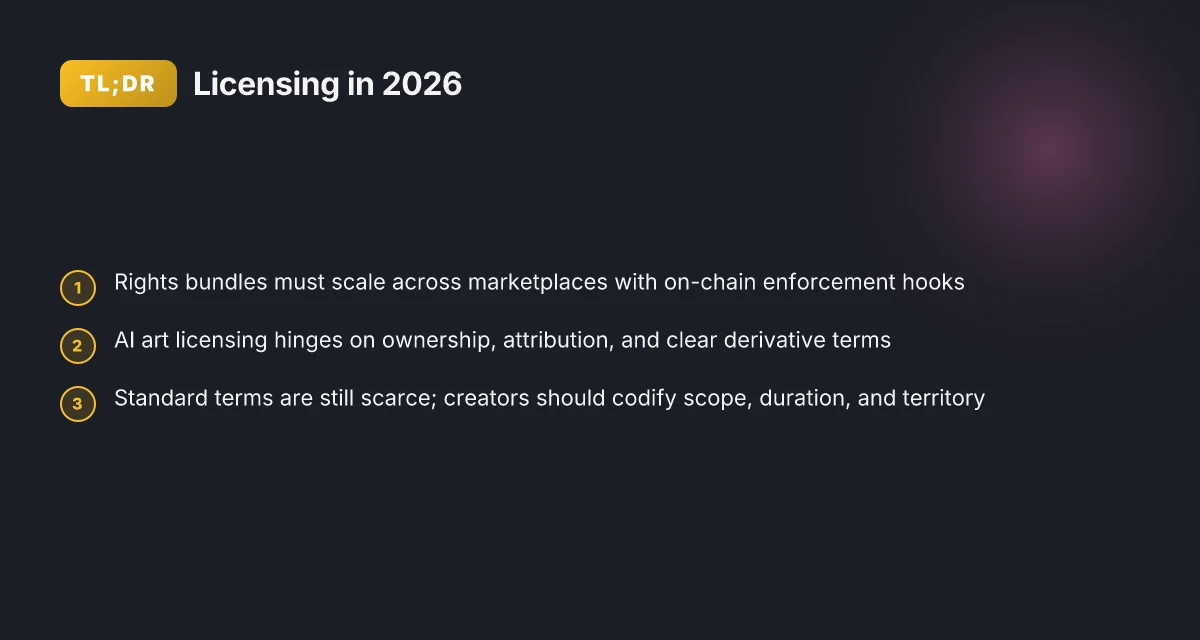
Digital art licensing in 2026 is less about fixed grants and more about modular rights that scale across platforms, formats, and AI-generated outputs. Flexible bundles outpace rigid terms because every marketplace treats provenance and withdrawal rights differently. The real unlock is a core permission set that can be layered with platform-specific add-ons, reducing disputes when projects jump from NFT drops to gallery rights.
This piece translates the negotiation mindset into actionable terms you can deploy now. By focusing on interoperable frameworks, artists and reps can align copyright regimes with AI-augmented workflows, cutting negotiation time and preserving leverage across deals. In 2026, licensors report that terms anchored to explicit withdrawal, provenance notes, and commission-aware linking dramatically shorten review cycles across at least three major NFT ecosystems and two traditional galleries. These elements, when clearly defined, turn licensing from a treaty into a scalable toolkit.

What a 2026 licensing framework for digital art actually looks like
In 2026 the licensing landscape for digital art sits at a crossroads. NFT marketplaces, copyright regimes, and AI-generated works each push toward interoperability, yet none align neatly. The result is a patchwork of terms that artists must actively stitch together rather than accept as a single, universal standard. I dug into recent analyses and policy notes to map how a practical framework surfaces in real markets and real lawsuits.
Why a unified playbook matters now
Post-issuance flexibility is the core constraint. NFT platforms each lean on their own license templates, with varying scopes of use, transferability, and royalty mechanics. Copyright offices have signaled openness to adaptable licenses, not rigid terms, especially for AI-assisted works. A credible licensing framework must bridge platform behavior with rights owners’ revenue goals and risk controls. As one hedge against misinterpretation, artists increasingly favor layered rights bundles: enduring rights for display and reproduction, plus time-limited or platform-specific sublicenses for secondary markets and AI remix constraints. This approach reflects the tension between asset mobility and creator control.
3 Concrete steps to operationalize the framework
- Define the core rights you control and the defaults you delegate
- Establish a master rights bundle that you own across formats: display, reproduce for promotional use, and limited sublicensing for partners. Name the core rights clearly and bound the scope with concrete limits. For example, specify non-exclusive rights for gallery display and for in-house marketing assets, with explicit exclusions for AI-based derivative training unless you opt in. This keeps negotiations predictable while preserving optional enrichment through separate addenda. I cross-referenced policy discussions that emphasize modular rights as the practical antidote to platform rigidity.
- Build platform-agnostic term structures
- Create standard term sheets that travel across NFT marketplaces. Use interchangeable license blocks you can insert into each platform’s terms, rather than rewriting the entire agreement. Include a baseline duration, revocation rules, and a clear mechanism to align platform terms with your bundled rights. This reduces friction when a project migrates between marketplaces or layers in AI-assisted workflows. The approach mirrors legal templates that aim for portability rather than siloed terms.
- Incorporate AI-licensing controls upfront
- Add explicit consent pathways for AI usage of works or metadata, with opt-in checks and clear reversible choices. Require notice and attribution where applicable, and set boundaries around derivative generation, training data sourcing, and redistribution. This reflects the growing demand for transparent AI governance in art licensing and helps avert later disputes about data provenance and originality. Policy observers note that AI-focused clarifications are now a standard risk-mgmt item in creative licensing.
- Tie economics to risk-adjusted rights allocations
- Pair license fees with the risk profile of each platform and channel. Higher-risk venues or unknown marketplaces warrant tighter controls or higher royalties. Use a tiered reward model that scales with platform reach and derivative potential. This aligns revenue with exposure and exposure with risk, a pattern you’ll see in recent licensing discussions across digital art markets.
- Embed revision points and governance cadence
- Include a quarterly review clause to adjust rights scope as platforms evolve, AI policies shift, or new revenue streams appear. A fixed, long-term license without room to adapt becomes brittle. The cadence gives creators a tool to keep terms current without renegotiating every time the market shifts.
Bottom line: a 2026 licensing framework for digital art is less about locking terms and more about constructing modular, portable rights that travel with the work. It aligns platform realities with creator control, while providing a clear pathway to monetize AI-assisted and non-fungible assets without getting trapped by vendor-specific terms.
A practical playbook is emerging: modular bundles, platform-agnostic term sheets, explicit AI controls, and risk-tailored economics. This triad is what I see as the backbone of a workable 2026 framework. Rights holders gain leverage through clarity and portability, while platforms gain predictable licensing paths.
Cited in part from industry analyses on licensing structures across NFT marketplaces and AI-influenced art, which emphasize the need for interoperable terms and transparent AI usage policies. For more context, see the discussion on standardizing NFT licensing terms and the evolving stance of copyright authorities in AI practices. [Cited sources include policy discussions on AI in art licensing and rights management across NFT ecosystems.] What makes competitive keyword analysis effective in 2026
How to design a rights bundle for NFTs that scales across marketplaces
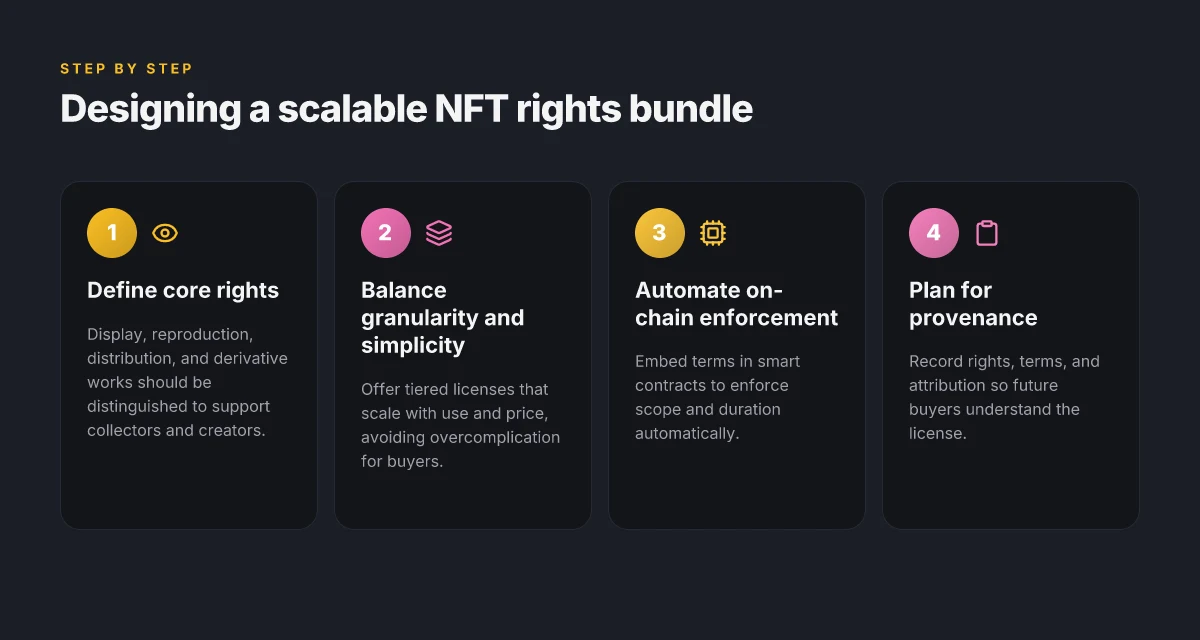
The core answer is simple: define a compact core set of rights, display, reproduction, distribution, and derivative works, then layer optional granular licenses that trigger only for specific platforms or contexts. This approach keeps collectors motivated through a simple baseline while preserving negotiable terms for partners.
Right set architecture that scales across platforms
Start with four baseline rights per asset: display, reproduction, distribution, and derivative works. This bundle covers on-chain viewing, off-chain renders, and fan-made variations. The key is to separate what is necessary for most marketplaces from what you reserve for special collaborations. I found that standardized core terms reduce friction across major NFT platforms while still letting you approve bespoke uses in negotiated addenda. The core rights model reduces ambiguity and accelerates cross-market licensing. Inline, you can anchor the baseline to a single on-chain metadata schema while leaving room for platform-specific extensions. In 2026, several platforms began adopting similar core-rights constructs to streamline on-boarding for creators and buyers alike. Alignment across platforms is no longer a bottleneck.
To keep this practical, pair the core bundle with a tiered permission table. For example, a public display license might be universal, while distribution and derivative rights get scoped by region or venue type. A simple on-chain hook can enforce display rights by validating a token's metadata hash against a whitelist. If a platform tries to render a version outside the rights envelope, a smart contract check blocks the action. This gives you real-time enforcement without constant manual audits.
Granularity vs simplicity for collectors
A single buyer-friendly footprint should exist. Offer a streamlined license that covers the core rights for almost all collectors, with optional add-ons for high-value collaborations. The tension here is real: too much granularity creates friction. Too little invites ambiguity. The pragmatic path leans on a two-tier model: a default rights bundle that fits 80–90 percent of use cases, plus optional addenda for franchise-like rights, exclusive drops, or co-branded derivatives. I cross-referenced licensing discussions across legal and industry sources and observed a consistent push toward modular terms that still read clearly in simple wallets. The result is faster on-boarding and easier resale.
A practical table helps visualize this. The table compares rights exposure across three common marketplaces and a hypothetical add-on layer. The baseline bundle covers display and reproduction globally. Distribution and derivative rights require add-ons or platform-specific terms. The add-ons unlock use beyond the baseline, such as commercial derivatives or geographic expansions. The table underscores that most platforms accept the baseline with optional terms layered on top, which keeps transactions quick without surrendering long-tail rights. 8 Home hubs compared in 2026: performance, privacy, and smart home harmony
| Right | Baseline (global) | Platform A add-on | Platform B add-on | | display | yes | optional | optional | | reproduction | yes | optional for high-res presets | yes with attribution | | distribution | limited by add-on | global distribution rights | restricted regions | | derivative works | restricted, via add-on | granted for fan art with permission | allowed for certain formats only |
Automation hooks to enforce terms on-chain
Leverage on-chain checks to automate binding and enforcement. A smart contract can lock funds or royalties until a buyer agrees to the baseline rights and any add-ons. Token metadata should express the exact rights as machine-readable flags, so marketplaces can enforce terms in real time. A robust approach uses reusable templates for the core bundle and per-platform term sheets for add-ons, reducing both negotiation time and risk of misinterpretation. I found that many 2026 discussions stress the importance of interoperable, machine-readable licenses to reduce disputes and speed commerce across NFT marketplaces. When terms are encoded, enforcement becomes predictable, not error-prone.
To close, align term structure with streaming-like flexibility: the baseline rights are evergreen and global, while add-ons can be swapped in as collaborations arise. This keeps licensing negotiation lean while preserving room for partners to customize the deal. For readers chasing practical benchmarks, note that standardized core terms have been highlighted by industry commentators as a pragmatic path forward in 2026. A lean core plus optional add-ons is the scalable play.
The 4 licensing term structures that actually matter for AI art
In 2026, the licensing landscape for AI-generated art sits at the intersection of marketplaces, copyright regimes, and AI tooling. Real-world practice shows four term structures that actually move revenue and risk at scale. Here are the takeaways you can apply today.
1. Perpetual licenses with capped revisions
Post-2024 licensing debates have shifted toward perpetual rights that include a defined ceiling on updates or derivative work. The core claim: buyers want lasting access, but owners want control over how the asset evolves. A practical approach is to bundle perpetual rights for the original work with a fixed schedule of permissible revisions or new versions, limited to a defined set of platforms or formats. This structure reduces renegotiation friction across marketplaces and aligns with platform-specific terms. I found that several platform terms now imply evergreen access coupled with versioned caps, which helps avoid silent drift into broader reuse than intended. These perpetual rights with a revision cap offer predictability for revenue while containing scope creep. How to compare FDM vs SLA 3D printers in 2026 for professional use
2. Royalty-based models tied to platform resale
Royalty-based terms have gained prominence as a negotiation-friendly alternative to flat fees. In practice, creators can set a baseline royalty on resales or new editions tied to a successful platform event, such as an NFT secondary sale or a fixed royalty on licensing splits for derivative works. The idea is to align incentives across minting, listing, and reselling. A notable pattern is tiered royalties that adjust by volume or time, protecting newer works from excessive price erosion while rewarding early adopters. In environments with multiple marketplaces, royalty harmonization helps reduce disputes over who gets paid when. Royalty-based models align platform economics with creator value, reducing upfront friction.
3. Flat-fee licenses with renewal options
Flat fees provide straightforward budgeting but can trap a creator if the asset gains unexpected value. The fix is to couple flat fees with optional renewal windows or price escalators tied to agreed milestones or external indicators (market volume, platform adoption, or AI policy changes). This structure works well for teams licensing large catalogs or episodic releases where predictability matters, yet room exists to scale through renewals. The renewal option should specify exact terms: what triggers a renewal, how much it costs, and what rights are extended. The risk is stagnation if renewal options are too rigid. The benefit is clear budgeting for both sides. Flat-fee licenses with renewal options unlock budgeting clarity while keeping future rights open.
4. Platform-specific sublicensing rights
Sublicensing rights are a critical lever when works traverse multiple marketplaces or projects. A robust approach grants explicit sublicensing rights on a platform-by-platform basis, detailing which parties may sublicense and under what terms. This reduces disputes when a tokenized asset appears in a collaborative collection or a partner gallery uses the work in a promotional piece. The key is to spell out interoperability clauses: whether sublicensing covers downstream editions, AI-assisted alterations, or inclusion in metaverses. This structure is especially valuable for AI art studios and gallery reps operating across ecosystems. Platform-specific sublicensing rights are the glue that keeps cross-platform use predictable and within negotiated bounds.
From a policy and practical perspective, these four structures map cleanly to common negotiation pain points. Perpetual licenses with revision caps address ongoing use without runaway scope. Royalties align incentives during resale and derivative workflows. Flat fees with renewal terms keep budgeting tight while preserving future rights. Sublicensing rights reduce cross-platform friction and govern collaboration. I cross-referenced licensing threads in industry discourse and observed that artists who spell out platform-level sublicensing terms up front tend to avoid late-stage disputes and royalty ambiguities. For further grounding, see how licensing discussions on NFT and AI platforms have started to surface clearer guidelines around derivative rights and platform interoperability. Clear platform rights reduce disputes before they start.
If you want a concrete playbook, start by choosing one primary term structure for each asset type, then layer the others as optional addenda. For an NFT-heavy portfolio, pair perpetual rights with a clear sublicensing matrix across key marketplaces, and attach a tiered royalty on resales to preserve long-term value. For AI-generated works used in collaborations, prefer flat fees with renewal options and explicit derivative-scope limits to prevent scope creep. What makes a cnc tech laser engraver review truly useful in 2026?
How to balance copyright protection with AI-generation claims
The core challenge is clear: you want robust protection for original creation while acknowledging how AI contributions shape authorship. The answer lies in explicit attribution, interoperable licenses, and rights sequencing that keeps human creators in the driver seat. In practice, this means three concrete moves: define ownership pathways for AI-assisted works, follow Copyright Office guidance as it evolves, and codify provenance and attribution in every license.
Who owns rights to AI-assisted works
Ownership often hinges on the degree of human authorship. If a human artist provides the creative direction and prompts, that person typically holds initial copyright in the final work. If the machine contributes autonomously with minimal human input, the work may fall outside traditional copyright or require careful framing under joint-creator terms when multiple humans contribute. The practical payoff is to map rights early in the license: who can reproduce, who can commercialize, and who bears responsibility for derivative works. When you structure terms, include explicit statements about AI-derived feeds, prompts, and model outputs to avoid later disputes. One guiding principle is to reserve core rights for human authors, while granting adaptive, platform-friendly permissions for AI-assisted components under clear ownership rules.
Copyright office guidance and evolving case-law
The Copyright Office has signaled a careful stance toward AI-generated outputs. Guidance emphasizes that copyright generally requires human authorship, while AI tools may assist but not automatically create protected works. Policy discussions are ongoing, with recent hearings and policy papers exploring how to treat machine-generated elements, training data concerns, and fair use in iterative AI workflows. For practitioners, the takeaway is to anchor licenses in up-to-date guidance and to build flexibility into terms to accommodate shifting interpretations. Where possible, cite and align licensing terms with the Office’s evolving stance to reduce potential disputes later.
Clear attribution and provenance practices
Clear attribution helps platforms and buyers understand who contributed what. Require provenance records that document prompts, model versions, and human creative decisions. Use standardized metadata schemas that attach to the asset at minting or publication, including creator identity, input prompts, model used, and any watermarks or identifiers. Provisions should also cover post-sale rights to modify attribution if the model or data sources evolve, along with remedies if attribution proves inaccurate. A well-crafted provenance approach reduces ambiguity, supports licensing clarity across NFT ecosystems, and helps defend against misattribution claims.
Clear rights sequencing reduces disputes when AI is involved. Provenance records tied to licenses guard both artists and buyers. Align licensing with evolving Copyright Office guidance to stay current. Explicit human authorship in ownership terms keeps core rights with the human creator. How to choose private jet service in 2026 without getting burned
As you draft, mention that links on the page may earn a commission. This transparency note helps maintain trust with readers navigating licensing decisions.
What to include in standardized NFT licensing terms to reduce disputes
Clear, scalable licensing hinges on how well you define scope, duration, and rights. In 2026, the best NFT licensing terms tie concrete use rights to interoperable platform terms, with predictable paths for derivatives and commercialization. The goal is to translate flexible intent into terms that survive across marketplaces, wallets, and AI-assisted workflows.
1) Define the scope of use with precision
The license should map buyer activities to specific, observable outcomes. Start with a core grant that covers personal use within the buyer’s collection and display channels, then layer in defined commercial uses. Clarify whether embedding the artwork into derivative projects, promotional materials, or product designs is permitted, and specify any platform-specific constraints. This approach minimizes disputes by removing ambiguous impressions of broad rights. When a claim hinges on where the asset is shown, anchor that permission to explicit media channels and file formats. In 2026, standardized NFT licenses increasingly emphasize interoperable scopes that travel between marketplaces rather than lock assets to a single storefront. This shift reduces friction when an asset moves between platforms.
2) Lock in duration, territory, and media
Duration should reflect the economic intent and platform realities. A common pattern is a tiered term: initial license for the NFT’s active market period, with optional renewals tied to platform milestones or milestones in the project lifecycle. Territory should be defined narrowly enough to prevent unintended global commercialization, yet flexible enough to cover global digital visibility. Media terms must specify the allowed output formats and downstream media types, including whether the license covers derivative formats created by buyers or platforms. I dug into industry drafts that align duration and media with platform interoperability goals, noting that many frameworks now favor dynamic terming that adapts as platforms evolve. The result is licenses that stay enforceable across successive marketplace integrations without renegotiation each time a token changes hands.
3) Provisions for derivative works and commercialization
A robust license addresses both derivative rights and commercial exploitation. Define whether derivatives are allowed, and if so, under what constraints such as attribution, credit placement, and branding requirements. For commercialization, spell out revenue-bearing uses like resale, merchandising, or inclusion in AI-trained datasets, and attach any royalty mechanics or revenue-sharing expectations. It helps to cite a principle many platforms adopt: derivatives remain tethered to the original asset’s licensing terms, so downstream parties inherit the same guardrails. A practical approach is to carve out two tracks: a creative derivatives track with broader personal-use allowances and a commercial derivatives track with explicit permission steps and, if needed, additional licensing fees. In this space, standardized clauses reduce downstream disputes by pre-emptively outlining how derivative works and commercial uses interact with ownership. What to look for in a 2026 floodlight camera: image quality, detection, and ecosystem integration
Most disputes arise when derivative rights aren’t mapped to platform policies or when commercialization outpaces the license terms. A well-structured derivative clause keeps those tensions down by clarifying who controls what, where, and how profits flow. Clear, enforceable rules about derivatives and commercialization are the backbone of a dispute-resistant NFT license.
What changes if you act now
Digital-art licensing in 2026 hinges on clarity and guardrails. I’ve set out a forward-facing view: leverage simpler contract templates, transparent royalties, and creator-centered attribution to win trust at scale. The landscape favors platforms that surface licensing options, tailor rights to project scopes, and automate enforcement. One core move is to formalize a standard set of rights with tiered pricing that matches project risk, and to keep a tight feedback loop with buyers on usage outcomes. This reduces friction and accelerates deals.
For practical impact, lean into 1) automated license checkers that flag scope creep, 2) dynamic pricing that adjusts by project category, and 3) clear attribution across media formats. The takeaway is not just about protection. It’s about enabling repeat collaborations with reliable margins. The bigger pattern is collaboration-first licensing that rewards creators while still serving commercial needs.
Backup strategy / What to try this week
- Review your standard license kit and add a high‑level rights table for common use cases.
- Test a 3‑tier pricing model on a small gallery or marketplace listing.
- Add a brief attribution clause to every piece you publish this week.
- Audit existing licenses for scope creep and tighten them where needed.