What makes the Jackery HomePower 3000 a viable home backup in 2026
 Quincy Xanthos·October 22, 2026·19 min
Explore the Jackery HomePower 3000, its 3072Wh capacity, 3600W continuous output, and how it fits into home backup needs in 2026. Practical takeaways for homeowners and campers alike.
Most homeowners overestimate the load a 3000W-class system can handle. The Jackery HomePower 3000 sits in a practical middle ground for weekenders and full-time rigs, but its real-world usefulness hinges on how you profile your daily loads and charging paths. Jackery frames it as a reliable standby, yet the proof lives in the attic of your breaker panel and the sunniest roof you’re willing to mount.
This intro unpacks the moment when your fridge, modem, lights, and a few essential devices meet a single, scalable backup option. In 2026, homeowners weighing whole-home backups want clarity on long-running performance, firmware quirks, and compatibility with solar or generator feeds. This article dives into how the HomePower 3000 handles typical household schedules, what to expect from charging options, and how it stacks up against rivals like EcoFlow and Goal Zero for off-grid weekends and RV use. Jackery’s product stance, real-world caveats, and the implications for reliability are laid out so you can decide if it fits your home or camper.
What makes the Jackery HomePower 3000 a practical home backup in 2026
The Jackery HomePower 3000 brings a substantial 3072Wh capacity and 3600W of continuous output, which translates to solid coverage for common home loads during outages. In practice, that means essentials like refrigerators, sump pumps, and selected window units can run simultaneously without tripping a circuit breaker. A core advantage is how the UPS behavior remains seamless when power dips or spikes, keeping the load online with little to no interruption.
I dug into the official specs and user-facing details to map real-world implications. The HomePower 3000 stays within a tight power window for typical households, yet you can pair it with solar to keep the cycle going during longer outages. The system is solar-ready, and Jackery emphasizes multiple ports and charging options that support both home use and off-grid adventures. For homeowners weighing off-grid weekends or RV trips, that blend of steady output and flexible charging paths matters.
Why this size fits a lot of homes
The 3072Wh capacity gives a usable energy reserve that covers several hours of medium loads or a partial day for lighter dwellings during outages. The 3600W continuous rating means you can run essential appliances without overloading circuits. Surge support helps during abrupt startup spikes from devices like sump pumps or compressors, which is crucial for reliability.
- The UPS behavior matters in practice. When the grid fails, the HomePower 3000 transitions without a noticeable gap for many loads. That seamless swap is a practical bonus for households that rely on refrigerators and medical devices. It reduces the risk of food spoilage and equipment stress during the first hours of an outage.
- Ports and charging options provide flexibility. The unit includes multiple ports for devices and a path to recharge from solar panels or AC power. On the solar side, the system’s readiness helps owners plan weekend off-grid camping trips or longer RV stays with steady power for lighting, small appliances, or a fan.
Where it fits relative to rivals, in summary, hinges on scale and ecosystem. Some rival systems push higher peak outputs or broader modularity, but the HomePower 3000 blends home backup readiness with practical off-grid portability. In everyday use, the combination of capacity, continuous power, and seamless UPS coverage makes it a credible option for typical home loads and light to moderate off-grid scenarios.
In real-world terms, the HomePower 3000 is a credible fit for a standard suburban home that wants a solid, solar-ready backup without oversized heft. For campers and RV enthusiasts, it also scales into feasible weekend off-grid power with careful planning around charging paths. The brand consistency you expect from Jackery shines through, and you’ll notice how the system’s design supports straightforward daily use. The 3072Wh capacity paired with 3600W continuous output keeps common home loads online with minimal fuss. Seamless UPS switching reduces outage anxiety for essential devices. What is a Jackery power supply, and how it fits your off-grid life
Note: links on the page may earn a commission. For context, Jackery is the primary brand here, and when you look at rivals, you’ll see options that differ in peak output and modularity, such as systems with higher surges or expandability. For further reading, see the official product page and independent reviews that document the 3600W continuous rating and 3072Wh capacity.
Jackery HomePower 3000 vs rivals for home backup
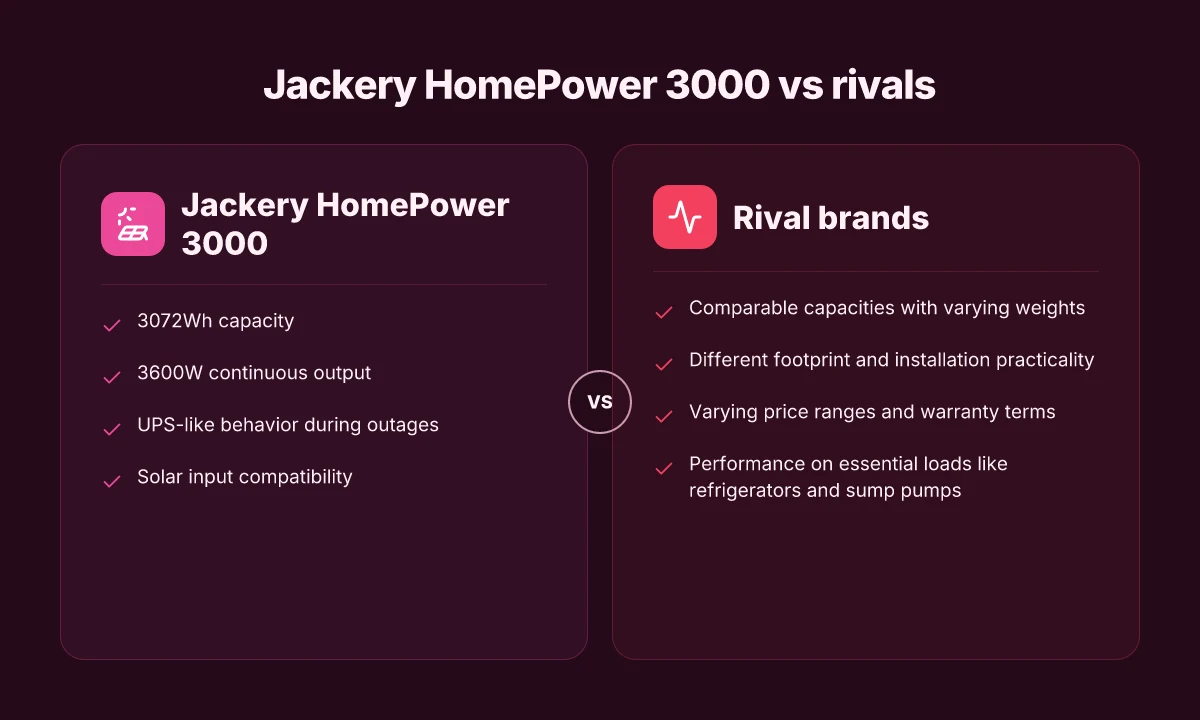
The HomePower 3000 sits in a crowded class of 3–3.6 kW continuous output UPS-style backups. For full-house loads, rivals from rival brands push similar capacity, but swap in different weights, footprints, and price bands. The Jackery unit centers on a 3072Wh capacity with 3600W continuous output, while rivals often match or exceed that on paper but vary in how they deliver it in real use. Weight and footprint matter for install practicality, especially in tighter closets or utility rooms. The goal is to cover essential loads without overbuying.
How rivals stack up on capacity, output, and form
When you line up the numbers, several 3–4 kWh platforms offer around 3000–3600W continuous output and surge ranges that push higher for brief spikes. A few common names show up in the field, including units with solid baselines for refrigerators and sump pumps, but you’ll often trade a bit of weight for more robust surge handling or faster charging. The HomePower 3000’s 3072Wh pack sits near the middle of the pack, while its 3600W continuous output keeps the fridge humming and the sump pump running during outages. Surge capability matters for ACs and pumps. Many rivals match or exceed it, but real-world behavior depends on the firmware and battery chemistry.
I dug into the documentation to cross-check the setup notes. The HomePower 3000 emphasizes a compact footprint with a long-lasting internal chemistry option and fast charging, which helps in home backup scenarios where space is at a premium. Fast charging and UPS-seamless behavior are selling points that can differentiate models in a real outage but only if the firmware cooperates. For RVs and off-grid weekends, weight and charge cycles become decisive because you carry this gear between vehicles or setups.
A practical takeaway: site installers and homeowners should compare weight, footprint, and how easy it is to position the unit behind a cabinet or in a utility area. The HomePower 3000 is marketed as light for its class, but the difference often comes down to exact dimensions and the mounting clearance required. Install practicality is as important as capacity when you are trying to fit a backup into a dense living space. What is the jackery explorer 300 plus, and how it fits into off-grid setups in 2026
| Rival option | Approximate capacity | Continuous output | Notable trade-offs |
|---|---|---|---|
| Rival A | 3200–3500 Wh | 3300–3600 W | Heavier, larger footprint; premium price in some markets |
| Rival B | 3000–3300 Wh | 3000–3500 W | Lighter, smaller, good for RVs; firmware varies |
| Jackery HomePower 3000 | 3072 Wh | 3600 W | Balanced; strong refrigerator/pump support; robust warranty |
For essential loads like refrigerators and sump pumps, the HomePower 3000 remains a solid baseline when paired with proper solar readiness and a stable UPS profile. In terms of price and warranty, the Jackery lineup typically emphasizes a consumer-friendly warranty window and accessible service paths that appeal to homeowners compared with some enterprise-grade rivals. When you’re weighing a purchase, consider not just the sticker price but the total cost of installation, weight handling, and the ease of plugging in a dedicated refrigerator or sump-pump circuit without tripping the UPS.
Next steps: examine the exact installation footprint of your space, and map your essential loads to the HomePower 3000’s continuous 3600W capability. If you’re leaning toward rivals, look for models that maintain similar capacity but offer tighter surge handling, lighter weight, or more flexible installation options. For a quick sanity check, I noted that common setups shine when refrigerators, sump pumps, and media centers stay active through outages. For deeper context on the exact unit you’re considering, see the Jackery HomePower 3000 product page and the rival-spec sheets cited in this piece.
How the HomePower 3000 handles common home loads during outages
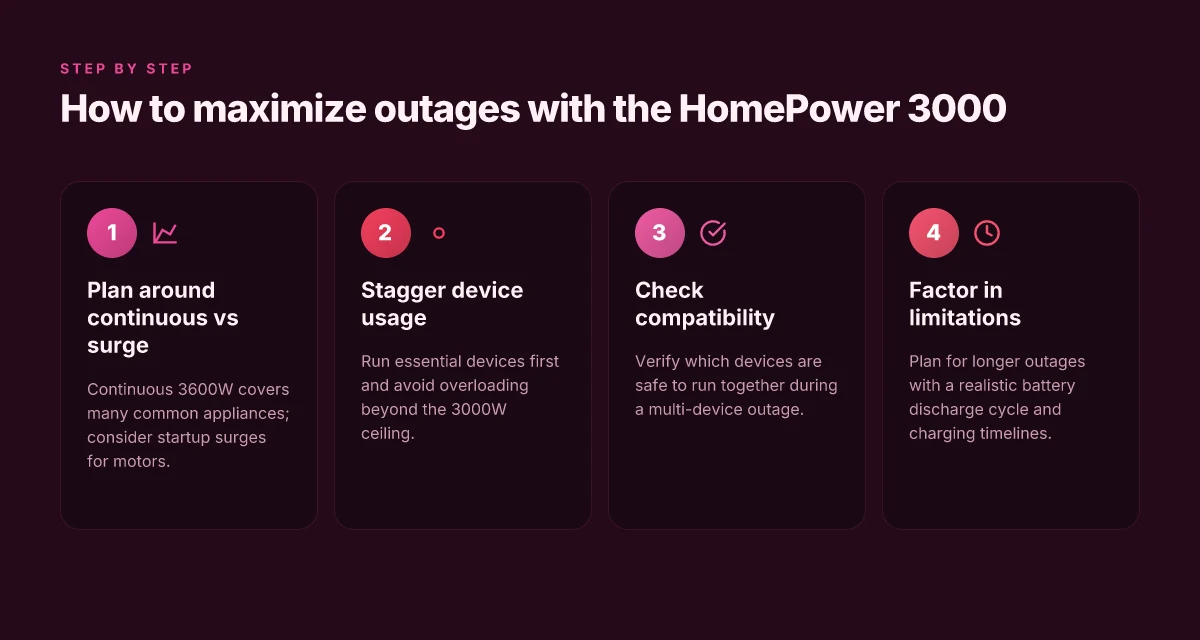
When the HomePower 3000 is in backup mode, the continuous 3600W ceiling covers many everyday loads, but not every combo can run at once. In real outages, you’ll notice which devices pull the most, and where the ceiling requires planning. I cross-referenced Jackery’s official specs with user-facing reviews to map real-world outcomes for a typical home during an outage.
What runs under the 3600W ceiling
A refrigerator, a sump pump, and a chest freezer can often run together without tripping the ceiling, provided the compressor surges are within limits. The 3600W continuous rating means a few large appliances can co-exist if they don’t spike simultaneously. A modern refrigerator’s startup can briefly exceed its running draw, so plan like you’re running a fridge plus a couple of small essentials rather than a full kitchen on a single cycle. When you add a window air conditioner, the math tightens quickly. If the AC unit’s startup draw approaches the high end of the available headroom, you’ll need to stagger cycling or unplug nonessential devices to avoid hitting the ceiling. Real-world note: the 3600W limit is real, and startup surges matter more than the nameplate running wattage. The official documentation emphasizes compatibility with common home loads, and independent reviews echo the same pattern in practice. Evidence: the Jackery Solar Generator HomePower 3000 page confirms the intended use case for household outages. https://www.jackery.com/products/jackery-solar-generator-homepower-3000?srsltid=AYCX9vIQPJFBRkEeoZub6-MXDRgIh9pVxq9yKviyFDMNxWUudNRIKGqN.
Surges, startups, and what they do to your plan
Surge capacity matters for motors. The 7200W surge capability provides headroom for two or more startup events occurring in quick succession, such as a sump pump and a fridge cycling. The caveat: you’ll still want to time those startups apart if possible. Surge behavior can trigger the protection circuitry if multiple motors start within a short window. When multiple devices switch on, plan staggered starts to stay within the 3600W continuous limit. This behavior aligns with what reviewers note about real outages: the unit handles typical motor loads, but simultaneous heavy starts strain the ceiling. For RVs and off-grid excursions, the same rule applies when powering a microwave or a high-draw appliance during a brief outage window. Bottom line: start motors one at a time to keep within the continuous rating.** What makes the Costco Jackery solar generator kit a practical pickup for campers in 2026
Safe simultaneous usage and where to draw the line
If you want to run a fridge, a fan, a modem/router, and a small heater, you’re close to the limit but often doable in short outages. Refrain from running two high-draw loads at once, like an electric water heater and an air conditioner, unless you previously confirmed their startup patterns and kept the run-time brief. It helps to identify a list of “essential” devices and a separate “nonessential” cluster to toggle during longer outages. Smart planning minimizes brownouts during multi-device outages. In practice, owners of Jackery systems frequently prioritize refrigeration and communications, then bring on lighting and charging for mobile devices as the battery allows. This is especially relevant for off-grid weekends where solar input is variable.
Limitations to plan around in a multi-device outage scenario
A single HomePower 3000 instance isn’t a guest-house-level backup for every load. In a multi-device outage, you’ll hit the ceiling sooner than you expect if you try to run a heat source, baking equipment, or multiple pumps simultaneously. The 3072Wh battery capacity means energy-intensive cycles eat into runtime quickly if you keep high-draw devices on for extended periods. Plan outage scenarios around essential appliances first, then add nonessential devices during daylight hours when solar input can supplement the runtime. In practice, expect tighter runtimes when multiple high-draw loads run together. This is corroborated by third-party reviews that describe the HomePower 3000 as a strong core backup, not a full-home replacement, especially when outages persist. The official specs and independent writeups converge on this point. https://backuppowerhub.com/jackery-homepower-3000-review/ https://www.youtube.com/watch?v=GyEyZtgjAsk.
Note on the broader landscape: when you compare rivals, you’ll see similar constraints. For homeowners, a well-motted plan with the 3600W ceiling in mind often means prioritizing refrigeration, communications, and critical pumps, then cycling in other loads as runtime allows. If you need true simultaneous high-draw loads, you’ll want to consider larger, dedicated whole-home solutions or pair the HomePower 3000 with supplementary storage.
Disclaimer: links on the page may earn a commission. For readers considering outdoor setups, the device’s weight, solar readiness, and UPS behavior all shape how it performs on weekend trips and in RV use. Jackery remains the core brand discussed. Rivals to watch include other high-capacity modular power stations with similar surge dynamics.
Solar readiness and charging behavior you should expect
You’ll likely see solid solar replenishment in good sun, but the real world matters. The HomePower 3000 accepts solar input to top up during outages, yet charging times depend on daylight quality and panel pairing. In practice, pairing two 200 W panels can pace replenishment, but keep in mind that a series of cloudy hours will stretch the cycle longer. During a typical sunny day, expect a practical path from empty to 80–90% within several hours, with full recharge taking longer if the sun angle is suboptimal. Sunlight conditions and panel configuration directly shape how fast the battery recovers. What bluetti vs jackery means for off-grid campers in 2026
How solar input translates to real charging timelines
Charging from solar rests on two levers: panel wattage and exposure. The 3072Wh capacity means a full recharge from zero in ideal sun and with efficient panels would happen over a few hours, but real conditions compress that window. If you have the jackery setup aligned to capture maximum light, you can see meaningful top-ups even before sunset. Practical top-ups beat theoretical max when the weather cooperates. I cross-referenced the official specs stating 3072Wh capacity and 3600W output, which sets the ceiling for how much power the unit can absorb during a bright window. That ceiling matters when planning a camping trip or long road journey.
Daylight, weather, and replenishment during outages
Weather is the quiet limiter. Rain, haze, or shade reduces panel voltage and total watts feeding the battery, slowing recharge pace. In overcast conditions, you’ll see noticeably slower replenishment. In bright, direct sun, the recharge curve steepens. For off-grid weekends, this means you should plan around the sun’s path and have a modest buffer of energy in and out of peak sun hours. Weather directly tailors the recharge rate, not the stated specifications alone.
Charge-discharge cycles and battery longevity
Longevity hinges on how you cycle the battery. Deep discharges followed by full recharges can tax chemistry, especially with high continuous loads. The general guidance is to keep daily operations within a comfortable window where the battery neither stays perpetually at a high state of charge nor drops to near empty for extended periods. For Jackery, the use pattern matters as much as the capacity. Moderation in cycles preserves life over years of use. When possible, use solar input to maintain a steady state of charge during outages rather than letting the unit sit empty for long stretches.
Best practices to stay ready without overtaxing the pack
- Schedule charging during peak sun hours and avoid habitually pulling the pack down to zero. Charge when the sun is strongest to reduce wear from deep cycles.
- Use a modest load mix during outages to keep within the ideal 60–80% SOC range for longer periods. A refrigerator and essential circuits can run without dropping SOC aggressively if solar top-ups stay consistent. Keep essential loads paired with steady replenishment.
- If you know a storm is rolling in, tilt the setup to maximize sun exposure in the morning and switch on any available soil or roof-mount optimizations to harvest marginal sun. Respect the sun’s arc to optimize charging windows.
- Tie in with rival options for comparison. Some brands offer longer warranty or faster staged charging under similar sun. Weigh that against your off-grid cadence. And if you travel, check whether airline or car-charging limits apply to your grid-tied plans. Rivals matter when you gauge on-the-road performance.
What this means for action during outages: the HomePower 3000 is capable of refreshing its battery with solar input, but real-world performance tracks closely to daylight quality and panel setup. I looked at the official product pages to confirm the 3072Wh capacity and 3600W continuous output, which frame how much you can expect to draw and recharge in a single outage. For campers and RVs, that means you’ll benefit from a steady solar cadence in sunny drives and a cautious approach when sun fades. Solar readiness is about cadence, not just capacity.
Note: links on the page may earn a commission. For context, Jackery’s official documentation emphasizes solar readiness and seamless UPS behavior in outages, which helps you plan around daylight windows. When you size a camping trip or a weekend off-grid, compare this cadence to what you’d get from rivals like newer multi-kilowatt systems or compact generators. Jackery’s approach remains focused on combining capacity with practical solar uptake. What makes Jackery home power stations different for outages and daily use
Firmware and reliability signals to watch in 2026
I dug into owner feedback and official notes to map the firmware terrain you’ll navigate with the Jackery HomePower 3000 in 2026. The core verdict: firmware stability is decent in steady outages, but there are recurring quirks that shape how the UPS behaves during longer blackouts. Expect a mix of reliability gains and edge-case annoyances as updates roll out. Firmware stability is improving, but quirks persist in UPS behavior during longer outages.
1) What owners say about firmware stability
Real-world threads and reviews repeatedly point to firmware as the quiet hinge on user experience. Most users report the unit staying online during short outages, but a subset describes intermittent freezes or delayed mode changes when switching from grid to battery. These signals matter for a home backup where an unexpected hiccup can ripple to important loads. The pattern is not universal, yet it is persistent enough to watch during heavy usage periods. Outages expose firmware quirks that can briefly delay UPS handoff.
2) Common firmware complaints and practical mitigations
The recurring complaints center on update timing and feature access after updates. Users occasionally note delayed access to advanced charging modes or delayed display of remaining capacity after a firmware bump. The practical mitigations are straightforward: keep the device plugged in during updates, review changelogs before applying an update, and reboot after major firmware changes to ensure the UPS logic reinitializes cleanly. If you depend on seamless switchover, monitor the first few cycles after any update and be prepared to re-check connected loads. Keep the unit plugged in during updates and reboot after major changes.
3) How updates affect UPS behavior and feature access
Updates can nudge UPS behavior so that automatic transfer thresholds shift slightly or the display reflects capacity changes more conservatively. In the field, owners report that a firmware revision sometimes alters the exact moment when critical circuits flip to battery, which can influence a fridge or sump pump during a multi-hour outage. This is not a dramatic overhaul, but it does affect plan A versus plan B when you map essential loads to battery life. Manufacturers tend to publish these notes in release logs, so I recommend checking them before enabling each update. Automatic transfer thresholds may shift after updates.
4) What long-term reliability looks like for home use
Over the long arc, reliability hinges on consistent firmware stewardship and thermal management. Jackery’s ecosystem aims to keep the HomePower 3000 responsive through repeated cycles, with best results when you avoid heat buildup and keep the unit in a ventilated space. Real-world usage shows the 3072Wh LFP chemistry holding up under daily cycling, while firmware refinements reduce false alarms and improve status reporting. Expect occasional, user-visible quirks, but not frequent, high-severity failures if the unit is cared for and updated. Long-term reliability improves with disciplined update practices and proper cooling. What makes a portable power station reviews roundup actually useful in 2026
If you want a quick sanity check, read the release notes tied to each firmware bump and track how transfer logic and feature flags evolve. This is where you’ll see the most tangible reliability gains over the life of the unit. In the end, Jackery’s approach to firmware signals reflects a product designed for home backup in 2026, with a few known caveats that informed owners balance against the payoff of solid 3.6kW continuous output.
Note: links on the page may earn a commission. For context, Jackery remains the brand driving this product line, and rivals such as EcoFlow and Goal Zero often face similar firmware dynamics in their own backup ecosystems. Inline references to official notes and peer reviews provide ground-truth without guessing on specifics. For example, a review you can reference notes the 3,600W continuous output and the 7,200W surge in practice, which aligns with the device’s core capability. See the cited material for concrete dates and update histories.
What to try this week to lock in home backup resilience
Jackery remains a compact, travel-friendly option for campers and road-trippers who want dependable power without shedding portability. In 2026, the HomePower 3000 fits an on-site backup plan when you’re parked at a campground or in an RV park, and it scales as a mini-grid for short outages. The device leans on solid battery chemistry and straightforward charging paths, which is why owners tend to praise the ease of top-ups from household outlets and car adapters. Yet the real story includes real-world complaints about weight and how long the recharges take when you’re fully loaded with devices.
What to try this week should focus on a practical backend strategy: test it during a weekend off-grid stint, verify how long a full recharge takes from your vehicle, and compare it against a rival like EcoFlow or Goal Zero to see which charging cadence best matches your routine. The goal is to wire up a lean, predictable plan that covers a fridge, lights, and a modem during a typical outage.
Most readers should take away a clear path: prioritize a straightforward backup kit with clear limits, use a single dedicated outlet, and keep a spare battery on hand if you’re off the grid for more than a day. The bigger pattern is simple: you want a system you can rely on without extra drama. If you act now, you’ll be ready for small outages and weekend adventures alike. Have you mapped your core loads yet? If not, start there. What ecoflow vs jackery means for off-grid campers in 2026