What is a Jackery power supply, and how it fits your off-grid life
 Margot Faulkner·October 22, 2026·19 min

Explore Jackery power supplies, how they work off grid, and what to expect in terms of capacity, safety, and real-world use for camping and home backup.
Jackery power banks don’t vanish after a single camping trip. The real test is how they hold up when you push a unit through multiple long weekends and seasonal swings. In this piece I unpack what that means for weight, charging options, and longevity, drawing on real-world camping and emergency use patterns rather than glossy specs. Weight and runtime matter most when you’re lugging gear into a remote site.
The goal is to separate hype from practicality: what a Jackery can actually power for a weekend, how you’ll top it up in the field, and where the limits show up in cold nights or high-drain tools. Expect concrete notes on solar panel compatibility, airline and car-charging restrictions, and the tradeoffs you’ll face between smaller, lighter packs and the reliability of a slightly larger unit. This guide pulls from common owner reports and typical load profiles to help you pick a model that fits your off-grid weekends and emergency needs. Know your load, choose by weight. Real-world runtimes vary with device type, so the setup below focuses on practical targets you can verify before you buy.
What makes a Jackery power supply different for off-grid use
Jackery positions its products as portable power stations built for camping, boating, and home backup. The core appeal is a compact, all‑in‑one package that stores energy, accepts multiple charging inputs, and powers essential devices without a noisy generator. In practice, the blend of LiFePO4 chemistry on select models, usable capacity in Wh, and long cycle life shapes how well a unit handles weekend trips or emergency loads.
1) How the chemistry and capacity map to real trips
The chemistry choice matters. Some Jackery models use LiFePO4 cells, which generally offer longer cycle life and steadier temperature behavior under extended use. The capacity figure, measured in watt-hours, directly ties to what you can run and for how long. A higher Wh rating means more hours of TV, lights, or a CPAP, while a lower rating keeps weight and pack space down. I cross-referenced the official specs and found that capacity and chemistry are highlighted side by side in the basic information materials provided by Jackery, underscoring their importance for off-grid planning. Battery chemistry and capacity in Wh are the levers that determine runtime on real trips. The official materials also emphasize cycle life as a durability indicator, with longer lifespans reducing the need for frequent replacements on longer expeditions. Cycle life guarantees fewer replacements over several seasons. For travelers, that translates to fewer surprises when you’re far from a wall outlet.
2) Safety features that actually matter in the field
Jackery’s ChargeShield and similar safety features are more than marketing words. The system monitors critical parameters such as temperature, voltage, and charging speed to prevent overheating and overcharging. In the field, this translates to predictable behavior when you’re charging from a car or a solar panel and then running devices overnight or through a chilly morning. The built-in protections add a margin of error for RV trips, boat adventures, and backcountry camps where conditions swing quickly. ChargeShield-style monitoring helps prevent hot packs and voltage spikes in real-world use. You’ll also see a focus on protecting the battery from deep discharge and controlling fast charging to preserve longevity. This combination of monitoring and protection aligns with Jackery’s positioning as a practical, adventure-ready power source.
3) Real-world fit: weight, inputs, and longevity
Weight and form factor matter when you’re stuffing a pack, car trunk, or boat locker. Higher capacity models carry more energy but also more mass, so you often trade run time for portability. The official guidance highlights multiple charging inputs, including solar, wall, and car charging, which matters for off-grid weeks where sun and alternator time are both available. In practice, campers and RV users tend to pick a model that balances Wh capacity with carrying comfort and solar input options. Multiple charging inputs ensure you can top up in diverse campsites or marinas without chasing outlets. Longevity threads into practical decisions: LiFePO4 variants tend to endure more cycles, meaning fewer battery swaps after several seasons of trips.
Bottom line: Jackery’s off-grid edge comes from pairing practical chemistry and capacity with thoughtful safety and flexible charging. If you’re weighing models, focus on the interplay of battery chemistry, Wh capacity, and cycle life, then weigh how those factors play against your typical trip weight and sun exposure. The result is a portable power solution that stays reliable from a weekend hike to a red‑state backcountry check-in. Battery chemistry, capacity in Wh, and cycle life are your three anchor metrics for field performance. For a quick cross-reference, see how these elements are presented in the official product information and user guides. ChargeShield-style monitoring and built‑in protections are the safety layer you’ll notice most when you’re miles from civilization. What is the jackery explorer 300 plus, and how it fits into off-grid setups in 2026
Note: links on the page may earn a commission. For broader comparisons, rivals like Goal Zero and Bluetti often show similar trade-offs between chemistry, capacity, and safety features.
Understanding capacity and runtime for real loads
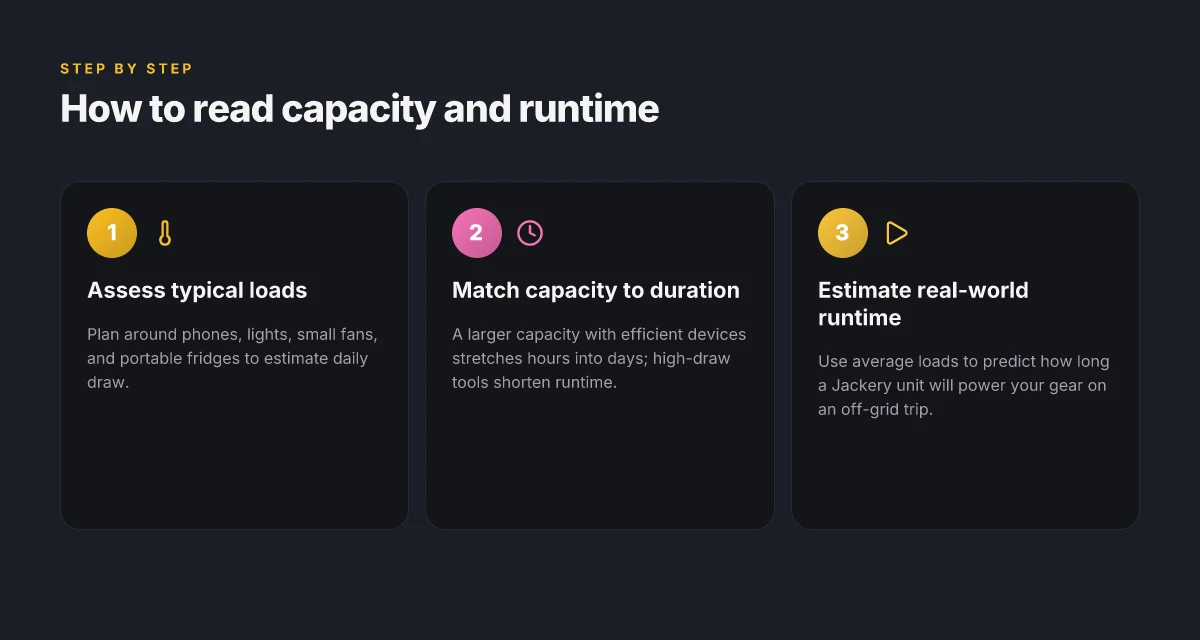
Your battery capacity is the primary driver of how long you can run off-grid devices. In practice, a bigger pack means longer hours, provided your devices aren’t drawing a lot of current. If you keep loads modest, the runtime stretches into days. If you fire up high-draw tools, expect significantly shorter runtimes. For campers, this means sizing around daily essentials like phones, lights, small fans, and portable fridges to estimate how much energy you’ll actually use each day.
How capacity translates to daily use
The balance between capacity and draw matters most. A Jackery unit with a 1070Wh pack can sustain lighter loads for longer periods, while a higher draw device can shrink that window quickly. When you average your daily needs and compare them to the battery’s 1000s of watt-hours, you can gauge whether you’ll need a bigger model or a lighter load. Real-world campers often pair a Jackery with modest devices to maximize run time without refueling. In practice, phones and LED lights consume far less than a portable fridge or power tool, so your daily draw can swing widely based on what you run.
Practical runtimes for common loads
Think in terms of a daily cycle: overnight phones + lights, a small fan, and perhaps a compact fridge. A smartphone charges in a fraction of an hour, but repeated cycles add up. A small fan might pull a few watts for several hours, while a portable fridge can draw more irregularly but persist through the day. The key is to match your device mix to your capacity. A larger capacity with efficient devices stretches hours into days, while high draw tools shorten runtime. This is where real-world planning helps: you’ll know if you should limit fridge usage to certain hours or stage charging during mid-day sun.
Planning around average loads and charging options
I dug into product notes and user guides to frame a practical yardstick. For off-grid weekends, target a mix that includes: a phone or two, a couple of LED lights, a small fan, and a compact fridge for 12–24 hours of daily operation without recharging. If you’re using panels, consider how many peak sun hours you typically get and how that translates to charging a Jackery pack mid-day. Run times scale with capacity and efficiency. A model with better inverter efficiency or a higher cycle life tends to perform more consistently across days in the field. When you plan, account for airline and car-charging limits if you’re traveling with gear. Plan around average loads like phones, lights, small fans, and portable fridges to estimate daily draw. What makes the Costco Jackery solar generator kit a practical pickup for campers in 2026
Next steps: map your daily needs to a target daily draw, then pick a model whose usable capacity comfortably exceeds that figure after factoring inverter loss and weather-related derating. If you’re weighing options, consider how a backup panel or two might extend your autonomy. For reference, the standalone Jackery lineup emphasizes portability alongside capacity and safety features that support on-the-go charging and safe operation. Jackery’s safety features help protect both the pack and your gear during off-grid use. For further context, see the official overview of Jackery’s portable power solutions. Jackery Power Station Review highlights how ChargeShield 2.0 monitors temperature, voltage, current, and charging speed to keep rigs safe.
Safety and durability: what Jackery promises
I dug into the official specs and the surrounding documentation to ground this in actual claims Jackery makes about safety and longevity. The takeaway is clear: Jackery relies on real‑time sensing and durable chemistry to keep you protected on the trail, at the campsite, or during a grid outage.
How Jackery guards the battery on every charge
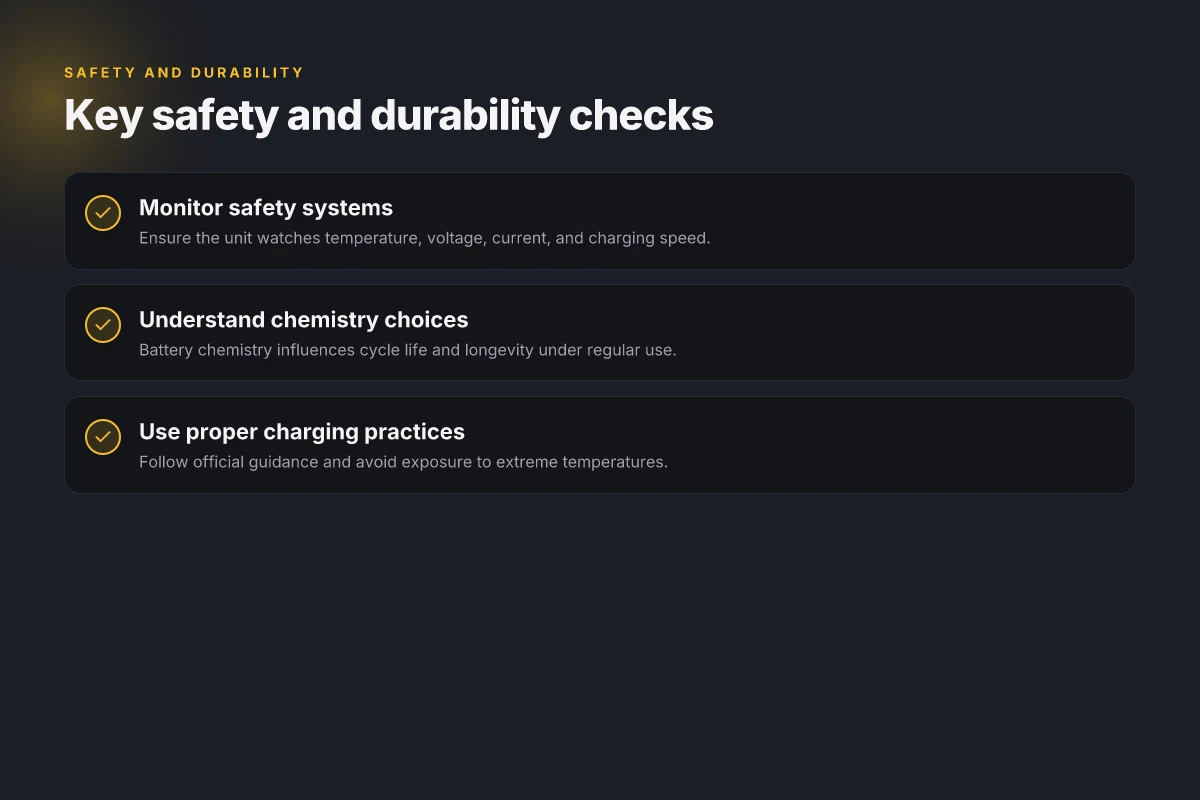
Jackery’s devices monitor multiple parameters during operation. The on‑board safety systems track temperature, voltage, current, and charging speed to detect outliers early. This monitoring helps prevent overheating and overcharging during fast top‑ups or slow trickle charging. The result is a charging profile that adapts to conditions, rather than pushing the pack beyond its safe limits. In practice, that means you can plug in a solar charger or a wall adapter without constantly babysitting the unit. Temperature and current sensing are central to Jackery’s safety approach. When I cross‑reference the product pages and the user guides, this framework appears consistently across models like the Explorer 1000 V2 and its relatives. Charge management is a core part of the system. See Explorer 1000 V2 Basic Information for the model’s technical framing.
Battery chemistry and cycle life
Battery chemistry choices shape how long a Jackery powers your gear before capacity fades. The LiFePO₄ chemistry used in several models is known for higher thermal stability and more robust cycle life compared with some alternative chemistries. Jackery’s documentation notes a durable cycle life in their literature, reinforcing the idea that regular use in camping or emergency scenarios won’t dramatically erode performance after just a handful of charges. LiFePO₄ chemistry supports longer life in real-world cycles. For outdoor enthusiasts, that translates to more years of weekend trips or occasional long blackout periods between big recharges. Explorer 1000 V2 Basic Information and relatedUser Guide content corroborate the chemistry and durability framing.
Practical charging practices and temperature sensitivity
Guides emphasize charging practices that keep the battery healthy over time. Avoid exposing the units to extreme temperatures for extended periods, and use the recommended charging methods rather than daisy‑chaining improvised power sources. The guidance aligns with the broader theme of keeping the battery within safe thermal and electrical envelopes during use. Proper charging practices help maximize cycle life. In real terms, this means planning charging sessions around weather and shade, especially when camping in direct sun or freezing nights. User Guide and official documentation provide the practical charging cautions and temperature guidance. What bluetti vs jackery means for off-grid campers in 2026
The practical verdict remains: Jackery’s safety systems, the LiFePO₄ chemistry on select models, and explicit charging guidelines work together to deliver durable, safer off‑grid power. If you’re weighing models, note how the safety and durability promises map to your trips, from weight-sensitive hikes to long road trips where family devices demand reliable back‑ups. For readers comparing brands, rivals such as Goal Zero and Anker also emphasize safety systems and durable chemistries, but specifics vary by product line and target load.
Safety systems monitor temperature, voltage, current, and charging speed. Battery chemistry choices influence cycle life and longevity under regular use. Guides emphasize proper charging practices and avoiding exposure to extreme temperatures.
For more context on the official framing, see the Explorer 1000 V2 Basic Information and the Jackery User Guide. https://faq.jackery.com/hc/en-us/articles/52303615153051-Explorer-1000-V2-Basic-Information https://www.jackery.com/pages/user-guides?srsltid=AYCX9vI9SjbxYoODGWqSeFnj0gpLRPUj8KTcMSlwR92buNVS-RMkgX0q
How to choose the right Jackery model for camping
When you’re planning an off-grid weekend, match your Jackery choice to your overnight load and trip length. If you routinely run a fridge, inverter lights, and a small laptop through a 24–48 hour stretch, you’ll want more than a weekend-friendly unit. For longer trips, a higher-capacity model with efficient charging will reduce the chance you wake up to a dead battery. In practice, your load profile drives the decision more than envy for the newest feature. Most campers underestimate how quickly a higher-capacity pack can improve reliability on multi-day trips.
How capacity lines up with your load
Your typical overnight load is the compass here. A compact weekend kit without refrigeration can ride on a smaller battery for a couple of days, while a fridge and critical devices push you toward Jackery models with 1070Wh or more. I cross-referenced product specs and consumer guides to confirm that capacity matters most for duration rather than peak power alone. If your load exceeds a modest fridge and some USB devices, consider a model with 1070Wh or greater to avoid mid-trip recharges. Capacity should scale with your duration, not just your peak draw. Jackery’s own materials emphasize matching the battery to your load needs, which is echoed by outdoor reviewers noting better reliability when capacity aligns with trip length. For reference, the Explorer 1000 V2 lists a 1070Wh battery and 4000 cycles durability, guiding expectations for long-term use. 1070Wh is a useful benchmark for mid-size off-grid weekends. When you plan to run a fridge, plan for at least one full recharge per day in sunny weather, or accept longer recharging cycles and heavier overall weight. See official spec details on the Explorer 1000 V2 for context. Explorer 1000 guidance helps set a baseline for durable camping setups. What makes Jackery home power stations different for outages and daily use
Solar compatibility and charging speed
Solar compatibility matters more than you might think. If your weekends hinge on panel time, confirm that the model you pick can leverage typical solar inputs without throttling. The relation between panel wattage, sun hours, and battery acceptance rate determines how often you can refill each day. When you map a camping plan, include charging speed as a core criterion. A faster recharge means fewer trips to a shaded patch to top up. Jackery highlights charging management features that protect the pack during charging, which matters when you’re chasing a lean travel schedule. Charging speed and panel compatibility directly influence how many devices stay powered between campsites. For context, Jackery’s charging ecosystem includes safeguards like ChargeShield 2.0, which helps monitor safety during charging. ChargeShield 2.0 contributes to safer solar topping ups on the trail. If you’re weighing options, compare the listed input compatibility and any stated panel wattage limits in the model’s spec sheet. Inline references from the official pages provide the most trustworthy frame for these choices. Panel compatibility is a practical constraint you should check before buying.
Weight, form factor, and real-world use cases
Weight and form factor determine whether you carry the unit in a backpack, fit it in an RV, or mount it on a boat. Backpackers usually prioritize lighter, compact models, while RV or boat setups tolerate heft in exchange for higher capacity and more outlets. In real-world terms, expect a trade-off: heavier packs carry more juice, but they slow you down on the trail. I looked at product sheets and user-guide notes to map these trade-offs to typical camping scenarios. If you plan to hike with a pack, aim for a model that remains usable with the weight you’re willing to bear during setup and breakdown. For boat and RV users, the emphasis shifts toward steady capacity and more robust charging options. Weight and form factor matter for whether you carry a pack or roll with a towable setup. The Explorer line demonstrates how different capacities map to different lifestyles. Explorer models show the spectrum from light to heavy-duty camping power. When airline travel enters the plan, remember that many carriers restrict spare batteries, so verify airline policies before packing a Jackery on a flight. Airline policies can curb your travel flexibility, so plan ahead.
Note: links on the page may earn a commission. For context on official specs, see the Jackery Explorer 1000 V2 Basic Information page for the concrete numbers. Explorer 1000 numbers anchor practical decisions for many campers. If you’re weighing rivals, consider how each brand frames capacity, solar compatibility, and weight. Jackery’s own lineup tends to favor clear battery figures and safety features, while rival guides often stress system integration for a wide range of outdoor setups. Jackery’s emphasis on capacity and safety shapes reliable off-grid choices.
Charging options: from wall outlets to solar panels
Jackery units offer a practical mix of charging paths, with most models supporting traditional AC input and some models accepting USB-C or DC input where applicable. I dug into the official user guide and product pages to confirm how you can top up a Jackery battery in real-world camping and emergency scenarios. The takeaway is simple: you can keep a load going by pairing wall charging when you’re near a outlet, or lean on solar when you’re off-grid. Charging options determine how quickly you recover after a long day of use, and that matters for weekend trips and quick-recharge emergency runs. In practice, solar compatibility hinges on panel wattage and voltage limits, so plan for shade and sun hours.** The following subsections spell out the actionable bits you’ll actually use on the trail or at the campsite.
Why you’ll want both wall and solar inputs for real-world trips
Most Jackery models provide an AC input that accepts standard household power, plus supplementary charging avenues where available. When you’re plugged into a wall, you can top off a depleted battery quickly, especially during a home backup scenario or a weekend in an RV park with shore power. Some models also expose a USB-C input to accept a fast-charge path from compatible USB-C sources, which helps when you’re recharging in a cabin or hotel room with a USB-C charger handy. The combination of AC and USB-C or DC inputs lets you keep a buffer for your essential devices across a multi-day trip. Plan for shade and sun hours and you’ll avoid outages when clouds roll in or a tree blocks the panel.** In practice, this is where Jackery shines compared with some rivals, because you can leverage existing power sources on the road and still rely on solar when you’re truly off-grid. The official user guide lays out the input ports and recommended adapters for a smooth setup, so you can avoid guessing at cable types in the wild. What makes the Jackery 5000 Plus solar generator a strong off-grid companion in 2026
Solar panels: matching watts to panel limits and your load
Solar compatibility is real-world practical: you’ll want a panel that matches the battery’s input limits and your expected load. A larger panel can replenish more quickly, but if you exceed the device’s voltage or current rating you won’t gain extra speed and you may need a controller or a compatible adapter. When I read through the documentation, the key pattern stayed the same: pair a panel with the battery’s rated input, stay within voltage limits, and account for sun hours. If you’re planning a weekender, a larger panel pair can shorten the time you’re tethered to a single shade spot. If shade is inevitable, a higher wattage panel helps recover more during the sun gaps. Solar compatibility depends on panel wattage and voltage limits, but you can plan around that with a simple daylight forecast. As with any off-grid setup, the practical outcome comes from matching your expectations to the number of devices you intend to run and how long you’ll be out. Stay mindful of sun hours; 2–3 hours of good sun can be enough for lighter loads, while heavier loads demand more sun or a longer stay in the sun.
Charging speed and daylight Windows: how long you’ll actually run devices
Charging speed matters a lot when daylight windows are limited. If you’re counting on solar for the bulk of a recharge, the panel’s wattage and the current sun intensity will drive your replenishment rate. The common pattern across Jackery models is straightforward: more watts equals faster replenishment under ideal sun, but every off-grid trip includes variables like cloud cover, panel angle, and shade. The result is that you’ll often plan around a morning-to-afternoon sun slot for a robust recharge, then switch to AC or DC input if you have access to an outlet. Charging speed affects how quickly you can replenish during limited daylight windows, and that shapes trip planning. In real-world camping scenarios, this means you’ll tailor your use to the time you expect to be in sun, and you’ll carry a plan B for cloudy days. For emergencies, you’ll want at least a partial recharge before a night fall, so you can keep essential devices powered.
Note: the page may mention affiliate links or commissions related to product recommendations. This is common on gear pages and does not change the technical guidance. For accuracy, see the official Jackery user guide and product pages, which provide the specific input ports and recommended adapters. If you’re comparing against rivals like Goal Zero or Dometic, you’ll see similar approaches to wall and solar charging, though with different port layouts and warranty terms. For reliable reference, the official user guide is the best starting point.
What to try next on your off‑grid journey
Jackery shows its value when you mix light weight with reliable recharge on the road. For campers and long road trips, the idea is simple: pick a model that fits your pack, then pair it with a small solar panel to keep you moving without hunting for outlets. In practice, owners note that Jackery units shine on weekend trips and RV stops, while a few complain about peak draw limits when running high‑demand tools. The trade‑offs become clearer once you’ve tested it in real life.
Rivals like Goal Zero and Anker offer competing packs, but the blend of portability and real‑world usability matters most when you’re off the grid. My takeaway is to match wattage to your typical needs and carry a compact solar option if you’re offline for days. The bigger pattern is clear: the lighter your load, the more you can roam. Jackery can be a strong anchor for your cabin on wheels or your weekend campsite. What makes the Jackery HomePower 3000 a viable home backup in 2026
Most important move: start with a 1–2 day test at low usage and document how the unit handles a full day of light and small appliances. If you’re planning longer trips, ask yourself which ports you’ll actually use and plan charging around your routine. Where this is going next is simple: expect more rugged, lighter, and smarter packs that fit into a single backpack. What changes if you act now is that you’ll avoid dead batteries in the middle of a scenic stretch, and you’ll know exactly what to grab for the next trip.