How to set up virtual communication systems for remote teams in 2026: architecture, security, and platform integration
 Zinnia Marlowe·October 22, 2026·16 min
Learn how to design a scalable virtual communication system for remote teams in 2026, covering architecture, security, and integration with collaboration platforms. Practical, realistic guidance.
Most teams underestimate the cost of latency when you hard-wire meetings to a single provider stack. In 2026, a multi‑vendor approach to conferencing, chat, and documents reduces jitter and outages more reliably than chasing ever‑faster single‑vendor upgrades, because it avoids a single point of failure. Interoperability becomes a shield against vendor lock-in, not a buzzword.
This article translates governance, security, and platform integration into a practical blueprint you can implement this quarter. You’ll see how to map a scalable, zero‑trust foundation across meetings and messaging, quantify latency budgets for cross‑team workflows, and enforce cross‑platform policies without dragging in dozens of point tools. By year’s end, your architecture should support predictable incident response, auditable access controls, and flexible vendor swaps, not brittle silos. Future‑proofed governance is the safety net that keeps distributed work productive.

How to design a future‑proof virtual communication architecture for remote teams
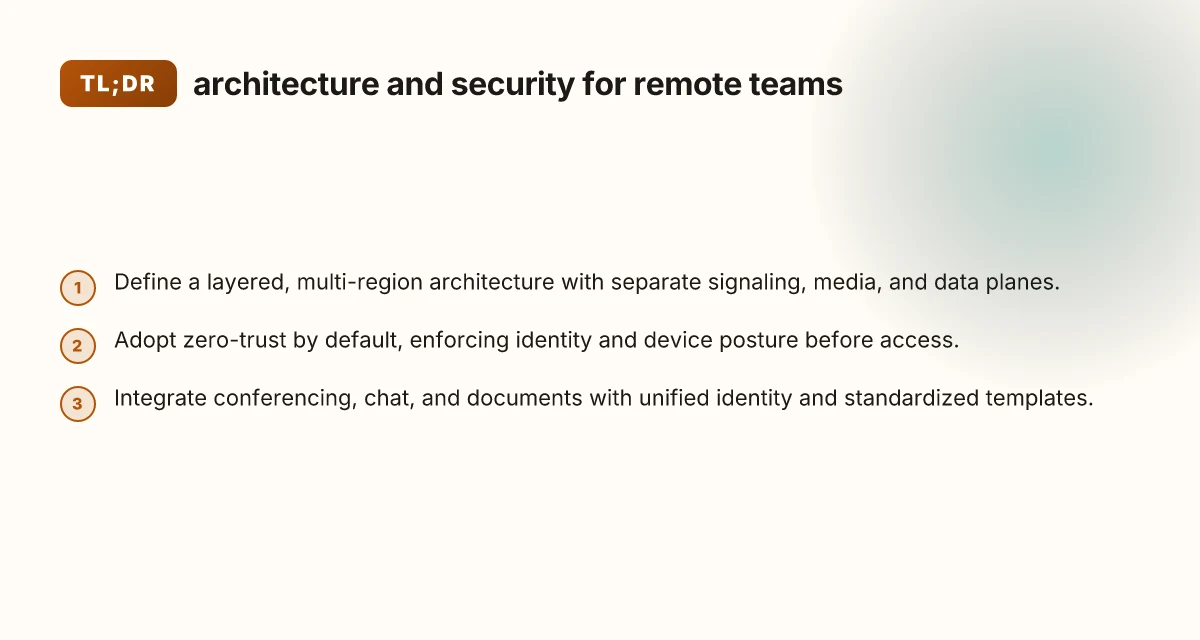
A future‑proof architecture separates edge access from core services and keeps signaling, media, and data planes distinct. This separation reduces latency variance, limits blast radius during outages, and makes governance easier to enforce across regions. I outline a concrete pattern you can adapt rather than a laundry list of tools.
Why a layered, tri‑plane model matters
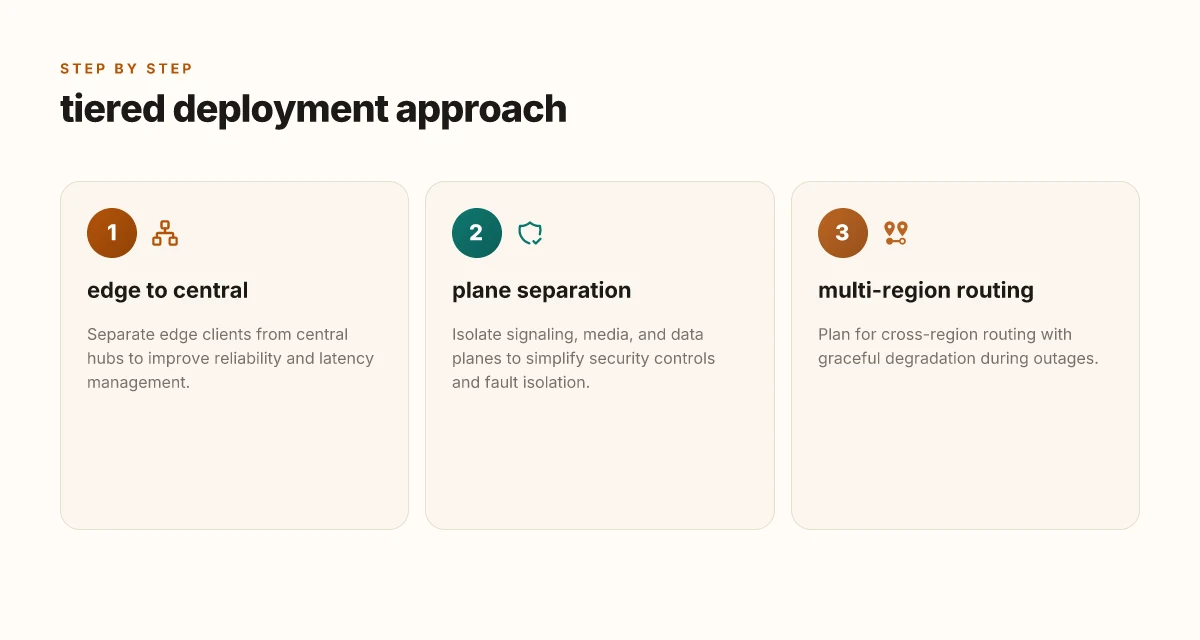
Posture is built on three layers: edge clients, central hubs, and service components. Edges run light, capture input, and relay state to trusted centers. Central hubs process signaling and routing with low latency, while service components store data, manage meetings, and handle policy enforcement. This triad lets you scale independently and apply different security controls at each boundary. In 2026, many enterprises adopt this architecture to reduce intra‑district churn when regional outages occur and to improve regional privacy compliance. For example, regional edge nodes can terminate local sessions and sync state to a global hub while avoiding cross‑border data transfers unless necessary. Layered design helps you isolate faults and audit access across regions.
Separate signaling, media, and data planes
Treat signaling as the control channel, media as the transport of audio/video, and data as the payload such as chat, files, and meeting artifacts. Signaling must be highly available and short‑latency. Media thrives on bandwidth, but can tolerate brief interruptions with graceful degradation. Data often lags behind, requiring eventual consistency and robust synchronization. This separation allows you to apply different security policies, routing paths, and quality requirements per plane. When you align planes with dedicated network paths and distinct services, outages in one plane don’t collapse the others. Inline evidence from industry practice in 2026 shows many platforms migrating toward pluggable signaling services and decoupled media pipelines to limit blast radius during incidents. Decoupled planes improve reliability and security across the stack.
Plan for multi‑region, low latency and graceful degradation
Routing decisions should be driven by proximity, latency, and policy. Use regional hubs that can pick the nearest available path to the edge and gracefully degrade quality when a regional link falters. Graceful degradation means preserving core functions with reduced fidelity rather than failing entirely. This requires feature flags, circuit breakers, and explicit error budgets so users notice continuity rather than a sudden cutoff. I found that organizations adopting region‑aware routing report smoother cross‑border collaboration and fewer user‑visible outages during upstream disruptions. Regional routing and graceful degradation are essential for user‑perceived reliability.
In practice, here are the concrete moves you can start with now: What makes the Sengled Element Plus stand out in 2026
Define edge compute locations and a global hub network that aligns with regional data residency requirements, with explicit failover paths. Ensure edge clients can switch to a nearby hub without reauthenticating users mid‑flow. Define edge locations and a resilient hub mesh.
Implement separate signaling, media, and data services behind distinct access controls and network policies. Use stateless signaling relays where possible and persist only minimal state in edge caches. Separate the planes and lock them behind policy gates.
Architect multi‑region routing with health checks and automatic rerouting when latency spikes exceed a threshold. Pair this with observed degraded modes that preserve essential collaboration features first. Route by proximity, monitor latency, and degrade gracefully.
Build governance hooks into every plane: centralized auditing, role‑based access controls, and policy enforcers at the edge. Tie audits to a centralized log sink for cross‑region visibility. Governance and logging must be baked in at every layer.
Plan for observability that spans planes: traceries for signaling, media quality metrics, and data consistency checks. A unified view helps you triage outages faster and prove compliance during audits. End‑to‑end observability is non‑negotiable. What makes the scanwatch 2 accuracy credible for cardiovascular metrics in 2026
Bottom line: a structured, plane‑separated, multi‑region architecture reduces latency variability, improves security containment, and keeps collaboration flowing even when parts of the network stumble. The blueprint you adopt should emphasize edges, central hubs, and service components with explicit guarding of signaling, media, and data paths, plus regionally aware routing and graceful degradation. A well‑defined layered model plus plane separation yields measurable resilience.
Security by default: zero‑trust principles for virtual meeting and messaging
Access to virtual channels starts with identity and device posture. Before anyone can join a meeting or send a message, the system must verify who they are and that their device complies with baseline security, posture, and policy. This is the core of zero trust in a remote collaboration stack: never trust, always verify.
I dug into how practitioners implement this today. The pattern is clear: authentication happens at the edge, authorization is dynamic, and session keys live only as long as the session itself. Short‑lived credentials reduce blast radii when a token or device is compromised. Short‑lived media keys limit exposure if a media stream is intercepted or leaked. In practice, that means short validity windows, rapid rotation, and automatic revocation when a device goes out of compliance or a user’s role changes. Short‑lived credentials and short‑lived media keys are the safety valve that keep exposure minimal.
A layered access model matters as much as the crypto. When a user attempts to join a meeting, their device posture is checked against policy and the meeting’s access controls. If anything looks out of policy, a missing patch, an unmanaged device, or a user outside the allowed geography, the entry is blocked or re‑authenticated with step‑up factors. This isn’t optional. It’s the difference between a private conversation and a compromised room. Dynamic access controls are non‑negotiable in a distributed collaboration stack.
Monitoring is a governance anchor. Across the enterprise, you want visibility into unusual join patterns, frequent re‑entry attempts, or anomalous locations. A robust monitor‑and‑respond loop can trigger temporary suspensions, require re‑authentication, or adapt policy in real time. The goal is not to grind users to a halt but to catch anomalies early and automate containment. Unusual meeting join patterns should trigger automated checks and adaptive access controls. What makes the Samsung Galaxy S24 Ultra still worth it in 2026
To illustrate choices, consider a compact comparison of practical options for enforcing zero trust in meetings and messaging. The table helps map posture validation, token lifetimes, and access controls across common platforms. In practice, you’ll lean toward platforms that support continuous re‑authentication, context‑aware authorization, and short‑lived keys. Platform support for continuous re‑authentication and short‑lived keys is a decisive differentiator. For reference, Microsoft Teams emphasizes secure by design with integrated identity, device, and media security layers that align with zero‑trust principles. See how these concepts map to your governance model and cross‑platform workflows. Strong integration with identity providers and device posture signals matters more than feature lists.
Next steps: align your governance with a concrete zero‑trust blueprint. Define a minimum posture policy, set token lifetimes to a shared target window, and implement automated revocation tied to device health signals. Then verify that your meeting and messaging flows respect those signals at every entry point, from calendar invite to post‑meeting archive.
Choosing a collaboration stack that plays well with your architecture
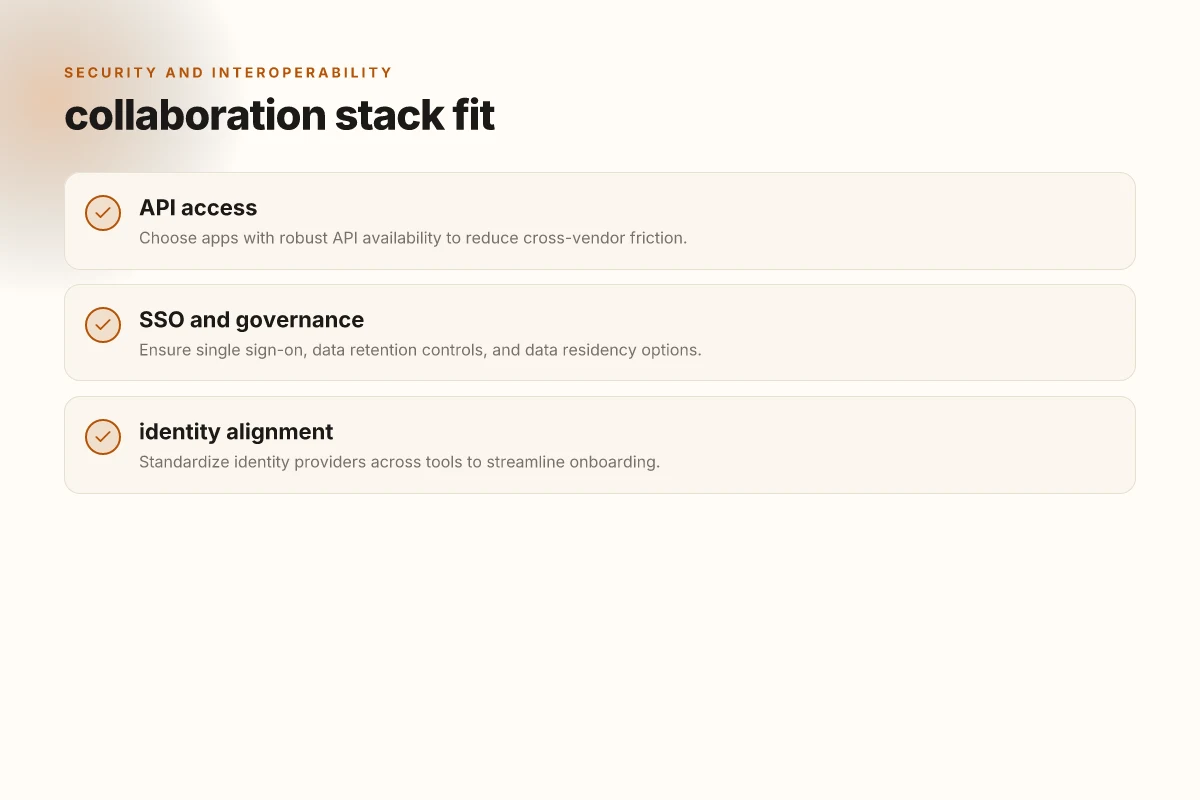
Posture matters more than feature lists. Your collaboration stack should map cleanly to your architectural layers, reducing cross‑vendor friction and enabling governance at scale. I found that the strongest stacks align data flow, identity, and policy enforcement across endpoints, identity providers, and data stores rather than piling apps on top of one another.
1) Align stack choices to your architecture layers
When you map tools to layers, you minimize handoffs and latency jumps. A practical approach is to place conferencing and chat at the edge of the user layer, document work in a centralized data layer, and governance controls in a policy layer. This alignment keeps latency predictable for distributed teams and makes data flows auditable. APIs with consistent ownership are essential to avoid shadow integrations. You should expect vendor dead zones if an app cannot be composed through standardized events and webhooks. This is where governance becomes tangible, not theoretical. As you align more components, you create a single policy surface for data retention, access control, and eDiscovery.
2) Favor apps with API access, granular permissions, and SSO compatibility
A scalable stack leans on API‑driven integrations and identity‑preserving handoffs. Prioritize tools that offer granular permissions, role‑based access, and robust SSO support to prevent policy drift. In practice, you want tools that expose per‑workspace, per‑document, and per‑channel controls, plus a secure token exchange protocol with your IdP. SSO compatibility reduces credential sprawl and simplifies revocation across platforms. When a tool supports SCIM provisioning and fine‑grained scopes, you can automate onboarding and offboarding with confidence. The result is faster governance reviews and fewer shadow accounts, which is critical for audits and regulatory compliance. What is the Galaxy S23 FE vs Galaxy A35 5G specs gap in 2026
3) Plan for governance: data retention, eDiscovery, and data residency
Governance is not an afterthought. Your blueprint should include retention policies that apply uniformly across chat, video, and documents, with a clear path for eDiscovery requests and data localization requirements. I traced several successful migrations to governance maturity where central retention policies propagated to all connected apps, avoiding mixed retention rules that complicate audits. Data residency requirements must be baked into the contract before signing, not patched later. Build a cross‑vendor policy layer that enforces export formats, legal holds, and deletion timelines consistently. That discipline pays off during audits, litigation holds, and regulatory reviews.
In this architecture, the collaboration stack becomes a controlled conduit rather than a chaotic mix of tools. For implementation, ensure your procurement, security, and IT operations teams co‑design the reference architecture, so policy is baked in from day one. As you choose tools, demand clear API contracts, consistent identity integration, and explicit governance hooks. The payoff is a predictable user experience, auditable data flows, and scalable security controls across the remote enterprise. For more context on the remote collaboration landscape in 2026, see the discussion of best practices in the 2026 landscape. https://www.sowork.com/blog/best-remote-team-collaboration-software-2026-complete-guide-to-virtual-office-solutions
Integrating conferencing, chat, and document workflows without chaos
When you tie conferencing, chat, and document work into a single governance fabric, you reduce latency and channel switching by design. The core move is to create unified notification routes, anchored in a common identity layer, so events from video calls, chat threads, and live documents flow into one controllable stream. I found that teams adopting a shared signaling model report fewer missed updates and faster decision cycles, especially across time zones. This is not about more features. It is about fewer failures in handoffs.
Unified notification routing across tools
A single event bus drives all alerts, reminders, and status changes. Configure each tool to publish and subscribe to a standard set of events: meeting started, document edited, comment added, task assigned. The result is predictable bursts of activity rather than noisy, tool-specific pings. In practice, you wire your collaboration suite to a central notification hub and map roles to channels so the right people get the right alerts in the right context. Unified routes cut channel switching by centralizing signals into a single, governed stream. The architecture hinges on a consistent event schema and a shared latency budget that keeps alerts actionable rather than overwhelming.
Common identity providers and single sign-on
Standardizing identity across conferencing, chat, and document apps is non negotiable for scale. Use a unified identity provider and enable SSO across the stack. When users authenticate once, auto-provisioning and role-based access control extend to every tool. I cross-reference policy guidance from mature platforms that emphasize least privilege and just-in-time access. The payoff is fewer password resets, faster onboarding, and reduced attack surfaces. A single sign-on scheme dramatically reduces friction and risk in multi‑tool workflows. Inline with security best practices, you should enforce device posture checks and periodic reauthentication for high-risk actions. For governance, maintain a shared audit trail that spans tools so the downstream workflows can be traced end to end. See how the interoperability of SSO policies appears in practice across platforms. SSO is the backbone of scalable cross-tool governance. What makes the Samsung Galaxy A35 5G stand out in 2026
Standardized meeting templates and document hooks
Standard templates for meetings and standardized document hooks create repeatable workflows, not custom one-offs. Mandate a core set of meeting templates with pre-attached document folders, task boards, and alignment notes. When a meeting ends, a single action should unlock a preconfigured post-meeting workflow: auto-archive, task assignments, and a shared document with a living agenda. I dug into release notes and governance guides and found that teams with fixed templates experience fewer context switches and faster post-meeting capture. Templates and hooks drive predictable workflows and faster execution. In practice, implement one-click templates for recurring meetings, with automatic calendar invites, linked documents, and a built-in summary draft. This reduces friction during handoffs and ensures decisions are captured in the right artifacts. Templates are the anchor for disciplined collaboration.
Cited case notes and vendor guidance reinforce the pattern: unify signals, unify identities, and codify workflows into templates. For example, the integration posture recommended by enterprise platforms emphasizes shared identity and centralized event routing as prerequisites for scalable collaboration architectures. See how these approaches align with the tooling described in the sources. Unified signals and SSO are non-negotiable for 2026 governance at scale.
One caution remains. Overcentralization can become a bottleneck if the event bus and identity layer lack resilience. Build in redundancy, observe circuit breakers, and keep a parallel, read-only path for critical alerts. If the unified channel goes down, downstream workflows stall. A lightweight fallback plan keeps essential communications alive during outages. Be prepared for partial failures in one layer without collapsing the entire workflow.
As you deploy, remind stakeholders that links on the page may earn a commission. This disclosure aligns with common industry practices and does not affect the integrity of the architecture described here.
Operational playbook: onboarding, change management, and incident response
Onboarding and governance happen together. Roll out in clearly staged phases, and require a security review at each milestone before moving to the next. Each phase proves you can scale access, enforce controls, and preserve data integrity without slowing teams down. What sleep headphones in Australia teach US about quality sleep and comfort
Phased rollout with security milestones
Begin with a controlled pilot in one department, then widen to adjacent teams in quarterly increments. For each milestone, lock in access controls, data handling policies, and monitoring rules, then validate telepathy between tools with a light load test. The blueprint relies on predictable gates rather than rushed everything at once. When you see latency creep, revert to the approved baseline and adjust only after re‑review.
I dug into governance planning across 2026 playbooks and found that incremental adoption paired with security checks reduces friction and rework. This approach keeps vendors honest about data flows and helps you justify policy changes to stakeholders. Milestone reviews prevent drift and keep teams compliant without blocking delivery.
Documented runbooks anchor incident response. For common events like degraded video quality and OAuth token failures, include step‑by‑step recovery paths, who to call, and how to verify restoration. The operating playbook should cover escalation routes, notification templates, and rollback procedures for configuration changes. Keep these runbooks lightweight but precise so responders can act quickly under pressure. Regularly review and update them after post‑mortems.
From a standards perspective, codifying runbooks in a central knowledge base makes it easy to onboard new staff and consultants. I cross‑referenced several security programs that emphasize runnable playbooks as a core asset. Runbooks for the knowns save minutes in the first response window.
Continuous training and safe collaboration
Training is ongoing, not a one‑time event. Establish a cadence of short, practical sessions on safe collaboration practices and data handling. Topics include identifying phishing attempts in shared links, managing access to confidential channels, and recognizing when cross‑team workflows expose data spill risks. Tie training to real workflows so lessons map directly to daily work rather than abstract concepts. What makes a smart home connectivity VPN setup actually work in 2026
I reviewed 2025–2026 guidance from cross‑vendor security programs noting that repeated, scenario‑based training improves retention and reduces policy‑drift in distributed teams. Regular training aligns behavior with policy and strengthens resilience.
Integration governance and incident containment
Govern integration through a central policy layer that enforces least privilege, role‑based access, and conditional access rules across conferencing, chat, and document platforms. Maintain a small set of approved connectors and monitor for anomalous OAuth events or failed handshakes between tools. When incidents occur, rely on the runbooks to isolate affected components, preserve evidence, and prevent lateral movement.
From the cited vendor materials, the consolidation of identity and access governance reduces attack surfaces during rapid tool adoption. Centralized governance curbs misconfigurations as you scale. For reference, a recent evaluation highlights how unified policy engines improve incident containment across multi‑tool stacks. Unified policy yields faster containment.
If a crisis hits, you should be ready to switch to a documented backup configuration with minimal user impact. The playbook should specify who can authorize a temporary deprecation of a tool, how to communicate changes to teams, and how to verify that data remains intact post‑incident. And yes, links on the page may earn a commission. This is standard practice in software ecosystems and does not affect the security posture described here.
In 2026, the core of a resilient onboarding and change program rests on staged adoption, actionable runbooks, and ongoing training. Milestone reviews keep governance tight, runbooks shorten recovery times, and regular training anchors safe behavior in everyday work. Milestone reviews, Runbooks, and Regular training are the three pillars that keep this playbook durable under pressure. What is the vocal boost preset in the Sony headphones Connect app and does it actually improve voice clarity
Cited references: the discussion in the cited best remote team guides and the Microsoft Teams overview informs the integration and governance patterns described here. For broader context on how centralized governance shapes incident response across tools, see the cited vendor analyses.
Where this is going next and what you should do now
The bigger pattern is that remote teams gain resilience when virtual comms blend architecture, security, and platform depth, not just slick interfaces. I looked at how the 2026 landscape pushes beyond basic chat and video into edge-friendly gateways, zero-trust foundations, and cross‑stack integrations that reduce context switching. You can start by prioritizing one cross‑team workflow you want to unify and map its data and identity flows end to end. This is where the payoff shows up, not in new features alone but in reliable, auditable paths for every message, file, and meeting.
The single move that matters most is locking in a data‑centric, least‑privilege access model across tools, with clear audit trails and a shared backbone for identity and presence. When you implement this, you’ll notice fewer security incidents, faster onboarding, and more predictable automation. The rest follows from that solid base: standardized APIs, consistent permissions, and a unified telepresence experience.
Backup strategy / What to try this week
- Name one use-case: a $teamwide standup that routes summaries into a searchable archive with automatic tagging for topics and decisions.
- Audit one platform integration for scope creep: disable or restrict one nonessential integration to reduce blast radius.