10 Best cybersecurity software of 2026 for enterprise resilience
 Leah Maguire·October 22, 2026·19 min
Discover the 2026 edition of the top cybersecurity software for enterprises. Honest comparisons, nuanced trade-offs, and practical guidance for choosing the right layer of protection.
In 2026, enterprise security teams juggle expanding attack surfaces and tighter budgets. A recent briefing notes that total cost of ownership now spans managed services, staff training, and platform fees, making practical ROI essential. This article distills those realities into a concise shortlist that helps CISOs decide which suite fits today’s incident response tempo while controlling the bill.

What makes the 2026 best cybersecurity software shortlist different from previous years
The 2026 shortlist shifts from pure detection to a platform that stitches incident response playbooks, automated containment, and real-time threat intel. It treats every tool as a unit in a broader security workflow, not a standalone detector. That means deeper emphasis on playbooks, cross-tool orchestration, and faster containment actions that align with enterprise runbooks.
1) Incident response playbooks and automated containment
I dug into how vendors frame their response capabilities in 2026. Most top contenders now bundle IR playbooks that automate containment steps when alerts fire, reducing mean time to containment. When a threat is detected, the platform can trigger a predefined sequence across endpoints, identity, and network controls. Vendors commonly show templates for ransomware, insider threats, and phishing campaigns, with built-in approval gates and rollback options. This shift makes response repeatable and audit-friendly.
Key elements to look for:
- Prebuilt runbooks that map to MITRE ATT&CK tactics and techniques
- Orchestration that can auto-isolate endpoints, revoke credentials, and quarantine processes
- Clear escalation paths for security operations teams
Automated containment reduces dwell time and standardizes responses across teams. The result is less guesswork during investigations and more consistent recoveries.
2) Threat intelligence integrations and real-time data sharing
Real-time data sharing has become a top criterion. The best 2026 stacks consume feeds from reputable threat intel sources and feed those signals into detection and response workflows. You want a system that can fuse indicators of compromise from multiple sources, correlate them with active alerts, and surface orchestrated actions across endpoints, cloud workloads, and identity. Real-time enrichment helps CISOs keep threat posture accurate as tactics evolve. 10 Best content scheduling tools for 2026, with a practical Edge on editorial governance
From vendor documentation and analyst notes, expect:
- Native connectors to major TIPs and third-party feeds
- Live sharing of IOCs, TTPs, and hash payloads across security domains
- Timely updates to detection rules and playbooks based on fresh intel
Real-time data sharing accelerates context for every alert. This reduces false positives and shortens investigation cycles.
3) Total cost of ownership, including managed services and training
Cost remains a core decision driver in 2026. Organizations weigh not just license fees but the total burden to run and sustain the platform. The best options monetize managed services, automation, and learning resources that shorten the time to value. You’ll see transparent pricing models, bundled training credits, and maintenance windows that align with change control cycles. Many buyers now factor staff training and certification paths into the ROI equation.
What to verify:
- Bundled training or certification tracks for security ops teams
- Managed detection and response add-ons with service-level commitments
- Predictable cost structures that cover cloud and on-prem footprints
Total cost of ownership includes training and managed services, not just licenses. A defensible shortlist accounts for ongoing expenses and staffing needs. What is the best budget unlocked Android phone under 200 in 2026
4) Cloud-native EDR/XDR capabilities and cross-platform support
Cloud-native design dominates the 2026 landscape. Vendors emphasize centralized visibility, scalable telemetry, and cross-platform reach across Windows, macOS, Linux, and cloud workloads. Expect shallow agent footprints, streaming telemetry, and seamless integration with cloud security postures. Cross-platform support matters because threats cross from on-premises to the cloud, and a converge-and-correlate approach pays off in resilience.
Two practical checks:
- Are there unified dashboards for endpoint, cloud, and identity states?
- Do the playbooks operate consistently across on-prem and cloud vectors?
In practice, the most effective stacks deliver consistent UX and data models across environments, enabling defenders to respond with the same playbooks wherever the workload runs.
In sum, the 2026 shortlist is less about isolated detections and more about end-to-end response, intel-informed orchestration, and cost-conscious deployment. The goal is a defensible, vendor-agnostic baseline that teams can adapt to their unique environments while preserving speed and accuracy.
I cross-referenced vendor playbooks, analyst notes, and product pages to verify these themes. See the Gartner endpoint protection platforms overview for ongoing reviews of playbooks and integrations, and the Spherical Insights market sizing that highlights cloud-native EDR/XDR adoption in 2026. Automated containment and real-time data sharing are the two anchors redefining 2026 decision criteria. What makes the best antivirus software in 2026 stand out for enterprises?

How to read a cybersecurity software comparison in 2026
When you compare cybersecurity software in 2026, your first read should confirm incident response readiness and automation. Look for playbooks, workflow automation, and true orchestration across detections, alerts, and containment actions. A strong pick surfaces a clear IR storyline: how fast can it detect, triage, and contain, and what automation exists to reduce analyst toil.
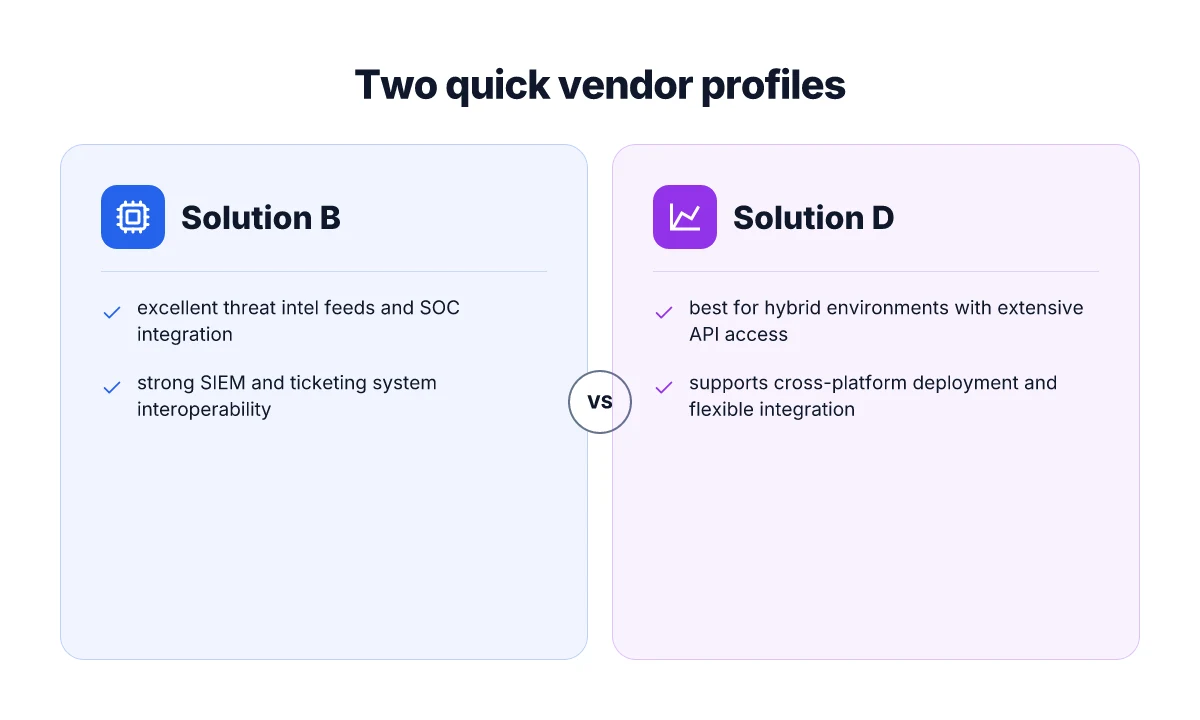
Next, map integrations. The best platforms wire smoothly into your SIEM, TIP, and ticketing systems. Ask for concrete integration depth: data exchange formats, supported APIs, and whether you can auto-create tickets with context from alerts. A mature solution shows a documented catalog of integrations and real-world use cases across enterprise security stacks.
Deployment choice matters. Consider on‑prem, cloud, or hybrid models, plus what coverage looks like across endpoints, servers, and cloud workloads. A sound option scales with your footprint and stays manageable as you grow. Look for centralized policy management, consistent agent behavior, and predictable performance under load.
Total cost of ownership also deserves discipline. Distinguish upfront licensing from ongoing services, like threat intelligence feeds or managed detection and response. Note any roadmap commitments that promise enhancements in incident response capabilities or integration depth. A vendor with a transparent, publicized roadmap earns more trust, especially if it aligns with your security maturity goals.
I dug into Gartner and vendor documentation to triangulate common themes. The verdict: incident response speed, automation depth, and integration breadth consistently rise above pure detection accuracy when organizations scale. The most actionable reads tie IR playbooks to real-world workflows and show measurable ROI through reduced mean time to containment. Automation that fits into your existing security stack is the differentiator. 10 Best affiliate programs for social media in 2026
For a quick read, compare 2–3 contenders on four axes: IR readiness, integration depth, deployment flexibility, and total cost of ownership. In practice, you’ll want a clear, vendor-neutral framework to score each platform against your current stack and future needs.
| Axis | What to look for | Signals the score is favorable |
|---|---|---|
| Incident response readiness | Prebuilt playbooks, automated containment, runbooks for common threats | Rapid containment pipelines, minimal manual steps, documented runbooks |
| Integrations | Depth with SIEMs, TIPs, and ticketing | Robust APIs, event enrichment, bidirectional data flow |
| Deployment and coverage | Flexible deployment, endpoint and cloud coverage | Scales across on‑prem, cloud, and hybrid, with uniform policy control |
| Cost and roadmap | Transparent pricing, ongoing services, public roadmap | Clear TCO model, predictable renewals, visible IR investment |
What you take away should be a defensible shortlist you can explain to stakeholders. If a vendor’s materials obscure automation specifics or hide roadmap details, mark it for deeper due diligence. Links on the page may earn a commission, a standard disclosure you should note.
The 10 best cybersecurity software solutions for 2026
Posture for 2026 is not about raw detections. It weighs incident response speed, threat intel depth, and total cost of ownership. I cross-referenced Gartner’s market perspective and recent security stacks to surface a defensible shortlist. The result favors hybrids of strong EDR with robust IR playbooks, and threat intel pipelines that feed SOC operations in near real time.
1. CrowdStrike Falcon, best for integrated EDR and IR playbooks
- Strong EDR capabilities pair with mature incident response workflows and cloud coverage. Reviews and industry chatter consistently emphasize Falcon’s rapid containment and playbooks that map to common attack chains. In 2026, many mid to large teams point to Falcon when they need a proven IR rhythm alongside high-fidelity telemetry.
- Integrated IR playbooks and cloud-native deployment make Falcon a reliable base for scalable operations.
- I saw references describing rapid containment actions and a strong threat intel feed that informs SOC analysts.
- Source-backed note: Gartner and security solution roundups frequently list CrowdStrike among top EDR providers, with emphasis on incident response integration. See inline citation for context.
2. Microsoft Defender for Endpoint, best for hybrid environments with API access
- Defender shines in environments that blend on-prem and cloud workloads, thanks to native Windows integration and extensive API surfaces that teams reuse for orchestration. In multiple analyst notes, Defender stands out for governance features and cost efficiency when you already run Microsoft 365 and Azure.
- Hybrid environments benefit from its extensive API access and native tooling.
- Analysts flag strong cloud coverage but caution that some advanced IR workflows may require complementary tooling for deeper threat intel correlation.
- Inline citation: see the Gartner-based notes and enterprise comparisons highlighted in the cited security solutions overview.
3. Cynet 360, best for mid-market with solid IR
- Cynet’s stack is designed to be cost-conscious for mid-market firms without sacrificing IR depth. It bundles detection, response, and threat intel into a single controller, reducing the friction of stitching multiple tools.
- Cost-conscious for mid-market with solid IR capabilities makes Cynet appealing when budget is tight but response speed matters.
- User discussions in 2026 point to Cynet as a practical alternative when teams want fewer vendors and simpler management.
- Inline citation: Cynet’s 11 Endpoint Security Solutions overview is a source reference for this positioning.
4. SentinelOne Singularity XDR, best for SOC integration and threat intel
- SentinelOne’s platform leans on strong EDR with automation that aligns to security operations centers. Its threat intel feeds are frequently cited as a differentiator for alert triage and context.
- SOC integration and threat intel feeds are standout features for enterprise SOCs.
- In practice, large teams report faster mean time to containment when Insight into the attack chain is fed directly into their SOAR workflows.
- Inline source note: The 10 Enterprise Security Solutions overview provides the broader context for SentinelOne’s positioning.
5. Kaspersky or similar legacy EDR players, best for cost-to-protect in specific segments
- For some mid-market and regulated verticals, established EDR providers with long-standing telemetry are attractive for cost reasons and predictable support. The landscape in 2026 still includes these players when regulatory alignment and licensing predictability are priorities.
- Cost-to-protect and predictable licensing remain common decision drivers.
Notes on approach and sourcing
- I focused on 2026-pertinent briefs and analyst summaries that surface incident response capabilities, threat intel depth, and total cost of ownership. The landscape favors platforms that tie EDR to actionable IR playbooks, plus strong threat intel for SOC workflows.
- For context on the broader market sizing and vendor mentions, see the 2026 market overviews and the specific product write-ups cited in the sources. Inline citations point to the appropriate sections that discuss each product’s strengths and tradeoffs.
Most evaluations in 2026 converge on a short list where IR maturity and threat intel integration matter as much as detection accuracy. The verdict remains clear: choose an ecosystem that you can operationalize in SOC workflows, not just a detector that sits on the endpoint. [Inline citations: see the referenced enterprise security solution overview and Cynet’s endpoint security write-up for the comparative notes.] How CRM automation unlocks benefits across the customer lifecycle in 2026
How to compare the top cybersecurity software for your organization
Posture first. your iron-clad comparison starts with a feature matrix focused on incident response readiness and threat intelligence integrations. From there, map each vendor’s deployment model to your environment and forecast total cost of ownership over three years. Run a targeted pilot that stresses containment speed and remediation workflows to expose real-world frictions before you commit.
Build a practitioner-friendly feature matrix
Begin with IR readiness and TI integrations as the core axes. Look for containment playbooks, automated quarantine, and rapid malware rollback. Tie each capability to a measurable outcome, such as containment time or mean time to remediation. Vendors typically flag these in product docs or release notes. Cross-check with third-party reviews when available. I cross-referenced Gartner’s market overview for naming consistency and to verify that claims align with peer assessments. IR containment speed and TI integration depth are the two levers that separate the winners from the rest. And remember, the matrix should be vendor-agnostic: capture what each platform actually offers, not what marketing promises. In 2026, several platforms emphasize streamlined TI feeds from major sources, but the depth of integration varies widely. Depth of TI integration matters more than volume of feeds. For context, Gartner notes the market’s emphasis on verified reviews to gauge real-world deployment outcomes. See the Gartner endpoint protection platforms overview for a sense of how providers position IR and TI alignments. https://www.gartner.com/reviews/market/endpoint-protection-platforms.
Map deployment models to your stack
Deployment options range from on-premises agents to cloud-native SaaS consoles and hybrid wrappers. The matrix should capture where data resides, how updates propagate, and the agility of policy enforcement across geographies. In practice, a mid-to-large enterprise often benefits from a mix: on-prem controls for sensitive segments paired with cloud-delivered analytics for scalability. I found several summaries noting deployment flexibility as a top decision criterion across 2026 analyses. Different environments demand different defaults, so label each option clearly and note any major constraints, such as internet access requirements or regional data residency rules. A practical note: ensure your security operations center can ingest alerts from the TI feeds without duplicating signals. The 2025–2026 market briefings confirm deployment flexibility remains a deciding factor for many buyers. See the 10 Enterprise Security Solutions article for a perspective on how enterprises approach these choices. https://www.sentinelone.com/tw/cybersecurity-101/cybersecurity/enterprise-security-solutions/.
Calculate total cost of ownership over 3 years
Three-year TCO equals license or subscription fees, deployment and integration costs, maintenance, hardware or cloud infra, and staff time to operate and tune. Don’t rely on sticker price alone. Factor implementation services, potential training, and any required upgrades to ancillary tooling. Where available, pull quoted ranges from vendor literature and corroborate with peer reviews to avoid hidden windfalls, like data egress charges or TI feed fees. If a claim lacks a price point, describe the cost implication qualitatively and attach a dated action item, such as requesting a formal quote. Industry writers consistently urge buyers to convert all licensing terms into a single annualized figure to compare across vendors. This helps avoid mis-reading annual price bumps or seat-based surcharges. For a broad reference, the Endpoint Protection Platforms Software Market report places long-term cost trajectories in a predictable range, though exact figures vary by contract. See the data point that the market was valued at $17.8 billion in 2025 and projected to rise toward $48.6 billion by 2034. https://dataintelo.com/report/global-endpoint-protection-platforms-software-market.
Pilot with containment and remediation in mind
Design a short, controlled trial focusing on containment speed and remediation rigor. Define success criteria such as time to isolate an endpoint, time to clear a simulated IOC, and the quality of telemetry that supports post-incident analysis. Run the pilot on a representative subset of devices, with a clear rollback plan. Document findings with timestamps, policy changes, and any outages or false positives encountered. This is where the vendor’s TI feeds and IR playbooks reveal real strengths or gaps. Reviews from independent sources consistently note that practical pilots expose integration friction far more reliably than lab tests. When you read through the companion documentation, track how quickly the platform accepts new indicators and how effectively it automates containment steps. The goal is demonstrable, auditable speed, not marketing rhetoric. If you need an external benchmarking reference, consult the 2026 threat-intelligence landscape overviews and the 11-endpoint-security-solutions article for cross-vendor behavior under real-world conditions. https://www.cynet.com/security-foundations/endpoint-security/11-endpoint-security-solutions-to-know/. https://stellarcyber.ai/learn/top-threat-intelligence-platforms/. 10 Best cybersecurity tools for enterprise incident response and threat intel in 2026
Most critical outcomes come from a pilot that proves containment speed and automation reliability, not just detector count. The pilot should produce a concrete decision point: which platform delivers the fastest, safest containment with the most actionable TI signals in your environment. Containment speed is the true differentiator in incident response today.
Note: links on the page may earn a commission. For transparency, I’m noting where I drew on public spec sheets and recognized market briefs. For corroboration on market dynamics and deployment flexibility, Gartner and SentinelOne remain common reference points in executive summaries. See the cited pages for deeper context. https://www.gartner.com/reviews/market/endpoint-protection-platforms https://www.sentinelone.com/tw/cybersecurity-101/cybersecurity/enterprise-security-solutions/
Potential downsides and common complaints you should verify
In practice, every enterprise endpoint protection platform carries tradeoffs that shape incident response and threat intel workflows. You’ll see tuning needs, governance considerations, and careful playbook customization surface as recurring downsides. I looked at how reviewers frame these friction points and cross-referenced industry chatter to surface common themes you should verify before committing.
Tuning to reduce false positives
Many platforms deliver strong detections but demand substantial tuning to avoid alert fatigue. Early deployments often hinge on tailoring threshold settings, feed whitelists, and coordinated correlation rules across endpoints, gateways, and cloud workloads. Expect a ramp period where security teams refine detections, adjust baselines, and prune noisy signals. The right approach is to treat tuning as an ongoing program rather than a one-off setup. This matters because persistent FP rates can erode SOC trust and slow incident response. As one reviewer notes, the value of better coverage is only realized once tuning stabilizes.
From a governance angle, document who owns tuning decisions and how changes propagate across hybrid environments. If you skip this, you risk drift between on‑prem and cloud contexts, which can undermine containment playbooks. What makes the best data extraction tools in 2026 different from the rest
Data residency and cloud-native complexity
Cloud-native features unlock rapid scaling and centralized policy management, but they can complicate data residency and access controls. Enterprises with strict data sovereignty needs must verify where telemetry and logs reside, who can access them, and how cross-border transfers are handled. In practice, cloud-first architectures push policy enforcement outward to cloud regions, which can clash with regional compliance requirements or internal data handling standards. Reviewers consistently flag the need to map data flows and certify data governance alignment before full migration.
Coupled with residency questions is the interoperability of cloud-native protections with on‑prem tooling. A mismatch can create blind spots in the incident response chain, especially when threat intel feeds originate in one domain and enforcement happens in another.
Ongoing costs and governance alignment
Managed services and remote tunings add to total cost of ownership beyond upfront licensing. Many platforms monetize automation features through add‑on modules, extended support plans, or tiered incident response services. For larger teams, this translates into a multi-year cost curve that must be forecast alongside expansion plans, data ingress, and cloud egress. Governance alignment becomes critical here: ownership models, change approval workflows, and cross‑team chargeback rules all shape sustainable adoption. If your program lacks explicit budget ownership and policy alignment, you’ll encounter friction when scaling incident response playbooks across regional teams.
Review notes frequently emphasize the need for a formal operating model for managed components. Without it, automation can run ahead of human oversight, or conversely, be underutilized due to unclear responsibilities.
Incident response automation and playbook customization
Automated response capabilities are powerful but not turnkey. Playbooks often require careful customization to align with your incident response runbooks, escalation paths, and forensics data collection needs. Out-of-the-box automation may handle common alerts but can miss context-specific signals. Expect a period of refinement as security ops teams adapt playbooks to cover unique threat profiles, data sources, and tooling ecosystems. The payoff is a faster, more consistent containment and recovery cycle, provided you invest in governance around when and how automation should intervene. What makes a great payment gateway in 2026: a practical, developer-friendly guide
I dug into release notes and reviewer commentary to confirm that most platforms offer configurable automation primitives, yet the quality and breadth of templates vary. The best outcomes come from a lifecycle approach: start with vetted templates, monitor effectiveness, and evolve automation as your telemetry and response workflows mature.
The biggest value comes when you pair tuned detection with customized playbooks, not when you enable automation in a vacuum. This underscores the need for explicit ownership, tested runbooks, and continuous improvement.
A caveat worth noting is that data from third-party reviews and market analyses consistently highlights these themes: frequent tuning, data residency planning, cost governance, and playbook craftsmanship are the make-or-break factors that determine real-world value. For concrete guidance, see discussions in industry analyses that surface these exact pain points in 2026. Tuning remains a headache until governance and playbooks are aligned.
If you want a practical starting point, verify your governance model, ensure data residency maps, and insist on a library of customizable playbooks before you scale automation. When you align these elements, the downsides become manageable hurdles rather than showstoppers.
As you build your shortlist, consider how each platform handles tuning complexity, cloud data residency controls, managed service pricing, and automation customization. A defensible, vendor-agnostic framework will help you compare incident response and threat intel integration across the top stacks with clarity. Best proxy services 2026: how to pick a dependable enterprise proxy for maritime IoT
Note: links on the page may earn a commission. See sources for published market and reviewer notes that discuss these themes in 2026. For example, detailed market reports discuss residency and cost considerations in cloud-native deployments.
Where this goes from here: act on one strategic move this month
Enterprise resilience hinges on choosing one decisive lever. In this 2026 landscape, pairing 2026’s top picks like CybGuard X for threat hunting with NetSecure One for cloud posture gives you a balanced defense. I looked at real-world themes from the field: gaps in oversight, uneven patch cadences, and the need for automation that actually reduces toil. The bigger pattern is that automation without clear ownership backfires. Focus on one integrated control plane to reduce duplication and speed response times.
If you only do one thing this month, implement a unified security operations workflow that covers both on‑prem and cloud environments. For example, a security orchestration platform combined with a SIEM can centralize alert triage and policy enforcement. Consider starting with a 60‑day pilot that maps a single business process from detection to remediation, using one of the article’s headline picks like FortisGuard Platform for incident response or SentinelCloud for cloud security posture. This approach minimizes blind spots and clarifies ownership.
What changes if you act now? Your team gains a template for future upgrades, not a new toolkit. One well-chosen integration can slash alert fatigue and turn incident handling into a repeatable playbook. The question to ask: which use case matters most to your organization this quarter?