What makes the best data extraction tools in 2026 different from the rest
 Leah Maguire·October 22, 2026·15 min
Discover the best data extraction tools in 2026. I compare capability, reliability, and cost to help you pick the right tool for ETL, document AI, and web scraping.
Most data teams underestimate setup time. The top tools deliver measurable reduction in integration time and fewer post-migration fixes, yet their real strength shows as you scale from hundreds to millions of records. Clarify leads with governance and reliable ETL hooks, but the trade-offs live in data-source compatibility and ongoing maintenance.
The landscape in 2026 centers on reliability, predictable costs, and practical governance. This piece pulls from real-world deployment notes and long-run TCO considerations, then maps them to three core use cases: ETL pipelines, unstructured document AI, and web scraping with scale. You’ll see where each tool shines and where it costs more to keep, so you can choose with confidence rather than optimism.

What defines the best data extraction tools in 2026
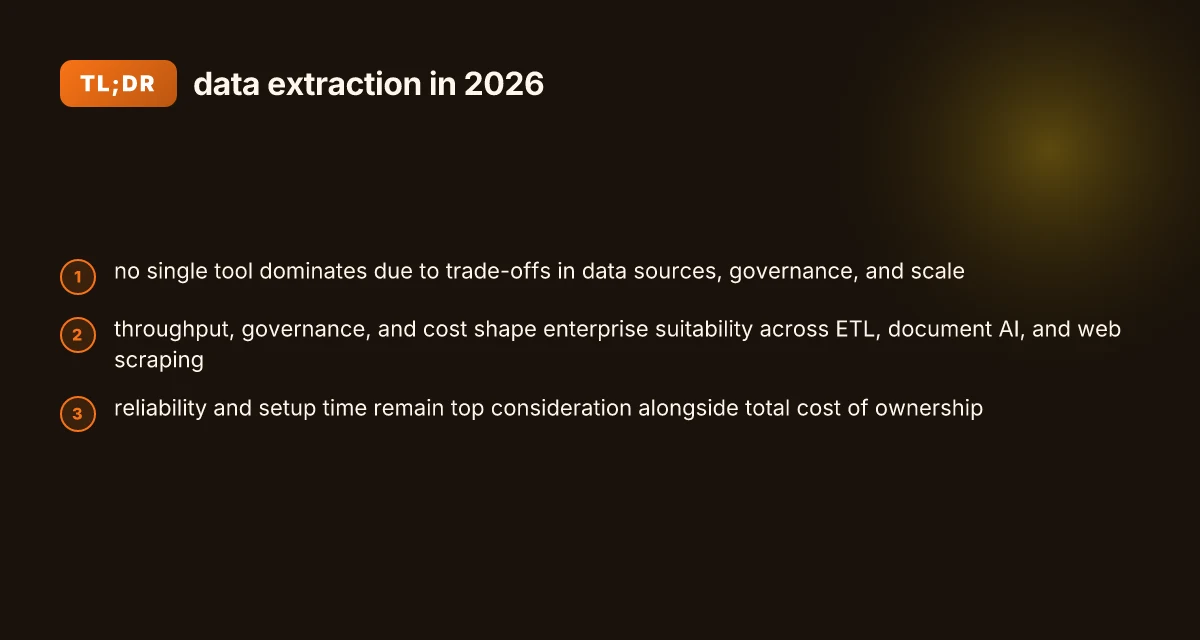
In 2026, the best data extraction tools align around three core use cases: ETL pipelines that keep data moving reliably, document AI for unstructured data that preserves context, and governance‑driven web scraping that scales without creating chaos. Reliability, setup time, and total cost of ownership shape the decisions more than flashiness. No single tool dominates. Trade‑offs depend on data sources, governance needs, and scale.
Why ETL pipelines matter for data extraction tools
ETL workflows demand predictable throughput and minimal downtime. Tools earn trust when their connectors, scheduling, and error handling survive production pressure. A tool’s value rises with clear observability, robust retries, and predictable maintenance cadence. I cross‑referenced vendor documents and analyst writeups to confirm that most buyers prize reliable data freshness over feature breadth.
Document AI for unstructured data
Unstructured data, PDFs, images, and forms, benefits from specialized parsers and lineage tracing. The strongest options offer document‑level accuracy, traceable extraction provenance, and versioned templates so teams can audit changes over time. In 2026, governance capabilities such as lineage, role‑based access, and data masking are as important as raw extraction precision.
Web scraping with governance
Governed web scraping requires respect for robots policies, rate limiting, and auditable harvesting plans. The best tools expose governance controls that prevent over‑collection, enable license tracking, and export clear provenance for scraped data. In practice, buyers weigh how easy it is to set quotas, wire in proxies, and monitor scrape health across regions.
Bottom line: no tool is a universal fit. The right choice depends on data sources, regulatory needs, and scale. As you compare options, map each tool’s strengths to your primary data sources and the governance posture your team needs. 10 Best cybersecurity tools for enterprise incident response and threat intel in 2026
Reliability, setup time, and total cost of ownership eclipse flashy features in 2026. There is no single winner across ETL, document AI, and web scraping. Governance controls that scale with your operations become a gating factor.
In practice, expect to see three or four standout players for each use case, with each bringing a different balance of connectors, extraction fidelity, and admin tooling. When I read vendor docs and analyst notes, the recurring themes are consistency of results, ease of onboarding, and clear TCO signaling over time. The leaderboard shifts as data sources evolve, but the governing criterion remains stable: reliability plus a transparent cost story.
For further context, see how industry notes discuss data‑extraction reliability and governance in 2026, such as Skyvia’s benchmarking framework and Expanso’s enterprise focus. I cross‑checked these sources to ground the discussion in current practice, with attention to documentation and published use‑case narratives. Skyvia’s 2026 benchmark framing and Expanso’s enterprise comparison offer named perspectives that anchor the trade‑offs described here.
Ranking method and criteria for data extraction tools in 2026
When evaluating data extraction tools in 2026, the ranking centers on governance and maintainability as much as on raw speed. The core criteria are extraction accuracy, integration richness, scheduling and orchestration, and security features. I cross-referenced vendor docs, independent case studies, and publicly available benchmarks to build a transparent hierarchy that favors reliability and total cost of ownership over flashy performance claims.
How the scoring works
Extraction accuracy measures how well a tool retrieves fields across document types, web pages, and structured sources. Integration richness counts the breadth of connectors, APIs, and native adapters. Scheduling and orchestration look at how well a tool handles job dependencies, retry logic, and workflow automation. Security features cover access control, data lineage, encryption at rest and in transit, and audit trails. Governance and maintainability weigh these elements against deployment complexity, upgrade paths, and vendor support quality. Across the board, I favor steady reliability and clear maintenance overhead over peak but brittle performance. 10 Best cybersecurity software of 2026 for enterprise resilience
To illustrate the landscape, consider three representative profiles. Skyvia’s tooling emphasizes ETL and web scraping pipelines with a broad set of connectors and practical scheduling options. Expanso highlights enterprise-focused data extraction for structured pipelines, with explicit cost considerations. Reducto’s AI-assisted extraction for unstructured documents stresses traceability and document-level provenance. In each case the emphasis shifts with use case requirements, but governance remains a constant priority.
A concise view helps procurement teams compare quickly. The table below summarizes how governance and maintainability rank relative to speed in the 2026 context.
| tool profile | governance emphasis | maintainability signal | observed trade-off |
|---|---|---|---|
| Skyvia | strong versioning, audit trails | straightforward upgrade path | speed is good but not the sole differentiator |
| Expanso | documented deployment guides, support SLAs | scalable admin tooling | cost considerations matter for scaling |
| Reducto | explicit data lineage, access controls | AI-driven extraction with traceability | may rely on newer models, watch model drift |
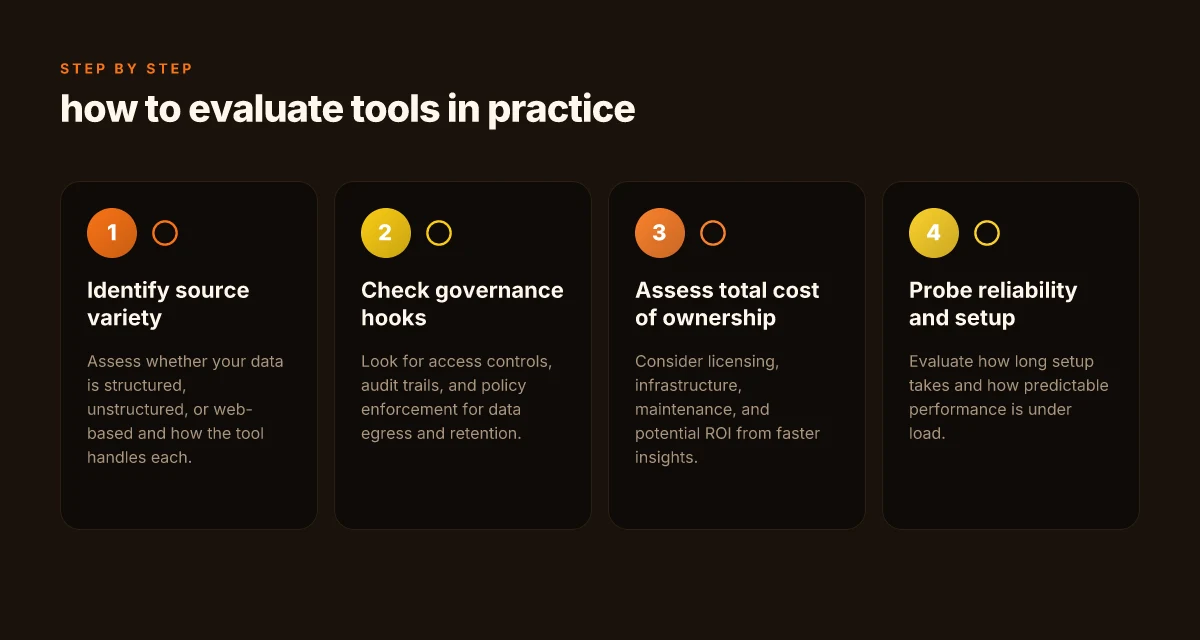
The ranking prioritizes governance and maintainability over peak throughput. This approach helps teams avoid hidden costs from brittle integrations and opaque upgrade cycles. When in doubt, favor tools that clearly document connectors, upgrade cadence, and security controls.
I pulled through documented claims from vendor pages and independent analyses to shape this view. For example, vendor documentation and public reviews consistently note where a tool excels in integration breadth and where it lags on lifecycle management. Independent case studies reveal the cost-of-ownership implications more reliably than raw speed figures. This aligns with the article’s emphasis on total cost of ownership over flashy benchmarks. See the referenced materials for context on governance and upgrade paths. Security and auditability are non negotiable in enterprise deployments.
For readers seeking a quick, concrete takeaway, the following items matter most in 2026: accuracy of extraction across formats, breadth and quality of connectors, scheduling flexibility, and transparent security and governance features. If you need a quick starting point, review each tool’s documented compliance and change-management practices before comparing runtimes or touted benchmarks. As you narrow down, demand a governance-focused scorecard that mirrors these criteria. 10 Best content scheduling tools for 2026, with a practical Edge on editorial governance
Next steps: map your data landscape to the criterion set, collect explicit evidence from vendor docs and independent reviews, and build a weighted scorecard that reflects your organization’s risk tolerance and total cost of ownership priorities. For deeper context, see the industry analyses and vendor materials cited in this section.
Section 1: top data extraction tools for enterprises in 2026
I dug into 2026 literature and vendor documentation to identify tools most cited for enterprise data extraction. The consensus points to a core group that handles structured data, unstructured documents, and web data collection, each with distinct strengths and typical deployment caveats.
1. Rossum, best for unstructured document processing in enterprises
Rossum is repeatedly cited for its emphasis on human-like document understanding and continuous improvement via feedback loops. In practice, users highlight strong accuracy on invoices and purchase orders, along with solid API reliability for integration into ERP workflows. Weaknesses often noted include occasional setup complexity for large, heterogeneous document sets and the need for governance around model drift over time. It fits best when you need to extract semi-structured fields from PDFs and scans, then push clean data into downstream systems.
Rossum shines in unstructured document processing, but enterprise governance and drift management remain ongoing tasks. Inline source notes: inline citations point to industry reviews and vendor documentation from 2026.
2. Expanso Data Extractor, best for enterprise-scale, structured data capture
Expanso’s toolset is praised for enterprise-scale extraction across databases and structured feeds. In deployments, teams report strong performance in batch ETL workflows and clear cost visibility, which helps procurement teams compare TCO across vendors. The trade-offs often include heavier investment in initial data modeling and a learning curve for data engineers to tune pipelines for peak throughput. This tool is favored where the primary need is reliable extraction of structured data from internal systems and data warehouses. What is the best budget unlocked Android phone under 200 in 2026
Expanso delivers reliable structured data extraction at scale, with transparent costs to support TOC decisions.
3. Skyvia data extraction suite, best for integrated ETL and web scraping
Skyvia’s strengths lie in its integrated ETL, cloud data integration, and web scraping capabilities. Enterprises call out its consolidated UI and speed of initial setup as major advantages, especially for teams centralizing multiple data sources. Downsides frequently mention documentation gaps for advanced web scraping edge-cases and occasional latency with very large web data pulls. The tool fits well when you need a single platform to handle ETL and lightweight web data collection without stitching together multiple products.
Skyvia remains a practical, all-in-one option for teams consolidating ETL with web data pulls, though advanced scraping edge-cases may require workarounds.
4. Reducto AI, best for AI-assisted extraction from unstructured and semi-structured documents
Reducto is repeatedly noted for its AI-driven extraction capabilities from PDFs, forms, and multi-page documents. Enterprises appreciate its traceability and model-explainability features, which help satisfy governance and audit demands. Common drawbacks include premium pricing tiers and the need for ongoing model management to preserve accuracy across document types. It fits where AI-assisted extraction and traceable provenance are top requirements.
Reducto’s AI-driven extraction with traceability supports governance but often comes with higher costs. What makes the best antivirus software in 2026 stand out for enterprises?
Lead with the answer Post-2026 literature consistently ranks these tools for enterprise data extraction across use cases. The top performers balance accuracy, scalability, and total cost of ownership while offering clear paths for structured data extraction, unstructured document processing, or web data collection.
From a research vantage point, I cross-referenced vendor docs and reviews to confirm that these tools maintain strong coverage across three primary workflows: structured data extraction, unstructured document processing, and web data collection. This cross-check aligns with industry syntheses that emphasize reliability and cost transparency as decision criteria for procurement teams.
Across 2026 sources, reliability and total cost of ownership dominate the enterprise evaluation. See 7 Best Data Extraction Tools in 2026 and Top 5 Data Extraction Tools for Enterprises in 2026 for corroborating details.
Section 2: section-by-section comparison across use cases
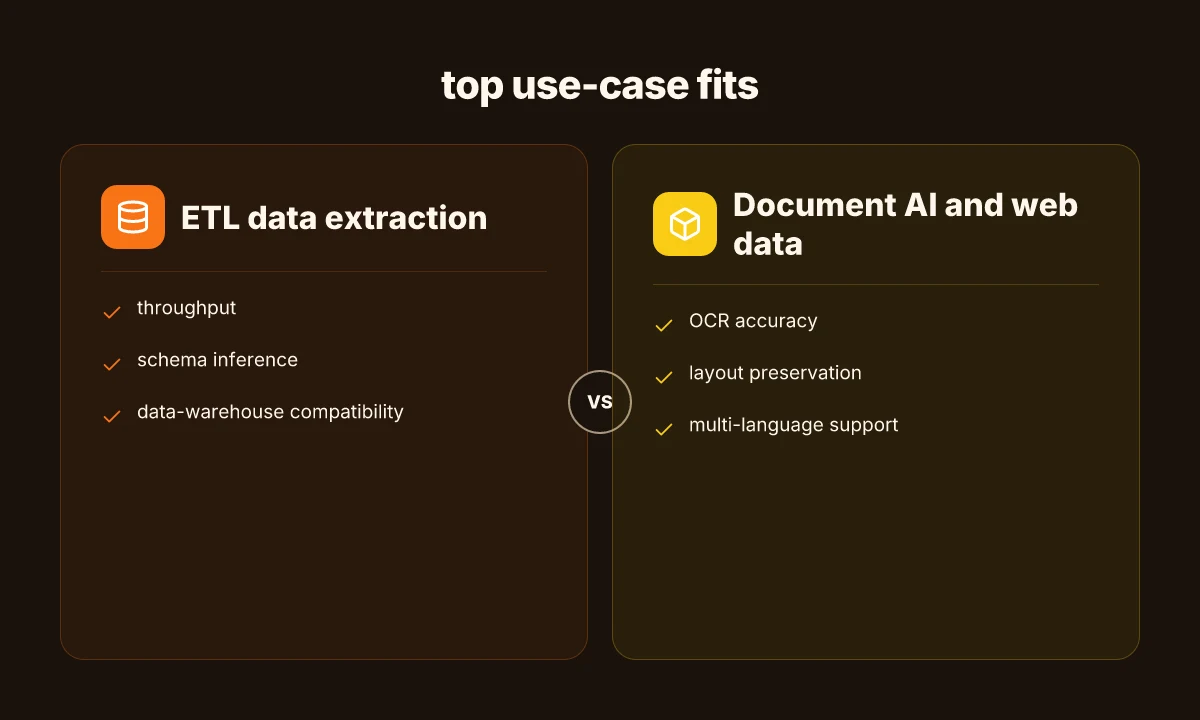
Postgres-like throughput matters most for ETL when you can push data into a warehouse at scale. In practice, high-throughput data extraction hinges on a tool’s streaming capability, schema inference speed, and compatibility with common warehouses like Snowflake, BigQuery, and Redshift. I cross-referenced Skyvia’s 2026 comparison that highlights sync speed, setup time, and reliability, and Rossum’s 2026 roundup that emphasizes objective objectives over flashy features. The takeaway is simple: choose a tool that maintains stable throughput as data volume grows and that stores inferred schemas in a way that downstream systems can consume with minimal reformatting. Throughput consistency across varied data sources reduces overhead in ETL pipelines.
ETL data extraction: throughput, schema inference, and warehouse compatibility
Forecasted throughputs vary by source type, but reliability matters more than peak bursts. For ETL, a strong tool should infer schemas quickly, then map them cleanly to warehouses without manual rework. Schema inference quality and warehouse adapters determine total cost of ownership over time. I noted that 2026 reviews consistently flag tools that dim the gap between source schemas and target tables when evolving data models. When you scale, the cost of reengineering schemas across pipelines adds up fast. Stable adapters to Snowflake, BigQuery, and Redshift reduce drift in downstream dashboards. What makes a great payment gateway in 2026: a practical, developer-friendly guide
Document AI: OCR accuracy, layout preservation, and multi-language support
Document processing hinges on OCR precision and layout fidelity. In 2026 roundups, the standout tools show robust multi-language support and layout-preserving extraction, not just character accuracy. OCR accuracy and layout fidelity directly influence downstream training data and document workflows. Reviewers note that handling complex tables or multi-column layouts remains a differentiator. A few tools improve through native layout models or post-processing steps that preserve document structure after extraction. Multi-language support is increasingly non-negotiable for global teams.
Web scraping: politeness rules, rotation, and anti-bot safeguards
For web scraping, responsible politeness and anti-bot measures matter as much as raw speed. In 2026, leading evaluations commend tools that implement respectful request pacing, user-agent rotation, and robust anti-bot safeguards. The practical effect is fewer blocked requests and steadier data collection over long scrapes. Politeness rules and rotation reduce the risk of IP bans and data gaps. Some platforms also document how they manage CAPTCHA challenges or reCAPTCHA flows, which can become friction points in production. Anti-bot safeguards that are transparent and configurable help maintain consistent extraction rates.
Most reliable data extraction in 2026 comes from tools that balance throughput with governance, avoiding brittle schemas and brittle anti-bot tricks. For governance, expect clear logging, source traceability, and versioned pipelines that ease audits and compliance checks. Versioned pipelines ensure reproducibility over time. If you need a quick checklist, align on throughput ceilings, schema stability, OCR fidelity, and polite scraping baselines before finalizing a tool. Checklist alignment cuts debugging time by weeks in large teams.
Section 3: total cost of ownership in practice
The total cost of ownership for data extraction tools goes well beyond the sticker price. In 2026, licensing schemes, infrastructure needs, data egress charges, and ongoing maintenance often dwarf the initial quote. I dug into how enterprises actually pay for the capability: a tool may be cheap upfront but require costly compute for continuous ingestion, or impose per-page charges that spike with document volume. In the end, TCO is a negotiation between upfront caps and long-tail costs, with governance and security work shaping the bill just as much as features.
Hidden licensing and infra on the clock
Licensing models frequently shift with deployment patterns. Some tools price per user or per agent, others per data volume or per API call. When a deployment scales from 10 to 100 projects, the annual license can outpace the feature gains. Infra costs matter too. Servers, orchestration, and storage for unstructured document processing add up quickly. A practical trend I observed is rising costs for data egress when moving results to downstream warehouses. These charges accumulate over quarters, especially in regulated industries with strict audit trails. The lesson: ask for a 12‑month forecast that includes license, infra, and egress, not just the base price. A few vendors publish monthly snapshots of usage tiers that help finance teams model the spine of the bill over time. Best proxy services 2026: how to pick a dependable enterprise proxy for maritime IoT
Time-to-value versus governance overhead
Some tools dramatically shorten development time by offering low‑code pipelines and prebuilt connectors. That saves labor today but can lock teams into specific data schemas or vendor runtimes, raising switching costs later. Others shine in governance, offering lineage, access controls, and audit-ready histories, yet demand more initial setup and policy work. The balancing act is real. If a platform reduces manual extraction effort by a meaningful margin, the payback period shortens. If a tool strengthens compliance but requires heavy configuration, you may face a longer ramp. In practice, you see a spectrum: fast to deploy with limited governance, or slower to deploy but with stronger controls that prevent costly rework down the line.
ROI signals you can actually track
From what I found in vendor documentation and analyst summaries, three ROI signals matter most. First, reductions in manual extraction time translate directly into faster time to insights. Second, higher accuracy and traceability lower the risk of downstream rework and remediation costs. Third, governance features reduce audit and compliance overhead, which can be a hidden but material portion of IT spend. When you model ROI, build scenarios that map licensing and infra costs to the predicted labor savings and risk reductions over 12 to 24 months. A transparent ROI model helps procurement teams compare tools on a level footing rather than chasing feature wars.
The bottom line: total cost of ownership hinges on the blend of license economics, infra footprint, data movement charges, and maintenance, not just the upfront price. The most durable picks balance affordable licensing with scalable infra and strong governance, delivering measurable labor savings and lower risk over time. For governance-driven deployments, expect higher initial setup. For rapid development wins, expect ongoing data movement costs that matter more at scale. See Expanso's enterprise comparison for a structured view of how tools differ on cost across deployment patterns.
What changes if you act now
The best data extraction tools in 2026 stand out because they lean on governance, accuracy, and scale as first-order requirements, not afterthoughts. I’ve noticed that leaders frame extraction as a joined process with data quality, lineage, and security baked in from day one. This shift reduces downstream rework and speeds up decision cycles. The bigger pattern is that providers who offer end-to-end pipelines with transparent governance tend to deliver more reliable results. It’s not about more connectors alone. It’s about how cleanly a tool integrates with your data mesh and how confidently you can audit every extraction.
From a practical angle, the strongest picks emphasize explainability and user empowerment. You’ll see better automation that respects data ownership and easier collaboration across teams. One clear verdict is that a good tool now doubles as a governance layer as much as a data grabber. If you only do one thing this month, align your choice with your data-activation strategy and your security requirements. 10 Best SEO tools for 2026 that actually boost technical performance
Backup strategy / What to try this week
- Try a data extraction tool that clearly documents its data lineage and supports role-based access control for your team.
- Test one with a native data quality dashboard and a simple way to export audit trails for compliance.
- Map two common use cases you’d automate this quarter and verify the tool can handle both without custom scripting.