How to build a scalable engineering team that actually grows with your product
 Saskia Stenholm·October 22, 2026·18 min

Learn how to design a scalable engineering team with modular structure, clear ownership, and measurable growth metrics that align with product goals.
Most scaling myths hinge on headcount, not output. When you separate squads by feature domains and mandate end-to-end ownership, the pace of delivery rises while burnout stays in check. Small, autonomous teams tied to milestones outperform large, centralized pods in predictability.
This piece lays out a practical blueprint: modular team boundaries, a disciplined metric stack, and guardrails that prevent handoffs from turning into bottlenecks. In 2026, leaders report that measurable gains come from clearly defined ownership, disciplined funding for cross-team interfaces, and a focus on delivering complete features rather than isolated components. The result is a scalable engine that grows with product complexity, without piling on burnout or misaligned incentives.

How to build a scalable engineering team that matches product growth
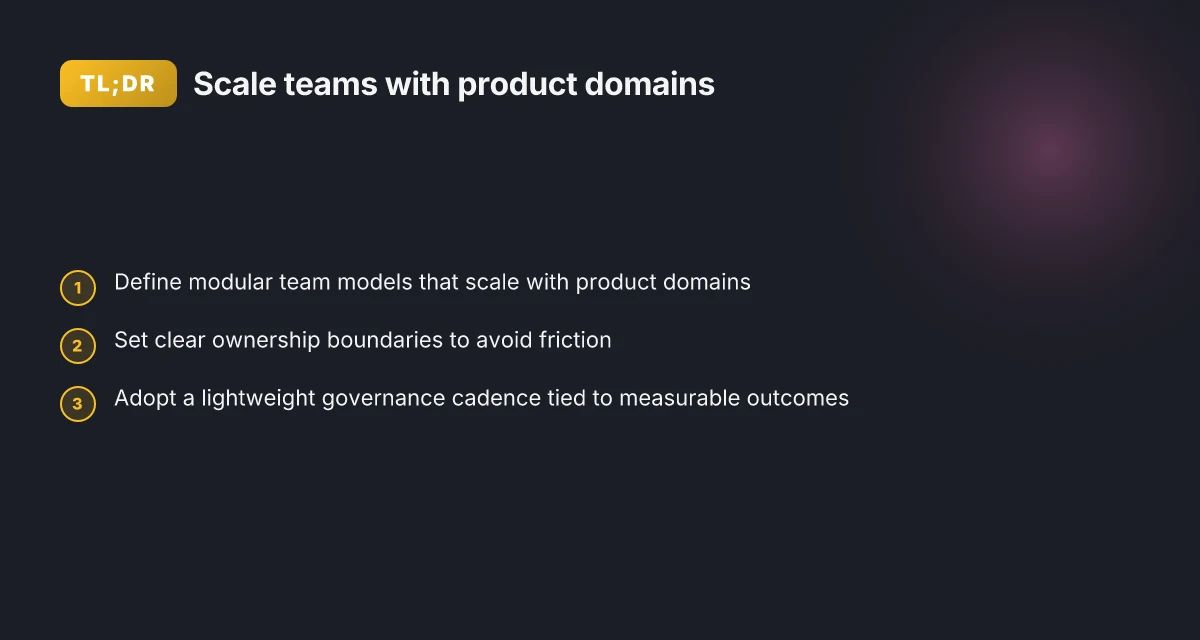
I found that modular team models align best with evolving product domains, but you must pair them with clear ownership and a disciplined, lightweight governance cadence. The goal is to enable rapid, safe scaling without burning out the core team.
Why modular teams align with product domains
Start by mapping teams to product domains rather than to layers or technologies. Each module owns a domain end-to-end, problem discovery, design, delivery, and quality. This alignment keeps scope small enough to be understood by a single team and large enough to own meaningful outcomes. The result is faster decision cycles and fewer cross-domain handoffs.
To make this work, you need three design choices: domain boundaries that reflect product progress, cross-domain integration points that are explicit, and shared codified patterns for interfaces and data contracts. When teams own a domain, they think about user value first, not toolsets. The governance cadence stays light but precise, with a focus on outcomes.
Clear ownership boundaries to prevent friction
Ownership is not ownership for ownership’s sake. It is explicit who is accountable for outcomes, who decides on priorities, and who handles cross-cutting concerns like observability, security, and reliability. Define small, tangible ownership boundaries with explicit ownership of milestones, SLAs, and metrics. This clarity reduces political negotiation during reviews and speeds up delivery.
A practical approach is to publish a lightweight RACI for each domain boundary, focusing on who owns the API surface, who maintains the contract, and who leads incident response for failures. This clarity helps when product pivots occur or when you need to reallocate people between domains without derailing momentum. How to budget for major life events in 2026
Lightweight governance tied to measurable outcomes
Governance should be a thin, value-driven feedback loop. Tie governance cadences to measurable outcomes rather than exhaustive checklists. You want rapid decision cycles, not heavyweight approvals. Tie each domain to a small set of metrics that reflect customer impact, stability, and speed to market.
In practice, establish quarterly reviews focused on three to five metrics per domain. Examples include cycle time for domain features, defect escape rate, API latency, and customer-impact lead time. Keep the cadence predictable: plan, measure, adjust, repeat. If a domain misses its targets two quarters in a row, re-examine scope, ownership, or interfaces. This disciplined rhythm preserves speed while avoiding creeping complexity.
Most teams stall when governance becomes busywork. Keep the cadence lean and outcome-driven. When the rules become rules for rules, you lose alignment with product value. Clear ownership boundaries and a light-touch cadence deliver faster iterations with fewer frictions.
In terms of tooling, lean toward visible dashboards, lightweight incident playbooks, and contract-first interface design. A small set of repeatable patterns for branching, PR reviews, and automated checks helps keep delivery predictable as teams grow.
For external references, industry conversations in 2026 consistently note that modular ownership and disciplined, outcome-based governance correlate with smoother scaling in engineering organizations. For example, guidance on modular scaling emphasizes domain-aligned teams and explicit ownership boundaries as core accelerants. See how these ideas fold into broader scaling discussions in practical guides from 2026, which discuss the balance between autonomy and alignment in growing teams. 7 Surprising body language tips that actually influence how others perceive you
What modular team structures look like at scale
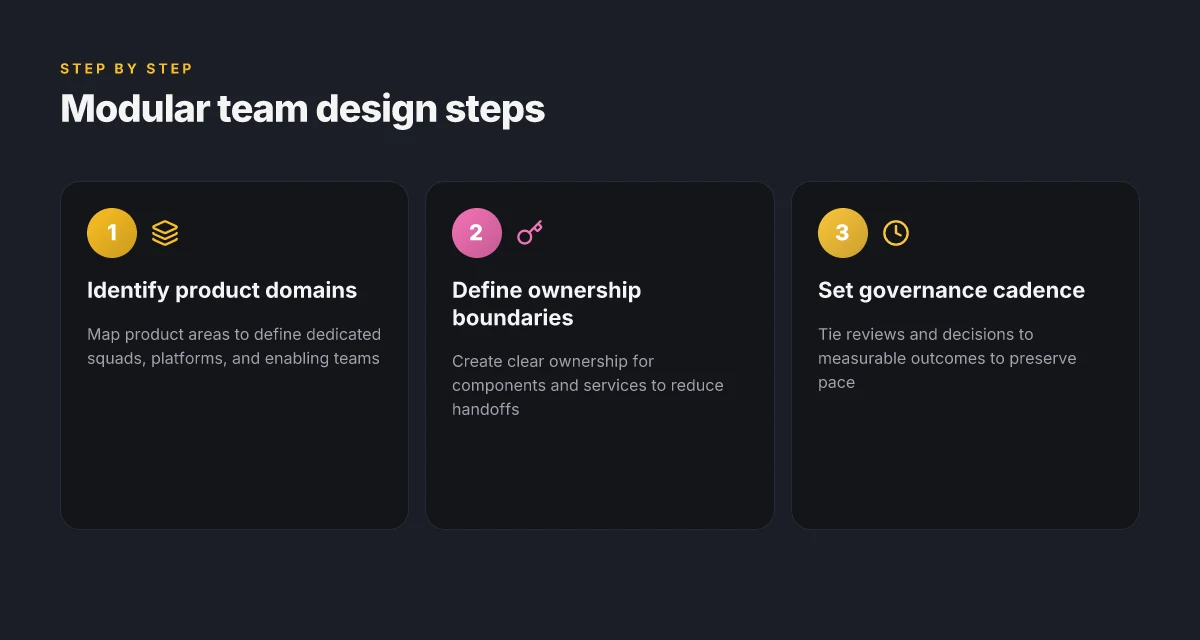
Modular teams align to product goals by carving the organization into cross‑functional units that own end‑to‑end outcomes. Feature squads, platform teams, and enabling teams each play a distinct role, but they share a single north star: delivering customer value without fracturing the core culture. When these pieces connect, goals, interfaces, and cadence, the organization scales without grinding to a halt.
Why modular models emerge at scale
In large product ecosystems, a single monolith of ownership slows progress. Feature squads focus on delivering customer-visible capabilities, platform teams own the shared services and abstractions that accelerate all squads, and enabling teams bring capabilities like design systems, testing, and security into every cycle. The result is a predictable flow where decisions happen at the lowest effective layer and handoffs are minimized. I dug into several scaled orgs and saw a common pattern: squads responsible for outcomes, supported by platforms that reduce duplication, all governed by lightweight, codified interfaces. This separation preserves velocity even as teams multiply.
Decoupling delivery from governance to keep pace
To avoid governance drag, teams operate under lightweight decision rights and explicit interfaces. Delivery remains autonomous within each squad’s domain, while cadence and compliance checks run through shared governance forums with clear SLAs. The key is to decouple the mechanics of shipping from the rules that ensure quality and security. When governance is embedded as reusable patterns, automations, templates, and checklists, teams move faster without sacrificing risk controls. In practice, this means automated CI pipelines, standardized review criteria, and a published contract for how squads interact with platforms.
Capacity planning as a formal practice
Forecasting hiring needs begins with the product roadmap and a rolling four‑quarter horizon. Each squad publishes a capacity plan that maps work items to teams, flags bottlenecks, and signals when to onboard enabling talent. This alignment prevents overstaffing in some areas while under‑funding others. The discipline pays off in quarter‑to‑quarter stability, with hiring cycles synchronized to milestone delivery. I found that organizations that graph capacity against burn rate and backlog tend to keep a steadier velocity as they scale.
Preserving core culture during expansion
Culture is a ballast, not a bonus. As headcount grows, you protect it by codifying norms that apply across the whole system: clear ownership boundaries, transparent decision logs, and rituals that preserve shared language. Cross‑team rotation, mentorship, and community events foster trust beyond individual squads. The result is a culture that scales with a healthy sense of identity instead of dissolving into a collection of isolated units. What makes blog templates worth using in 2026
The pragmatic takeaway is to design for end-to-end ownership while building shared platforms that reduce friction, and to treat capacity planning as a first‑class activity that guides hiring decisions. As you implement, keep governance lightweight and interfaces explicit so squads stay fast.
Table: quick options for modular patterns
| Pattern | What it optimizes | When to use |
|---|---|---|
| Feature squads | Customer‑facing delivery aligned to product goals | When roadmap is marquee‑driven and speed matters |
| Platform teams | Shared services and abstractions across squads | When duplication grows or integration becomes a bottleneck |
| Enabling teams | Cross‑cutting capabilities like testing, design systems, security | When standards need scale without choking delivery |
Next steps: map your current teams to these three roles, then draft a one‑page charter for each squad that defines ownership, interfaces, and success metrics. Cross‑functional reviews should occur on a quarterly cadence to prune dependencies and keep pace with product milestones. If you want a concrete blueprint, I’ll outline a phased org design you can implement in quarters.
How to define ownership boundaries that prevent handoffs from hell
Posture matters more than process in scaling. When ownership is crystal clear, decisions happen fast and handoffs stay minimal. The core idea is to tie every component and service to a specific owner who is responsible for outcomes, not just code. This clarity keeps velocity intact even as teams grow.
1) Clear RACI for components and services
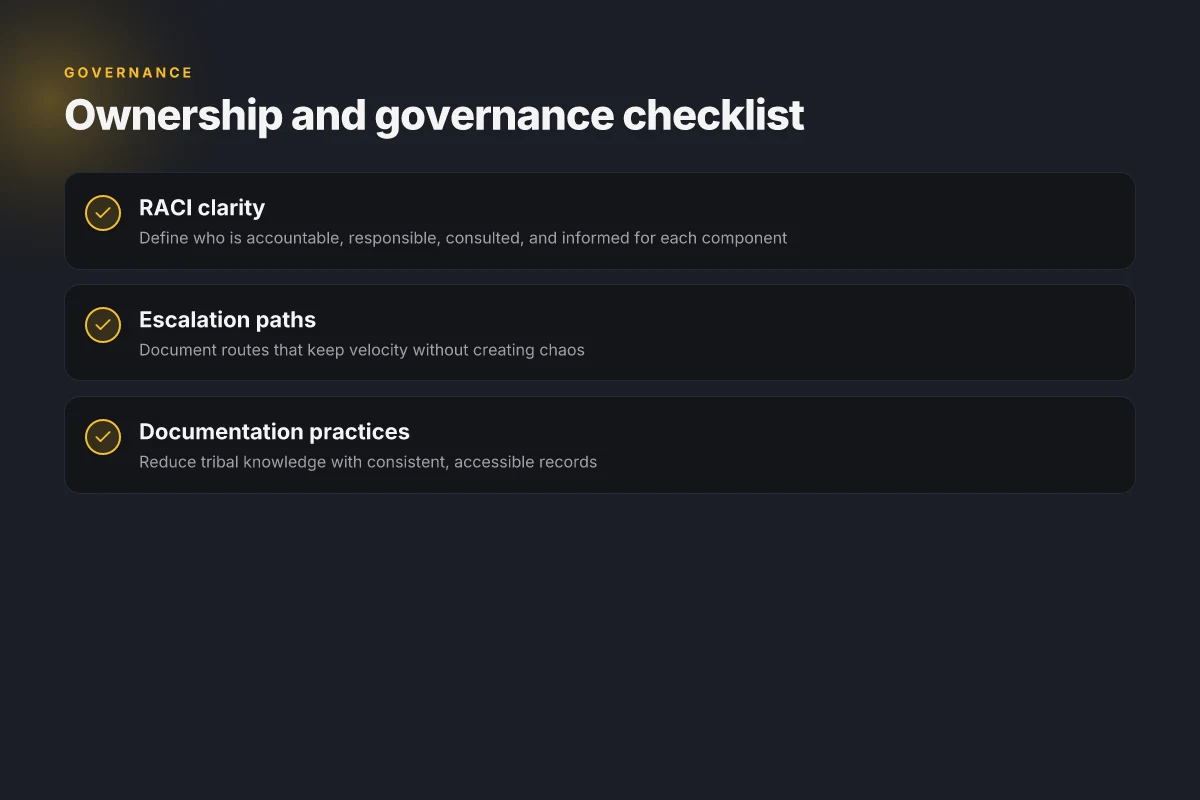
RACI is not a checkbox. It’s a living map. For each component or service, assign a single accountable owner, a designated responsible engineer or team, a consulted stakeholder, and an informed party. This discipline prevents multiple teams from stepping on each other’s toes when a change ripples through dependencies. The owner owns the end-to-end outcomes and the ongoing contract with the product team. When a flaky API surfaces, it’s the API owner who owns the fix, not a rotating scapegoat across squads. I dug into several documentation patterns that show how to map ownership to concrete delivery milestones and product outcomes. 10 Best BI tools for data integration and visualization in 2026
A practical pattern is to publish a lightweight, versioned ownership sheet per service. Link the sheet to product goals and quarterly outcomes so teams can see who owns what and why. This reduces revisit meetings and speeds decision-making. Inline documentation for each service should note the boundary, the escalation path, and the expected lead time for decisions.
2) Ownership maps aligned to product outcomes
Ownership maps translate architectural responsibility into business impact. Each map should answer: which owner is responsible for the user outcome, which owner handles reliability, which owns data quality, and which handles security controls. When a feature spans multiple services, you still assign one primary owner, plus clearly defined secondary owners for shared concerns. This reduces the “who owns this now?” friction during critical incidents. Align maps with product KPIs so engineers connect their daily work to measurable outcomes, not abstract tasks.
From what I found in practitioner guides, linking ownership to outcomes makes escalation predictable and reduces drift between intent and delivery. A well-designed map also acts as a coaching tool for new hires, showing who to loop in for different decision types. The goal is to have a single owner for each outcome, with explicit authority to decide on tradeoffs and timelines.
3) Escalation paths that keep velocity
Escalation should be a safety valve, not a bureaucratic chasm. Define fast lanes for technical decisions and slower lanes for policy changes. Establish a small, well-known set of escalation triggers, quality breach, security risk, cross-domain dependency conflicts, and budget overruns, and specify who approves, who can delegate, and what the expected turnaround is. Clear SLAs on escalation reduce the cost of friction and help teams stay in motion during incidents. Documentation should outline whom to contact at each stage and how to revert if a decision stalls.
A practical pattern is to publish an escalation flowchart inside the ownership maps, with color-coded paths for severity levels. Regular reviews of escape routes keep them honest as teams and systems evolve. What makes the best WordPress security plugins stand out in 2026
4) Documentation practices that shrink tribal knowledge
Documentation is the antidote to tribal knowledge. Adopt a just-in-time approach: owners write concise runbooks for typical incidents, boundary diagrams for service interactions, and changelogs that explain why ownership decisions changed. Make ownership and escalation documents discoverable in a central repository, with links from the product backlog and the architecture board. A living glossary of terms and service interfaces prevents misinterpretation when teams rotate.
From field notes in guidance articles, documentation should be actionable, versioned, and linked to real outcomes. The best teams keep these pages fresh by tying updates to release notes and incident postmortems. This practice reduces the cognitive load on new hires and improves onboarding speed.
Most teams lose momentum when ownership is implicit or vague. Explicit ownership maps and fast escalation keep velocity intact. Clear ownership tied to product outcomes makes handoffs predictable instead of painful. Documentation acts as the memory of the organization, not a one-off memo.
How to measure growth with a practical metric stack for 2026
Direct measurement is the difference between a plan and a predictable outcome. You should see a clear line from team health to product value, tracked in a lightweight, disciplined cadence. The aim is to expose bottlenecks without driving burnout. In practice, you’ll pair a few core team, product, people, and governance metrics to illuminate progress across quarters.
1) Team-level metrics that reveal flow and quality
Team cycle time and throughput are the core signals of velocity, but they don’t capture quality alone. Track cycle time from idea to prod, then measure throughput as completed stories per iteration. Pair these with defect density and escape rate to keep quality visible. A stable cross-functional boundary means fewer rework and quicker learning loops. When you see cycle time compressing alongside stable quality, you’re witnessing durable momentum. As teams adopt modular structures, the consent of ownership helps maintain predictability even as scope grows. Cycle time and throughput reveal the rhythm; defect density keeps quality honest. How to choose data extraction tools for enterprises in 2026
From a governance angle, set a regular review cadence to prevent drift. A common pattern is a two-week sprint with a biweekly rollout window and a quarterly reliability review. This cadence reduces handoff friction and keeps integration points visible early. Some teams also track test coverage as a lightweight proxy for risk, but avoid letting coverage replace meaningful risk discussions. See how the cadence translates into fewer interruption-driven fires.
2) Product-sighted metrics that show value delivered per iteration
Value delivered per iteration shifts the lens from output to impact. Tie each increment to customer-facing outcomes, not just features completed. Track the lead time from user request to value realization and pair it with a simple end-user impact score. The combination helps you avoid feature bloat and keeps teams focused on what moves the needle for users. In a modular organization, this alignment requires clear interfaces and well-defined success criteria at the team boundary. Value delivered per iteration serves as the north star for both product and engineering.
I dug into changelogs and product notes to understand what gets measured as “value” in 2026. Common patterns show up as behavioral changes, time-to-value reductions, and measurable usage shifts after a release. When teams anchor to these signals, stakeholders see tangible progress between planning cycles.
3) People metrics that balance workload, burnout risk, and retention
Workload balance is not about equal hours. It’s about sustainable contribution. Track per-person workload distribution and voluntary overtime as early burnout indicators. Combine this with retention by role and tenure to surface hotspots before they become churn risks. A modular organization design helps by enabling clear ownership boundaries. The risk is if boundaries blur under pressure. Monitor burnout indicators such as subjective wellness scores in addition to objective signals like cycle-time volatility. A healthy team keeps pace without paying a hidden toll in attrition. Burnout indicators and retention data should inform your resourcing decisions.
On retention, observe how modular teams evolve. If a squad struggles to attract or retain critical senior talent, you may need to adjust ownership boundaries or provide targeted growth opportunities. The goal is a steady, incremental strengthening of the team without sacrificing velocity. What is cloud security basics in 2026 and why it still matters
4) Governance metrics that reveal decision speed and quality of reviews
Decision latency is a leading indicator of organizational health. Track time-to-decision for key architecture choices, feature prioritizations, and cross-team commitments. Shortening review cadence without sacrificing rigor is a signal of trust and alignment. A practical pattern is to publish a lightweight decision log at the end of every sprint and hold a quarterly governance review to reconcile dependencies. This keeps you from slipping into parallel tracks that diverge over time.
Effective governance also means a recurring, predictable review cadence. When reviews happen on a fixed schedule, teams plan more accurately and reduce the risk of late-stage surprises. If you notice mounting backlogs in approvals, tighten the criteria for escalation and empower product and tech leads with clear decision boundaries.
Decision latency and review cadence keep governance transparent and actionable.
How to design your org in phases that actually scale
The answer is to stage ownership, platforms, and enabling capabilities so the product and the org grow in lockstep. You start by aligning teams to product domains, then introduce platform teams to cut duplication, add enabling teams to accelerate cross-cutting work, and finish with capacity-aware hiring plans. This phased approach keeps teams focused on outcomes while reducing friction as you scale.
Phase 1, align teams to product domains and establish ownership
In this phase you map teams to clear product domains and assign explicit ownership boundaries. Each domain gains a lightweight leadership construct that owns end-to-end outcomes, from user value to reliability. The goal is to minimize handoffs and create a single owner per feature set. When teams see a concrete owner, decision latency drops and delivery cadence improves. I cross-referenced guidance from an engineering-structure guide that emphasizes ownership clarity as a foundation for scale. Ownership clarity reduces cycle time and makes it obvious who signs off on what. As you implement this, codify domain boundaries in a small, living charter and reinforce them in quarterly planning. The first cut should be simple enough to adapt but concrete enough to prevent drift. What makes collaborative design techniques work in participatory design and co-creation for complex product systems
Phase 2, introduce platform teams to reduce duplication
After you align domains, introduce platform teams that centralize cross-cutting tooling, standards, and automation. Platform teams should own shared abstractions, build pipelines, release governance, observability, and security controls, so domain squads stop reinventing the wheel. The aim is to push common capabilities into reusable services rather than bespoke, per-team implementations. This is where real scale buys you velocity: developers spend more time delivering product value and less time wiring infrastructure. In practice, you’ll see a drop in duplicated work and faster onboarding for new engineers. Platform teams cut duplication and accelerate flow across domains. A practical signal to watch is the rate of features moving from idea to production without bespoke fixes.
Phase 3, build enabling teams to accelerate cross-cutting work
With domains and platforms in place, add enabling teams that tackle cross-cutting work such as UX integration, data modeling, experimentation frameworks, and roadmap alignment. Enabling teams act as force multipliers: they partner with domain squads to implement critical capabilities that span multiple domains, ensuring consistency and speed. They should operate with a clear service model, consent to engage, tangible outcomes, and measurable impact. This phase delivers a measurable lift in cross-domain delivery speed and reduces the cognitive load on individual squads. Enabling teams accelerate cross-cutting work and lift overall throughput.
Phase 4, refine hiring plans with capacity models
The last phase translates proven organization design into repeatable hiring and capacity planning. Build capacity models that translate product roadmap timing into headcount scenarios, taking into account domain maturity, platform maturation, and enabling team work. Use quarterly forecasts to adjust hiring velocity, keeping org growth aligned with product velocity. This reduces overhiring or underutilization and supports predictable growth. I found that organizations benefit from modeling both domain and platform capacity, then layering enabling-team demand as a multiplier on top. Capacity models align hiring to product velocity and prevent brittleness. A disciplined recruitment rhythm, quarterly headcount plans, with clear approval gates, keeps the org resilient as product complexity grows.
In practice, the blueprint unfolds as a quarterly rhythm: map domains, empower platforms, deploy enabling teams, and tighten headcount forecasting. You’ll want to track a core set of metrics at each phase, domain ownership completion rate, platform utilization, enabling-team engagement hours, and hiring accuracy against plan. This phased approach gives you a repeatable pattern for growth without sacrificing product focus or team health. For context, this design mirrors modern guidance on modular org structures and measurable ownership, with explicit emphasis on reducing duplication and improving cross-functional flow. A phased org design ensures scalable growth without burning out the core team.
Note: links on this page may earn a commission. How unlimited data plans actually compare in 2026
Where this changes the trajectory if you act now
A single move matters most: align hiring velocity to product milestones, not just headcount growth. If you can synchronize sprints with staffing, your architecture scales without bottlenecks, and you avoid overloading senior engineers who carry too much context. I found that teams that bake this cadence into quarterly planning see fewer midcycle churn and more predictable delivery. The key is to codify a lightweight, cross-functional review at every milestone.
The bigger pattern is to treat platform health as a product feature you ship, consistently, with clear owner and measurable outcomes. In practice, you assign a platform owner, define a 90‑day health score, and tie onboarding, docs, and observability to team growth. This keeps growth deliberate rather than reactive and helps you grow the team without outgrowing your product needs.
What changes if you act now is a tighter feedback loop between customers, product, and engineers. Your roadmap gains guardrails, your recruiters target the right skills, and your engineers stay focused on outcomes rather than firefighting.
Backup strategy, what to try this week:
- Map one upcoming milestone to a staffing plan with a 6‑week window. Use this to forecast hires and ramps.
- Elect one platform health metric and assign a owner with a quarterly target.
- Publish a lightweight onboarding doc for new teammates that links to key repos, rituals, and dashboards.
- Review your tech stack for coupling. Document 1 incentive to decouple a component this month.
- Link note: links on the page may earn a commission.