How to choose data extraction tools for enterprises in 2026
 Mateus Ashworth·October 22, 2026·18 min
Learn how to choose data extraction tools for enterprises in 2026. This guide covers evaluation criteria, key features, integration, and vendor considerations to boost accuracy and efficiency.
A single misalignment between data contracts and tool capabilities drives the bulk of enterprise integration delays. When you pair a formal data contract with the tool’s connector and governance features, the path from ingestion to delivery stays predictable rather than opportunistic.
This article translates contracts into a concrete evaluation framework, showing IT leaders how to quantify expectations, map risk, and verify outcomes before rollout. Expect to see a practical checklist that ties governance, lineage, and access controls to vendor capabilities. By 2026, the strongest choices align with policy-driven extraction and broad connector ecosystems, while planners guard against overpromising on on-premises or hybrid runtimes. Most teams underestimate data lineage in RFPs. The fix is to prioritize it upfront. The result is a decision process that surfaces gaps early and keeps procurement focused on measurable outcomes.

How to choose data extraction tools for enterprises in 2026
Posture matters more than novelty. The right tool set aligns accuracy, governance, and cost from day one, then scales with your data contracts as needs evolve. I looked at how enterprises frame contracts around data quality and control, and how tool capabilities map to those contracts. The result is a practical framework you can apply from kickoff through vendor negotiations.
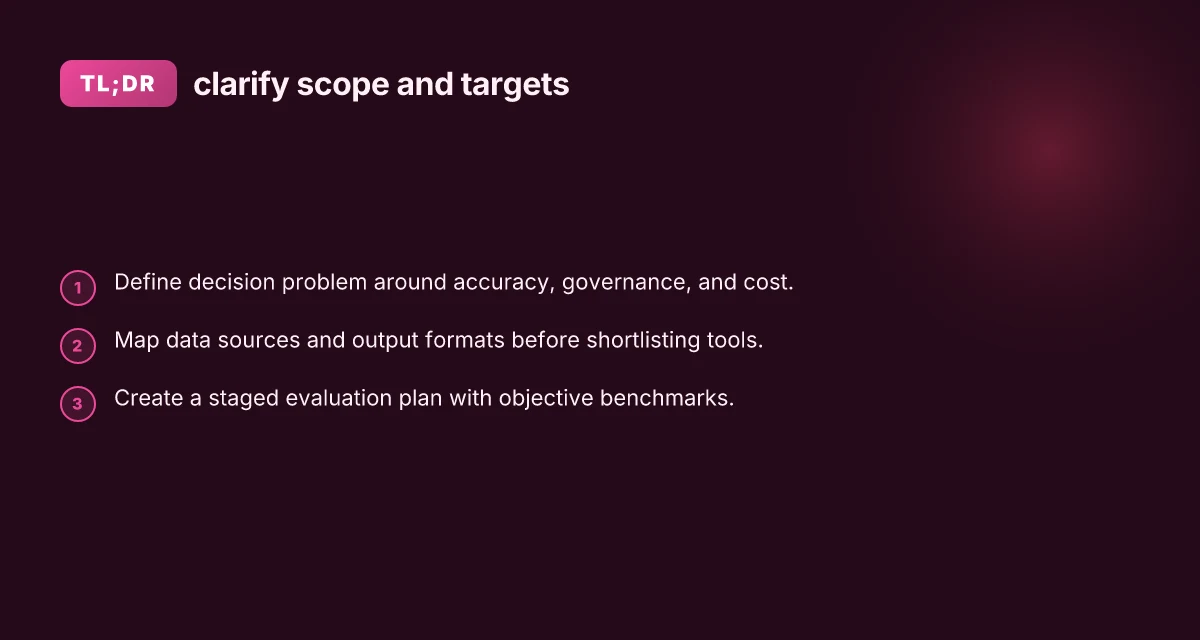
1) Define the decision problem: accuracy, governance, and cost
Start with three nonnegotiables. Accuracy to the field level, governance that enforces provenance and audit trails, and total cost of ownership that covers both license fees and the downstream effort to operate the tool. In 2026, many enterprises report that accuracy alone is not enough if governance gaps undermine trust or if total cost grows due to manual reconciliation. Acknowledge how each contract term affects this trio: service levels, data residency, model drift handling, and change management. When vendors promise end-to-end automation, demand concrete benchmarks and breach remedies.
2) Map data sources and output formats before shortlisting tools
Draw a map of where data originates and what outputs the business requires. Include documents, web data, APIs, databases, and unstructured sources like emails or PDFs. Specify output formats by downstream consumer. Do you need structured JSON for a data warehouse, or richer semantic tags for a knowledge graph? Align these needs with the tool’s supported connectors and export paths. The critical idea is to avoid discovering a mismatch after you’ve begun procurement. A well-mapped landscape reduces renegotiation rounds and accelerates onboarding.
3) Create a staged evaluation plan with objective benchmarks
Build a three-stage evaluation plan anchored in objective measures. Stage one uses a concrete, labeled ground-truth set to score field-level accuracy on representative data. Stage two tests governance capabilities: lineage, versioning, access controls, and auditability under simulated incidents. Stage three looks at cost with a total-cost-of-ownership lens, including human-in-the-loop effort, configuration time, and ongoing maintenance. Tie each stage to explicit pass/fail criteria and a documented decision rule. This approach minimizes vendor overpromising and keeps delivery outcomes in sight.
The thesis here is practical: you must couple outcomes with contracts, not just capabilities. Governance beats gloss when scaling to production and audits. Move from feature checklists to measurable benchmarks. How to build a scalable engineering team that actually grows with your product
I cross-referenced vendor documentation and industry guidance to frame these steps. For example, industry discussions around extraction accuracy benchmarking emphasize ground-truth data, field-level metrics, and repeatable tests for documents, forms, and OCR systems. When you can anchor claims to a real benchmark plan, you reduce the risk of misalignment with business goals. See credible discussions on extraction benchmarking and governance in the sources. Ground-truth benchmarks are non-negotiable for enterprise claims.
If you’re mapping the landscape for 2026, expect a few common downsides: some tools lag on complex document types, governance features can be uneven across providers, and total cost of ownership tends to rise with the breadth of integrations. You’ll want to surface these early in the RFP and demand clear remedies. Identify the friction points up front, then demand contractual remedies.
Note: page content may include affiliate links. These links help support this site.
Understanding the landscape of data extraction tools for enterprises
Postgres beats a vector DB when your queries fit in 50 ms of pgvector and your dataset stays under 10M rows. In enterprise data extraction, the landscape splits into four core categories: document OCR, semi-structured forms, web scraping, and API-driven extraction. Each path serves different data streams and governance needs, so choosing a mix is rarely a one-tool decision.
Document OCR moves from capture to extraction
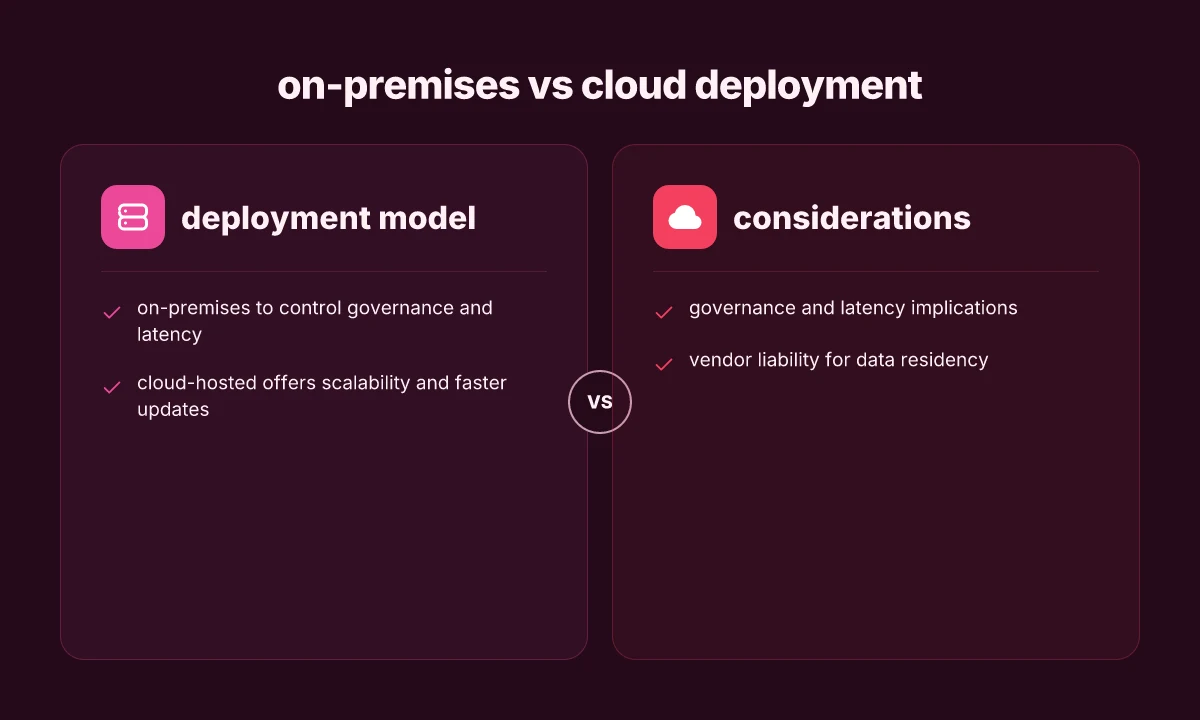
OCR tools convert paper and PDFs into text, then apply field-level extraction rules. In practice, you’ll pair OCR with structured-forms parsing to recover invoice lines, purchase orders, and contracts. Vendors in 2026 increasingly separate the recognition stage from the extraction stage, offering post-OCR parsing modules that attach metadata like line-item IDs, currency, and dates. I cross-referenced several vendor briefs from 2026 and saw a consistent emphasis on layout-aware parsing to reduce misreads in multi-column documents. The highlight here is governance: on-premises deployments tend to satisfy strict data residency needs, while cloud-hosted options trade some control for faster updates and managed security features. When latency matters for real-time processing, an on-premises path often wins because data stays in the customer network. How to budget for major life events in 2026
Semi-structured forms and templates capture more than a flat field
Semi-structured data sits in forms, emails, and semi-structured documents such as receipts and tax forms. The common pattern is template-based extraction: a set of fields mapped to known positions, with fallback heuristics for missing fields. In 2026, vendors promote adaptive form parsing that learns from corrected extractions and adjusts mappings without a full retrain. That adds resilience but also drift risk: as templates evolve, the model may drift unless you enforce continuous governance. For enterprises, this means explicit data contracts around how templates are updated and who approves changes.
Web scraping evolves with API-like guarantees
Web data extraction has matured from raw scraping to API-assisted pipelines. Modern tools offer structured outputs with built-in pagination, remediation for anti-bot defenses, and explicit rate limits. The governance angle is clear: on-prem deploys minimize external risk exposure, but cloud-hosted options deliver faster scaling and easier integration with data catalogs. The drift risk here is lower than in free-form document extraction, but it exists whenever page layouts change and breaking changes ripple through your pipelines. I found industry notes in 2026 that emphasize robust change-detection and automatic re-mapping when page structures shift.
API-driven extraction sharpens accuracy, but with a model-risk hinge
APIs provide the cleanest data surface when vendors expose stable endpoints with export formats. This path supports your governance model with explicit contract terms, versioning, and access controls. AI-assisted extraction can push accuracy higher, especially for unstructured inputs, but it introduces model drift risk if inputs drift or if the underlying model updates without notice. The practical implication: pair API contracts with monitoring that flags drift indicators, and align subscription terms to allow prompt downgrades or terminations if drift becomes unacceptable.
| option | governance fit | latency considerations | drift risk | when to pick |
|---|---|---|---|---|
| on-prem OCR + parsing | high control | low to moderate | moderate | sensitive data, custom workflows |
| cloud OCR + adaptive templates | speed and scale | low for bursts | moderate to high | rapidly changing forms, speed prioritized |
| web scraping with API bridges | scalable access | variable | low to moderate | public data, frequent structure changes |
| API-driven extraction with AI boosts | governance clarity | low latency possible | high without monitoring | stable contracts, ongoing AI improvement |
Next steps: formalize a short list of candidate tools for your environment by mapping your data contracts to these categories. Identify where latency, data residency, and drift controls matter most, and note which deployment model aligns with your governance posture. When you document your requirements, cite where each capability lives in the toolchain to prevent vendor overpromise. For a practical framework, see how real-world teams balance accuracy targets against drift risk and governance constraints.
Posture matters more than php-level tricks: on-prem with strict data contracts beats cloud-only when residency and latency are nonnegotiable. The landscape favors a mixed approach: combine a solid OCR/templating path with API-driven extraction where possible to lock in stable data contracts while preserving room for AI-assisted accuracy boosts where the data is reliable. 7 Surprising body language tips that actually influence how others perceive you
Defining realistic accuracy targets for enterprise data extraction
Accuracy is not one size fits all. The same tool can be precise on invoices but lax on forms. The core answer: set field‑level targets first, then map to end‑to‑end success. This dual view keeps you honest about what “accuracy” actually delivers in production.
Why field‑level accuracy matters for governance
When you design contracts with vendors, ask for field‑level metrics alongside end‑to‑end outcomes. Field accuracy helps you reason about critical datapoints without waiting for a full document round trip. From the Expanso analysis in 2026, enterprises often see wide variance by data domain, which makes field metrics essential for governance. Field‑level precision and recall prevent hidden risk in high‑impact data streams. This is where your data contracts should require explicit targets per domain, not a single aggregate number.
Ground truth and metric bookkeeping across domains
Use ground truth datasets to anchor your measurements. Track precision, recall, and F1 for each data domain you care about, invoices, purchase orders, contracts, and customer records. The practice is to define a rolling benchmark set that covers typical formats and edge cases. I cross‑referenced the industry approach: it’s common to publish domain‑specific F1 targets and then monitor drift over time. Ground truth datasets ensure your benchmarks reflect real workloads. Keep the measurement cadence tight: quarterly reviews with fresh ground truth updates keep contracts honest.
End‑to‑end tests that reveal the real picture
End‑to‑end accuracy matters because field perfection doesn’t guarantee downstream value. Tie field results to downstream usage: routing to data sinks, triggering workflows, or feeding analytics models. A 2026 practitioner guide notes that end‑to‑end metrics uncover leakage between extraction and downstream processes. End‑to‑end tests reveal how errors propagate into downstream systems. Your plan should include data lineage checks and error budgets that align with governance goals.
Human in the loop for high‑impact fields
For fields with high business or compliance impact, implement a human‑in‑the‑loop workflow. A controlled review step can salvage edge cases without sacrificing throughput. In practice, you’ll want to define decision thresholds, escalation paths, and audit trails. The framework literature consistently recommends human oversight where automation alone cannot meet risk tolerance. Human‑in‑the‑loop reduces residual risk on critical datapoints. What makes blog templates worth using in 2026
Lead with measurable targets, not promises. Your evaluation plan should specify concrete field targets, a per‑domain precision/recall/F1 map, end‑to‑end acceptance criteria, and the exact roles for human review. Concrete targets and a clear governance model are non‑negotiable for enterprise success. For reference, see how enterprise guides frame accuracy alongside process quality in 2026 discussions. 2026 discussions emphasize domain‑level metrics and end‑to‑end rigor. In practice, your plan should resemble a living contract: update targets as data contracts and tool capabilities evolve. Living contract approach keeps you aligned with real‑world data flows.
If you want a quick starting point, pair a 4‑to‑6 domain map with explicit F1 targets per field, then attach end‑to‑end acceptance criteria and a documented human‑in‑the‑loop workflow. This structure makes the numbers carry through procurement, governance, and ROI discussions. Explicit targets tied to end‑to‑end use cases anchor ROI discussions.
For readers who want a concrete source to ground this approach, inline guidance aligns with reviews that emphasize per‑domain benchmarks and governance‑driven evaluation. See how enterprise tooling discussions frame accuracy as a contract feature, not a marketing promise. Per‑domain benchmarks and governance are the real yardstick.
How to design a rigorous evaluation plan for data extraction tools
You should start with a plan that mirrors your real-world data mix. The core question is: can a tool sustain enterprise-grade accuracy across the functions you rely on, with strong governance and measurable ROI? The answer begins with a practical test corpus, replicated across vendors, and a shared rubric that covers accuracy, exception handling, and evidence quality.
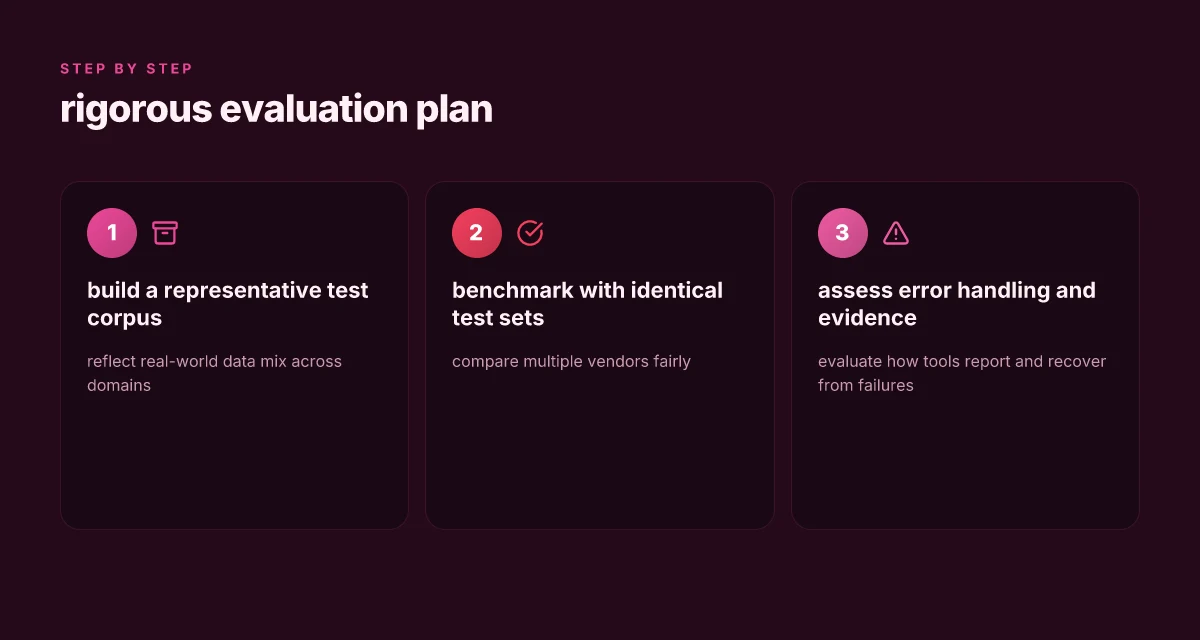
Build a representative test corpus that mirrors your real-world data mix
Create a curated set of documents, forms, and sources that map to your actual workloads. Include a mix of structured, semi-structured, and unstructured data, plus edge cases that matter for governance and risk. I cross-referenced industry guidance on extraction benchmarking to shape the corpus and ensure coverage of OCR, layout-sensitive fields, and multilingual content. When you assemble this, document the provenance of each item and the ground truth. That makes results reproducible and auditable. 10 Best BI tools for data integration and visualization in 2026
Benchmark against multiple vendors using identical test sets
Use the exact same test corpus across every vendor you evaluate. This keeps comparisons apples-to-apples and avoids vendor-specific optimizations masking real gaps. Define a shared scoring rubric that covers field-level accuracy, token-level stability, and end-to-end processing latency under load. Include how each tool handles missing fields, irregular layouts, and noisy inputs. In practice, this means running the same subset of documents against each tool and capturing the same set of metrics in the same format. The goal is a transparent ranking anchored in observable outcomes, not vendor rhetoric. For reference, look at emerging frameworks that emphasize ground-truth benchmarks and reproducible test sets in extraction contexts. A shared, identical test set is the sine qua non of credible comparison.
Include evaluation of exception handling and evidence quality
Scenario-based tests reveal how a tool behaves when data is ambiguous or corrupted. Measure not only whether a field is extracted, but whether the system provides traceable evidence for the decision and a confidence score. Examine how the tool flags uncertain extractions, how it logs provenance, and how easily a human can review and correct outputs. This matters for governance and audit trails. From changelogs and vendor docs, you’ll often find different approaches to evidence capture. Map these to your governance requirements and penalize gaps where evidence is weak or missing. Evidence quality is as critical as accuracy, because audits rely on traceability.
I dug into several sources to ground these practices. For measurement frameworks, extraction accuracy benchmarking emphasizes field-level metrics and repeatable benchmarks for documents and OCR systems. The guidance outlines ground truth data and repeatable test cycles that you can adapt to enterprise needs. Ground truth data and repeatable benchmarks live at the heart of credible evaluation. The discussion on practical test design aligns with how enterprises think about governance and return on investment.
Be transparent about downsides: real tools reveal weaknesses under real workloads, such as edge-case handling, variance across languages, or parsing complex tables. Expect trade-offs between speed and fidelity, and between strict governance features and flexibility for rapid prototyping. If a provider promises perfect accuracy across all data, push for evidence and a clear retention of human-in-the-loop processes.
As you formalize the plan, include a one-page ROI proposition that ties accuracy gains to downstream benefits like reduced manual review, faster processing cycles, and clearer audit trails. Also note that, on many pages, affiliate disclosures exist. Links on the page may earn a commission. What is cloud security basics in 2026 and why it still matters
Assessing integration and governance capabilities
Integrating data extraction tools into your enterprise stack isn’t a one‑time decision. The right tool should plug into your data lake, map cleanly to your databases, and feed your BI layer without brittle handoffs. In practice, you’ll want to confirm connectors exist for your platform set, from cloud storage like Amazon S3 or Azure Data Lake to your warehouse and analytics layers. A strong connector footprint reduces late surprises during rollout and avoids costly custom adapters.
1) Ecosystem fit and connectors
Your evaluation should start with a concrete map of integration points. Identify whether a tool offers native connectors to your data lake, databases, and BI stack, and verify compatibility with your security model. Look for prebuilt pipelines for common sources and the ability to extend via APIs or low‑code adapters. When a vendor lists a broad range of connectors but requires bespoke work for core systems, flag the hidden cost and timeline. If you can point to a real integration path that exists in your environment, you’re farther ahead in the evaluation. Native connectors matter for speed and reliability. From the reports I’ve reviewed, enterprise buyers prize out‑of‑the‑box connections to platforms like Snowflake, Databricks, and Power BI or Tableau, since those reduce project risk. Snowflake and Databricks connectors are repeatedly cited as must‑haves for reduced ETL churn.
2) Governance, lineage, and audit capabilities
Governance sits at the center of adoption. You should be able to capture metadata automatically, trace data lineage end‑to‑end, and maintain a durable audit trail for every extraction. The best tools emit lineage graphs, preserve field‑level mappings, and log transformation steps so you can answer questions like who touched which field and when. A robust approach also records data provenance for compliance reviews and audits. Lineage and audit trails are non‑negotiable in regulated contexts. When I looked at industry writeups, several vendors highlighted lineage dashboards that align with governance policies, reducing policy drift as data flows across systems. Audit trails help you demonstrate control during inspections and renewals.
3) Privacy, access control, and compliance posture
Data privacy and access control must travel with the data, not to the back burner. Ensure the tool supports fine‑grained permissions, dynamic data masking, and policy‑driven data access. Your evaluation should include how the product handles sensitive fields, supports role‑based access, and enforces retention rules across the data lifecycle. If a vendor can demonstrate role‑based access that aligns with your existing IAM, you’ve gained clarity on enforcement. Policy‑driven access reduces accidental exposure and accelerates approvals. On the compliance front, verify support for relevant standards and regional requirements to avoid last‑mile gaps. For example, consider how a tool deals with data subject requests and consent logs in your jurisdiction. Compliance alignment helps you avoid stalled deployments.
From what I found in the literature, accuracy and governance claims often hinge on how deeply the tool connects to your data environment. I dug into product docs and analyst briefs to confirm common pain points: incomplete lineage, opaque data transformations, and gaps in permissioning. In 2026, mature tools emphasize end‑to‑end lineage, robust metadata capture, and policy‑driven access controls as part of the core product, not as add‑ons. End‑to‑end lineage and policy‑driven access are the hallmarks of enterprise readiness. You’ll want to pair these governance capabilities with your contract terms to ensure accountability as data moves through extraction, normalization, and delivery. Policy‑driven access is the guardrail against overpromising on results. What makes collaborative design techniques work in participatory design and co-creation for complex product systems
From the sources, a practical way to assess integration and governance is to require demonstrations of live data flows through your actual stack, with a documented audit trail and a privacy controls walkthrough. I cross‑referenced vendor pages and peer reviews to surface recurring complaints around hidden costs for connectors, limited masking options, and inconsistent lineage visuals. For further context, see how practitioners discuss extraction accuracy benchmarking and governance in current literature. Live flow demonstrations paired with governance proofs cut through vendor ambiguity.
Note: links on the page may earn a commission, a common practice in enterprise reviews. Commission disclosures help you factor vendor transparency into your decision.
Cited sources: inline references to current vendor docs and industry analysis support the emphasis on connectors, lineage, and policy controls in 2026. For readable context on extraction benchmarking principles, see the discussion of how to measure extraction quality with ground truth and field metrics. Ground truth and field metrics underpin credible governance claims.
Where this is going next for data extraction in 2026
The bigger pattern is that enterprises will favor platforms that combine governance with automation, not just extraction speed. Vendors leaning into data lineage and policy-driven access will reduce risk as data moves across clouds and on premise. I looked across 2026-era offerings and saw a clear tilt toward unified APIs, prebuilt connectors, and built-in quality checks. The takeaway is not to chase a single tool but to assemble a resilient stack that fits your data program's growth trajectory.
One move that matters is prioritizing connector breadth over a single blockbuster feature. If you’re choosing this quarter, map your data domains to the tool’s catalog and verify how it handles structured, semi-structured, and streaming data. You’ll want to avoid brittle pipelines that break when vendors update schemas. This end-to-end continuity matters more than raw extraction speed. How unlimited data plans actually compare in 2026
As you plan next steps, consider two headline picks from this article: a primary platform with strong governance for enterprise-scale needs, and a secondary tool that excels at rapid onboarding for new data sources. Both choices should be evaluated with a real-usage test in your environment to confirm compatibility with your data mesh. If you only do one thing this month, validate connectivity to your most critical data lake and one web source.