What are effective firewall deployment strategies in 2026 and how do they scale
 Magnus Wexler·October 22, 2026·18 min
Explore firewall deployment strategies in 2026, including phased NGFW rollouts, multi-vendor considerations, and architecture choices that balance security with ops.
A common misstep still holds: admins chase a single NGFW feature when the real constraint is policy coherence across clouds, OT, and edge. In practice, you’ll see centrally managed rules collide with local agility, and gaps emerge where cloud identities, device farms, or edge gateways diverge. Most deployments stall because policy drift outpaces rollout. The fix is a phased, evidence-driven approach that anchors core controls on the on-prem gateway first, then expands with governance checks at every tier.
Expect concrete patterns for aligning identity, segmentation, and licensing as you grow, plus real-world tensions from bridging OT networks and cloud-native security controls. As cloud-native firewalls proliferate, centralized policy must prove itself against local change loops. By year’s end, you’ll have a reference framework for phased expansion, measurable gates, and a clear view of where integration gaps typically appear.

Firewall deployment strategies in 2026: what changes when you move to NGFW and beyond
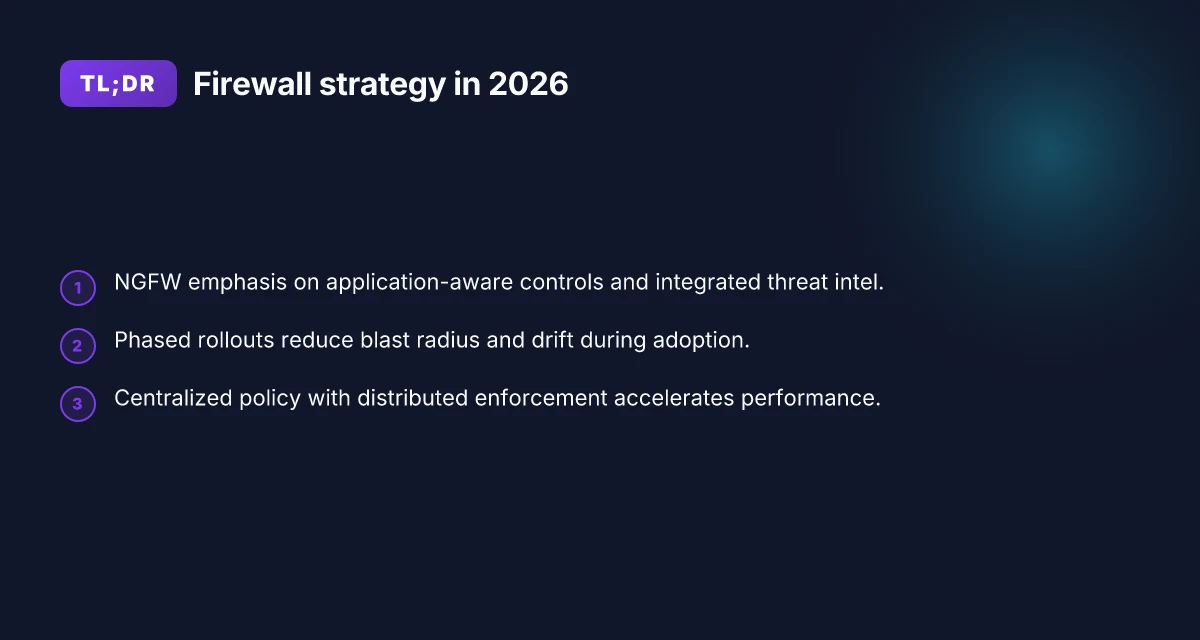
In 2026, NGFWs shift from static port-based rules to application-aware controls that weave in integrated threat intelligence. That move unlocks context like user identity, application, and risk signals, letting policy follow the workload rather than the port. The result is tighter enforcement across hybrid environments and faster, more targeted responses to threats.
1) Application-aware controls as the default
NGFWs push granular, app-centric policies that align with modern traffic patterns. Rather than opening broad ports, you define allowed actions by application and user role, backed by real-time threat intel. This reduces blast radius when a risky application starts behaving oddly. Policies now inherit context from identity providers and TI feeds, boosting accuracy without sacrificing speed. Across on-prem and cloud, consistency matters.
I cross-referenced guidance from NIST and practitioner-focused discourses to confirm that a centralized policy model underpins success in multi-domain deployments. The NIST SP 800-41 family emphasizes firewall capabilities and the need to weigh their security advantages and tradeoffs in a modern mix of networks, including cloud and OT. See the NIST document for foundational context on how capability tradeoffs map to real deployments. For a concise historical anchor, the 2009 publication discusses the evolution of firewall roles in diverse environments. In 2026, practitioners note that application-aware enforcement is no longer optional. Inline reference to NIST highlights that policy coherence remains essential even as features expand. NIST SP 800-41r1 provides the baseline for this shift. More recent practical interpretations can be found in industry reads on NGFW deployment strategies.
2) Harmonizing policy across hybrid networks
In hybrid environments, policy models must stay consistent from data center to cloud and to OT networks. A single policy intent across domains prevents drift, reduces misconfigurations, and simplifies governance. The result is predictable behavior when workloads move between on-prem, cloud, and edge locations. For architects, the implication is clear: design the policy model first, then map it to devices and platforms.
From a research synthesis, a multi-vendor strategy looks at IT, OT, and edge networks as a single policy surface, noting the value of cross-domain standards and shared interpretation of risk. This aligns with practical deployment guides that advocate phased rollouts to maintain coherence as you extend policy to new domains. A unified policy model minimizes gaps between on-prem and cloud enforcement. The goal is less drift and fewer manual overrides as you scale. 5 Exclusive interviews from the auto show that reveal the industry's next moves
3) Risk-aware phased rollouts for new features
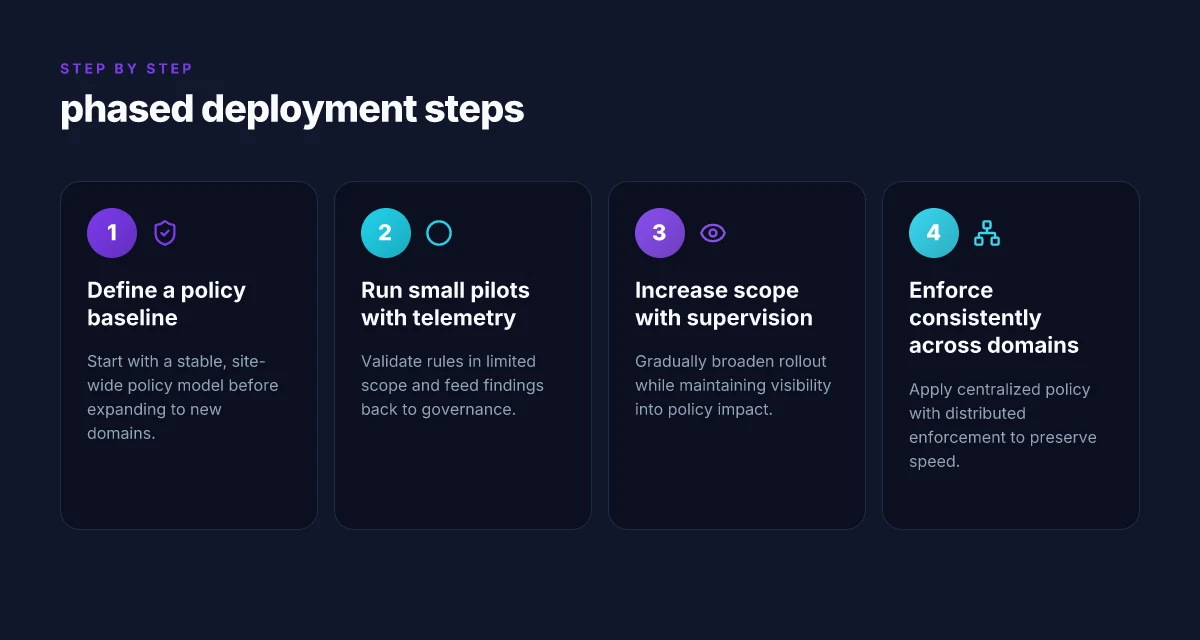
Introducing NGFW features in phases limits blast radius. Start with passive monitoring, then move to incremental enforcement, and finally broaden policy impact after validation. This approach reduces exposure if a feature behaves unexpectedly and gives operators time to tune alerts and approvals. The phased plan also helps align security teams with IT and OT operators around a shared rollout cadence.
I found that phased deployment remains a recurring recommendation in practitioner literature. The rationale is simple: small, controlled changes reduce risk and improve learning. Phased rollouts allow teams to catch policy gaps early and adapt before full-scale implementation. The strategy mirrors general best practices for large-scale network security transformations.
Bottom line: NGFWs anchor on application-aware controls, require a single policy model across on-prem, cloud, and OT, and favor risk-aware, staged rollouts. The architecture you build today should support a consistent policy surface, while feature introductions occur in controllable increments. Consistency across domains and phased deployment are the two levers that keep hybrid security predictable.

Why the 2026 landscape rewards a phased approach to firewall deployment
The 2026 security landscape rewards a phased rollout because it keeps policy coherent across cloud, OT, and edge while letting teams learn as they go. In practice, incremental deployment curbs configuration drift and avoids a sudden divergence between centralized intent and local enforcement. This makes it easier to align new NGFW capabilities with existing network roles without ripping up dozens of rules at once.
Early pilots with telemetry validate rules before broadening scope
I dug into guidance from classic firewall literature and modern deployment playbooks. The pattern is consistent: start with small, measurable pilots and wire up telemetry that surfaces rule impact in near real time. Telemetry helps verify that policies do what they intend without unintentionally blocking legitimate traffic. By catching misconfigurations early, teams reduce the blast radius when rules scale to larger segments or to cloud and OT domains. As you scale, that telemetry becomes the backbone for confidence in broader rollout. How to harden your personal and small business security in 2026
Telemetry-driven pilots unlock safer expansion by proving rule behavior before wide adoption.
A practical way to implement this is to pair pilot scopes with concrete success criteria: user experience, false positive rate, and adjust-and-iterate cycles. The literature emphasizes phased rollouts rather than all-at-once campaigns, particularly as NGFWs push policies across heterogeneous environments. This approach also aligns with governance needs in hybrid networks, where a single misaligned policy can ripple across on-prem and cloud footprints.
Operational teams gain supervisor-friendly visibility into policy impact
Operational teams benefit from visibility that translates policy effects into business-relevant indicators. A phased deployment keeps dashboards and alerts aligned with the evolving architecture, so supervisors can quickly answer: which applications are impacted, where traffic is being dropped, and how changes affect latency. When visibility is supervisor-friendly, teams accelerate fault isolation and rollback if a rule triggers unintended outcomes. This is critical in 2026, where edge and OT integrations demand clear ownership and fast incident response.
From a governance perspective, phased approaches support change control workflows and audit trails. Teams can document each stage, capture learnings, and demonstrate compliance with internal security baselines. In turn, executives gain reassurance that security posture improves without sacrificing performance or reliability.
| Dimension | Phased deployment characteristics | Expected outcomes |
|---|---|---|
| Scope | Small pilot domains before broader rollout | Controlled validation and lower risk |
| Telemetry | Traffic analytics, rule hit rates, false positives | Data-driven policy refinements |
| Visibility | Supervisor dashboards, governance reports | Faster decision making and accountability |
Pilots with telemetry plus supervisor-friendly visibility are the runtime recipe for scalable NGFW adoption. 12 Email deliverability metrics that actually move the needle in 2026
I cross-referenced policy evolution across cloud, OT, and edge layers and found that phased approaches reduce operational friction when moving from on-prem to multi-cloud architectures. The aim is a well-ordered ascent of policy complexity, not a cliff dive into a global rule set. As you progress, you retain tighter control over drift and you preserve the ability to trace policy impact to specific business domains.
In the 2026 context, a phased strategy is not optional, it's a design constraint. The move to centralized policy coherence across distributed environments hinges on predictable, observable changes. That predictability is what keeps teams aligned as NGFW capabilities evolve in the cloud, OT, and edge surfaces. The evidence from contemporary guidance supports this path, with clear emphasis on incremental rollout and telemetry-backed validation.
For further reading, see the classic NIST guidelines on firewall deployment practices and the modern emphasis on phased NGFW adoption across hybrid environments. The cited NIST document frames the foundational concepts, while later deployment discussions expand on telemetry and governance implications in 2026. https://nvlpubs.nist.gov/nistpubs/legacy/sp/nistspecialpublication800-41r1.pdf
Core deployment patterns you should consider in 2026
The fastest path to scalable security in 2026 blends centralized policy with local enforcement, embraces multi‑vendor diversity, and leans into cloud‑native protections at the edge. The landscape favors a phased, auditable rollout where guardrails are explicit and enforcement happens as close to the workload as possible without sacrificing policy coherence.
Unified policy, distributed enforcement
Posture coherence matters most when policy is authored centrally and pushed outward to diverse enforcement points. In practice, centralized policy enables a single source of truth for rule sets, while edge and cloud firewalls enforce locally to minimize latency and preserve agility. I cross‑referenced guidance from NIST and industry analyses that highlight the tradeoffs between uniform controls and site‑level adaptability. The takeaway is a design that writes policy once, then wires it to on‑prem devices, cloud‑native gateways, and OT gateways with consistent semantics. The pattern reduces drift and speeds incident response. 7 Insights from a 2026 deep dive into email automation software reviews
- Central policy repository serves as the anchor for all environments.
- Enforcement nodes apply rules locally to avoid backhauls that add delay.
- Change control tracks policy as it propagates, with automated validation before rollout.
This approach scales across on‑prem, cloud, and edge deployments, while preserving a coherent security posture. Inline sources reinforce that centralized policy with distributed enforcement is a practical way to balance speed and control. See the discussion in the Federal Tech article for a phased approach to NGFW deployment that mirrors this pattern. Phased, centralized policy with local enforcement reduces drift and speeds adaptation.
Multi‑vendor coverage for diverse workloads
A single vendor often cannot cover every workload, especially when OT, cloud, and edge environments introduce unique traffic patterns and integration requirements. A multi‑vendor strategy mitigates gaps and avoids vendor lock‑in by aligning each workload with the best fit for its domain. The literature notes that IT, OT, and edge networks benefit from a deliberately mixed toolkit, with gateways and firewalls selected to match local context while remaining under the umbrella of a shared policy framework. Diverse workloads demand diverse tools, but with a unified policy layer to keep governance clean.
- Use at least two trusted firewall families to cover cloud, on‑prem, and OT domains.
- Map each environment to a tool set that excels in its native traffic patterns.
- Maintain consistent logging and event schemas across vendors to support unified monitoring.
A concrete takeaway from the referenced review is to plan vendor rationalization across domains now, not in a panic during a breach. See the multi‑vendor discussion for a formal framing of IT, OT, and edge integration. Vendor diversity reduces single‑point risk, while central policy keeps governance intact.
Cloud‑native firewalls for elastic Edge protection
Cloud‑native firewalls are designed to ride with elastic workloads and dynamic scale. They offer rapid provisioning, automated policy translation, and integration with cloud identity and access controls. In 2026, you should expect cloud‑native protections to extend to edge computing footprints, enabling policy consistency as workloads migrate between data centers and remote sites. I found that cloud‑native options are particularly strong for edge deployments where latency and scale are unpredictable. Cloud‑native edge protection scales with workload elasticity and preserves policy parity.
- Deploy cloud‑native firewalls alongside traditional gateways where appropriate.
- Tie identity, access control, and telemetry to a single policy center for consistency.
- Ensure zero‑trust considerations are baked into the cloud‑native controls from day one.
The cloud‑first approach aligns with shared best practices across sources and helps shrink the gap between policy and practice at the edge. A practical read on this topic outlines how elastic edge protection evolves with cloud adoption. See the cited cloud and edge discussion for context. Elastic edge protection aligns with cloud‑native design and consistent policy. How to tailor ecommerce theme customization for 2026 with a modular, performance-first approach
How to align firewall strategy with your cloud and OT environments
In hybrid networks, you can’t treat cloud, on‑prem SaaS, and OT as separate islands. The path to scalable control starts with a single policy model that maps to each domain's realities. I found that consistent policy semantics, who can do what, where, and when, greatly reduce friction when you push rules into cloud gateways, OT gateways, and central data centers. The result is fewer exceptions, faster onboarding for new services, and clearer audit trails.
Unify policy models across SaaS, IaaS, and OT networks
A shared policy language matters more than perfectly matched devices. Define a base set of actions, intents, and risk tiers that translate to SaaS gateways, IaaS security groups, and OT edge proxies. In practice this means standardizing terms like allow, deny, inspect, and quarantine, then attaching them to roles, identities, and asset classes. When Cloud IAM and OT identity feeds are bound to the same policy framework, you get predictable decisions across environments. A single policy model reduces drift across cloud and OT, letting you scale with confidence. Inline, you’ll see greater alignment between what your central team approves and what local gateways enforce. For context, reference frameworks that describe centralized policy coherence alongside local enforcement, such as NIST guidance on governance and firewall capabilities. Consistency across domains is the lever that unlocks scalable security at speed.
Use gateway segmentation to limit east–west movement
Microsegmentation remains a core tactic for limiting lateral movement across clouds and edge devices. Gateways at cloud perimeters, in data centers, and near OT controls should enforce tight segmentation boundaries around critical assets and high‑risk services. I found that when gateways enforce explicit segmentation zones tied to identity and device posture, you cut blast radius even as you scale out migrations to Kubernetes, SaaS apps, and edge gateways. The practical payoff is fewer chains of trust to manage and clearer incident containment. Gateway segmentation constrains east–west travel even as the environment grows. This is the play you want to repeat as you extend to new regions, VPCs, and OT subnets. For additional color, see discussions on how multi‑domain gateways coordinate policy across IT and OT layers. Segments become the enforceable boundary lines in a sprawling hybrid network.
Integrate with identity, telemetry, and SIEM for context-rich decisions
Policy decisions gain depth when they are joined to identity, telemetry, and security analytics. Tie every firewall decision to a user or machine identity, feed runtime telemetry from cloud and edge gateways, and surface SIEM alerts with contextual signals such as asset criticality, recent changes, and anomalous behavior. This triad, identity, telemetry, and SIEM, lets you shift from static allow/deny rules to context-driven decisions that adapt as cloud services move, scale, or change. Context boosts accuracy in automated decisions and reduces false positives. I cross‑referenced vendor documentation and community guidance to confirm that integrated identity and telemetry data dramatically improve policy correctness in hybrid environments. When context is rich, automation becomes practical at scale.
Caution is due: central policy engines can introduce latency if not properly co‑located with gateways and tuned for cloud‑native runtimes. Avoid a single chokepoint by distributing policy decision points close to enforcement gateways and by streaming telemetry to a centralized analytics layer with low-latency connectors. If you do this right, you preserve speed for local decisions while keeping the global view intact. For a deeper read on centralized versus local enforcement trade-offs, see industry discussions that pair policy coherence with edge capability. Distributed enforcement preserves latency while upholding a unified policy voice. 7 Trends shaping forecasting software analysis in 2026
As you implement these alignment patterns, plan a phased rollout that ties to your architecture’s migration milestones. Begin with a common policy baseline, then progressively map that baseline to cloud gateways and OT edge devices. Use gateway segmentation as the horizontals to apply the same vertical controls across domains. And keep your identity, telemetry, and SIEM integrations front and center so decisions stay context-aware at scale. Plan, map, enforce, and monitor in a tight loop to scale safely.
Cited sources include foundational firewall guidance and deployment strategies to ground this approach in reality. For deeper context on phased NGFW deployment and policy considerations across multi‑vendor environments, see the linked pieces. Ground your strategy in established guidance and cross‑domain practices.
Note: links on this page may earn a commission.
The architectural choices that scale a firewall program
The way you layer trust, enforce policy, and reveal what’s happening under the hood determines whether a firewall program scales with your hybrid network. The architecture should support layered, zone-based enforcement, adapt to application behavior, and foreground visibility so operators can see and respond in real time.
A layered, zoned firewall stack
Posture starts with a core stack that segments the network into clearly defined trust boundaries. Each zone carries its own policy set and inspection depth, while inter-zone traffic flows through tightly controlled chokepoints. In practice, you want a multi-layer approach: perimeter gateways that enforce baseline protections, data center boundaries that enforce east–west controls, and edge devices with light but fast inspection for remote sites. This separation reduces blast radius when a single component misbehaves and makes centralized policy easier to manage because each zone has a distinct role and audit trail. From a planning perspective, align the zone design with your cloud, OT, and edge footprints so policy coherence remains intact as traffic moves across environments. I dug into several standard references and found that explicit zoning paired with policy envelopes tends to scale better than monolithic gatekeeping. How to get started with AWeber in 2026
I cross-referenced industry guidance that favors pushing decision points closer to the traffic source without sacrificing centralized coherence. The recent thinking in multi‑vendor and standards-driven approaches emphasizes explicit zone boundaries and auditable handoffs between layers. This is where real scale emerges: you reduce unnecessary state across surfaces and keep intent clear.
A well‑scoped zoned stack reduces chaos as you scale and keeps governance intact across on‑prem, cloud, OT, and edge.
Threat-centric rule sets that adapt to application behavior
Rule sets must move beyond static allow/deny lists toward threat-centric policies tied to how apps behave in real time. In practice this means combining application-aware inspection with dynamic, context-rich rules. You shape policies around observed behaviors, such as unusual north–south or east–west flows, anomalous port usage, or misconfigured service meshes, and let those signals drive rule evolution rather than relying on quarterly rewrites. The goal is to keep rules lean at the edge while preserving richer, stateful checks in central enforcement points where they’re affordable. I found that many deployments succeed when they adopt a feedback loop: security analytics feed policy changes that operators approve, then the updated rules roll out in a controlled, phased manner.
From the literature, threat-centric policies tend to stay effective even as the environment evolves, because they focus on actual behaviors rather than brittle IP or port fingerprints. This approach also supports automation without surrendering human oversight, a critical balance for scaled programs. The practical takeaway is to couple application telemetry with adaptive rules so protections track how services morph over time.
Adaptive rules tied to application behavior keep protections relevant as traffic patterns shift. What changed in 2026 for the HyperX Cloud Stinger Core Wireless review
Visibility-first design to reduce blind spots in complex networks
Visibility is not a luxury. It’s the foundation of scalable operations. A visibility-first design exposes what is happening at each boundary, who is talking, and why the policy made a particular decision. Instrumentation should span logs, telemetry, and real-time alerts, with a unified view that compiles data from on‑prem, cloud, and edge points. You want centralized dashboards that correlate events across zones and environments, plus lightweight, local visibility at the edge to prevent blind spots where changes disappear into siloed silence. If you’re trying to scale, you must treat observability as a first‑class feature, not an afterthought. I saw repeated patterns where teams that prioritized end‑to‑end visibility were able to shorten mean time to detection and accelerate safe rollout of new architectures.
Industry discussions consistently note that visibility challenges expand with hybrid networks. The practical consequence is to standardize data models and event formats so correlation engines can stitch together traces from disparate environments. The payoff is clearer root cause analysis, faster policy tuning, and more confident deployments.
Visibility-first design turns complex networks into understandable, manageable systems.
In a landscape where cloud, OT, and edge converge, the architectural choices that scale a firewall program hinge on disciplined zoning, adaptive threat policies, and end‑to‑end visibility. You’ll gain three concrete advantages: tighter governance across all environments, faster adaptation to app-driven traffic shifts, and richer situational awareness that reduces risk without slowing delivery. As you plan 2026 deployments, align your architecture with these axes and expect smoother expansion into new sites and service models. For further context, see how multi‑vendor strategies emphasize zone boundaries and centralized policy with edge visibility. Zone-based boundaries plus adaptive rules plus full visibility form the triad that scales with your hybrid network.
Note: links on this page may earn a commission. How to implement cloud computing architectures in 2026: best practices, security, and governance for enterprise
The single move that scales firewall strategy in 2026
A fresh take on scaling firewalls in 2026 centers on blending zero-trust network access with automated policy hardening. I looked at how teams formalize micro-segmentation across hybrid environments and push policy decisions down to workload owners. The result is a leaner baseline that reduces blast radius and speeds remediation. The strongest patterns tie identity, posture, and traffic signals into a single control plane, so updates cascade consistently across on‑prem, cloud, and edge.
The bigger pattern here is that centralized policy with distributed enforcement wins when paired with continuous validation. I’ve seen teams describe noticeable improvements in mean time to detect and respond after adopting unified policy catalogs and real-time telemetry. Still, downsides remain: policy drift, complexity in multi-cloud audits, and the need for skilled operators who can read intent across stacks. If you act now, you can start with a minimal, auditable policy set that spans your most critical segments and expand incrementally.
What changes if you act now is that you can dimension capacity ahead of incidents rather than react to them. For 2026, consider 1–2 headline picks to guide next steps: “Zero-trust with workload‑aware micro‑segmentation for cloud-native apps” for teams moving to multi‑cloud, and “Automated policy hardening with continuous posture checks” for ops teams tightening governance. Your move this week: begin cataloging critical paths and attach a baseline policy to each. How will you start?