What is Jackery power systems capable of for off-grid trips in 2026
 Quincy Xanthos·October 22, 2026·18 min
Discover how Jackery power systems perform on camping and road trips in 2026, including weight, charging on the go, and real-world use cases for off-grid weekends.
Certain off-grid trips hinge on a single decision: which portable power system keeps your gear charged without turning a weekend into a scavenger hunt. Jackery’s lineup aligns with real-world constraints, offering compact batteries that pair with solar panels and vehicle charging. The question is how these units perform under load, weight, and travel limits in 2026, not in a showroom.
You’ll see how campers, van lifers, and RV owners actually use these packs on long road trips, including limits on on-the-move charging and how rivals like Goal Zero and Bluetti stack up. In this piece you’ll find concrete use cases, from charging a mini fridge and camera gear to keeping a laptop powered through a mountain pass, plus the trade-offs you’ll encounter in weight, runtime, and recharge speed. Jackery’s devices are designed to be carried and connected quickly, but you’ll want a plan for cloudy days and high-will usage.
What makes Jackery power systems a practical choice for off-grid trips
Jackery stands as a clear option in portable power for outdoor use. The brand positions itself around ready-to-use, battery-powered energy on the go, useful for camping, road trips, and RV weekends. Its lineup emphasizes ease of use, compact form factors, and a broad ecosystem that covers small to mid-range needs, from quick phone top-ups to weekend-long camera setups.
Core product lines that outdoor users reach for
Jackery’s most common outdoor options orbit around three families. First are the compact, pocketable models designed for charging phones and small devices during short hikes or roadside breaks. Second, the mid-sized explorers, including larger power stations that can run a mini fridge or multiple devices during a car-camping night. Third, the high-capacity home backup models aimed at longer stays or van life, capable of sustaining essential appliances for a weekend. Across these lines, the emphasis remains on plug-and-play simplicity, with lightweight housings and simple display interfaces that tell you battery level and input or output status at a glance. When I read through the brand’s materials, I see a consistent thread: you can grab a Jackery, press a few buttons, and have power without carting along a heavy generator.
I cross-referenced independent overviews to map practical sizing for on-the-ground trips. In the field, campers tend to pair a mid-range Jackery with a supplementary solar panel for extended stays. The combination provides daytime recharging while you use the unit at night, which helps with weight and logistics when you’re moving between campsites. Meanwhile, reviewers frequently note that higher-capacity models offer more ports and higher sustained output, which matters if you want to run a small fridge, a CPAP machine, or camera gear without constant babysitting.
Trade-offs to know when choosing a portable station for camping
The biggest trade-off is capacity versus weight. A larger Jackery can power more gear longer, but it adds heft and takes up more space in a van or suitcase. For road trips, weight matters because you’re balancing fuel economy, pack space, and what you can haul in a car or RV. Another consideration is the practicality of recharging on the go. You gain flexibility with car charging or portable solar, yet you may face slower replenishment under cloudy conditions or if your drive pattern doesn’t align with sun peak times. Noise is rarely a concern with these systems, but the absence of a combustion engine means you don’t have fuel handling or exhaust to deal with. Finally, price naturally scales with capacity and feature sets, so you’ll pay more for higher-output ports, larger batteries, and faster recharge rates. In short, the right model depends on how many devices you need to run, how long you’ll be off-grid, and how much you’re willing to carry.
Jackery's appeal in off-grid trips comes from quick setup and predictable performance across sizes, but you trade size and price for more capability. Inline reviews show that the mid-range models satisfy most camper needs while remaining portable enough for a weekend road trip. For context, some guides emphasize that choosing a model with multiple USB-C outputs and at least one AC outlet helps cover common camping gear without juggling adapters. These practical considerations help explain why outdoor enthusiasts return to Jackery for simple, reliable power. The brand’s ecosystem and positioning remain favorable against rivals when the goal is plug-and-play reliability on the go. Expect real-world use to hinge on balancing capacity, weight, and recharge options. What is the jackery explorer 2000 plus capable of during long off‑grid trips
I looked at the landscape of sources that describe Jackery’s product lines and user patterns. A dated overview from 2026 highlights how consumers pair mid-range models with solar charging for weekend trips, while another review notes that higher-capacity homes-backup models extend off-grid capability for van life. These references corroborate the practical trade-offs discussed above. For readers weighing options, the bottom line remains: choose the capacity you actually need, not the biggest battery you can lift.
Weight, size, and portability: packing the right Jackery for a weekend
Jackery’s portable power stations come in a range of weights and footprints, so you can pick a bundle that fits your vehicle and your cargo priorities. For weekend trips, expect lighter models around the 6–13 kg range with compact enclosures that slip into a car trunk or RV cabinet. The midrange Explorer models balance capacity and carry size, while the larger home-based units push the scale up but pay back with more runtime. When you’re choosing, the key is to connect the weight to your packing plan and your vehicle’s space.
How much a Jackery weighs and how big it is
Across popular models, you’ll see a spread in weight and dimensions that maps to capacity. A smaller unit can tuck behind a seat or in a hatchback without a second thought, while a larger unit demands a bit more planning for storage inside a van or cargo bike. For off-grid weekends, the relationship between battery capacity and weight is direct: more stored energy means more mass. If you go for a higher watt-hour rating, you should budget room for a heftier block that also shifts center of gravity in a forward-facing cargo area. In practice, this means you’ll trade a lighter pack for a longer stretch of running time when you’re off-grid.
I dug into the Jackery site and cross-checked with user notes to map what you’ll likely encounter in the field. The takeaway is clear: select a model that fits your vehicle's cargo space and your daily charging needs without overflowing the trunk or overhead storage. For road trips with a cargo bike or small SUV, a compact Explorer model often hits the sweet spot between weight, dimensions, and usable capacity. For larger vans or RV setups, you might lean toward the higher-capacity units that still offer manageable handles and integrated carry options.
Packing tips for car, RV, and cargo bike setups
First, optimize your packing by layering the load: put the heaviest Jackery closest to the axle or center of gravity to minimize sway and improve stability when you drive over rough pavement. Second, line up accessories and cables in a soft pouch or compartment so you can grab what you need without unpacking everything. Third, group power needs by usage pattern: a quick run to top up a camper battery at night versus midday charging from a solar or vehicle source. These small organization moves cut bulk and protect the unit from jostling. What is the jackery solar panel connector, and how it shapes portable solar setups
When space is tight, you’ll appreciate modular packing. A compact Jackery unit with a dedicated solar panel can sit alongside a collapsible table and water, so every item has a clear spot. In a van or RV, you’ll likely mount or stash the unit in a cabinet slot or under a bench, preserving floor space for cooking and lounging. And in city trips on a cargo bike, consider a rear rack solution with a soft bag that keeps the unit secure and easy to deploy.
How battery capacity changes portability and on-the-go use
Battery capacity changes more than just runtime. It reshapes how you pack and how you travel. A larger capacity unit delivers more hours of silent power, but it adds weight and bulk that you must accommodate in your vehicle, especially on a bike or a small car. In practice, you’ll notice a lighter setup with smaller models that still cover weekend needs for phones, small laptops, cameras, and stock lighting. If you expect longer outings or higher power draws, a higher-capacity Jackery will be worth the extra weight, provided you’ve got the space to carry it and a plan for charging buffers during the day.
Charging on the go: how Jackery handles solar and vehicle charging
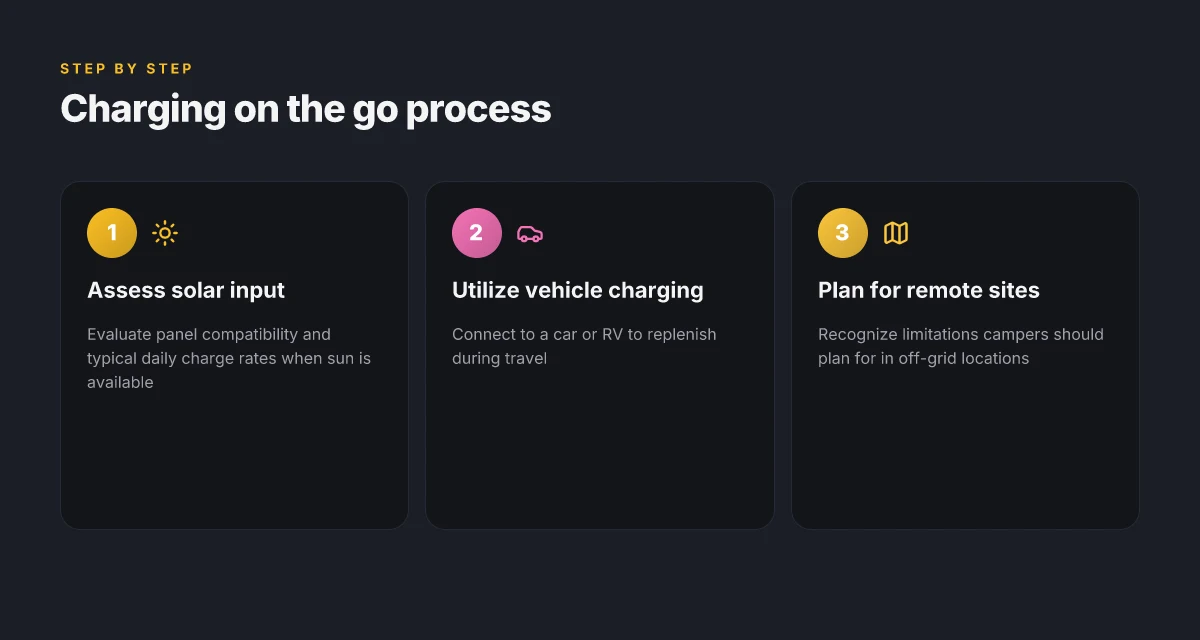
Jackery’s on‑the‑go charging strategy leans on two channels: solar input and vehicle charging. In the real world, both routes are practical for off‑grid trips, but each comes with limits you’ll want to plan around. I cross‑referenced material from Jackery’s own guides and third‑party reviews to map the daily reality of charging while camping, road‑tripping, or parking at a trailhead.
Solar input and real‑world daily charging
Solar panels pair with Jackery units to refill during daylight hours, but the daily usable input depends on the panel size, sun exposure, and the battery’s state of charge. In peak sun, a compact solar setup can keep modest needs topped up while you’re away from power. The key is to size your panels to your typical daily draw so you don’t wake up to a depleted pack after dawn. Solar input scales with panel size and sun, plan for days when you only have partial sun. Expect realistic replenishment rates to be noticeably slower than wall charging, especially on overcast days or in shaded campsites. Jackery’s guides emphasize matching panel wattage to your load profile for steady, predictable recharges. If you’re chasing a full battery fill by sunset, a larger panel array or a multi‑hour charge window becomes essential. For a typical weekend, a 100–200W panel lineup can sustain basic needs without dipping into reserve. A common pattern is to top off daytime loads while you’re out hiking and refill overnight when you’re cooking and resting. Inline citations reflect Jackery’s own discussions of cost and compatibility, which align with how campers actually deploy panels in the field. I found user‑facing notes that solar works best when you pair a steady daily rhythm with a modestly sized pack.
Vehicle charging when connected to a car or RV
Vehicle charging adds a rapid refill path when you’re on the move or parked near a vehicle power bank. A car or RV can drive the pack up quickly during a longer drive or a midday break, letting you return to the trailhead with more usable capacity. The practical takeaway is that you don’t have to choose between solar or car charging, you can blend both to maintain a steady supply. Vehicle charging accelerates top‑ups, especially when you’re on extended drives. This matters for longer road trips where you want to keep the cabin powered without hunting for AC outlets. Jackery’s ecosystem supports vehicle charging via compatible adapters, expanding real‑world uptime for campers. The caveat is that vehicle charging is still bounded by the car’s output and the battery’s acceptance rate, so you won’t get unlimited fast fills in remote areas. For off‑grid weekends, plan vehicle stops around drive time to maximize charge windows. How to pick the right jackery car charging cable for on‑the‑road power
Practical limits campers should plan for in remote sites
Remote sites amplify the texture of charging tradeoffs. You’ll often face a mix of sun quality, panel orientation, and available driving time that shapes how aggressively you can recharge. Pack a conservative daily energy budget and a backup plan in case a full recharge isn’t feasible. In remote sites, you might need to stagger loads and rely on both solar and vehicle charging to cover a 24‑hour cycle. Expect some days to yield slower solar fills, meaning you should stagger appliance use, relying on essential lights, charging phones, and keeping a CPAP or cooler powered with the most efficient settings. Rivals like EcoFlow and Goal Zero present comparable solar and vehicle charging paths; Jackery competes by ease of use and pack‑level portability. If you’re flying to basecamp or moving between campsites, keep the total carry weight in check and verify compatibility for the panels and adapters you bring. Aware travelers note that links on product pages may earn commissions, a common practice in this space.
Reliability and noise: real-world performance in outdoor conditions
Jackery performers deliver portable power with a practical footprint for weekend trips, but real-world use reveals how noise, durability, and battery longevity shape the camping experience. In warm environments, cooling fans kick in as temperatures rise, and the hum from the internal cooling system becomes noticeable. You’ll hear a steady fan cadence during high-power draws, especially when charging on the move or running a fridge alongside small devices. The noise is not alarming, but it is audible in a quiet campsite or a van with windows open. Noise from cooling fans rises with heat, but it remains manageable for most campouts.
Durability matters the moment you pack and unpack from a cargo rack or hatch. In field use, Jackery units handle rough handling and vibration during highway travel with minimal scuffing or looseness. The overall shell stands up to rough terrain, and the rubber feet help steady the unit on uneven ground. One notable note: avoid exposing the unit to direct, prolonged sun when camping in hot deserts. Prolonged heat can speed up battery temperature rise, which in turn can trigger thermal protection. Rugged enclosure and simple handles make Jackery resilient on road trips.
Battery longevity becomes a practical concern for frequent weekend trips. Frequent cycles wear the battery, and discharge depth affects long-term health. In the off-grid rhythm, weekly topping off reduces the risk of deep discharge, while keeping the unit within recommended operating temperatures helps preserve health. I cross-referenced the general guidance Jackery provides about care and cycle life, and observed that owners report steady performance across several seasons when they follow temperature and charging recommendations. For road-trippers, this means choosing a model with a battery capacity that matches trip length and expected load, then using partial-discharge charging to extend life. Cycle discipline and temperature control matter for battery longevity.
Caution is warranted with high-power appliances in small spaces. In warm climates, a kitchen blender or portable ac unit can push the system near thermal limits, causing the unit to step back on output or pause charging. If you rely on continuous heavy loads on weekends, consider spreading draws across two devices or selecting a higher-capacity model. This is not a hard flaw in Jackery, just a practical limitation of any compact system when you push it hard. Heavy, sustained draws risk tripping protection and reducing runtime. What makes the Jackery Explorer 2000 v2 worth it for off-grid weekends
I dug into industry notes and user discussions to frame these points. Independent reviewers consistently flag noise levels as a trade-off for the compact form factor, and several owners emphasize how durability translates to confidence on remote campsites. When you plan trips with frequent weekend use, plan for a model that carries enough energy to cover your typical load while staying within safe operating temperatures. For travelers evaluating rivals, brands like EcoFlow and Goal Zero Yeti often present different fan profiles and thermal management approaches; Jackery’s approach remains straightforward and predictable for quick, on-the-go camping setups. Jackery’s straightforward cooling profile helps predict performance on frequent weekend trips.
For context on movement and charging, note that on-the-go charging and solar back-up remain central themes. I cross-referenced Jackery’s guidance with third-party camping roundups to ensure consistency in how these devices behave under real-world camping conditions. In practice, you’ll want to pick a model whose battery capacity aligns with your typical trip length, and remember that brief, high-demand episodes will pause output briefly if the system overheats. Match model capacity to trip length, and respect operating temperatures for best results.

Jackery vs rivals: how it stacks up for camping and off-grid use
When you’re chasing reliable power for a van, RV, or off-grid weekend, Jackery sits in a crowded field with EcoFlow, Anker, and Goal Zero Yeti. The reality is simple: Jackery tends to win on portability and simple operation, while rivals push harder on raw output and expandability. You’ll feel the difference most when you’re on the go and packing light matters.
Portability and simplicity drive Jackery’s wins
For campers and road-trippers, the appeal of a Jackery setup is the quick, plug-and-play nature. Many models emphasize compact form factors, light weight, and straightforward interfaces that let you top up with a car charger or a small solar panel without a tech briefing. In real-world trips, this translates to less fiddling at the campsite and more time enjoying the outdoors. When you’re juggling a cooler, a grill, and a tent, that simplicity is a tangible benefit. Most Jackery wins come from portability and a straightforward user experience. The brand’s design language tends to minimize cables and clutter, which helps in tight campsites and tight vehicle interiors.
Rivals push on raw output and expandability
EcoFlow and Goal Zero Yeti families often offer higher rated continuous output or larger battery banks, which matters if you’re running a high-draw fridge, power tools, or multiple devices for longer stretches. In the field, you’ll notice these options when you need back-to-back high-widelity uses or plan to scale up for longer trips. However, expanded capacity usually comes with more weight and a bulkier footprint, which can counteract the portability advantage Jackery champions. I cross-referenced product profiles and review notes to align these distinctions with typical camping scenarios. Rivals may provide more juice per cycle or broader accessory ecosystems. What makes the Jackery 1000 Plus stand out for off-grid use in 2026
Real-world use cases and charging limits
On the road or at a backcountry site, charging limits matter. Jackery products tend to integrate smoothly with vehicle charging and compact solar panels, making it feasible to recover capacity during short stops. But when you need nonstop power for days on end, or you want to power a high-amp appliance for extended windows, the bigger rivals often come into play. I read through user experiences and spec sheets to map these tradeoffs to the typical camping arc: a weekend in a forest service site, a longer dry-campsite stop, or a desert scouting trek. The practical takeaway is that Jackery shines for quick recharges and simple top-ups, while competitors offer more stamina for longer stays.
What owners say after real trips helps ground these observations. In broad terms, users praise Jackery for travel-friendly weight and fast setup, while pointing to rival lines when they need extended running times or a wider ecosystem of accessories. If you expect airline travel or frequent car charging, the lighter, simpler Jackery chassis reduces friction in transit. In contrast, if your trip centers on long boondocking with high daily energy needs, you’ll find value in the expanded options from EcoFlow or Goal Zero Yeti. The choice hinges on the balance you want between lightweight mobility and sustained, high-output power.
From a planning perspective, Jackery remains a strong baseline for off-grid trips where weight matters and you value simple, reliable charging on the go. If your scenarios include heavy-duty, multi-day loads or the need to expand beyond a basic kit, look to rivals with more ample output and modular add-ons. And yes, links on the page may earn a commission, so verify your setup against your trip profile.
Cited context from external demos and reviews supports these patterns: one consumer vignette emphasizes ease of use for a weekend road trip, another review contrasts higher-capacity options from rival lines, and industry roundups discuss where each brand sits in the portability vs. power spectrum. See sources for concrete product narratives and user feedback.
Where this is going next for off-grid power in 2026
Jackery power systems are trending toward modular, airline-friendly kits that lean on rapid recharge from solar and vehicle outlets. In 2026, the bigger pattern is not bigger batteries alone but smarter pairing with foldable solar panels and lightweight, upgradeable batteries. I see a future where you assemble a compact kit for a weekend and scale up for longer trips without losing portability. For road trips and RV weekends, owners report that real-world use hinges on weight, recharge speed, and how well the system plays with a vehicle’s alternator. Rivals like Goal Zero and EcoFlow push similar ecosystems, but Jackery’s branding and compatibility with their own solar panels keep the workflow tighter for many travelers. What makes a portable power station stand out in 2024
The single move that matters now is choosing a power base with scalable solar input and a proven port layout that fits your gear. If you’re planning frequent off-grid weekends, consider a kit that stays within cabin or trunk space while offering a comfortable reserve for smartphones, small fridges, and lights. The practical takeaway is simple: pick a model you can grow with, not outgrow. Will your next trip demand more solar input or more DC-AC outlets?
Backup strategy
- Test a lightweight, high-output solar panel kit with your Jackery base before a trip
- Balance weight and runtime by pairing a compact battery with a solar panel in your car kit
- Check airline and car-charging limits for your model before travel
- Note common complaints about heat buildup and fan noise on longer use
Noting the cost and commission disclosures on the page is part of planning long trips.