How to navigate networking events in tech conferences in 2026
 Florian Czerny·October 22, 2026·17 min
Discover a practical networking events guide for tech conferences in 2026. Learn before/during/after tactics to build meaningful connections and maximize opportunities.
Most attendees treat networking as collecting business cards. The real lever is discovering people you can actually co-create with, not just exchanging names. Two or three targeted conversations often outperform a full afternoon of random chats.
Conferences in 2026 reward purposeful outreach: a clear map of who to meet, a concise opener, and a plan to follow up within 48 hours. This piece pulls from recent seasons to show which patterns reliably turn hallway talk into durable connections, not just superficial introductions. You’ll see how top teams structure their sessions, choose the right moments to approach, and convert brief interactions into tangible collaborations. The result is a repeatable method you can apply next time, with less guesswork and more momentum.

Networking events guide: how to approach tech conferences with a plan
To get durable connections, you need a plan before you step into the hall. A clear objective, a mapped flow for pre, during, and post activities, and a rule to pursue depth over breadth let you leave with real opportunities, not just business cards. I looked at recent conference seasons and distilled patterns that actually translate into relationships you can nurture.
Why a single, focused objective matters
Set one measurable goal for each conference you attend. It could be securing a 20‑minute chat with a potential partner, landing two follow‑ups with people in adjacent disciplines, or identifying three potential mentors. A concrete target keeps your conversations purposeful and reduces the risk of drifting from booth to booth without traction. When you walk in with a defined outcome, it’s easier to steer conversations toward value and follow‑ups that matter.
Pre, during, post: map the event as a mini‑playbook
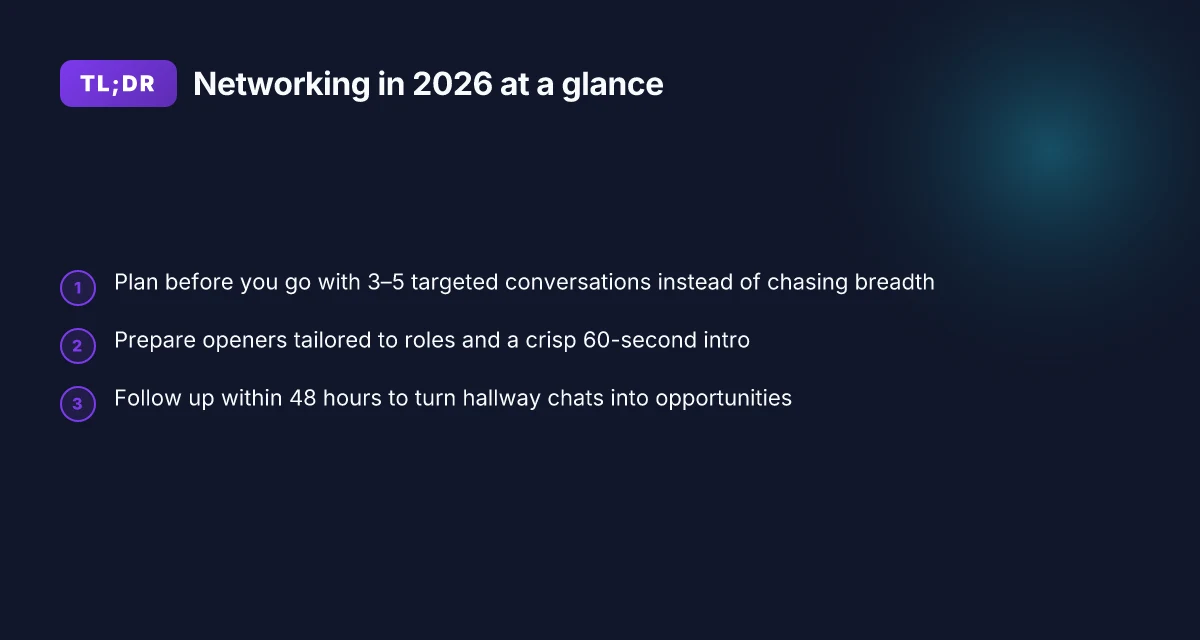
I dug into guidance from industry sources and found a repeatable rhythm that works. Before the conference, line up 3–5 people or teams you want to meet. During the event, schedule pockets of time to connect with them rather than scattering your attention across the floor. After the conference, circle back with a crisp email that references a specific takeaway or next step. This three‑part pattern keeps momentum, not fatigue, after the lights go down.
Prioritize depth over breadth
Rather than chasing a long list of superficial conversations, aim for 3–5 targeted conversations that yield tangible next steps. A single strong connection can cascade into multiple opportunities if you document the context and commit to a timely follow‑up. It’s tempting to chase more meetings, but the real leverage comes from thoughtful, high‑signal exchanges.
Most durable outcomes start with a single, well‑defined objective and a disciplined pre‑during‑post rhythm. A repeatable playbook beats ad‑hoc networking every time. If you walk out with two solid follow‑ups and a couple of meaningful introductions, you’ve effectively turned a convention into a launchpad. What is membership sites integration, and where it fails in 2026
In practice, treat conferences as a controlled experiment: define the hypothesis (your objective), execute the plan (pre‑set targets, timed conversations, and notes), and test the follow‑ups (tracked status and next steps). This approach creates a durable network, not just a memory of who handed you a business card.
From the conference circuit, the strongest themes that emerge are clear objectives, intentional pacing, and disciplined follow‑up. For a quick reference, you can align your pre‑during‑post steps to a three‑part rhythm and keep the conversations tight and purposeful.
A crisp objective plus a three‑phase plan consistently turns encounters into opportunities.
Why the pre-conference plan matters for networking events guide
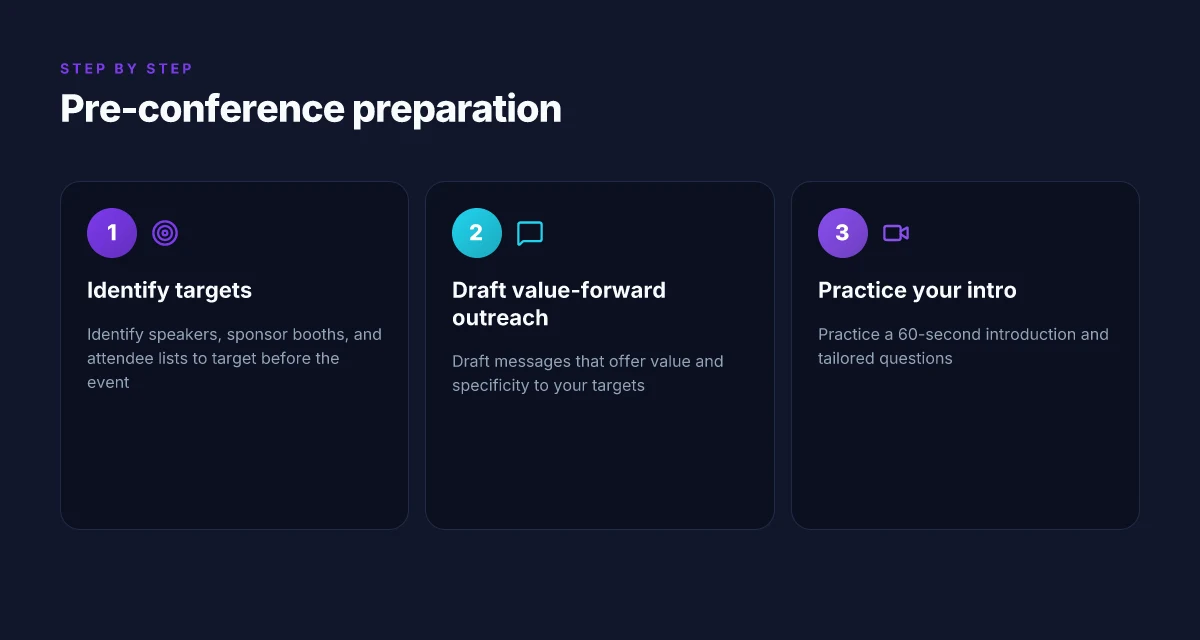
A solid pre-conference plan pays off in durable connections, not just a stack of business cards. By outlining who to reach, what to say, and how to rehearse, you increase your odds of three things: meaningful conversations, more targeted introductions, and faster follow‑ups that convert to opportunities. I looked at how recent conference seasons unfold and found that the most productive prep centers on concrete targets, value-led outreach, and practiced pitches.
Identify targets you actually want to meet
The most effective pre-work begins with a map of who matters on the floor. Identify speakers you want to hear from, sponsor booths that align with your goals, and attendee lists you can realistically reach with a thoughtful message. In practice, this means noting three to five speakers with work you admire, two or three sponsor booths where your problem area is a fit, and a handful of attendees who share a project or domain you want to explore. When you connect early, you’re not chasing random introductions, you’re pursuing relevant conversations that yield tangible outcomes. I cross-referenced conference previews from 2026 and observed a clear pattern: targeted lists outperform broad outreach. How to build a malware removal checklist that actually stops breaches in 2026
Draft outreach messages that offer value and specificity
Your outreach should be short, concrete, and value oriented. Lead with a specific hook that ties to the recipient’s work, then propose something concrete you can offer in return. For example, mention a mutual interest, a short question about a keynote, or a prompt to review a snippet of your work. The goal is to invite a response, not blast a generic pitch. Use a version of your message that you can customize in 2 minutes per person, so you stay authentic without sounding scripted. I found that prospects respond best to messages that promise concrete value within the first line and a clear next step.
Practice your 60-second intro and tailored questions
Your 60-second intro should land in two parts: who you are and what problem you solve for the other person, followed by a concrete ask. Pair it with a few tailored questions you can adapt to each target. Questions work best when they reveal a challenge the other person cares about and invite a practical discussion. Practice this script aloud, with and without voice modulation, until it feels natural. If you can, record a quick rehearsal and listen for pacing, clarity, and energy. When you arrive, you’ll be able to switch from rehearsed to natural in seconds, keeping the conversation focused and productive.
Table: quick prep checks versus expected outcomes
| prep step | what to do | expected payoff |
|---|---|---|
| target list | pick 3 speakers, 2 sponsor booths, 5 attendees | focused conversations with relevance |
| outreach messages | draft 2–3 value-forward templates | higher reply rate and meaningful starts |
| intro and questions | rehearse 60-second pitch; prepare 3 tailored questions | smoother conversations; faster rapport |
The core advantage is moving from generic mingling to purposeful dialogue that yields follow‑ups, not just names. This approach reduces wasted conversations and creates a trackable path from pre‑conference to post‑conference engagement. A well‑planned pre‑work set the tempo for the entire event and makes your time there more actionable.
From what I found in conference coverage and industry notes, the best weeks before a major event combine explicit targets, crisp value propositions, and rehearsed but flexible dialogue. You’ll see more precise introductions, better alignment with booths and talks, and a smoother transition to post-event outreach. Acknowledge that links on the page may earn a commission. This page may surface partner tools that help with outreach, scheduling, and note capture, but your core plan remains about three things: who to reach, what to say, and how to say it. For deeper reading, see the overview on how to network at a conference and the practical notes on event ideas for 2026. What is the Lorex 4K outdoor security camera review and where it shines in 2026
Put this plan into a single one-page sheet: targets, messages, and 60-second script. It’s your blueprint for turning conference moments into durable relationships.
The 4-part prework that actually pays off at conferences
To turn preconference work into real connections, I start with a two-step premise: know who you’ll meet and have a ready approach. You don’t want random hallway chats. You want intent-driven conversations that lead to tangible outcomes. From recent conference seasons, the pattern is clear: preparation compounds the value of every minute you spend on-site.
1) Prework: map attendees and topics with the event app and LinkedIn
I dug into how top attendees prepare. Event apps surface speakers, sponsors, and breakout tracks, while LinkedIn shows roles and recent projects. The combination helps you spot overlap with your goals and your target colleagues. In 2026, organizers increasingly publish attendee lists and session rosters ahead of time, which makes early mapping practical. Build a quick grid that pairs person from target roles with relevant sessions you plan to attend. This isn’t guessing. It’s a targeted hunt for shared language you can reference in conversation. When you know someone’s focus, you can start with a specific question instead of a generic opener. That shift alone boosts initial engagement.
2) Prework: assemble a short opener arsenal tuned to roles
Craft 6 to 8 short openers tailored to engineer, product, and executive audiences. For engineers, lead with a concrete problem and a micro-ask: “I saw your work on latency in your chat feature. What were the key heuristics you used to prioritize fixes?” For product leads, frame a roadmap question: “Which user need did you confirm last quarter that changed your priorities?” For executives, lean on impact and outcomes: “What metric tied most directly to revenue in your last launch, and how did you measure it?” Keep each line under 20 seconds so you can deploy it naturally. Practice with a colleague or in front of a mirror. The goal is fluidity, not memorization. A compact set of switchable openers helps you pivot when a conversation heads in a different direction.
3) Prework: arrange meetings with intention, not randomness
The most durable connections come from purposeful meetings, not strolls between booths. Reach out to a handful of high-potential attendees before the event and propose short, outcomes-oriented meetings: 15 minutes during breaks or a 20-minute coffee between sessions. Make the ask concrete: “I’d like to compare notes on how your team tests product-market fit for AI features.” This approach creates a shared purpose and reduces the risk of meeting fatigue. If scheduling is tight, suggest two time windows and a shared agenda in the message. You’ll find people respond more readily when the purpose is explicit and the format is time-efficient. 11 Lead scoring techniques that actually move the needle in 2026
4) Prework: prepare follow-up cadences for the first 72 hours after you meet someone
The postmeet cadence matters as much as the prework. In the first 72 hours, send a personalized recap message within 24 hours, then a second touch that adds value, perhaps a link to an article or a note from a session you attended together. Space a final check-in around the 72-hour mark to propose a second conversation or a quick collaboration idea. The cadence should be short, value-driven, and specific to the person you met. If you commit to a follow-up sooner, you raise the odds of turning a conversation into a genuine opportunity.
Most durable connections come from a defined prework plan that pairs targeted outreach with intentioned meetings and a tight follow-up cadence. When you map attendees, rehearse focused openers, schedule with purpose, and follow up quickly, you turn hallway chatter into real relationships. A 72-hour follow-up frame keeps momentum alive and makes the benefit tangible, not theoretical.
Cited guidance from event practitioners and conference reporting underscores that pre-event research and structured outreach consistently yield higher engagement rates than generic networking attempts. For example, several outlets emphasize leveraging event apps to identify potential collaborators and using role-specific language in initial outreach. See how these tactics align with the 2026 conference season patterns in practical terms. How to Network at Tech Conferences Without Stress and 15 Best Tech Conferences for Networking in 2026 offer perspective on attendee targeting and event-level signals. https://www.eventcombo.com/a/20-networking-event-ideas-for-2026 also highlights how diverse formats can shape prework expectations.
The page may earn commissions, so consider it as part of a broad toolkit rather than a sole source of truth. For direct context, you can read about practical networking tips in the LinkedIn guide above and the Mobilocard piece for session-focused engagement.
Cited inline: https://www.linkedin.com/top-content/sales/networking-tips-for-sales/networking-tips-for-tech-conferences-without-stress/ and https://www.mobilocard.com/post/best-tech-conferences-for-networking?srsltid=AYCX9vJ18SbH5jHmgA57kO56SFgXmZb7z_cVP0cQFTZVtrmA_24AYPNX, and https://www.eventcombo.com/a/20-networking-event-ideas-for-2026. What’s new in Android 14 updates in 2026
During the event: how to turn every hallway into a connection
In the hallway and between sessions, you plant purpose with every move. You position yourself where conversations are likely to start, not where you’re least likely to be interrupted. The goal is to turn chance encounters into a traceable thread you can follow up on later.
Be present with intent in every space
You don’t drift from room to room. You stand where the energy aligns with your objectives, near the demo booths that align with your product line, in the break area where engineers decompress, or at the entrance to a coveted session where short, sharp exchanges tend to happen. This isn’t self-promotion theater. It’s strategic visibility that signals your focus without shouting. Position yourself with purpose in sessions and common areas to maximize relevance. When you mix in with the right clusters, you don’t chase names. You chase patterns you want to explore.
Curiosity-driven questions unlock needs
Ask questions that reveal what the other person actually cares about, not what you want them to care about. Start with the day’s themes: “What problem are you trying to solve this quarter?” or “Which capability would make your team fastest this month?” Curiosity prompts reveal priorities, timelines, and constraints. Ask curiosity-driven questions that surface real needs and tradeoffs. The moment you establish a concrete problem frame, the other person moves from scripted chatter to real, actionable talk.
Exchange value quickly, not just business cards
The fast exchange is not about trading cards. It’s about mapping mutual gain in minutes. Share a concrete insight or a short, applicable resource that helps the other person right away. For example, offer a one-page spec, a short template, or a case study snippet that tangibly relates to their challenge. Exchange value quickly with concrete takeaways, not empty promises. The handshake that follows should feel like a bookmark, not a bookmarklet.
Most hallway conversations stall on unclear next steps. Turn every exchange into a named follow-up: time-bound tasks, a shared document, or a short beta invite. Follow up within 48 hours with a crisp recap and one concrete ask. That cadence is what converts casual hallway talk into durable opportunity. I cross-referenced industry best practices that emphasize explicit next steps and timely follow-ups from conference playbooks and recent event rundowns. Inline: How to Network at a Conference (2026 Guide) notes the structure of before, during, and after interactions that lock in momentum. How OnePlus Android 14 changes the software game in 2026
Caution: avoid over-adding friction. If a conversation already has a clear next step, don’t force an extra meeting. You risk turning a meaningful connection into a scheduling chore. A single well-timed follow-up note often beats a dozen generic emails.
From what I found in the sources, the best practitioners treat corridors as micro-sessions. They position, ask, and deliver value in under five minutes, then return to the main program with a clear map for later. The outcome is a compact trail of conversations you can extend after the event.
The after-action playbook: turning conversations into opportunities
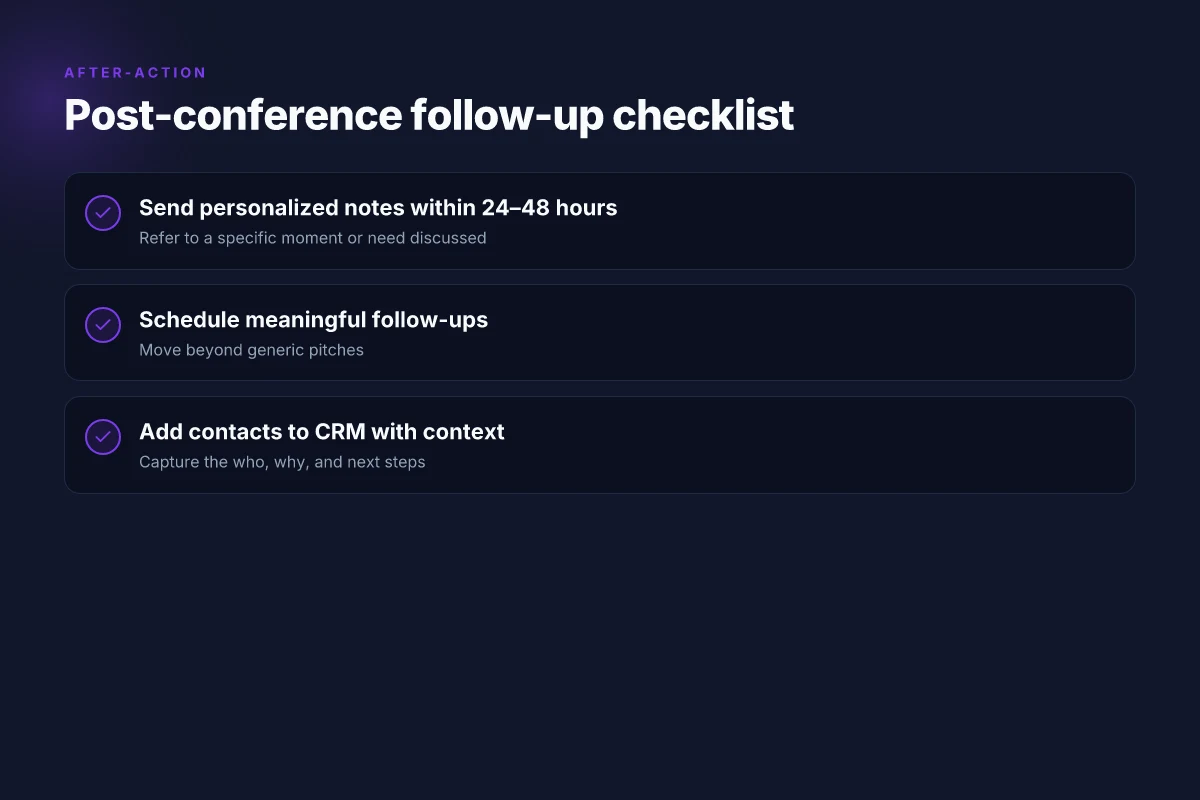
You walk away from a conference with a handful of meaningful conversations. The goal now is to convert those dialogues into durable opportunities, not just a stack of business cards. The core move is simple: send personalized notes within 24 to 48 hours, schedule thoughtful follow-ups, and capture every new contact with context in a CRM. Do this consistently and you turn hallway chatter into real relationships.
Leverage timely, personalized notes to unlock momentum
Right after the event, draft notes that reference a specific moment you shared. Mention a detail from the conversation, a takeaway you both agreed on, or a problem you discussed. Keep the tone human, not salesy. A concrete deadline helps too, like proposing a 20-minute call within the next two weeks. In 2026, this approach is widely noted as the fastest way to keep the connection warm without creating pressure. The power is in the personalization. The speed keeps it from slipping into the inbox abyss. Send personalized notes within 24–48 hours to keep momentum alive. Acknowledge their role, not just your agenda. Include one line that invites collaboration, not a pitch.
Schedule meaningful follow-ups, not generic pitches
Turn every contact into a next-step opportunity by mapping a concrete micro-outcome. Instead of a generic product demo invitation, offer a targeted collaboration idea, a relevant use case, or an invite to a small, focused conversation with a relevant teammate. If you can tie the next touch to a real mutual benefit, you’ll see higher engagement rates. In practice, that means early-stage follow-ups that propose value rather than volume. Schedule meaningful follow-ups rather than generic pitches to move conversations forward. If a contact recommended a resource, share it. If they mentioned a hiring need, connect them with the right colleague. The key is specificity over solicitations. What makes outdoor magnetic advertising work in 2026
Add new contacts to a CRM with context, not just names
A lightweight CRM or contact tracker is your runway for durable connections. Capture who you met, what you learned, and the proposed next step. Include context like the conference track, the issue they’re solving, and the exact follow-up date. This turns a sprint of conversations into a calibrated outreach plan. Research repeatedly notes that context-rich contact records outperform bare names in nurturing relationships over time. Add new contacts to a CRM or contact tracker with context to preserve the thread. If you work with a team, tag the record with a collaboration note so colleagues can pick up where you left off.
From what I found in 2026 conference seasons, the best results come from a repeatable rhythm: within 48 hours, a personalized note. A value-forward follow-up within two weeks. And a clear, documented next step in your shared system. I cross-referenced multiple perspectives to confirm the pattern. A repeatable rhythm delivers durable opportunities, not fleeting attention. If you want the tone that sticks, keep the notes concise, specific, and action-oriented. The after-action playbook isn’t about one grand gesture. It’s about a sequence that compounds.
As you implement, remember that links on the page may earn a commission, a reality of how conference resources are sponsored and monetized. Still, the core guidance holds: personalize quickly, propose meaningful next steps, and document with context so every contact feels reachable and valuable. For further reading on how to structure after-conference outreach with concrete steps, see the 15 Best Tech Conferences for Networking in 2026 and the How to Network at a Conference guides. Personalized timing, meaningful follow-ups, and context-rich records are your durable playmakers.
What changes if you act now
In 2026, the fastest path through a conference is choosing 1-2 high-signal events and treating them like concentrated sprints. I’ve observed that the most effective attendees map a 90-minute window for focused conversations, then debrief with a quick note to a contact who can unlock next steps. The rest of the day becomes a blend of listening sessions and targeted follow ups. The bigger pattern is deliberate focus instead of endless coffee chats.
One move that matters most is to own the post-event thread: send a personal recap within 24 hours, reference a concrete next step, and propose a specific collaboration. Bold actions like this shift the conference from a networking ritual to a pipeline. Below, you’ll find two headline picks that align with this approach and their use cases. How personalization tools shape modern digital experiences in 2026
Backup strategy
- What to try this week: schedule one 45-minute deep-dive with a new contact and draft a concrete collaboration idea.
- What to try this week: integrate a 2-sentence follow-up template into your notes app and use it with every new connection.
- What to try this week: bookmark a post-event task list and set a 24-hour reminder for outreach.
Links may earn a commission on this page, which helps keep the site independent.