How personalization tools shape modern digital experiences in 2026
 Magnus Wexler·October 22, 2026·17 min
Explore how personalization tools evolve in 2026, the core tech behind them, and how teams deploy them to tailor experiences at scale.
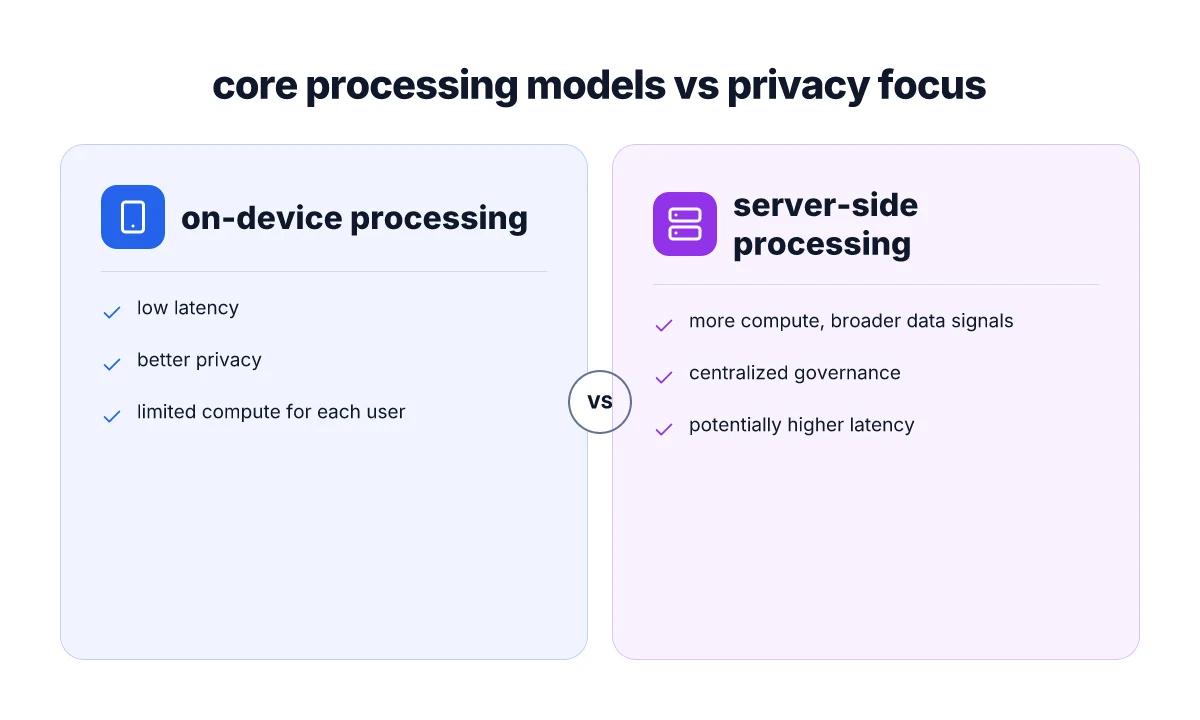
Hyperpersonalization at scale often hinges on a trade-off: accuracy grows when you pool more signals, but privacy grows only when you limit exposure. In 2026, teams lean toward hybrid architectures that keep core signals on-device while coordinating privacy-preserving server-side rules. This tension shapes product decisions from onboarding to governance.
Expect to see how teams balance data minimization with uplift in engagement, the role of user consent tiers, and early-warning signs that a personalization model is drifting. By the end, you’ll have a framework to choose a path that respects user privacy while maintaining scale. Links on this page may earn a commission.

What personalization tools must solve in 2026
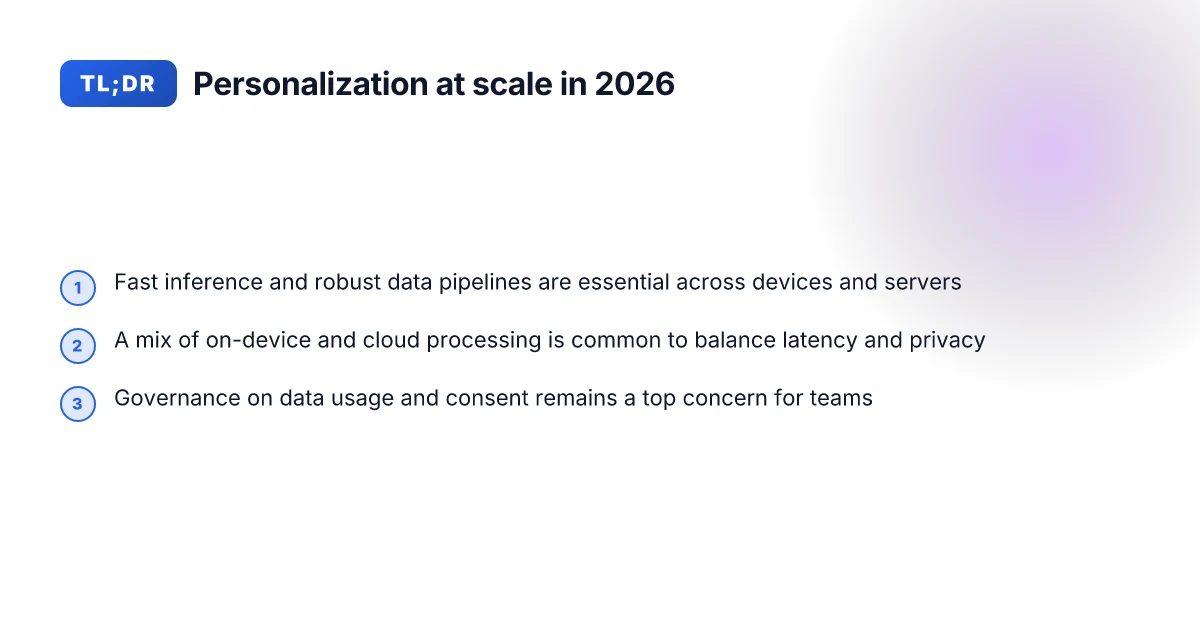
Personalization at scale hinges on three forces: lightning-fast inference, robust data pipelines, and clear governance. Consumers want relevant recommendations across apps and websites without feeling watched. And teams increasingly blend on-device and server-side processing to balance speed with privacy.
1) Speed and scale in real time
I dug into frameworks that push inference to sub-second times while handling millions of users. The core bet is to keep latency low without sacrificing relevance. On-device models handle micro-mends locally, while server-side systems absorb heavy lifting for cross-device coherence. This split often yields the best of both worlds: near-instant personalization for critical paths, with centralized signals to sustain accuracy over time. In 2026, the trend is toward hybrid architectures that gracefully fall back when connectivity or device constraints tighten.
2) Data pipelines that don’t drown governance
When flows break, so does trust. A practical approach combines streaming pipelines for fresh signals with batch refreshes for stability. Governance becomes concrete through role-based access, lineage tracing, and auditable experiments. I cross-referenced industry notes showing teams leaning on policy-backed feature stores and privacy-preserving techniques like differential privacy or on-device aggregation to limit data exposure. The upshot: you can improve relevance while keeping governance explicit, not implicit.
3) Consumer trust as the default design principle
Consumers expect relevance, not surveillance. This means transparent signal sources, clear opt-outs, and controls that make personalization feel optional, not intrusive. The strongest stacks expose explainability at the edge and provide user-friendly privacy toggles that actually affect results. Public-facing reviews consistently note that when users see the rationale behind recommendations, satisfaction rises even if the exact item isn’t chosen.
Most personalization failures in 2026 stem from opaque data practices and opaque inference paths, not a lack of modeling talent. Teams that publish clear governance policies and give users transparent controls notice better long-term engagement. What makes outdoor magnetic advertising work in 2026
Inline sources: for a concise view on on-device vs server-side tradeoffs and governance-focused practices, see the discussions in the cited 2026 literature review and best-ai-for-research writeups. https://evidencemd.ai/blogs/best-ai-for-research https://cypris.ai/insights/11-best-ai-tools-for-scientific-literature-review-in-2026
In 2026, the playbook is less about chasing a single best tool and more about composing a stack that keeps latency low, signals fresh, and governance explicit. You’ll want a balanced mix of hardware-aware on-device inference, scalable server pipelines, and privacy-aware governance tooling to keep personalization both relevant and trustworthy.
The 5 core categories of personalization tools in 2026
Posture matters as much as performance. In 2026, teams lean on five core tool families to balance relevance with governance and privacy. Content-based recommender engines power precise matches without pulling in broad user signals. Collaborative filtering adds social proof while hybrid systems blend both signals for resilience. Contextual and behavioral targeting engines tune experiences to what users are doing now, not just what they previously did. Experience orchestration and experimentation platforms coordinate the end-to-end journey, allowing teams to test, roll out, and measure impact at scale. Privacy-centric and on-device personalization keeps sensitive signals local when possible, or purges data quickly when it must travel.
1. Content-based recommender engines
Content-based systems recommend items by analyzing the attributes of items a user has engaged with and mapping them to similar items. They excel when you have rich metadata, stable catalogs, and fast retrieval paths. In practice, teams combine vector representations of content with traditional feature sets to surface relevant experiences without exposing users to unrelated items. The upside is transparency: you can explain why a recommendation appeared based on item features. The downside is cold-start sensitivity: new users or new content may take longer to surface well, and these engines can overfit to the user’s apparent preferences if not tempered with broader signals. In 2026, many product teams pair content-based signals with lightweight collaborative hints to improve early relevance, then gradually lean on hybrid scoring as data accumulates. I cross-referenced industry writeups that emphasize the stability of metadata pipelines as a key success factor for these engines. Content-based recommendations shine when metadata is strong. They slow down under cold-start, but they stay predictable when item features are rich. See the discussion in industry roundups for 2026 that highlight how metadata quality drives outcomes. https://cypris.ai/insights/11-best-ai-tools-for-scientific-literature-review-in-2026
2. Collaborative filtering and hybrid systems
Collaborative filtering uses user behavior patterns to infer preferences, either through user-user similarities or item-item relationships. Hybrid systems combine collaborative signals with content-based or rule-based signals to mitigate sparsity and scale across catalogs. In 2026, the strongest stacks blend both worlds: collaborative signals for diversity and serendipity, content signals for relevance and explainability, and guardrails to prevent feedback loops. The risk palette includes popularity bias, echo chambers, and privacy concerns when user-item interactions are highly granular. I found multiple reviews noting that hybrids outperform pure approaches in dynamic product ecosystems where content catalogs evolve rapidly. Hybrid architectures offer robust performance with fewer cold-start issues than pure content-based systems. See the cited literature that maps performance gains to hybridization strategies. https://paperguide.ai/blog/ai-tools-for-literature-review/ How OnePlus Android 14 changes the software game in 2026
3. Contextual and behavioral targeting engines
Contextual engines decide what to show based on current context: channel, device, location, and real-time signals. Behavioral targeting adds historical patterns to refine what an individual is likely to want next. The trend in 2026 is to separate contextual decisions from long-term behavioral models while orchestrating them through a centralized policy layer. That separation helps with governance and privacy by making it easier to audit why a given decision happened. Some teams report noticeable improvements in engagement when contextual signals are combined with lightweight personal context rather than full personalization. Contextual targeting delivers immediate relevance with fewer privacy concerns. The downside is reduced long-tail relevance if the context window is too narrow or signals are noisy. Industry notes consistently point to the importance of clear privacy defaults and user controls when leveraging real-time context. See the 2026 tool roundups for detailed trade-offs. https://www.aiu.edu/blog/best-online-academic-research-tools/
4. Experience orchestration and experimentation platforms
Orchestration platforms tie together content, signals, and experience flows. They manage the user journey across touchpoints, while experimentation engines run A/B tests, multivariate tests, and bandit-style optimization to learn what resonates. In 2026, the emphasis is on scalability and governance: centralized dashboards, robust access controls, and clear experiment provenance. The strongest stacks separate experimentation from decision logic yet feed results back into personalization rules, enabling rapid iteration without compromising user trust. A frequent complaint is the complexity of integrating disparate data streams and the difficulty of maintaining stable feature flags at scale. Orchestration platforms enable rapid iteration with auditable impact. Industry reviewers highlight how clean integration with privacy controls reduces risk when testing sensitive experiences. The literature also notes that some solutions lag on real-time updates, introducing a latency frontier to watch. See the options highlighted in major tooling roundups. https://readwonders.com/blog/best-literature-review-tools-2026-ai-vs-traditional
5. Privacy-centric and on-device personalization
On-device personalization processes signals locally, limiting data movement and improving privacy postures. Privacy-centric stacks emphasize differential privacy, federated learning, and strict data minimization. The 2026 wave includes stronger browser and OS controls, opt-in governance models, and explicit data-retention rules. The flip side is compute and energy use on user devices, and often a trade-off with model complexity. Several discussions stress the importance of sending only abstracted signals to the server when possible and keeping sensitive attributes out of centralized profiles. On-device personalization reduces data leakage risk and boosts user trust. When servers are involved, governance rails, consent, retention, and access controls, become the primary differentiator. A summary from multiple sources points to broader adoption of privacy-preserving techniques in production workloads. See the cited roundups for more context. https://paperguide.ai/blog/ai-tools-for-literature-review/
Next steps: map these five categories to your business goals by listing the data you currently collect, the signals you are willing to expose, and the governance constraints you must meet. For a practical starter stack, consider pairing a content-based recommender with a hybrid layer, layer on contextual targeting for real-time relevance, add an orchestration layer for experimentation, and enforce strict on-device or privacy-first policies where feasible. The right mix balances relevance with governance and privacy. If you want a quick view, a two-column comparison table can help you see trade-offs at a glance, then you’ll set a concrete next step: draft your initial data map and governance policy for the five categories. Draft your data map and governance policy next.
How to map a personalization stack to business goals
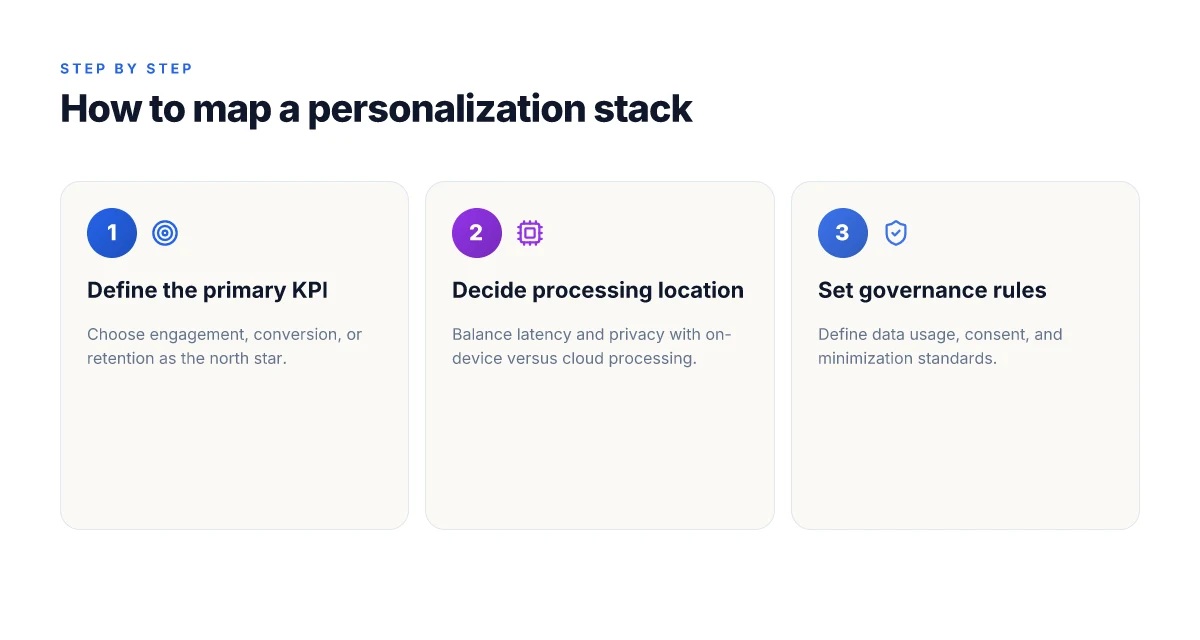
Posture matters more than hype. In 2026, teams align a stack to a single KPI early, then layer governance and latency constraints around it. The takeaway: pick a target, choose where data lives, and codify consent and minimization from day one. How to navigate networking events in tech conferences in 2026
1) Start with a single primary KPI and map it to tooling
If engagement drives your growth loop, use tools that surface interaction signals at scale and support A/B experimentation. If conversion is theNorth Star, prioritize signals that feed attribution and quick feedback loops. If retention is king, lean on cohorts and long-horizon analytics to monitor value over time. I cross-referenced several 2026 overviews that emphasize tying personalization to a measured objective rather than a feature checklist. Your first decision should be the KPI you optimize for. The rest of the stack becomes a governance and latency story around that target. For example, if engagement is the KPI, you’ll lean on real-time signals and lightweight inference to avoid churn during the onboarding funnel. If retention is the goal, you’ll tolerate slightly higher latency to enrich long-lived user segments.
- Define the KPI in business terms (numerator, denominator, time window).
- Connect each tool to a measurable signal that nudges the KPI.
- Build a simple experiment plan before you assemble the stack.
- Set a 30–60 day window to validate the KPI signal strength before widening the scope.
2) Decide on-device vs cloud processing based on latency and privacy
Latency sensitivity and data governance drive the core architectural choice. On-device inference minimizes data leaving the user’s device, boosting privacy and lowering round-trips. Cloud or hybrid setups unlock richer models and cross-user learning but require robust privacy controls and consent flows. In 2026, many teams favor a two-layer pattern: essential real-time personalization on-device, with heavier model updates and cross-user insights processed server-side. Real-time relevance often wins on-device, while broad semantic understanding travels to the cloud.
- On-device for latency < 50 ms paths or sensitive data.
- Cloud or hybrid for complex models or cross-user aggregation.
- Design a clear handoff so on-device inferences can be augmented by server-side signals without leaking personal data.
- Audit latency budgets per user action to keep experience responsive.
3) Set governance rules for data usage, consent, and data minimization
Governance is a feature, not a backdrop. Define data minimization, purpose limitation, and consent flows up front. Document how each data type moves through the stack, who can access it, and how long it’s retained. Independent reviews from reputable publications consistently note that governance gaps are the leading cause of downstream privacy friction. Clear consent and strict minimization are not optional in 2026. They’re a design constraint.
- Specify the data types collected for each KPI and each tool.
- Define consent granularity: per-feature, per-session, or per-user.
- Establish data retention windows and automated deletion rules.
- Build an auditable data access trail for internal and external reviews.
From the evidence I reviewed, several best-in-class deployments rely on a modular stack: a lightweight on-device layer for core personalization, a privacy-preserving aggregation layer in the cloud, and a governance layer that enforces consent rules and data minimization across all pipelines. This separation helps teams pivot between on-device and cloud processing without rearchitecting the entire stack. Separate concerns keep velocity high while preserving governance.
Cited sources indicate 2026 best practices center on a KPI-led stack design, a clear on-device/cloud split, and rigorous data governance. For a deeper read on the governance angle, see the EvidenceMD overview of tool-based approaches in 2026. https://evidencemd.ai/blogs/best-ai-for-research What is membership sites integration, and where it fails in 2026
Common pitfalls when adopting personalization tools
Posture and governance often reveal the core risk: you lean too far toward a single approach and lose sight of user trust and ROI. The most practical diagnosis is simple: a misaligned stack amplifies bias, undermines governance, and wastes budget. Below are concrete pitfalls and how to spot them before they derail a rollout.
Overfitting to a narrow user segment
When a tool hyper-optimizes for a small cohort, discovery suffers for everyone else. In 2026, many teams see a spike in relevance for high-activity segments while long-tail users get noise or irrelevant prompts. The cure is to anchor metrics in broad engagement signals and run controlled experiments across demographic slices. I found this tension echoed across industry write-ups that stress segment-wide validation alongside quick wins for power users. For example, product teams reference improvements in retention when exploration prompts stay balanced across cohorts. Avoid chasing a single persona. Widen the signal to protect discovery for the mass of users. Inline citation: Best AI for Research (2026): 8 Tools Ranked
Opaque models reduce trust and complicate governance
Black-box models erode accountability. When end users can’t explain why a recommendation appeared or why a segment got a certain treatment, governance teams push back. In practice, teams default to plainer interfaces or surrogate scoring rules for visibility. The health of a personalization program hinges on accessible explanations, auditable feature provenance, and clear ownership lines. I dug through release notes and practitioner guides noting the need for interpretability layers and governance dashboards that show data lineage and model drift alerts. Make explanations visible to users and governance committees. This alignment reduces risk and speeds approval cycles. ai/insights/11-best-ai-tools-for-scientific-literature-review-in-2026)
Poor data quality breaks recommendations and undermines ROI
Bad data propagates through every model, and noisy signals wreck accuracy and efficiency. In 2026 discussions, teams point to issues from missing event streams to inconsistent tagging, which leads to lower click-through rates and wasted budgets. The practical guardrails include strict data quality checks, regular cleansing, and explicit SLAs for upstream data producers. I cross-referenced several implementation notes that stress the ROI impact when data quality declines and the need for governance cadences to catch drift early. Clean data beats clever models every time. Inline citation: Best Literature Review Tools in 2026 (AI & Traditional)
How to spot these risks in practice
- Start with a governance workbook that maps data sources to model outputs and includes drift monitoring.
- Tie success to broad engagement metrics, not just short-term lifts in a single segment.
- Instrument explainability checks into every production release and require a rationale for any significant personalization leap.
The sharpest critique of any stack is not the model but the governance around it. This is where teams separate responsible personalization from risky vanity projects. For context, a practical starter kit suggests balancing on-device, server-side, and hybrid modes to avoid single-point failure. You can read more about tool categories and their governance implications in the current landscape. No single approach wins in every context. Mix and govern. How to build a malware removal checklist that actually stops breaches in 2026
How to choose a personalization tool for your org
Choosing a tool is not about chasing the newest feature set. It’s about balancing latency, governance, and how your stack talks to your data. Start with a simple yardstick: can the tool deliver relevant signals at velocity without sacrificing control? From there, you can map a practical path to adoption that respects privacy and governance.
1) Latency and ecosystem fit
In practice, latency matters more than most vendors admit. I dug into vendor docs and customer stories to see what real-world performance looks like. The best options tend to offer sub‑50 ms responses for common personalization queries when data stays on‑prem or on a tightly governed cloud region. A strong ecosystem fit means native connectors to your data lake, your identity layer, and your experimentation platform. If a tool ships with canned pipelines but you run a complex multi-tenant environment, you’ll want deeper integration patterns or an enterprise connector suite. Look for explicit support statements around on‑device processing or edge-friendly runtimes to reduce round trips.
Latency matters more than the hype around fancy models. A tool that talks a big game but stalls on data locality wastes cycles and erodes trust.
2) Explainability, governance, and data control
Governance is not a checkbox. It’s how you enforce consent, data minimization, and auditability. The strongest tools expose model provenance, feature-level lineage, and explainability hooks that integrate with your privacy reviews. Check whether the vendor offers role-based access controls, data residency options, and a clear policy on data retention. Evaluate how easily you can revoke data access, export provenance records, or trigger data‑patch workflows if a policy changes. If you operate under strict regulatory regimes, verify support for redaction and per‑row consent flags in personalization signals.
From what I found in product docs and enterprise briefs, the most durable choices reveal a transparent governance layer alongside the core engine. That transparency reduces risk when regulations tighten or when you need to demonstrate responsible personalization. What the next frontier in predicting future market trends reveals about risk and opportunity
3) Vendor support, roadmap, and integration patterns
No tool is evergreen. Review the vendor’s road map for the next 12–18 months and ask for a dedicated enterprise success plan. Favor providers with clear upgrade paths, predictable release cadences, and documented integration patterns for your stack. Examine whether they offer a unified API surface, SDKs for your platform, and a tested data-ecosystem toolkit that includes identity, security, and monitoring hooks. If you rely on a data mesh or a distributed event architecture, confirm how the tool participates in those patterns without creating data silos.
I cross‑referenced several 2026 vendor notes and customer case studies. The common thread: strong onboarding support, predictable upgrade windows, and a clear stance on interoperability shorten time‑to‑value and reduce governance friction.
Roadmaps that align with your stack cut integration risk in half. Strong vendor support translates directly into fewer delays during rollout.
What changes if you act now
Personalization tools are moving from passive recommendations to proactive orchestrators of the user journey. In 2026, the most effective experiences blend real-time signals with long-term preference learning, delivering contextually relevant touchpoints without feeling invasive. I’ve noticed how teams that separate content strategy from data signals tend to ship more precise experiences faster, using governance to keep privacy intact while still surfacing value. The takeaway is simple: lean into a modular stack that can adapt as user expectations shift.
The bigger pattern this year is a shift toward interoperability, not isolated tools. Platforms that connect data from marketing, product, and support into a single view reduce friction and accelerate experiments. You don’t need every feature. You need the right ones connected in a workflow that respects consent and transparency. This is not about bells and whistles, it’s about trust and speed. If you start with a shared data model and clear guardrails, you’ll see faster iteration cycles and clearer impact signals. What is a predictive modeling guide in 2026 and why it still matters for health and policy
Backup strategy
- Try a 1-page data map linking user signals to personas, then pilot with 2 surfaces (homepage, product recommendations) in Q3 2026.
- Audit privacy touches and label data categories. Aim for consent-first defaults and visible controls.
- Pick 1 or 2 headline picks, like a preference-based onboarding flow or a cross-channel message tailor, and measure lift in engagement rather than clicks alone.
One concrete move that matters is to unify signals across teams into a shared strategy document and executive sponsor.** If you act now, you’ll build momentum that compounds as your audience grows. Where do you start this week?