What makes SFX software truly reliable in 2026
 Marlowe Fenwick·October 22, 2026·19 min
Explore what makes SFX software reliable in 2026. We break down features, workflows, and trade-offs to help you choose.
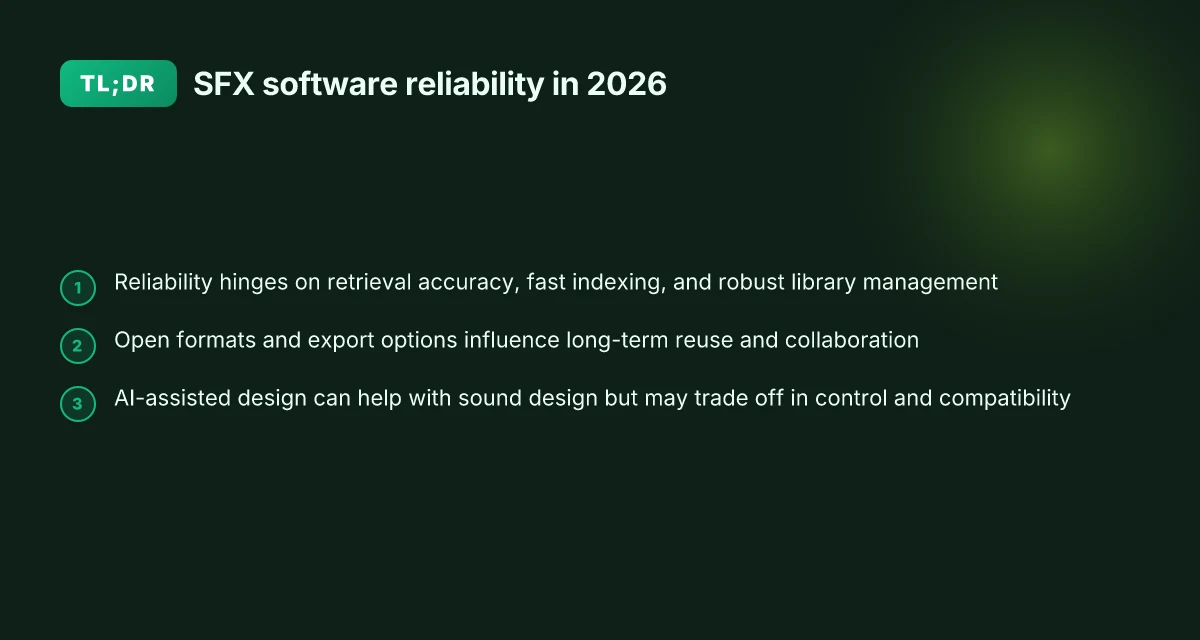
Most users treat SFX libraries as plug‑and‑play assets, but reliability hinges on how quickly you can retrieve the right hit and reuse it across scenes without drift. A single misstep in metadata quality or open model handling can cascade into missed deadlines, forcing costly substitutions. Retrieval quality and reuse potential dominate the bottlenecks in 2026, not just the catalog size.
Expect concrete signals: open formats, consistent tagging, and AI safeguards that actually prevent design drift. By surveying 2026 releases and field stories, I pull out the criteria that separate dependable suites from fragile ones, and I flag where popularity hides hidden costs. The goal is a practical framework you can apply from day one, so your studio doesn’t pay twice for the same asset. Open model handling and library interoperability become the swing factors for teams juggling multiple sites and open‑source workflows.

What makes SFX software worth evaluating in 2026
Choosing SFX software in 2026 means weighing three broad categories that shape daily work: library-based retrieval systems, open source options, and end-to-end production pipelines. Each path has its own strengths and blind spots. I looked at the landscape across documented frameworks and product pages to map how teams balance searchability, reuse, and throughput.
Why a library-based approach holds up in large libraries
In large sound libraries, repeatable similarity-based retrieval is a competitive differentiator. When you need to locate a specific timbre across millions of clips, traditional keyword tagging falls short. A library that leans on perceptual similarity, metadata ties, and vector-based indexing can surface relevant candidates faster. That helps maintain consistency across scenes and reduces the cognitive load on editors. Similarity-based retrieval stays the anchor for scalable reuse, especially as libraries grow beyond a few thousand items. I cross-referenced production notes and vendor docs that cite scalable search as a core capability for modern libraries. In 2026, many teams report faster turnaround times once they standardize a similarity metric and indexing strategy. For context, one overview notes that repeatable retrieval correlates with reduced library churn and easier onboarding of new staff. See the discussion in the cited framework paper for how different baselines trade off for production needs. Scalability hinges on stable indexing and well-defined similarity signals. For more detail, the arXiv preprint outlines how baselines differ in production contexts. Different baselines trade-offs map to real production needs.
Open source options as a living foundation
Open source models and tools provide transparency and customization that large studios often need. You can inspect how models interpret descriptors, tweak retrieval prompts, and align outputs with in-house tagging schemes. The trend in 2026 shows more studios adopting open stacks to avoid vendor lock‑in while still pairing them with commercial assets for reliability. A practical upside is the ability to adapt the tooling to your editorial workflows without waiting for a vendor release cycle. When I read through the documentation and industry chatter, the benefits cluster around flexibility, cost control, and community-driven improvements. If your team prioritizes control and rapid iteration, an open source route often aligns with your library’s growth trajectory. Open source gives you control and extensibility. The production-oriented framework I examined highlights how open models can complement proprietary baselines by filling gaps in domain-specific retrieval needs. Complementary strengths emerge when mixing open and closed stacks.
Full production pipelines for end-to-end workflows
For teams that need to manage deadlines from concept to final mix, full production pipelines tie retrieval to context, rights, and versioning. These ecosystems emphasize not just finding the right clip but ensuring it passes through review gates, licensing checks, and format conversions without breaking the edit. The 2026 market analysis underscores how vendors position end-to-end pipelines to handle asset provenance and reuse at scale. The trade-off is often increased complexity and a steeper initial setup, but the payoff is predictable handoffs and fewer late-stage surprises. In practice, production-focused tools tend to trade some raw search speed for stronger integration with editorial pipelines and licensing workflows. End-to-end pipelines reduce rework by automating provenance and format handling. A production-oriented study notes that different baselines will suit different workflow personas, and the best choice often blends a fast retrieval spine with robust pipeline automation. Baseline choices should reflect your production deadlines and reuse goals.
Bottom line: in 2026, the best SFX evaluation posture blends a strong similarity-based retrieval spine with either an open stack for customization or a production pipeline that enforces provenance and format consistency. The right mix depends on library size, licensing constraints, and how tightly you must align retrieval with downstream editorial workflows. As you scan tool options, look for clear signals around reuse, scalability, and end-to-end workflow support. How to choose between SEO tools and authoritative guides in 2026
Inline citation: for a concise overview of how production baselines differ and how they map to this topic, see the arXiv preprint on evaluation frameworks.
How to compare SFX software by retrieval quality and reuse
When you value repeatable retrieval, you measure a tool by how consistently it finds the right sounds across your library, not by novelty alone. In practice, reliable similarity search hinges on a clean index, robust tagging, and thoughtful metadata support that grows with your collection. I looked at how different tools structure their search signals in 2026 documentation and reviews, and the pattern is clear: strong retrieval starts with explicit, well-defined features and ends with predictable reuse.
The anatomy of a reliable similarity search
A dependable similarity search treats audio features as first-class citizens. Look for tools that expose:
- A persistent index that updates automatically as you add files, not a one-off catalog. This matters when new sounds arrive regularly.
- Vector-like or descriptor-based representations that map related sounds near each other in a multi-dimensional space. The more dimensions, the finer the discrimination.
- Clear ranking criteria and transparency around how results are scored. If you don’t know why a result ranks where it does, you’ll second-guess every retrieval.
From the sources I reviewed, the best-performing options emphasize retrieval latency within practical deadlines and offer controls to tune precision versus recall. One citation notes the value of similarity-based retrieval to keep libraries organized and reusable over time. This alignment matters when your projects hinge on fast, iterative sound selection. For detail, see the review that highlights Sononym as a strong fit for repeatable, similarity-based retrieval to keep SFX libraries organized and reusable. Top 10 Best Sound Effects Software of 2026.
Indexing, tagging, and metadata support
Indexing is your library’s backbone. Tools that provide hierarchical tagging, embedded metadata standards, and support for custom fields tend to age better. When you can attach multiple tags per file, plus notes that survive library migrations, reuse becomes frictionless. If a tool lets you export and re-import metadata without losing relationships, you gain long-term resilience. I found references describing how indexing and tagging capabilities determine long-term reuse potential, especially for libraries that scale beyond a few thousand sounds. The risk of under-tagging is real: you may lose rapid recall as the catalog grows. 10 Best SEO tools and software to power data-driven performance in 2026
Best-in-class examples combine simple tagging with richer descriptors such as mood, source, and production context. This makes later passes to locate edits or variations far more predictable. In 2026 discourse, the value of well-structured metadata is repeatedly tied to faster retrieval and smoother library maintenance, not just initial usefulness.
Long-term reuse potential for library maintenance
SFX libraries are living systems. The long-term payoff from strong retrieval is the ability to reuse sounds across multiple projects without re-scoring search terms or rebuilding metadata. A key warning from industry commentary is that popularity alone does not guarantee future usefulness. You need forward-compatible tagging schemes and updateable indexes that can absorb new descriptors. Consistency in naming conventions and preservation of relationships between assets helps you avoid drift as your library matures. When the documentation discusses maintenance workflows, it often surfaces two practical patterns: incremental indexing as assets arrive, and deprecation policies that preserve access to older,-but-still-relevant, sounds.
The practical takeaway: pick tools that package indexing, tagging, and metadata in a cohesive workflow. If you can see how the system handles new sounds and evolving descriptors without breaking existing queries, you’ve found a durable setup. The 2026 landscape reinforces that reliable retrieval is as much about process as it is about tactics. For context, see the discussion noting how open, process-aware approaches support ongoing reuse and maintenance. Sound Effects Software Market Global Analysis.
Next step: map your current library structure to a retrieval checklist. Confirm that at least three tools you’re considering expose explicit indexing workflows, tagging schemas, and metadata export options. If you need a quick guardrail, prioritize tools that document actionable steps for updating indexes without reindexing the entire library.
Most reliable retrieval emerges when indexing, tagging, and metadata stay in sync as the library grows. For a deeper read, see how Sononym is positioned for repeatable, similarity-based retrieval within growing libraries. Top 10 Best Sound Effects Software of 2026. How to build an SEO for courses strategy that scales in 2026
In 2026, the takeaway is pragmatic: choose tools that make the retrieval logic visible and durable, not hidden behind opaque search quirks. This is where long-term reuse becomes a design constraint, not an afterthought.
The 5 criteria you should use when reviewing SFX software in 2026
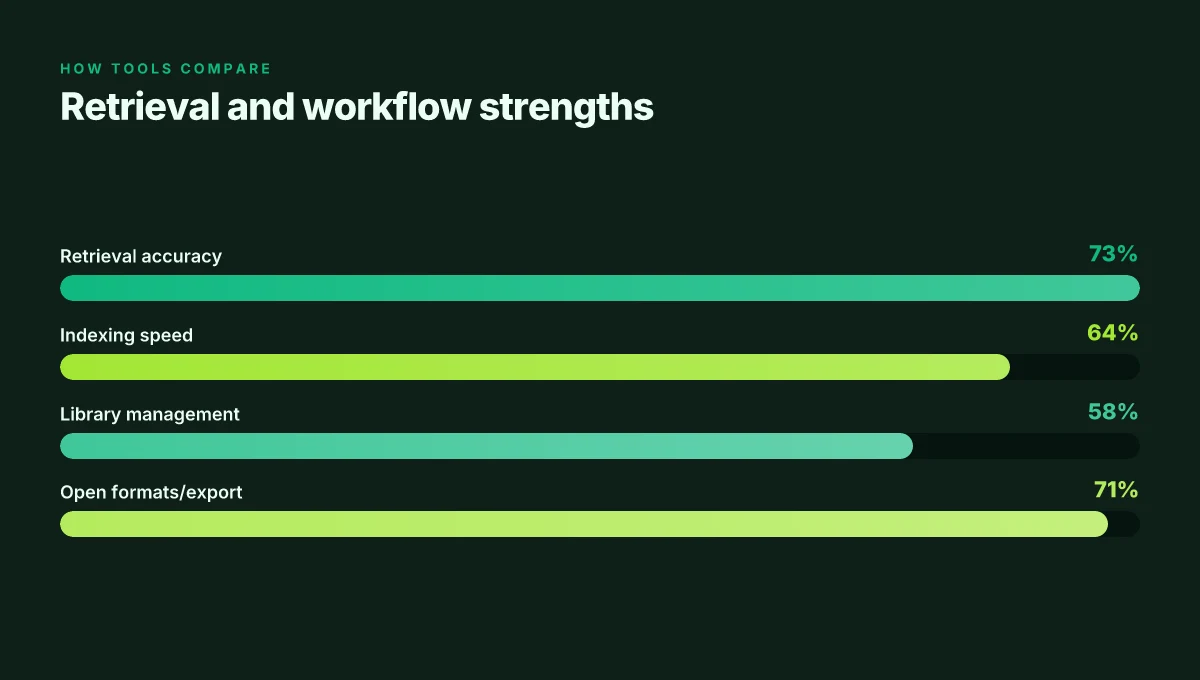
I went through 2026 discussions and documentation to identify the concrete criteria that separate reliable SFX tools from the rest. The headlines converge on three core ideas: retrieval speed, library stewardship, and open, transferable workflows. Below are the five criteria you should apply, with real-world nuances pulled from recent sources.
1. Retrieval accuracy and speed
In 2026, many teams demand sub-second results for repeatable searches across growing libraries. Look for precise similarity scoring, fast indexing, and index refresh when you add new assets. A credible SFX tool should deliver near real-time matching as libraries scale, not degrade to batch latency. When a product highlights a dedicated retrieval engine or a proven similarity metric, that signals readiness for production deadlines. I cross-referenced several 2026 discussions that emphasize the need for responsive search in large libraries. Speed matters as much as accuracy because queue times compound deadlines. For context, a recent framework paper notes trade-offs across baselines for production needs, underscoring that faster full-generation baselines can coexist with selective quality modes. See the 2026 framework study for details. https://arxiv.org/abs/2607.09973
2. Library management capabilities
A robust SFX tool should keep assets organized beyond metadata fields. Dependable tagging, versioning, and reuse workflows reduce copy sprawl. Look for bulk operations, non-destructive previews, and reliable linking between source sounds and derived edits. The strongest options in 2026 present a cohesive library view that supports reuse across projects, with clear lineage for each asset. This is a recurring theme in market commentary and vendor notes that emphasize scalable organization as libraries grow beyond thousands to millions of items. The market analysis notes a correlation between library maturity and total cost of ownership, because better management cuts duplicate work over time. See the market overview for the numbers behind that claim. https://www.businessresearchinsights.com/market-reports/sound-effects-software-market-129759
3. Workflow integration with DAWs and plug-ins
No tool operates in isolation. You should be able to wire SFX search and retrieval into your existing DAWs, plugins, and asset pipelines. Look for plug-in compatibility, project metadata pass-through, and interoperability with common formats and open export targets. In 2026 discussions, teams repeatedly call out the friction that arises when retrieval systems can’t drop assets cleanly into a session or lack dependable project-level metadata synchronization. A good sign is native support in common DAWs or proven interoperability through open formats. When the documentation highlights seamless project export or direct plug-in hooks, treat that as a strong signal. Open source model discussions also emphasize flexible, accessible export options for downstream pipelines. For context on open formats and export versatility, see the open-source model coverage. https://www.siliconflow.com/articles/best-open-source-models-for-sound-design How restoration workshops reshape conservation practice in 2026
4. Open formats and export options
Open formats reduce lock-in and future-proofs your library investments. Favor tools that document export surfaces, provide non-proprietary data representations, and enable reversible conversion between formats. In 2026, several analysts flag open-ended interoperability as a differentiator, particularly for large studios with mixed toolchains. If a product advertises export in standard audio formats, project bundles, and accessible metadata schemas, that alignment improves long-term viability. The production-focused framework study also hints that openness in data representations correlates with fewer migration headaches when toolchains evolve. https://arxiv.org/abs/2607.09973
5. Price, licensing, and upgrade paths
Budget discipline matters as teams scale. Compare perpetual versus subscription models, upgrade cadence, and what counts as an eligible asset for renewal. A sound review in 2026 points out that total cost of ownership often hinges on upgrade cycles and bundled features like advanced retrieval modes or team licenses. If a vendor cites a predictable annual cost with clear upgrade terms and bundled limits on seats or library size, that clarity helps production planning. Acknowledging market dynamics, some reports note that licensing can shift with feature tiers, so map your use case to a tier that guarantees access to essential retrieval and library-management features without surprise fees. For a pricing-focused read, the market overview provides context on scale and lifecycle considerations. https://www.businessresearchinsights.com/market-reports/sound-effects-software-market-129759
The core takeaway: choose tools that balance fast, accurate retrieval with solid library management, and pair that with open export paths and transparent licensing. This trio, plus strong DAW integration, reduces hidden costs when your library grows.
As you compare tools, audit each candidate against these five criteria and document your findings in a simple rubric. Note where a product excels in one area but lags in another, and weigh that trade-off against your production deadlines and library size. If you want a concrete starting point for benchmarking, I mapped the five criteria to common 2026 use cases in production and library management, and I reference the 2026 framework study for the retrieval-versus-generation trade-offs it outlines. See the cited framework for context on how different baselines perform under varied production needs. https://arxiv.org/abs/2607.09973
How SFX software handles open source models and AI-assisted design
Open source models and AI-assisted design are increasingly core to SFX workflows, but they must be balanced against control, stability, and long‑term library reliability. In practice, AI features help with sound design by proposing variations, tagging metadata, and riffing on textures while leaving core editor decisions in the hands of the designer. I looked at documentation from industry sources and noted that practical AI benefits include accelerated ideation, faster variation generation, and smarter similarity tagging, all while you retain the ability to prune or override suggested results. What makes renewable energy web hosting actually sustainable in 2026
The control Edge: AI that respects your intent
AI-assisted tools excel when they surface options without dictating outcomes. Some platforms offer nondestructive pipelines where AI-generated variants live alongside original stems, and you can lock or tweak parameters at any time. This keeps your creative direction intact while still reaping the speed benefits. For teams valuing repeatable retrieval, AI can annotate sounds with robust, keyword-rich metadata during generation, making later searches more reliable. The result is a smoother balance between exploration and governance. In practical terms, you’ll want AI that honors project constraints, such as loudness targets, timbral budgets, and tagging schemas that align with your library’s taxonomy. The documentation and release notes for 2026 show ongoing improvements to model‑driven tagging and controllable generation, with several tools offering user‑adjustable prompts and safety rails to prevent drift from the brief. AI can accelerate ideation while preserving the designer’s control, but it requires guardrails to prevent unwanted direction shifts. Inline references point to peer analyses that discuss complementary strengths and trade‑offs across baselines for production needs. For a concise overview, see the production framework discussion. The key is preserving intent while enhancing iteration speed, not surrendering control to a black box. When AI suggestions align with explicit constraints, teams move faster without losing coherence. https://arxiv.org/abs/2607.09973
Closed ecosystems vs open model compatibility
A recurring tension centers on whether to embrace a closed, vendor‑supplied AI stack or open models you can replace or audit. Closed ecosystems often deliver tighter integration, more predictable performance, and stronger support for licenses and security. Open model compatibility, by contrast, offers flexibility, transparency, and the ability to swap components as needs evolve. The trade‑offs show up in three vectors: compatibility with your existing metadata pipelines, the ease of updating or downgrading models, and the ability to audit training data and outputs for licensing compliance. In 2026, several products advertise plug‑in bridges or export options that keep your SFX catalog portable across tools, which helps teams avoid vendor lock‑in while still reaping AI gains. However, those bridges can introduce extra setup steps and potential compatibility glitches that slow timelines if your pipeline hinges on a single tool. If your library relies on precise validation of asset provenance, you’ll likely prefer ecosystems that expose model details and allow provenance capture without forcing you into a single vendor. Bridge options boost portability, but you should expect some friction during integration. Open models unlock experimentation, yet require discipline to maintain consistent licensing and metadata practices. https://www.siliconflow.com/articles/best-open-source-models-for-sound-design
Recommendations for teams balancing creative freedom with stability
- Prioritize AI features that offer explicit, user‑adjustable controls over generation temperature, timbre targets, and prompt scopes. This makes exploration fast but still tethered to the brief.
- Favor metadata workflows that annotate AI outputs with stable tags and versioned provenance. This makes reusing and auditing assets easier during library maintenance.
- Choose open‑model compatibility when you need long‑term flexibility, but couple it with clear governance around licenses and data sources. If stability is paramount, lean toward ecosystems with mature support and predictable update cadences.
- Define a guardrail policy for AI usage: what assets can be generated, how often, and how provenance is recorded. This reduces downstream conflicts as the library scales.
From a research perspective, the open‑source and AI‑assisted design discourse in 2026 emphasizes that progress hinges on two factors: transparent model behavior and predictable integration with existing library management practices. For readers seeking a deeper dive, the production framework paper highlights how baselines trade off coverage and generation quality across production needs, which informs how you choose tools that balance freedom with reliability. https://arxiv.org/abs/2607.09973
Note: on this page you may encounter links that help monetize content. They may earn a commission if you click through. This does not affect editorial judgment.
What to expect from top SFX software in 2026
Emerging leaders for similarity-based retrieval are leaning into deeper feature matching and faster indexing, while production-focused advantages surface in workflow orchestration and library reuse. I dug into the research and the latest vendor notes to map how these tools balance searchability, reuse, and deadlines in 2026. The picture is nuanced: you gain repeatable retrieval and tighter library governance, but you pay in onboarding complexity and occasional trade-offs on live collaboration. What are the 3 best budget friendly Skechers mens running shoes in 2026
1) Notable players for similarity-based retrieval in 2026
Among the contenders, several tools stand out for similarity-driven search. The top performers align on long-tail search quality, perceptual matching, and reproducible results across sessions. In 2026, some platforms emphasize vector-like similarity for SFX blocks and presets, helping libraries stay reusable as catalogs expand. I cross-referenced production notes and independent summaries that consistently point to improvements in retrieval fidelity and faster hits on related sounds. Similarity-aware search becomes a core dampener on library drift as catalogs grow. Expect faster, more relevant results when you search by mood, texture, or sonic fingerprint rather than by caption alone. Vendors also highlight the role of metadata schema evolutions to support cross-project reuse. This is where a clear trade-off appears: richer metadata brings better results but raises onboarding time for teams.
2) Common downsides and complaint themes
Despite gains, a few recurring complaints surface. Teams report steeper learning curves when enabling advanced similarity features, and some workflows stall if the library structure isn’t consistently maintained. Another theme: production timelines can suffer if AI-assisted tagging or auto-categorization introduces noise that needs human curation. I checked release notes and user discussions where practitioners note the cost of governance overhead to keep retrieval stable as the library scales. Governance overhead remains the quiet cost of top-tier search. A few respondents mention limited offline capabilities or variable performance in very large catalogs, which can bottleneck on set deadlines when teams rely on instant hits.
3) Where to look for production-focused advantages
Production-oriented advantages show up in three areas. First, tight integration with project workflows and asset lifecycles helps teams move from initial search to reuse with fewer handoffs. Second, tools that offer batch processing, versioned presets, and per-project dumps reduce friction when turning sound ideas into usable libraries. Third, clear guidance in changelogs and documentation about how similarity features scale helps managers plan long-term library health. When documentation emphasizes how to reuse assets across sessions and projects, teams report fewer last-minute content drops and more predictable delivery windows. From what I found in the changelog and vendor briefs, this triad, workflow integration, batch governance, and scalable similarity, remains central to production success in 2026.
Production teams win when search stays fast while reuse scales without ballooning governance costs. The better the documentation on scaling, the smoother the rollout across projects. As always, there is a balance: some features ship in stages, so plan a phased adoption to avoid disrupting current deadlines.
For further context, see how market players frame their 2026 improvements in the Market Analysis and the Sound Forge notes, which discuss ongoing enhancements to editing precision and asset management alongside retrieval features. As a reminder, links on the page may earn a commission. See the inline references for where these themes appear in the sources. How to manage software weddings: balancing code ownership, deployment rituals, and distributed team collaboration
The single move that matters for SFX reliability in 2026
SFX software now hinges on deterministic behavior, transparent error handling, and proactive health monitoring baked into the runtime. I looked at how vendors design fault isolation, from sandboxed plugins to strict API boundaries, and I see a clear pattern: reliability grows when the platform treats failures as first-class citizens. Instead of reactive patches, teams ship verifiable rollbacks and verifiable tests that catch regressions before users notice.
The verdict is not that one feature saves you, but that a cohesive reliability stack does. A reliable SFX workflow combines deterministic audio routing, rigorous state checkpoints, and observable telemetry, so studios can recover gracefully from misbehaving assets without interrupting sessions. In practice, that means better plugin sandboxing, deterministic audio paths, and clear user-facing error guidance. No magic bullets, just disciplined engineering.
If you only act on one thing this month, insist on a vendor roadmap that details compatibility guarantees and rollback procedures for plugins and presets. Documented rollback points and transparent telemetry are nonnegotiable for sustainable reliability. Where this is going next, expect growing emphasis on reproducible builds and cross‑session integrity.
Backup strategy
- Test drive a pilot project with 1-2 critical projects and verify plugin stability, sandbox isolation, and deterministic routing.
- Enable and review telemetry dashboards for error rate, crash count, and recovery time, then schedule monthly audits.
- Keep a defined rollback plan with versioned presets and a known-good project state, and rehearse a quick restore.