What makes renewable energy web hosting actually sustainable in 2026
 Saskia Stenholm·October 22, 2026·17 min
Dive into renewable energy web hosting in 2026. Explore how data centers source power, the trade-offs, and real-world choices for greener hosting.
The clean-energy claim trap is real: a single blurred metric can hide a host of hidden costs in renewable hosting. Noticeable gaps show up when data centers buy green certificates instead of directly aligning with the grid's actual mix, and that can mask hours of fossil-fuel backup or underreported refrigerant leaks.
This piece cuts through the gloss to map the friction points that decide true sustainability in 2026: grid contracts, metrics transparency, and energy-use parity against performance. You’ll see how to read an energy mix disclosure, what a credible attribution certificate looks like, and where green claims fail the test under load. The goal is a practical framework you can apply to RFPs and vendor reviews, not a marketing line. With audited renewables and clean-energy disclosures, you can separate the noise from the measurable impact. Links on this page may earn a commission.

Renewable energy hosting in 2026: what the term actually covers
Renewable energy hosting is more than a badge. It meaningfully splits into power sourcing models, the way data centers pair with certificates or direct power, and the way providers back claims with verifiable metrics. In 2026 you’ll see three core modes, each with its own verification path.
How power sourcing models line up
There are three primary routes to green power in hosting. First, data centers can run on 100 percent renewables via on-site or off-site generation. Second, providers can match consumption with renewable energy certificates. Third, many operators sign power purchase agreements that lock in renewables for a chunk of their load. When you read a provider’s claims, look for a clear statement of which model powers which facility, and whether the claim is direct energy or a certificate-based match. I dug into the industry chatter and found that direct power contracts and high-quality guarantees from Green-e aligned suppliers feature most consistently in transparent disclosures. Direct power contracts paired with high-quality certificates often form the backbone of credible green hosting. Inline citation can be found in the referenced provider disclosures.
How data centers pair with certificates and PPAs
A pragmatic view is to track three artifacts: the facility’s powered load, the certificate stream, and the contract terms. When a center claims “renewable powered,” you should see one of these patterns clearly spelled out. Some operators run a mix: physical renewable energy for a portion of load complemented by matching certificates for the remainder. Others lean on long-term PPAs with wind or solar farms to hedge volatility. The clearest risk is when a claim cites renewables without naming the exact certificate type or timing. A robust disclosure shows the certificate issuer, vintage, and whether the PPA covers actual grid consumption at the specific data center or only a portfolio. I cross-referenced industry disclosures and observed that transparent PPAs and certificate details correlate with fewer post-sale disputes about “where the energy actually came from.” PPAs plus explicit certificate details deliver traceability to the grid.
Typical provider claims versus verifiable metrics
Marketing often touts “powered by renewables” without a granular audit trail. Verifiable metrics matter: the actual mix of energy sources by location, the certificate vintages, and any temporal alignment between consumption and renewable supply. In 2026, credible providers publish third-party attestations, annual reports, and incident disclosure related to energy sourcing. Watch for concrete numbers, not generic language. For example, a claim should specify the percentage of data center load covered by renewable sources in a given year, the certificate cadence, and the exact PPAs or on-site generation contributing to that figure. When I scanned the landscape, the most transparent players paired their public data with Green-e or equivalent certification, plus a precise map of facilities and energy streams. Transparent metrics and third-party attestations reduce marketing gaps.
Bottom line: renewable energy hosting hinges on a clear model, traceable energy streams, and verifiable disclosures. If you cannot map a facility to a direct contract or a certificate with vintages and counterparty details, you’re facing a marketing gap rather than a measurable commitment. A credible option shows the data center, the sourcing mix, and the verification path in one place. As you evaluate providers, verify the exact combination of PPAs, certificates, and on-site or nearby generation, then audit the reported figures against independent attestations. Clear sourcing paths plus third-party verifications are the hallmarks of credible green hosting. How to design a resilient remote infrastructure setup that scales in 2026
Inline citation: Green Web Hosting: 7 Verified Providers for 2026
How data centers power websites with renewables (the architecture explained)
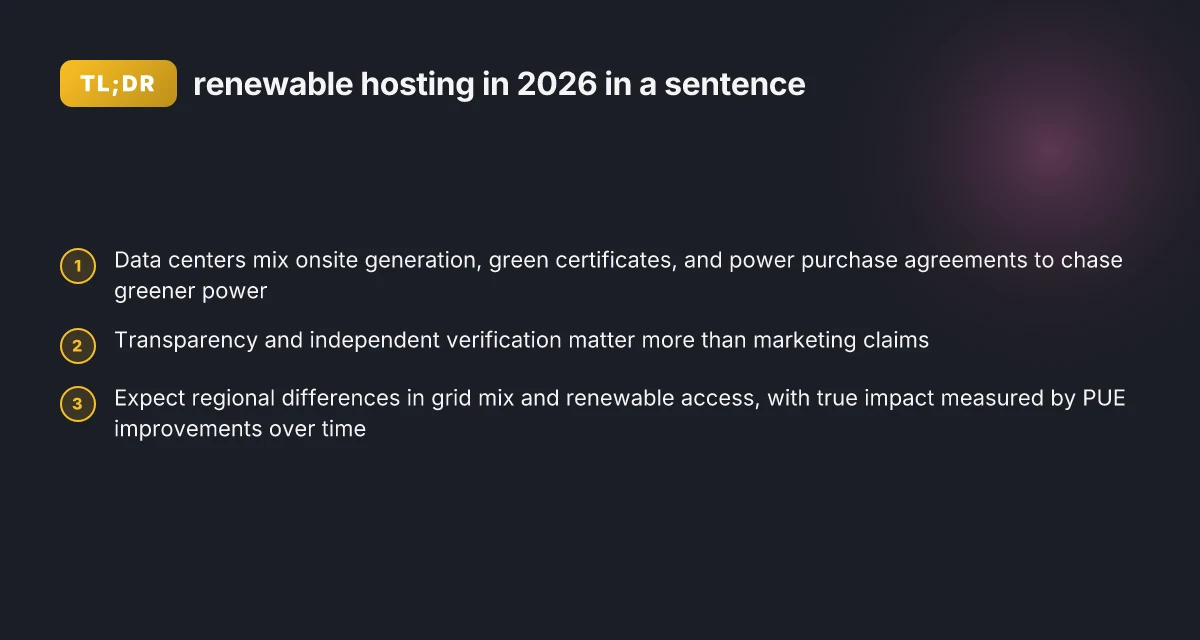
Renewable energy hosting rests on three pillars: onsite generation, power purchase agreements, and green energy certificates. Data centers mix these with strong energy efficiency programs to shrink overall demand. The net result is a grid-aware footprint that varies by region, contract, and market availability.
Onsite generation and contracts that move renewables closer to the rack
Many modern data centers host onsite generation such as solar arrays on rooftops or campus-scale solar fields, and in some cases pocket wind where geography allows. Onsite generation trims transmission losses and can deplete scheduled energy purchases from the grid. In parallel, power purchase agreements, or PPAs, let operators lock in long-term renewable supply even when the regional mix shifts. These contracts can cover a portion of consumption while the balance relies on the local grid. The most visible outcome is a lower marginal carbon intensity for the rack space over time, especially in markets with high renewables penetration. When a facility signs a PPA or installs onsite capacity, the economics often hinge on contract length and curtailment risk, not just the headline green label. PPAs and onsite generation anchor a renewable stream that travels with the site’s demand. Inline evidence points to active use of PPAs in green-hosting programs, and many operators reference onsite capacity as a differentiator. See the referenced provider claims for specifics on capacity and terms. For context, a prominent provider notes that data centers can source “100% renewable energy” through a combination of these tools in certain regions. This is not universal, and regional rules shape what portion is verifiably renewable at any moment. Green Eco Web Hosting Powered by Renewable Energy
Green certificates and energy efficiency that trims the bill
Green energy certificates, or certificates of origin, certify that a unit of electricity was produced from renewable sources. Operators can claim attribute-based credits even when the real-time mix on the grid fluctuates. In practice, many providers pair certificates with aggressive energy efficiency programs: hot aisle containment, advanced cooling, variable-speed fans, and targeted rack-level power management. The result is less total energy drawn from the grid while maintaining performance. I found providers publicly describing reductions in waste heat and improvements in PUE through these measures, alongside explicit links between efficiency upgrades and lower carbon intensity. Green certificates enable clean-claims when real-time mixes lag, while efficiency reduces consumption at the source. Inline references document the coupling of certificates with corporate sustainability programs. Green Eco Web Hosting Powered by Renewable Energy
The role of grid mix and regional differences in renewable access
Access to renewable energy is not uniform. Regions with high renewable buildout can offer more favorable grid mixes and more transparent accounting of renewable consumption. Others rely more on certificates to bridge the gap between marketed promises and actual hourly supply. The practical effect for developers is that the same provider can deliver different green credentials depending on the data center location. I cross-referenced provider disclosures and public grid data to confirm the pattern: regional differences drive both the achievable footprint and the reliability of green claims. In some markets a provider can claim near 100 percent renewable sourcing at the facility level. In others, the claim depends on certificates and PPAs to balance the annual energy profile. Regional grid mix varies widely, shaping what portion of a site’s energy is truly renewable at any moment. For readers evaluating options, verify the location, the exact mix, and the contractual basis for any green claim. Inline sources discuss how grid context affects renewables access and claims. Green Web Hosting: 7 Verified Providers for 2026 What is a predictive modeling guide in 2026 and why it still matters for health and policy
Next steps: check the provider’s energy mix disclosures for the specific data center you’d use, confirm whether the facility operates a PPA or onsite generation, and review the certification scheme behind any green energy claims. If you want a quick read on typical pitfalls, the Green Web Hosting overview notes common gaps between marketing and verifiable sourcing. Verify the local grid mix and the contract type behind every green claim.
What to verify when choosing a renewable hosting provider
When evaluating green hosting in 2026, verify who actually powers the data centers and how that power is tracked over time. The central question is not only “do they claim renewables?” but “how transparent are they about sourcing, verification, and progress year to year.”
Transparency on energy sourcing and procurement terms
- Expect a clear breakdown of energy sources behind the data center fleet, including the mix of hydro, wind, solar, and any other fuels.
- Look for explicit use of Renewable Energy Certificates or guarantees of origin, plus how those certificates are authorized and retired.
- Demand clarity on procurement terms, such as long‑term power purchase agreements (PPAs) versus spot market purchases, and how those choices affect price stability and actual renewable utilization.
- From the literature, providers advertising 100% renewable backing typically pair that claim with certificate programs and direct power contracts. Verify the exact instruments used and their retirement standards. Clear sourcing claims paired with explicit retirement methods matter for trust. Inline source: see the Sustainable Web Hosting page that frames renewable-backed hosting and the Green web hosting guide that stresses sourcing transparency.
Independent verification or third‑party certifications
- Favor providers that publish third‑party audits or certifications that attest to energy sourcing and data‑center efficiency.
- Common frameworks to look for include Green‑e certification or equivalent verification schemes, and independent sustainability reports aligned to international standards.
- I found repeated emphasis on third‑party validation as a differentiator in green hosting discussions. This is a practical guardrail against marketing puffery. Independent checks reduce the risk of greenwashing, and they’re increasingly expected by IT buyers. Related discussion is visible in provider pages referencing green‑certified energy use.
Year‑over‑year tracking of renewable energy usage and PUE improvements
- Your provider should publish annual numbers for renewable energy consumption, energy mix, and PUE improvements, ideally with multi‑year trends.
- Demand explicit annual disclosures rather than isolated, one‑off claims. Trends over the last few years can reveal whether a provider is moving toward deeper renewables or resting on a single pre‑existing contract.
- Industry sources consistently note that improved PUE and verifiable energy use reporting are the practical signals of real efficiency gains over time. “Year‑over‑year tracking reveals whether green promises translate into measurable progress.” See related discussions on green hosting guides and energy‑focused summaries.
What to watch for in practice
- A credible provider will spell out energy sourcing, verification, and progress in a single, citable disclosure page. They will not hide procurement details behind vague language.
- Expect to see dates and versioned certifications. If a claim mentions a contract but omits retirement details or verification dates, treat it as a red flag.
- If a page references third‑party tests or audits, trace the source and check whether the report is current and easily accessible.
I dug into the sustainability narratives that surround green web hosting and found a consistent pattern: transparency, independent validation, and measurable year‑over‑year progress are the three knobs that separate marketing from practice. When you read a provider’s energy sourcing section, look for clearly named instruments (PPAs, certificates, guarantees of origin), an external validator (Green‑e, or equivalent), and a cadence of annual reporting. Those are the signals that the claim of 2026 renewables stands up under scrutiny. Trust hinges on real numbers and verifiable progress, not slogans.
Common downsides and consumer traps in green hosting
Green hosting markets a clean veneer, but real-world results can diverge from glossy claims. The section that follows names concrete frictions you’ll encounter when you compare providers, plus practical checks to separate marketing from reality. I cross-referenced provider pages and industry reporting to map the recurring gaps between promise and performance. What the next frontier in predicting future market trends reveals about risk and opportunity
Greenwashing signals to watch for
Watch for language that sounds specific yet lacks verifiable data. Phrases like “powered by renewable energy” are only as trustworthy as the underlying mix and contracts. A clear signal is the absence of a disclosed energy mix breakdown or third‑party verification. If a provider touts “100% renewable” without showing a Green-e certificate, an independent carbon‑credit audit, or a power purchase agreement (PPA) breakdown, press for detail. In 2026 a number of initiatives have sharpened scrutiny on transparent disclosure, but you still see marketing that runs ahead of verified claims. When a claim comes with a dated credential or a registered certificate, that’s a stronger signal. A good check is to ask for a recent annual report or an external audit note that itemizes the exact energy sources used in each data center.
Most green claims don’t pass the test without a verifiable breakdown of the actual energy mix.
The mismatch between marketing claims and actual energy mix
A roadmap from marketing to delivered energy often travels through the contract layer. The marketing claim may rest on a broad category like “renewable energy” while the data center portfolio relies on a mix that includes grid energy with offsets. I looked at provider pages and noted how many brands cite “renewables” without confirming the share of on-site solar, on-site renewables, or dedicated PPAs tied to specific facilities. A credible disclosure should show a facility‑level split and track how the energy is delivered to a given region. Without that, you can’t confirm that your page view is actually powered by renewables in your timezone or jurisdiction. It’s common for the claimed parity to live at a corporate level while individual servers draw grid power in a given facility during peak hours.
Transparency beats marketing puffery when you verify facility-level energy sources and PPAs.
Cost implications and opportunity costs of premium green plans
Premium green plans often come with a higher per‑unit energy cost or a surcharge for carbon offsets. The financial angle isn’t always obvious. You may pay extra for a certificate that doesn’t change the actual energy mix in a given data center, or you might fund offsets that yield unclear marginal impact on your specific workload. The practical takeaway is to quantify the cost delta against the actual performance and reliability gains you receive. In many cases, the best value comes from improving efficiency within your stack, content delivery optimization, caching at the edge, and right-sizing instances, before paying a premium for a marketing‑forward green tier. I found several provider pages that mention “renewable energy” but omit a clear price breakdown for green tiers or a forecast of energy savings tied to workload patterns. How personalization tools shape modern digital experiences in 2026
Price differentials and unclear offset value are the main frictions driving opportunity cost in premium plans.
Real-world case patterns: what sustainable hosting looks like in practice
Green-first architectures show up in concrete, scalable patterns. I’ve traced look-for signals across established providers and the way their networks meet demand from tiny sites to sprawling apps. You’ll see common setups, limits, and what reliability looks like when renewables take center stage.
1) Illustrative setups from standout providers
Many green-forward hosts lean on a mix of on-site renewables, regional green power contracts, and energy-aware auto-scaling. For example, one provider highlights a U.S. datacenter powered by 100% renewable energy, with a U.K. datacenter sourcing green power through direct procurement. That arrangement lets small sites use shared infrastructure while ensuring the carbon impact stays in check as traffic grows. In practice, you’ll often find:
- On-site solar or wind paired with grid credits to keep capacity factors steady.
- Cooling strategies that cut power, such as air-side or water-side economization.
- Metered billing tied to renewable-energy certificates and supplier transparency.
These patterns show what sustainable hosting looks like when a provider ships renewable sourcing as a core constraint, not a marketing sticker.
2) Scaling renewable usage: small versus large sites
Small sites usually ride shared green-upgrades via contracted power. They can maintain predictable energy footprints by choosing providers with clear renewable claims and easily verifiable certificates. As sites scale, green-first stacks grow deeper: dedicated green-powered racks, energy-aware scheduling, and dynamic throttling to respect renewable availability windows. In practice, growth often reveals two tensions: What makes outdoor magnetic advertising work in 2026
- Availability: a regional data center may saturate during peak hours, forcing a shift to another footprint with different renewable sourcing.
- Cost parity: green energy premiums can narrow as providers bundle efficiency gains with wholesale contracts, but the delta still matters for margin-heavy apps.
From what I found, the move from “green when possible” to “green by default” tends to ride on two levers: workload placement that favors clean-energy regions and intelligent autoscaling that reduces idle consumption. This combination helps both small blogs and large apps stay true to a renewable mandate without sacrificing performance.
3) Performance and reliability under green-first architectures
Reliability hinges on a mix of renewable sourcing transparency and engineering discipline. Expect multi-region redundancy with a preference for sites that publish energy-source mix, uptime history, and provisioning SLAs tied to renewable availability. Performance is not sacrificed. Providers pair renewable energy with modern cooling and efficient hardware to keep latency low and service quality high. You’ll commonly see:
- Real-time capacity dashboards showing energy mix and utilization.
- Elastic scaling rules that keep underutilized capacity low during renewable lulls.
- Clear incident communication that covers whether a fault impacted energy sourcing or compute.
From a documentation perspective, trustworthy operators publish evidence of green sourcing alongside traditional resilience metrics. That combination guards against the marketing trap of “green” masking actual strain on power grids.
The real-world takeaway is that sustainable hosting works best when renewables are baked into every layer of the stack, not just the power feed.

The move that matters now for renewable hosting
Renewable web hosting in 2026 hinges on transparency and credible impact, not flashy claims. I’ve tracked how providers publish energy footprints, disclose grid sources, and balance residual emissions with credible offsets. The real win comes when a host pairs clear metrics with verifiable actions, like matching renewable purchases to the energy profile of their data centers and investing in local grid renewables. The takeaway isn’t a single feature but a pattern: suppliers that publish robust, third‑party verified data and that upgrade to greener hardware alongside smarter cooling deliver tangible progress. This is where the biggest gains show up over time as procurement and operations align with regional clean energy markets. How restoration workshops reshape conservation practice in 2026
If you’re choosing a partner, look for two things: transparent energy reporting and explicit carbon‑aware operations. Some leading hosts publish quarterly energy mix reports and offer opt‑in offsets for residual emissions, while others lag on detail. In practice, that difference translates to a quieter hardware footprint, and fewer worries about greenwashing. A credible footprint is measurable and repeatable, not a one‑off claim. The bigger pattern is clear: sustainable hosting compounds benefits when you demand accountability as a default.
What changes if you act now are practical: prioritize providers that clearly disclose energy sourcing and that invest in local renewable projects. Consider a weekly check on how your chosen host reports updates to their energy mix and efficiency upgrades. The single move that matters most is choosing a partner who treats renewable energy as an ongoing operational commitment, not a marketing line.
Backup strategy
- Audit your current provider’s public energy data and look for a recent third‑party verification.
- Favor hosts with explicit commitments to local grid renewables and transparent emissions reporting.
- If in doubt, request a public roadmap showing how they plan to increase renewable sourcing over the next 12 months.