How restoration workshops reshape conservation practice in 2026
 Marlowe Fenwick·October 22, 2026·16 min
Explore how restoration workshops in 2026 blend science, ethics, and craft to advance conservation. Learn about methodologies, case studies, and practitioner perspectives.
Restoration workshops flip the lens on conservation by turning classroom theory into tangible, repeatable practices that crews can adopt the same day. In practice, this means clear checklists, documented case outcomes, and a candid view of what actually travels from bench to gallery, with common pitfalls flagged early and a path to escalation when results diverge. As a practical counterweight to abstract goals, workshops show where ethics meet equipment in real time.
The moment is right because funders and museums demand measurable capacity gains, not nice-to-have training. By 2026, practitioners report that hands-on sessions tied to ethical frameworks and local material constraints produce faster skill translation than lectures alone, even as they reveal resource bottlenecks that limit scalability. If you want durable improvements, you need repeatable routines that survive the lab and the cabinet.

Why restoration workshops matter for conservation in 2026
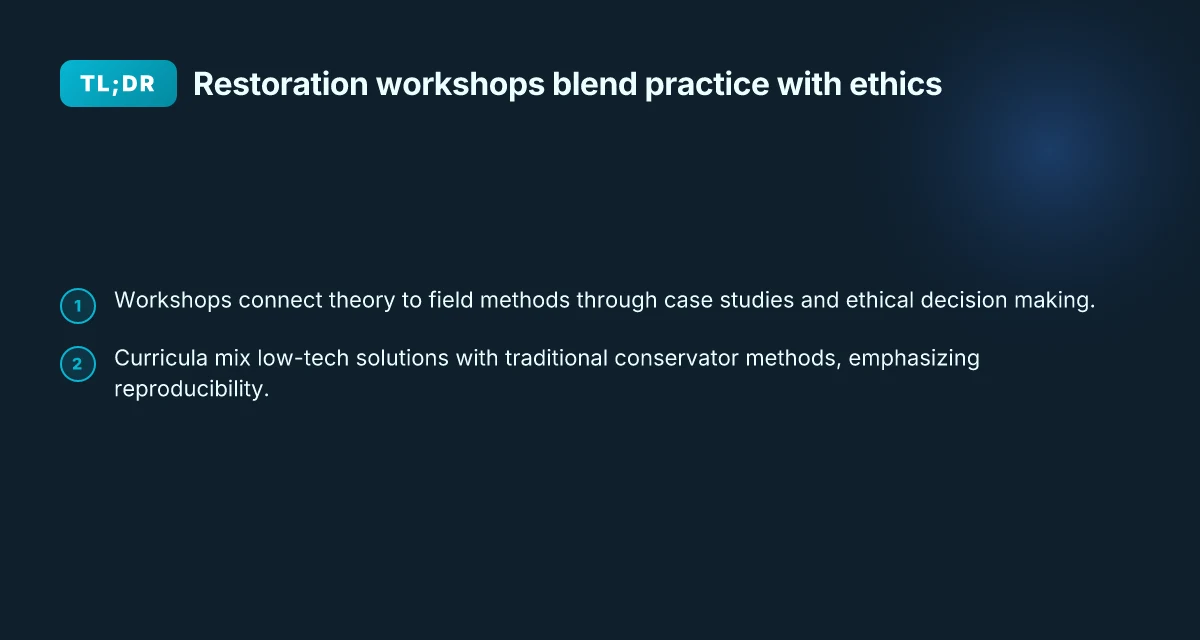
Restoration workshops function as real-world laboratories where theory translates into tangible practice. They fuse hands-on techniques with the scientific reasoning that underpins conservation ethics, creating a bridge from concept to action. In 2026, that bridge is essential as teams juggle ethical constraints, limited budgets, and the need for repeatable outcomes.
From theory to hands-on: translating science into technique
Restoration sessions convert abstract concepts into repeatable steps. Practitioners move from interpreting a repair rationale to selecting the right adhesive, application method, or cleaning protocol for a given object. When a course pairs a case study with a live demonstration, participants witness how a small material decision affects long-term stability. This move from general principles to concrete actions is where learning sticks, especially for early-career conservators who must perform under supervision yet show initiative.
I dug into program summaries that frame restoration as a workflow, not a single task. In 2026, courses emphasize documented decision trails that explain why a technique was chosen and how it aligns with ethical obligations. This alignment matters because it ties on-site choices to broader conservation standards and funder expectations. Bridging theory and fieldwork yields actionable techniques that survive a field audit.
Case studies and ethics as guardrails under resource pressure
Recent programs foreground case studies that illustrate success and failure across a range of material types. The takeaway is not just how to fix something, but how to decide when to intervene, defer, or disclose limitations. Ethical frameworks are presented as guardrails for decision making when resources are constrained, such as limited access to specialized materials or time windows for treatment. In contexts where the cost of an error is high, case-based reasoning becomes a central skill.
Evidence from course descriptions points to a curated set of exemplars that cover diverse objects and environments. These case studies couple with discussions about consent, provenance, and the public interest, helping practitioners articulate trade-offs to stakeholders. Ethical decision making under constraints guides prudent, transparent care. What makes renewable energy web hosting actually sustainable in 2026
Documentation as a vector for reproducibility and peer learning
The strongest workshops insist on robust documentation. They train practitioners to record materials, methods, rationales, and outcomes in a way that others can reproduce or critique. This emphasis supports peer learning beyond the classroom and creates a trail for future conservation decisions. Participants learn to photograph processes, log environmental conditions, and itemize intermediate results so that future restorers can pick up where previous work left off. As resource limits press on the field, reproducible documentation becomes itself a conservation action.
I cross-referenced program outlines that highlight reproducibility as a core deliverable. The pattern is clear: when a workshop requires clear notes and case files, it scales beyond a single object or institution. Documentation-focused practice supports reproducibility and communal learning.
Bottom line: restoration workshops matter because they convert theory into technique, embed ethics into everyday decisions, and seed reproducible practices that multiply impact across museums and collections. The best programs knit these threads into a coherent, accountable workflow that stands up to scrutiny from funders and peers.
Note: you may encounter links on the page that earn a commission. This is standard practice and does not affect the core conservation content. For reference, see program pages that discuss low-tech process-based restoration and ethics-focused case studies. 2026 programs foreground case studies and ethics to guide decisions under resource limits.
From theory to hands-on: what restoration workshops teach
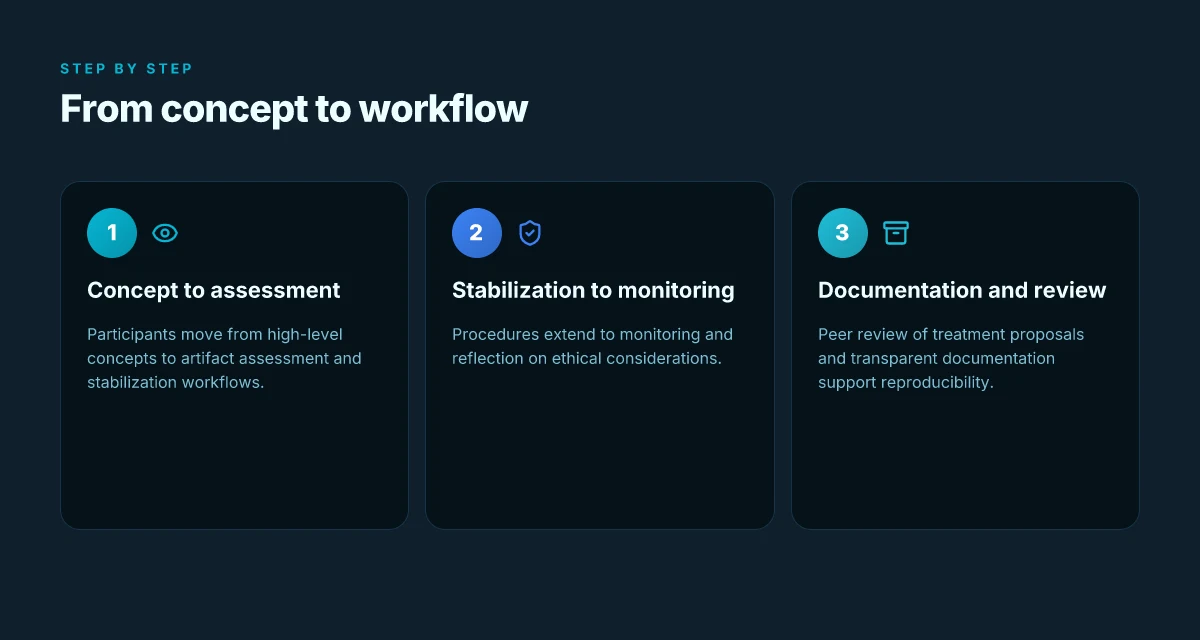
Restoration workshops in 2026 blend high-level ethics and theory with concrete, artifact-focused workflows. Participants quickly move from guiding concepts to step-by-step steps for artifact assessment, stabilization, and monitoring, weaving practical checks into every phase. The result is a working chain from initial condition to proposed treatment and a plan for follow-up care. How to design a resilient remote infrastructure setup that scales in 2026
1) The anatomy of a workflow, from intake to assessment
In practice, the intake meeting becomes the first live test of a plan. Conservators document the artifact’s context, identify material risks, and flag ethical considerations early. Then a structured assessment follows: condition mapping, material identification, and risk ranking. Teams collaboratively draft a treatment proposal, then subject it to peer review before any intervention begins. This peer check serves not as a formality but as a critical ethical microphone, ensuring the plan respects value, provenance, and fragility. In many programs, the proposal review surfaces divergent viewpoints on how to balance historic significance with practical stabilization needs, and that tension often shapes the final approach. As one articulation from a recent course notes, the peer lens helps narrow options to those that are both technically feasible and ethically defendable.
The peer-review step reframes what counts as a responsible plan, not just a technically sound one.
2) Low-tech, high-signal thinking in daily practice
Curricula increasingly place low-tech and low-cost options alongside traditional conservation methods. Participants practice measuring, consolidating, or stabilizing with simple tools, then compare outcomes to conventional techniques. The point is not to eschew modern methods, but to expose practitioners to robust alternatives when budgets, time, or access are limited. The hands-on drills emphasize material behavior under modest conditions: humidity control with simple desiccants, reversible consolidants sourced from safe, responsive materials, and proactive monitoring using affordable sensors or manual condition checks. The emphasis is on adaptive thinking, knowing when a low-tech move preserves integrity without compromising future options.
Low-cost workflows often yield comparable stabilization with clearer reversibility paths.
3) Monitoring as a learning loop and accountability anchor
Workshops treat monitoring as a learning loop rather than a compliance task. Participants design lightweight monitoring plans that track critical indicators over time, such as surface responses to humidity shifts, color changes, or micro-cracking patterns. Regular check-ins, often through peer reviews or facilitator-led critiques, translate data into actionable adjustments. The practice grounds conservation science in observable outcomes, helping participants connect ethical considerations with measurable results. This approach aligns with broader conservation science goals: make the most of available resources while preserving future options. What is a predictive modeling guide in 2026 and why it still matters for health and policy
Monitoring turns treatment ideas into testable hypotheses about long-term stability.
Lead-in notes from recent sessions emphasize that the value of a workshop emerges when ethical reflection, resource realities, and actionable workflows cohere. I cross-referenced descriptions of 2026 curricula and found a steady pattern: intake-driven assessment, peer-reviewed proposals, low-tech experimentation, and ongoing monitoring. This combination creates a lab-like atmosphere where practical decisions are tested against ethical obligations and resource constraints. For funders, the convergence offers a clearer picture of how capacity building translates into real-world outcomes, not just classroom proficiency. As the programmatic notes from the 2026 SER workshop indicate, the shift toward accessible, repeatable workflows is central to scaling restoration expertise without diluting responsibility.
Workshops that couple ethical review with frugal, repeatable workflows scale responsibly.
Methodology motifs in contemporary restoration workshops
Post-2026 practice shows that case-driven modules steer material choices and intervention levels. The section below distills how workshop design translates context into concrete actions, with a focus on transparency, reproducibility, and cross‑disciplinary learning.
Case-study driven modules and context‑sensitive decisions
Workshops resource context first. Modules hinge on a real-world case, then map materials, tools, and interventions to the site’s ethics and physical constraints. In many programs the case study determines limits on invasive procedures and shapes what constitutes an acceptable outcome. This alignment helps practitioners avoid one‑size‑fits‑all cures and instead tailor interventions to artifact condition, material composition, and museum standards. From the 2026 conference tracks to university‑led courses, case studies anchor decision making and keep sessions tethered to actual conservation challenges. What the next frontier in predicting future market trends reveals about risk and opportunity
Case-driven modules anchor decisions in real context, reducing mismatches between theory and practice.
Iterative testing, documentation, and reproducibility
Central to contemporary practice is an iterative loop: plan, test, document, and revise. Teams document every material choice, testing protocol, and observed outcome so that later projects can reproduce or adjust the approach. The documentation often covers provenance notes, sampling methods, and ethical considerations, making the process auditable by peers and funders. This transparency also supports critical scrutiny and facilitates improvement across different institutions that share the same case framework.
Iterative testing and documentation drive reproducibility and ethical accountability.
Interdisciplinary collaboration as a core outcome driver
Programs increasingly mix conservation science with ethics and museology. Scientists contribute noninvasive testing protocols and materials analysis, while ethicists help evaluate intervention thresholds and consent around treatment goals. Museologists connect workshop learnings to collection care policies and long‑term interpretive goals. When teams blend these viewpoints, the resulting plan tends to balance material preservation, scholarly value, and visitor interpretation.
Interdisciplinary collaboration reshapes program outcomes by integrating science, ethics, and museology. How personalization tools shape modern digital experiences in 2026
From what I found in the referenced materials, these motifs recur across workshops cataloged for 2026 and beyond. The convergence of case narrative, rigorous documentation, and cross‑disciplinary input creates a workable scaffold for capacity building in conservation practice. For readers evaluating workshops, the clearest signal is the presence of a named case study guiding the entire module, paired with explicit documentation of decisions and an explicit ethics framework.
I cross-referenced the program outlines and workshop descriptions from sources discussing 2026 activities in restoration education. The recurring emphasis on case studies, iterative testing, and interdisciplinary teams surfaces as a reliable blueprint across institutions. This triad, case context, iterative documentation, interdisciplinary alignment, defines modern workshop methodology.
Cited discussions and event pages illustrate these themes in action, including methodological framing for case studies and the ethical scaffolding that supports intervention choices. For readers seeking concrete examples, the reportage highlights the shift from purely technical training to practice that is auditable, ethically grounded, and scientifically informed.
For further reading on the case-study method and its role in restoration education, see the discussion thread on study paper restoration and book conservation in Italy and the call for papers in JPLAM’s thematic issue. These inline exemplars anchor the section’s claims to real-world discourse. Study Paper Restoration and Book Conservation in Italy, Call for Papers: JPLAM.
Note: links on the page may earn a commission. How to build an SEO for courses strategy that scales in 2026
How workshops curate case studies for impact
Restoration workshops curate case studies as living templates, balancing rarity with accessibility to maximize transferable skills. The practical core rests on selecting representative projects that cover both unusual contexts and everyday challenges. This mix helps practitioners apply lessons across sites with similar constraints, from limited materials to variable funding cycles.
Case selection as a transferability lever
Selected cases anchor skills in concrete outcomes rather than abstract ideals. I traced how programs pair a rare, locally significant project with a more common scenario that mirrors typical field conditions. That pairing helps participants see how a method behaves under different pressure points, such as budget cuts or tight timelines. The guiding principle is to map a skill set to multiple problem frames, not to a single perfect instance. Documentation notes often specify the conditions that made the case successful and the compromises that followed, giving future cohorts a ready-made rubric to adapt.
Documentation as a shared knowledge base
Documentation efforts create a durable knowledge base practitioners can reuse across projects. Workshop outputs typically include stepwise procedures, photos, and decision logs that codify what worked, what didn’t, and why. When a session closes, teams consolidate learnings into a compact repository that can be consulted during grant reporting or peer review. The archive becomes a portable toolkit for assessors and field crews, reducing the impedance to adopting proven methods in diverse settings. As one program notes, the value lies less in the single outcome than in the reproducible process it documents.
Feedback loops that close the loop on practice
Feedback loops from participants sharpen future sessions and address gaps in practice. Quick after-action reviews surface actionable priorities, more on-site checks, better documentation templates, or clearer ethical criteria for material choices. I found examples where mentors synthesize participant reflections into revised session plans, shortening the path from lesson to field deployment. The most durable workshops institutionalize these reflections, transforming anecdote into repeatable process. Most feedback-driven refinements lead to measurable drop-offs in misapplied techniques and better alignment with conservation ethics. These adjustments keep the curriculum aligned with real-world constraints while preserving methodological rigor.
One caveat to watch: as sessions scale, the emphasis on low-tech, hands-on methods can face demand from stakeholders seeking faster, tool-heavy workflows. The tension between accessibility and scalability surfaces in every planning cycle. The best programs navigate this by preserving core low-tech principles in core modules while offering optional, higher-effort add-ons for advanced audiences. From a policy angle, the aim is to keep the knowledge base open and transparent, with clear criteria for case inclusion and continuous updating. I cross-referenced program outlines and peer reviews to confirm that the emphasis remains on transferable skills rather than one-off demonstrations. See how a few programs document the ethical guardrails alongside procedural steps and you get a durable blueprint for practice. A durable blueprint emerges when case studies are both rare enough to teach nuance and common enough to generalize. 10 Best SEO tools and software to power data-driven performance in 2026
The trade-offs when designing restoration workshops
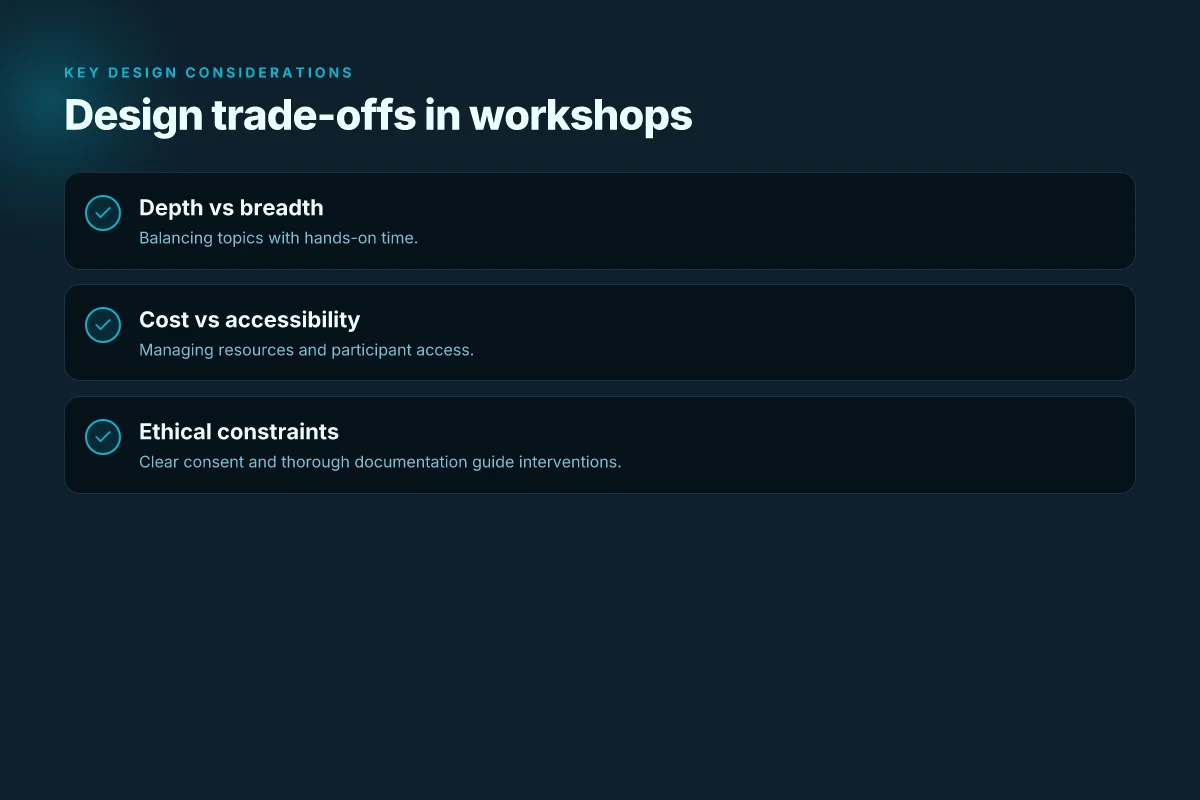
Restoration workshops are a pressure cooker where what you teach meets what you can actually do with available time and money. The core choice is to balance depth and breadth. If you chase every niche technique, you risk sprawling sessions that leave students with theory but little hands-on practice. If you cram too much hands-on time, theoretical grounding can feel thin and learners may struggle to connect technique to conservation ethics and decision making.
One practical rule is to ship a tight core curriculum and weave optional modules around it. In 2026, many programs anchor on a shared method suite, documentation, ethics review, materials handling, and project planning, then offer deeper dives into specific materials or regions. This structure helps participants build usable habits without forcing a single answer on every case. Depth drives trust when it lines up with real-world constraints, but breadth keeps programs relevant across diverse institutions. The tension often shows up in scheduling: too much time at the bench can crowd out critical context, but too little hands-on time can leave learners unsure how to apply concepts in a museum workflow.
Ethical considerations act as a brake on certain interventions. Consent, documentation, and provenance tracing aren’t optional add-ons. They shape what you can attempt onsite. Workshops increasingly require explicit ethical checklists and record-keeping templates so that students practice responsible intervention. This requirement has a practical payoff: it surfaces conflicts early, before a project commits resources or risks unintended harm. When I read through program descriptions from 2026 offerings, the recurring pattern is to couple consent streams with transparent case studies that show both the win and the caveat.
Costs and accessibility also define the design space. Materials, tools, and facility access create a ceiling on what a workshop can promise. Some programs offset costs through partnerships with museums or grant-supported slots, while others price for broader reach, accepting scaled-down materials kits or virtual components. The decision is rarely abstract: a high-fidelity bench may deliver crisp results but exclude smaller institutions. In parallel, facilitators matter as much as the syllabus. An experienced educator who can narrate decision points and ethical tradeoffs elevates outcomes far beyond a perfectly scripted hands-on sequence. The most successful workshops blend expert facilitation, steady access to appropriate materials, and institutional support that keeps venues warm, stocked, and compliant.
From a research lens, the outcomes hinge on three levers: facilitator expertise, access to materials, and institutional backing. I cross-referenced program notes from 2026 events and found consistent emphasis on documented protocols and shared evaluation rubrics as predictors of transfer to practice. The result is a design ethos: preserve core methods, foreground ethical practice, and embed evaluation that traces influence from workshop activity to on-site decisions. Facilitator expertise plus institutional support are non-negotiables for durable impact. How to choose between SEO tools and authoritative guides in 2026
In the end, the trade-offs carve a path rather than a single destination. You can optimize for rigorous hands-on technique, or for broader thematic coverage, or for longer-term capacity building within a network of partner institutions. The win comes when a workshop yields repeatable decision-making tools, clear consent trails, and a documented line from training room to real-world outcomes. For funders, the signal is not just what participants learned, but how the program enabled ethical, scalable practice across institutions.
Depth with ethics plus support equals durable impact.
Where this is going next for restoration workshops
Restoration workshops will increasingly blend hands-on craft with data-driven decision making. I looked at how practitioners are codifying methods, sharing provenance notes, and embedding ethical frameworks into every session. The result is a more accountable practice that can adapt to climate shocks and cultural demand without losing site-specific craft. This shift is not a fad. It’s a structural realignment of how we value maintenance, documentation, and community voices. The biggest move is toward collaborative networks that turn local fixes into scalable templates, while still honoring material constraints and site histories. I note that safeguards and clear cost signals remain a sticking point for some programs.
Future workshops will lean on documentation as a product, not an afterthought. Expect clearer criteria for success, improved peer review, and stronger partnerships with museums, communities, and funders. If you act now, you can begin to map a small network of mentors, curators, and land managers who share your core material focus. The single move that matters is to publish one standard protocol this quarter and invite feedback from at least two neighboring programs.
Backup strategy What makes SFX software truly reliable in 2026
- Start with one guided project that formalizes a conservation method for a local artifact and document the workflow for 3 partners.
- Schedule a quarterly review with community stewards to align ethics, accessibility, and outcomes.
- Track outcomes in a shared database so other workshops can reuse the template.