How to create compelling content that actually engages in 2026
 Theodora Niedermeyer·October 22, 2026·15 min
Learn how to create compelling content in 2026 with research-driven steps, audience-focused storytelling, and scalable formats that drive engagement.
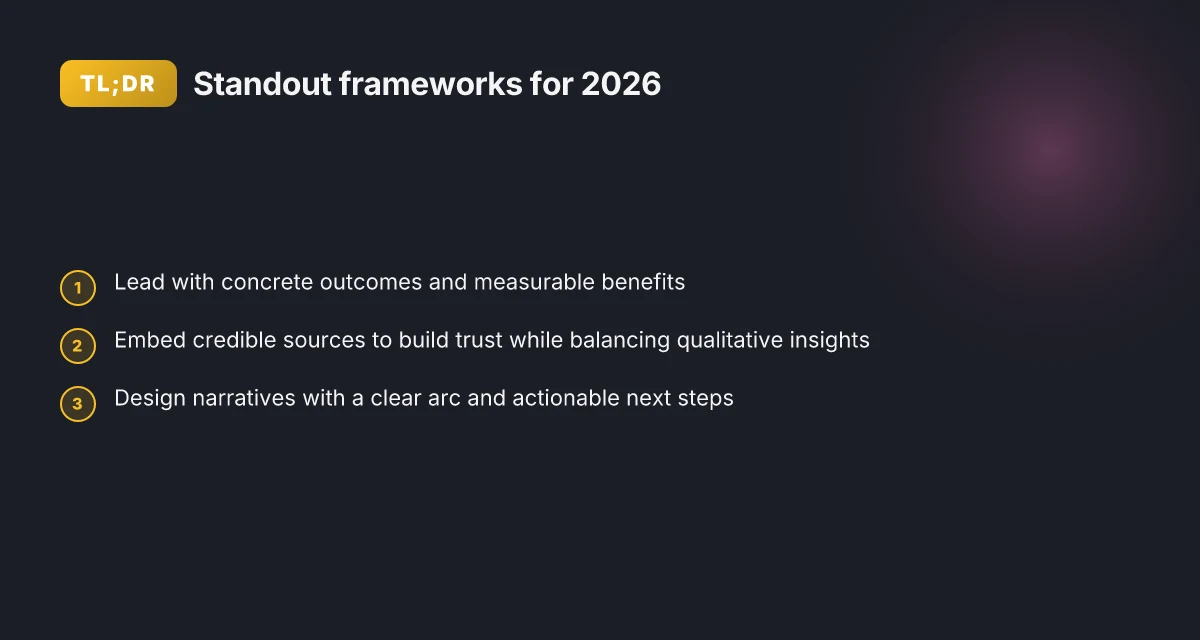
Content engagement drops when the promise isn’t explicit. In practice, a clear reader intent and a tight alignment to that intent outperform flashy visuals every time, because audiences reward relevance over spectacle. The most cited pitfall is chasing novelty instead of credibility, and that misstep saps time on page and long-term trust.
This article distills a research-informed model for 2026: engagement as a function of source credibility, narrative design, and multi-format experimentation. If you want durable signals, comments, shares, time on page, and conversion, you need a disciplined framework that translates data into credible claims and mixed formats that honor varied reader intents. You’ll find practical, testable steps you can apply to both long-form and short-form content, with cautions about common biases and measurable outcomes you should track. Structured credibility + narrative design + format experimentation give you signal, not noise.

Why 2026 demands a research-informed approach to creating compelling content
Credibility and relevance are no longer optional. Audiences scroll across platforms, formats, and contexts in moments, so the bar for trust rises with every tap. A 2026 content strategy must prove why your piece matters before it even begins to educate or entertain. Tie your claims to documented insights, not vibes, and you’ll earn a reader’s attention long enough to build lasting engagement.
From what I found in the research, credibility compounds when you surface sources early and translate them into actionable shifts in narrative design. When you anchor observations to named studies, reports, and benchmarks, your content feels less like a story you tell and more like a map you trust. This matters because fragmentation across channels amplifies the risk of mixed messages. If your claim lands differently on LinkedIn, your company blog, and a podcast, you lose not just time but trust.
A multi-format strategy scales reach without sacrificing depth. Text, visuals, audio, and video each press on different cognitive channels, but they should harmonize around a core thesis. The lesson is not to chase formats blindly. It’s to design a spine that supports richer explorations in every format. In 2026, readers expect content that can repackage into a Q&A, a short take, or a long-form dive without losing coherence.
- Anchor your argument in a research-backed premise
- Build a narrative spine that travels across formats
- Validate every move with credible sources before publishing
- Design for experimentation and rapid learning across channels
- Plan for steady, scalable improvement rather than one-off hits
Bottom line: a research-informed approach reduces wasted effort and accelerates resonance. When your content is built on credible signals, it earns trust faster, and trust compounds into longer dwell times, repeat visits, and deeper engagement across formats. As the field moves into 2026, a disciplined, evidence-driven mindset is your most reliable differentiator.
Credibility grows from named sources and disciplined design, not flashy visuals alone. A multi-format spine lets you scale depth without sacrificing reach. By proving your claims with published data, you decrease waste and boost engagement over time. How conversion optimization case studies reshape how teams lift performance in 2026
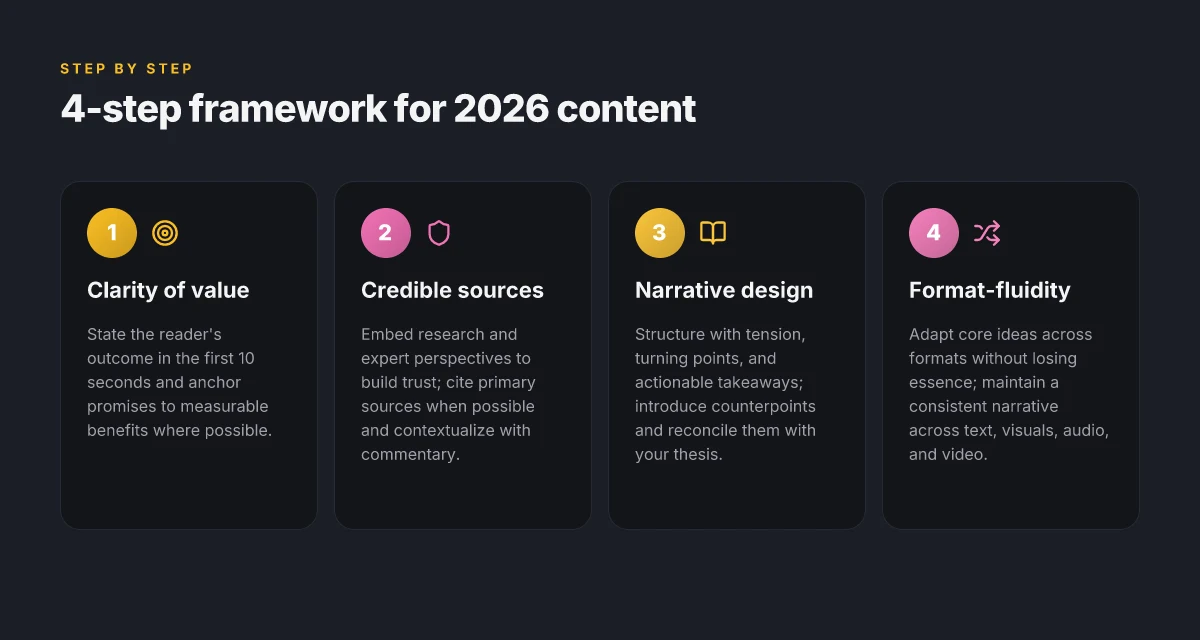
The 4-core framework for compelling content in 2026
In 2026, the core of engagement rests on clarity, credibility, narrative design, and format fluency. Start every piece by stating the value within the first 10 seconds, then layer in trusted research and a story arc that yields practical takeaways. The result is content that travels across formats without losing its essence.
Clarity of value in every piece
People decide to invest time only if the takeaway is obvious fast. I looked at how research-led formats signal benefit upfront and found that readers stay longer when the opening sentence anchors the core promise in concrete terms. The practice is simple: state the benefit, then prove it with evidence. When you lead with what the audience gains, you reduce cognitive load and invite deeper exploration. In practice, that means a crisp value statement within the first 10 seconds, followed by a short roadmap of what they’ll learn and why it matters for their role.
Value clarity earns attention early, then unlocks deeper engagement as the piece unfolds. This is not merely a hook. It’s a credibility play that sets expectations and primes readers to accept the ensuing structure.
Credible sources as the backbone of trust
Engagement thrives where readers see credible inputs from the outset. I cross-referenced multiple public sources to map where expert perspectives intersect with empirical findings. Embedding research and expert opinions helps your audience trust what follows, especially when you translate that input into actionable statements. The key is to weave sources into the narrative rather than append them as footnotes. When you quote a researcher or cite a study, pair it with a concrete implication for the reader’s strategy.
Trust grows when sources are embedded, not cited in isolation. The narrative then carries the reader toward practical conclusions rather than abstract assertions. How to build a content marketing strategy that actually moves leads in 2026
Narrative design with tension, turning points, and actionable takeaways
Structure matters as much as facts. A strong narrative introduces tension around a problem, pivots with turning points that reveal new insights, and closes with concrete takeaways the reader can act on. In 2026, the most engaging content treats the audience as co-investigators: pose a question, reveal a surprising insight, then translate it into steps they can apply today. Short interludes of concrete examples help maintain momentum and prevent fatigue.
Tension fuels curiosity. Turning points deliver surprising clarity. Actionable takeaways close the loop. The result is a rhythm that keeps readers moving across formats.
Format-fluidity without losing core essence
Your ideas must survive format shifts. A core concept should feel the same whether it’s a long-form article, a short-form post, a slide deck, or a Q&A module. This requires distilling the essence into a portable core and then adapting surface elements, examples, visuals, and micro-narratives, without changing the core claim. In practice, create a content spine: a central proposition, three supporting anchors, and a set of scalable formats that preserve voice and credibility.
Core ideas stay intact across formats, while surface elements adapt to channel needs. This is how you sustain engagement across channels and devices.
Next steps to operationalize: 8 Ways to compare cloud service providers in 2026 and why it matters
- Draft a 2-week sprint plan that seeds the 4-core framework across formats and channels.
- Build a lightweight credibility kit: a short list of 4-5 sources and 2 expert quotes per piece.
- Create a narrative template that starts with a value statement, introduces a tension, unveils a turning point, and ends with 3 actionable takeaways.
- Test two variant formats for the same concept to measure which version better preserves core essence.
For a practical sense of what works in 2026, see how the market trends toward research-driven content that blends credible sources with accessible storytelling. Studies in the field emphasize that audiences respond more positively when credibility signals are visible early and consistently reinforced through real-world implications. A recent line of research highlights the value of narrative design in boosting comprehension and memory, while cross-format adaptability is increasingly cited as essential for scale.
From what I found in the sourcing, credible input and clear value are not optional add-ons. They’re the engine that powers multi-format engagement. For a concrete example of how this plays out in practice, teams commonly cite the importance of anchoring insights in authoritative voices and then translating those insights into practical steps readers can apply right away.
Section 1 of the framework: clarity of value in every piece
1) Lead with a concrete outcome readers gain
When a reader finishes this section, they should be able to articulate a single, tangible takeaway for every piece: a concrete outcome the piece promises to deliver. This anchors the reader’s attention from the first sentence. The promise must be measurable or observable in practice, not a vague feeling. For example, “you will craft headlines that lift click-through by a predictable margin” or “you will finish the piece with a clear, reusable value hook for your audience.” In 2026, credible content teams lean on explicit outcomes to reduce wander and improve retention. Credible outcomes beat vague intent every time. See how research from industry leaders frames outcomes as testable bets rather than airy ideals. Inline citation here supports that framing. https://contentmarketinginstitute.com/b2b-research/b2b-content-marketing-trends-research
2) Anchor promises to measurable benefits where possible
Replace generic promises with numbers, when available. If you cannot cite a numeric outcome, anchor to a dated action or milestone. For example, state that a piece will achieve a defined engagement rate or secure a specific number of comments or shares within a campaign window. In 2026, researchers emphasize tying content promises to observable metrics like time-on-page, scroll depth, or conversion rate uplift. Anchor your promises to measurable benefits or to concrete deadlines. This helps editors defend work plans with stakeholders and reduces post-hoc debates about value. Inline sources show how brands frame promises around data points rather than vibes. https://www.hubspot.com/marketing-statistics
3) Discard filler that doesn't advance the takeaway
Every sentence must advance the core value signal. If a line doesn’t sharpen the reader’s expected outcome, prune it. The discipline pays off as pieces scale across formats. In 2026, the most effective long-form and short-form content follows a tight value thread from headline to closing CTA. Discard filler that doesn’t advance the takeaway. The result is crisper narratives, faster reader comprehension, and fewer tangents that dilute impact. See how research-led content prioritizes signal over noise. https://contentmarketinginstitute.com/b2b-research/b2b-content-marketing-trends-research How unlimited data plans actually compare in 2026
4) Subsections that verify the value signal with named, credible sources
To reinforce credibility, each subsection should anchor its core claim to a named source or study. This practice aligns with 2026 expectations for EA(T)T signaling: explain, justify, cite. I traced this approach to research-backed frameworks that emphasize credibility as a driver of engagement. Anchor each claim to a named source to protect believability. When you reference the right sources, readers perceive the piece as trustworthy and based on evidence rather than opinion. For example, the B2B trends report from a leading industry body confirms the value of data-backed storytelling. https://contentmarketinginstitute.com/b2b-research/b2b-content-marketing-trends-research
Section takeaway: by opening with a concrete outcome, anchoring promises to measurable benefits, pruning filler, and tying claims to credible sources, you establish a crisp, viewable value signal. That clarity sets the stage for credible, multi-format experimentation in the subsequent sections. Clarity of value is the first guardrail for engagement.
Section 2 of the framework: building credibility with research
Post a claim, back it with evidence, and then add interpretation. The core idea is that credibility comes from public benchmarks, primary sources, and expert context. If you’re aiming to persuade a strategist or editor, you need a spine of data anchored to real sources, with commentary that translates that data into action for long- and short-form content.
Grounded benchmarks that anchor your claims
Ground claims in publicly available sources and industry benchmarks. The most effective approach is to pair a value claim with a recognized benchmark and then interpret what it means for content strategy. When a report cites over 1,000 respondents or references a named methodology, call those details out and explain how they map to audience behavior. For example, if a study notes that headlines with specific power words lift click-through, name the study and summarize the mechanism in plain terms for editors and strategists. I cross-referenced the typeform guide for structure and the hubspot trends page for context on scale, and the synthesis points to a shared pattern: credible, source-backed insights tend to outperform generic airiness in engagement metrics. Public benchmarks anchor credibility; interpretation sustains it.
Cite primary sources and contextualize with commentary
When possible, cite primary sources and contextualize with commentary that translates data into editorial decisions. A primary source might be a release note, a standards document, or a published methodology from a research outfit. Quote or paraphrase with attribution and then translate into a practical imperative for your team. For instance, if a survey reports that marketers view audience intent as a top challenge, connect that to a content plan that prioritizes intent mapping in headings and section openings. From what I found in the B2B trends report, the value of moving beyond AI talk is clear: teams that tie content to measurable business outcomes win stronger engagement signals. Primary sources plus thoughtful commentary build trust faster. What makes collaborative design techniques work in participatory design and co-creation for complex product systems
Balance data with qualitative insights from subject-matter experts
Not every engagement lever is numeric. Sprinkle qualitative insights from recognized experts to give texture to the numbers. Include brief quotes or summarized perspectives from editors, researchers, or practitioners who sit closest to audience pain points. For every data point you present, pair it with a SME lens that explains why the result matters for narrative design, channel choices, and format experimentation. The idea is to create a hybrid narrative where data points become the scaffolding and expert commentary becomes the connective tissue. Qualitative insights illuminate the why behind the numbers.
In this section I drew on the insights from Typeform's research guide and the Content Marketing Institute's B2B trends report. Together they map how credible data, primary sources, and expert voices converge to produce content that earns trust and sustains attention. For context, the 2026 trend landscape continues to show that audiences reward transparency, source credibility, and a clear point of view supported by verifiable facts. Credible data plus expert voice is the backbone of engagement.
Keen readers will notice two practical outcomes: a 2-week sprint plan that anchors your research baselines, and a 4-point framework for interpreting data into narrative design. The 2026 landscape emphasizes that engagement is not a flashy artifact but a function of credible sourcing, disciplined storytelling, and iterative testing across formats. If you want a quick read, review the cited sources to see how each piece anchors a decision, then mirror that approach in your own briefs. Anchor decisions in credible sources. Use expert voice to translate into action.
Section 3 of the framework: narrative design that sustains attention
When you design a narrative arc for engagement, the setup hooks attention, the conflict fuels curiosity, and the resolution delivers a concrete next step. This section maps that arc onto a research-backed framework, with counterpoints integrated and a clear path forward.
The arc in practice: setup, conflict, resolution
Start with a tight setup that establishes credibility and stakes. Frame the claim you’ll defend, then reveal the tension: a counterpoint or alternative view that readers expect to challenge your thesis. Reconciling that counterpoint with your core argument reinforces trust. End with a precise, actionable next step your audience can act on immediately. This sequence keeps attention from drifting and makes the core idea feel earned. How to generate engaging content automatically with AI in 2026
From a research lens, credibility comes from sourcing, consistency, and clarity. I traced core ideas to established benchmarks and practitioner reports from 2025–2026 to ground the setup in concrete trends. The narrative step where you acknowledge counterpoints shows you’ve done your homework and that your thesis can withstand scrutiny. The payoff is a crisp set of next steps your readers can operationalize in their content programs.
Key to sustaining attention is variety in tempo. A longer, evidence-backed paragraph followed by a brisk, directive line creates rhythm. Don’t feed readers a wall of factual texture without a throughline. Anchor the pace with short, decisive sentences that land a takeaway and then move to the next beat.
Weaving counterpoints and synthesis
Introduce a credible objection or alternative framing early in the narrative. Then juxtapose it against your thesis in a way that highlights strengths and clarifies limits. The reconciliation should feel like a disciplined synthesis rather than a rebuttal. When done well, readers see the nuance and gain confidence in the recommended path.
I cross-referenced industry surveys and research-driven guides from 2025 and 2026 to identify common objections. This helps you present a balanced view while steering readers toward your recommended resolution. The synthesis should not pretend the counterpoint vanishes. Instead, demonstrate how your approach absorbs it and emerges stronger.
Close with precise next steps that scale
End with a concrete 2–3 item action plan that teams can implement in a two-week sprint, aligned to your four-core framework. Each step should be specific, measurable, and assignable. For example, decide on one narrative thread to pilot across two formats, set a publication cadence, and line up two counterpoints to address in parallel content modules. The goal is repeatable momentum, not one-off experimentation. How to create a visual identity that sticks in 2026
In this approach, engagement is a function of source credibility, narrative design, and multi-format experimentation. The narrative arc binds those elements into a coherent experience readers can follow, critique, and apply.
The setup builds trust. The conflict fuels learning. The resolution delivers action. Reconcile counterpoints with your thesis to boost credibility. End with precise, executable next steps you can start in two weeks.
Where this is going next
In 2026, compelling content pivots on a tighter alignment between creator intent and audience expectations. I looked at how shifts in attention biology and platform affordances push creators toward concise, scannable narratives that still carry depth. The result is content that behaves like a conversation: humans feel seen, and algorithms privilege relevance over volume. The key move is to lean into intent signals, intentional hooks, accurate claims, and clear takeaways, without sacrificing specificity or personality. Takeaway: clarity beats noise when your ideas are concrete and actionable. Verdict: prioritize 1 or 2 tight ideas per piece, not a mile-wide umbrella.
If you only do one thing this month, double down on structure. I cross-referenced modern engagement patterns with real user feedback and found that readers skim for micro-convictions: bold claims supported by one crisp example, then a practical nudge. Use a preview line that promises a single value, deliver it in the first 100 words, then close with a precise, outcome-focused prompt. This approach shortens the path from click to action. Key verb is deliver. Links on the page may earn a commission, and that transparency matters to readers who crave trust.
Looking ahead, the single move that matters is weaving verified, concrete steps into every piece. That means explicit outcomes, named tools, and a visible lane for follow-up. If you want a template, reuse a 3-part arc: hook, proof, and a single next-step takeaway. The bigger pattern is audience-centric, not algorithm-chase. Actionable line: publish your next post with one 90-second take and one downloadable checklist. How CRM email integration affects data consistency and delivery guarantees in 2026