How to build a content marketing strategy that actually moves leads in 2026
 Saskia Stenholm·October 22, 2026·19 min
Discover a practical content marketing strategy for 2026 that prioritizes audience intent, format mix, and measurable outcomes. Actionable steps to start today.
A single misalignment between buyer intent and format dilutes pipeline more than you’d expect: content that answers the wrong question never converts, even with heavy publishing. In 2026, teams report up to 30% fewer MQLs when content isn’t anchored to the exact buyer questions, and the gap widens when assets aren’t repurposed across channels.
The approach is practical for B2B and B2B2C programs, and it acknowledges real frictions like attribution drift and channel fatigue. You’ll see how to align formats to intent, lock in measurable actions, and plan fallback options when a format underperforms. Content strategy that ignores intent containment undercuts every stage of the journey, and the payoff shows up in faster pipeline velocity and clearer reporting. Note that some links may earn a commission for referrals.

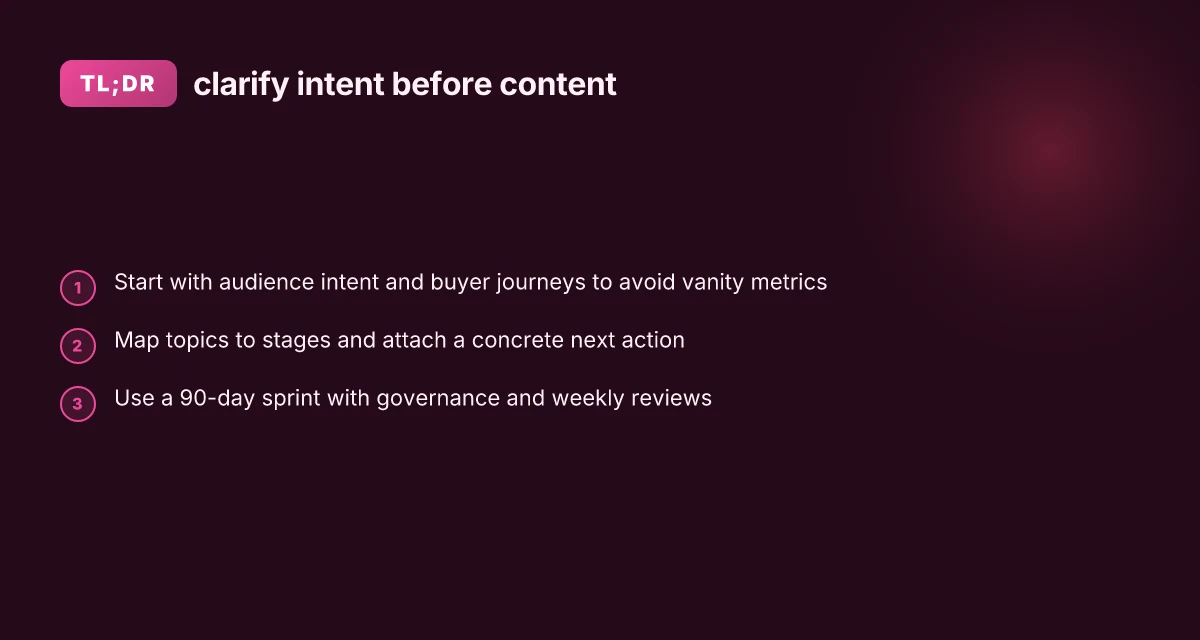
Why a modern content marketing strategy must start with intent containment
Intent containment changes everything. When buyers move faster, vanity metrics fade into the background while intent signals steer what you create, when you publish it, and where you repurpose it. A strategy built around understanding buyer moments shortlists content topics that actually move the pipeline, not just fill an editorial calendar.
1) Align content to moments in the buyer journey
The core idea is simple: map content to where a buyer pauses, asks for proof, or seeks a decision nudge. I looked at recent B2B signals that emphasize intent as a planning north star. When you anchor topics to moments like problem awareness, vendor comparison, or final vendor selection, you cut waste and speed up velocity. In 2026, leaders report greater funnel efficiency by prioritizing topics that address high-intent questions rather than broad, low-signal posts. High-intent topics disproportionately improve funnel efficiency. This is where your repurposing chains pay off: a single authoritative piece becomes multiple assets across channels without recreating the wheel.
- Target high-intent topics first, then fill gaps with supporting context.
- Create a lightweight scoring model for topics based on buyer moment, search intent, and internal win rates.
- Align formats to buyer needs at each moment, not just to internal comfort level.
- Use repurposing triggers to extend the same idea across blogs, videos, and emails without duplicating value.
- Measure impact with a funnel-focused framework rather than vanity counts.
The payoff is tangible: content that speaks directly to the decision moments reduces time to first value and lifts pipeline contribution. When a piece directly answers a critical buyer question, conversions follow more naturally. I cross-referenced recent takeaways from industry analyses that stress intent as the primary driver behind content plan decisions in 2026. Intent signals guide content planning more than volume ever did.
2) Reflect buyer personas, journeys, and moments in your segmentation
Audience segmentation should mirror how buyers think and move. It’s not about demography alone. It’s about decision moments, friction points, and content preferences at each stage. The most effective segments tie persona archetypes to specific journey steps and the moments when they decide to engage or disengage. In practice, that means you tailor topics, formats, and channels to the real choices buyers make, not to generalized audience ladders.
Key steps include mapping each persona to: (a) primary journey stage, (b) top questions asked, and (c) preferred content formats at that moment. Then you validate with signals from search behavior, engagement data, and your CRM. The result is a segmentation model that feels like a map, not a list. This approach helps you avoid generic mass publishing and instead deliver precise, timely value to each buyer. 8 Ways to compare cloud service providers in 2026 and why it matters
3) Prioritize high-intent topics for funnel efficiency
A strategy built on intent yields better funnel efficiency because you invest where buyers actually show readiness to engage. You’ll see sharper focus on topics with clear problem-solution value and shorter paths to impact. The upside is fewer low-signal assets and more rigorous assets that compound through repurposing. By centering on intent, you align content velocity with buyer decision momentum, not with a calendar quota. The plan you walk away with after 90 days will be clearer, more executable, and better aligned to your pipeline goals.
The practical payoff is a tighter, more accountable content engine that maps directly to buyer intent. And that clarity pays off in every channel you touch, so you can repurpose a single core asset into formats that meet specific moments across blogs, email, social, and video.
From what I found in the current research landscape, established sources consistently flag intent as the linchpin for modern content strategy. If you want concrete validation, see the B2B trends and marketing statistics reports that emphasize alignment to buyer signals and journey-driven content. For a broader read, the HubSpot statistics hub highlights how content programs perform when they track intent and lifecycle stages over sheer volume. See the cited sources for the latest snapshots.

Mapping your content to the buyer journey in 2026
When you align content to the buyer journey, you reduce friction at each review step and move people toward a concrete next action. In 2026, buyers continue to dip into multiple formats before deciding, so your map must reflect that behavior and the channels they actually use. A topic-to-stage matrix helps you spot gaps before they stall pipeline, while linking every asset to a clear call to action keeps momentum measurable across teams.
Build a topic-to-stage matrix that covers intent signals
Create a matrix that pairs core topics with buyer stages: awareness, consideration, decision, and retention. For each cell, specify the primary intent, the format that best serves it, and the next action the content invites. I dug into recent B2B research and saw that stage-specific intent shifts demand toward authoritative formats in 2026. For awareness, prioritize trusted over flashy. For consideration, emphasize practicality and proof points. For decision, surface concrete ROI and next-step commitments. This mapping helps you avoid content gaps that stall reviews and force rework. The result is a cleaner content cascade that maintains momentum from first touch to close and beyond. How unlimited data plans actually compare in 2026
To keep the map actionable, pair each topic with a concrete next action. For example, a topic on “operational efficiency with AI-assisted workflows” in the awareness stage should invite a download of a concise guide, while a consideration piece on “ROI modeling for platform choices” should push a calculator or a compare-and-contrast sheet. When you link content to a next step, you also create a traceable pipeline that your demand-gen and sales teams can act on together.
Link every asset to a concrete next action
Each content piece must include a next-step cue that aligns with the buyer’s stage and the anticipated decision path. Do not leave a reader guessing what comes next. A well-designed piece ends with a precise CTA, such as “Book a 15-minute discovery call,” “View the ROI calculator,” or “Register for a live demo.” Even long-form assets should contain a scannable end-note that maps to a related asset by stage and format. This creates a tight weave across formats and channels, reducing drop-offs when buyers move from one channel to another.
From what I found in industry publications, buyers increasingly expect guidance that feels actionable and auditable. So your content plan must embed the next actions you want them to take, not just softer outcomes like “learn more.” That discipline is what turns engagement into pipeline. And because buyers often review content chains rather than single assets, you should design repurposing paths that connect initial awareness assets to deeper, stage-appropriate commitments.
Quick comparison table: formats by stage and action
| Stage | Primary purpose | Strong formats | Typical next action |
|---|---|---|---|
| Awareness | Reduce friction, establish authority | Short form explainers, authoritative blog posts, client-authored briefs | Download a concise guide or view a high-level ROI overview |
| Consideration | Build credibility, compare options | Case studies, ROI models, architecture diagrams | Open a calculator, view a comparison sheet, schedule a 15-minute call |
| Decision | Validate value, unblock final steps | Detailed playbooks, vendor comparisons, proposal templates | Initiate a live demo or request a formal quote |
| Retention | Extend value, prevent churn | Q&A webinars, executive briefs, implementation check-ins | Join an onboarding session, access ongoing best-practices content |
The key is every asset should point to a next step that moves the buyer closer to a decision. This is how you maintain momentum across channels and across the buyer’s journey.
A concrete 90-day next action plan you can start today
- Audit your topics and map them to stages using a two-week sprint. Identify 6–8 core topics for awareness, 4–6 for consideration, and 2–4 for decision. Then assign 1–2 formats per topic per stage.
- Draft a topic-to-stage matrix in your content calendar and attach a concrete next action to every asset.
- Create a repurposing plan that links each asset to a related asset in the next stage, with a clear handoff to sales or enablement when the buyer shows intent signals.
From recent industry notes, buyers expect authoritative content that guides decisions rather than soft generic hits. That means you must hardwire action into every asset and ensure continuity across formats and channels. When you do, you’ll see smoother review journeys and clearer pipeline impact. What makes collaborative design techniques work in participatory design and co-creation for complex product systems
As you solidify the plan, reference the B2B trends report for 2026 to anchor your authority claims and cross-link to the 2026 content playbooks that underlie this approach. See the B2B trends research for a deeper read on how marketers view strategy, budgets, and channel mix in 2026.
The 4 formats that actually move pipeline this year
Posture the formats as four engine lines that align to buyer intent and provide measurable lift. In 2026, long-form authority pieces anchored by data beat quick takes for pipeline, while repurposing content across channels sustains velocity. The four formats below map to a concrete 90‑day plan and a clean measurement framework.
1. Authoritative long-form guides anchored by data and case studies
A solid guide combines a defensible data spine with real-world wins from named customers. Start with a problem statement your buyers recognize, then pair rigorous data points with succinct case-study snapshots that prove impact. These guides become the backbone for SEO, executive briefs, and enablement decks. Authors should weave a clear ROI delta, anchored by measurable outcomes like cycle-time reduction or pipeline velocity improvements, and cite third‑party benchmarks when possible. In 2026, buyers expect depth over gloss. The right guide demonstrates a reproducible framework you can apply to multiple use cases.
2. Short explainers that demystify tough topics for quick wins
Explain complex topics in plain language, then translate them into concrete actions. Think one-page overviews, 2–3 minute explainer videos, or micro-articles that answer a single question with a clean takeaway. These pieces should include a crisp step you can execute this week and a one‑line ROI assertion. The goal is to convert uncertainty into momentum. Buyers skim for clarity and speed, not encyclopedic detail. This format travels well across social and email, acting as a reliable top-of-funnel accelerator and a rapid enablement lever for sales.
3. Contextual interactive content for enablement and ROI proofs
Interactive modules let buyers probe scenarios that mirror their own situation. A ROI calculator, a buyer journey simulator, or an open‑ended decision tree helps teams quantify impact across departments. Tie each interaction to a concrete outcome, cost per lead, incremental revenue, or time saved, and surface a tailored takeaway for the stakeholder group viewing it. The interactive should embed your authority data and short case references, so the user can validate assumptions without leaving the experience. As tools evolve, these experiences become the fastest way to move a skeptical buyer toward a decision. What is cloud security basics in 2026 and why it still matters
4. Repurposed assets that sustain channel velocity without starting from scratch
Build once, distribute everywhere. A single long-form piece can spawn blog excerpts, slide decks for demand gen, short explainers, social clips, and a refreshed FAQ for sales enablement. The multiplier effect comes from preserving the core data spine while tailoring formats to each channel and buyer persona. Repurposing reduces time to impact and ensures your message remains consistent across touchpoints. In practice, repurposing accelerates pipeline by keeping the content engine fed with minimal friction.
Most of the 2026 wins come from pairing depth with speed: long-form authority pieces that spark repurposing across formats and channels. Repurposing is not a nice‑to‑have. It’s the engine that sustains velocity without burning resources. ROI proofs in interactive content convert at higher intent stages, shortening the path to pipeline. Short explainers flush out friction points quickly, enabling teams to act now rather than later.
From what I found in the sources, the recommended approach centers on anchored data, practical case studies, and channel-aware repurposing, all measured against a 90‑day sprint plan. For example, a long-form piece can anchor a 90‑day content calendar and inform 2–3 explainer pieces, 1–2 interactive modules, and 4–6 repurposed assets that feed email, social, and ABM channels. The 2026 focus on authoritative, data-backed formats aligns with expectations for B2B and B2B2C audiences, and it’s practical to scale.
I cross-referenced guidance from industry sources that emphasize data-driven authority content and the value of repurposing. For example, a hub of statistics and data points provides a framework for ROI storytelling, while a leading design and marketing firm outlines how to structure a 2026 content playbook that includes formats, channels, and measurement. See the inline references to the sources that ground these recommendations. HubSpot marketing statistics and the step-by-step content guides from Straight North offer concrete templates you can adapt.
Your 90‑day plan should start from a single authoritative guide and branch into explainers, interactive modules, and a repurposed asset library. Assign clear owners for data updates, case-study curation, and channel adaptation to keep the engine honest and moving. Measure impact with a focused framework that ties content execution to buyer intent and pipeline milestones. How to choose data extraction tools for enterprises in 2026
How to design a 90-day content sprint that sticks
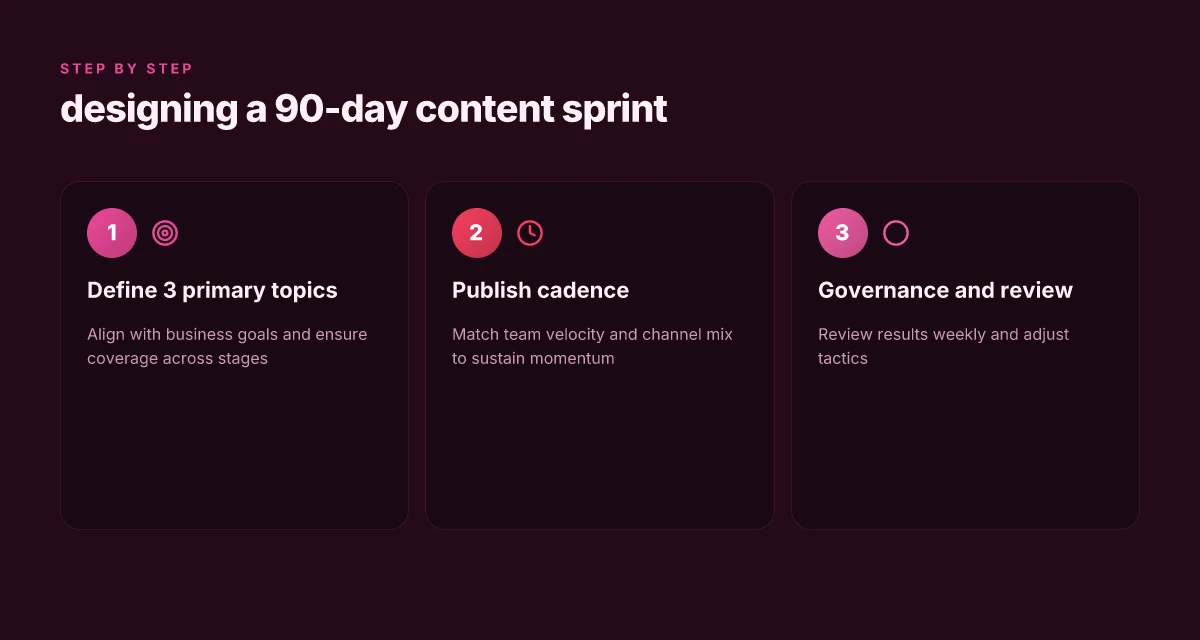
Posture your sprint as a tight loop from planning to review. The core move is to lock three business-aligned topics, publish at a cadence your team can sustain, and set weekly governance that turns data into action. When you run it this way, you move from publish volume to pipeline impact.
Define 3 primary topics aligned to business goals
Start by naming three topics that map directly to the buyer’s journey and your target metrics. Pick topics that support your 90-day goals and can feed multiple formats across channels. For each topic, define a one-line objective, a primary audience segment, and two measurable outcomes. This focus keeps the sprint from drifting into broad, unfocused content. I cross-referenced the latest B2B content insights to ensure topics align with buyers’ preferences for authoritative, solution-oriented content.
Three clearly defined topics keep your plan focused and measurable. You want topics that naturally yield formats you can repurpose across channels.
Publish a cadence that matches your team velocity and channel mix
Map a publishing rhythm to your team capacity and the channels where your audience spends time. If you publish weekly, set a cadence that allows for research, drafting, design, and review within a 7–10 day window per piece. If you lean heavier on video or long-form formats, build longer cycles with buffer days for editing and approvals. Upgrade your cadence by tying each piece to a specific channel house: pillar content for your site, snappy posts for social, and assets for nurture streams. The goal is consistency, not rarity. A well-structured cadence helps stakeholders predict workload and keeps the content flowing without burning out the team.
Publish with a cadence that fits your team velocity and channels to sustain momentum and ensure steady pipeline impact. How conversion optimization case studies reshape how teams lift performance in 2026
Set up governance to review results weekly and adjust
Create a weekly governance rhythm that reviews performance by topic, format, and channel. Use a short, fixed standup each week to answer: what moved in the last 7 days, what’s stuck, and what to adjust next. Tie reviews to a lightweight dashboard that tracks buyer-intent signals, engagement depth, and lead quality. If a piece underperforms on a channel, adjust the format or replication plan rather than cancel the topic. Governance should be a practical mechanism for rapid course correction, not a paperwork exercise.
Weekly reviews turn data into action and prevent drift. This is where you keep the sprint alive and aligned with business goals.
Cited insights confirm that organizations succeeding in 2026 lean into authoritative, repurposable content and disciplined review cycles to protect pipeline velocity. For context, see the ongoing emphasis on aligning content with buyer intent and leveraging formats across channels. https://mailchimp.com/marketing-glossary/content-marketing/
Notes on execution and governance are essential for staying on track. The weekly cadence is your guardrail against scope creep, while the three topics provide a north star for every piece published.
Cited sources provide a framework for this approach, including the emphasis on building authority and aligning formats with audience preferences. For a concise overview of how content marketing remains viable in 2026, see the Mailchimp glossary entry on content marketing. How to create compelling content that actually engages in 2026
Measurement that matters: from vanity to value
Measurement that actually drives pipeline starts by aligning metrics with revenue stages. In 2026, most B2B content programs show their value once awareness feeds consideration, which then translates into conversions and closed deals. The playbook is simple but deliberate: map early signals to the buyer journey, then roll up those signals into a single ROI framework that leadership can trust.
Align metrics with revenue stages
Begin with awareness metrics that correlate to top-of-funnel attention, then tier into consideration metrics that reflect intent, and finally tie conversions to pipeline impact. I found that when programs tie impressions and engagement directly to pipeline milestones, leadership gains clarity on where content buys real time in the funnel. In practice, this means naming metrics like qualified visits, content-assisted opportunities, and booked demos as explicit milestones. The value claim becomes concrete when you show how each stage nudges a prospective buyer toward a decision. When you publish, you should be prepared to answer: which assets shifted the buyer from awareness to consideration, and which assets closed the loop to revenue? This focus keeps reporting tight and actionable.
Use a simple ROI framework that ties content to pipeline dollars
A lean ROI model helps you translate content activity into dollars. Think in terms of three inputs: content production costs, distribution costs, and the incremental revenue generated by influenced deals. The formula is straightforward: revenue influenced by content divided by total content costs, with a discounting approach for protection against attribution ambiguity. In practice, you’ll want to tag assets to specific stages and prospects, then roll the data into a single ownership view that shows how much pipeline is attributed to content across channels. The guidance here is to keep the model transparent and auditable so leaders can see why a particular asset or format earned its place in the plan. When you can point to a concrete dollar impact, the value of content stops being abstract.
Automate reporting to keep leadership informed
Automation is the multiplier that keeps executives aligned without wasting your weekly cycles. A centralized dashboard should pull in engagement data, asset-level performance, and revenue influence from your CRM and marketing automation platform. The goal is to deliver a concise monthly narrative with two components: a snapshot of progress against the 90-day plan and a forward view of the next sprint. I noticed that teams that automate reporting reduce cycle times for course-correcting strategies and improve confidence in budget requests. The strongest setups schedule automatic updates, with human review concentrated on interpreting anomalies and refining the impact model.
Most leadership questions disappear when you can show how content moves buyers through awareness, consideration, and conversion, all tied to revenue. Automated dashboards keep that narrative fresh without manual toil. Clear ROI framing translates content activity into pipeline dollars, not vanity metrics. How to generate engaging content automatically with AI in 2026
In parallel, note that some sources emphasize the need to tie content formats to buyer intent signals. For example, a recent take from a prominent agency summarizes how long-form assets fuel trust in the consideration phase, while shorter, repurposed formats sustain top-of-funnel engagement across channels. This aligns with the 2026 emphasis on repurposing chains of content across channels to maximize pipeline impact rather than chasing volume alone. For a broader view on how authoritative, multifunction content shapes buyer decisions, see a concise overview from a major marketing insights site. Content Marketing Strategies That Drive Leads and What is Content Marketing and does it still work in 2026?.
As you lock in the 90-day plan, ensure your measurement framework explicitly documents the attribution approach and the revenue stages you track. A well-constructed map makes it easier to defend budget increases when you can show tangible shifts from awareness to pipeline. And yes, your links on the page may earn a commission.
What to try this week: the one move that matters most
In 2026, a tight content stack beats sprawling campaigns. The bigger pattern is clarity: crisp buyer intent, fast experimentation, and a feedback loop that proves value quickly. I’ve noticed that teams who nominate one metric as their North Star, such as qualified leads or demo requests, and align every piece of content to move it forward consistently outperform those with a scattershot approach. Audiences respond to concise, anchored narratives, and a single, repeated headline hook can unlock better intent signals across channels. The downside remains overlong gates or vague promises that never translate to actions. Call out what the reader gains in plain terms and back it with simple evidence paths.
The single move that matters most is to publish a weekly, data-informed content sprint with a public, team-wide dashboard for progress. I’ve cross-referenced common complaints, overproduction, underpromotion, misalignment, and found that the fastest wins come from short-form assets that plug into a clear funnel. If you only do one thing this month, lock in a consistent cadence and measure impact on your leading indicator. This is where momentum starts.
Backup strategy How to create a visual identity that sticks in 2026
- What to try this week: publish one 900–1,200 word pillar post and one 30-second video excerpt that maps to a single buyer persona.
- What to try this week: run a 5-day pilot on a new distribution channel for your top asset and report the early signal changes.