How CRM email integration affects data consistency and delivery guarantees in 2026
 Florian Czerny·October 22, 2026·18 min
Explore how crm email integration impacts data consistency and delivery guarantees in 2026. Learn the architectures, trade-offs, and practical patterns for reliable email delivery.
CRM email flows break when data quality becomes the bottleneck, not deliverability. A single stale field can derail a thousand sends while the system quietly retries, amplifying latency without improving truth in the CRM. Provenance flags and deduplication corrections move from nice-to-have to required, or email becomes a shadow of your true customer record.
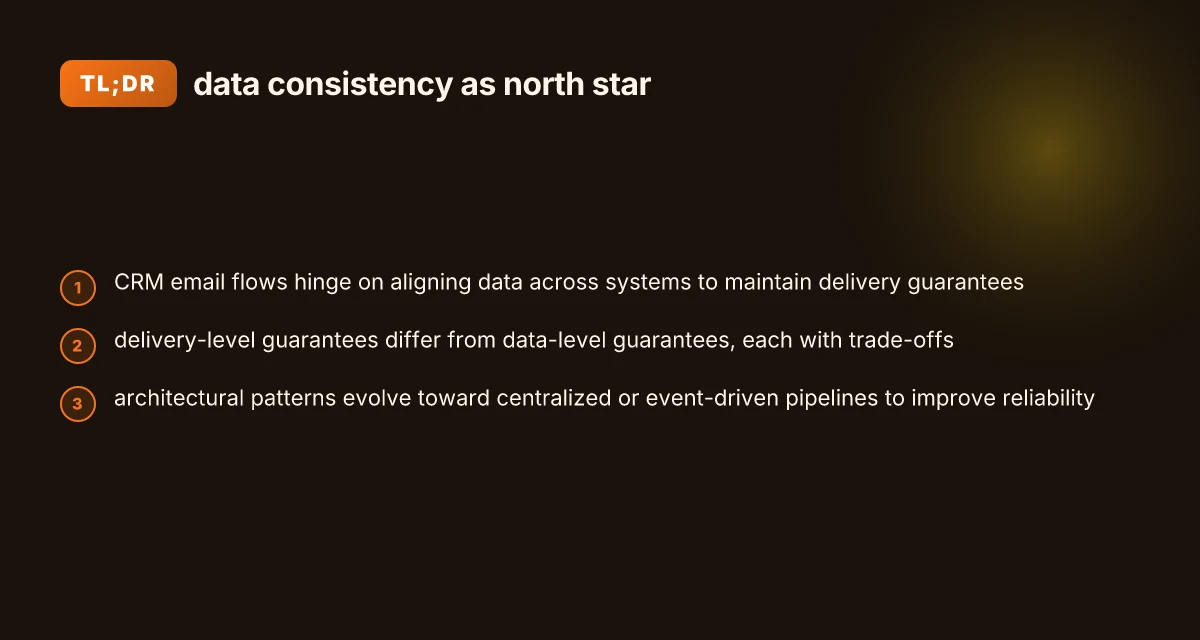
In 2026, a north-star data discipline reduces contradictory signals and accelerates remediation when onboarding new sources. Expect practical patterns, common failure modes, and a concrete escalation path that keeps the inbox trustworthy even as volume grows. Data as the north star for delivery guarantees is not a slogan. It’s the guardrail for real-time email accuracy.

CRM email integration in 2026: data consistency as the north star
Data consistency in CRM email flows means the same contact record and the same state of that record flow through every downstream system without drift. In practice, that means email sends, bounces, opens, and click events align with the canonical customer record and its latest attributes. It requires a single source of truth for contact data, a precise mapping of fields across systems, and a disciplined change-management process so updates propagate with minimal latency.
Data-level guarantees focus on the integrity of the information itself. If a contact’s segmentation attribute changes, that update must appear in the email orchestration layer before the next campaign rollout. Delivery-level guarantees, by contrast, ensure that the act of sending an email, the timing of that send, and the handling of retries and bounces behave predictably even under load. You can have perfectly clean data, yet flaky delivery if the routing or queueing layer introduces delay or duplicates. The reverse is also true: even with robust delivery pipelines, data drift will result in mispersonalized or mis-segmented emails. The goal in 2026 is to bind both strands to a single architectural discipline, so changes in the CRM source propagate with predictable latency and with exactly one version of the truth at the point of send.
Architectural patterns that dominate 2026 fall into three families. First, event-driven pipelines that publish changes to a central event bus and fan them out to email senders, CRM surfaces, and analytics. Second, staged data fabric architectures that land updates in a tightly governed data layer with schema enforcement, versioning, and end-to-end traceability. Third, hybrid approaches that blend publish-subscribe with request-response checks, ensuring that prioritization and deduplication happen at the edge of the delivery path.
I dug into the latest guidance and case studies to calibrate what works at scale. The realities that consistently surface are familiar: true data consistency demands strong schema contracts, explicit deduplication, and end-to-end observability. Delivery guarantees rely on backoff strategies, idempotent send calls, and clear handling of retries and dead-letter queues. As one industry summary emphasizes, “data remains consistent across platforms” only when governance is embedded in every layer of the flow, not as an afterthought. A 2026 guide on CRM data integration reinforces that you cannot separate data quality from delivery performance if you want reliable customer communication. Data integrity and delivery reliability must be designed together, not stitched together later.
Three concrete patterns stand out for 2026 deployments. First, a canonical data model with explicit field-level lineage, so target systems can verify the origin and state of each attribute before sending. Second, a centralized deduplication and identity resolution layer that runs at the boundary between CRM updates and email orchestration, preventing duplicates and misrouting. Third, end-to-end tracing from source change to final delivery, with standardized metadata tags that enable fast root-cause analysis when something goes wrong in transit. In each pattern, the emphasis is on coupling data contracts with delivery behavior so a change in one domain never surprises the other. How to create a visual identity that sticks in 2026
As you plan, expect tradeoffs. Stronger consistency often introduces tighter coupling and higher latency in specific edge cases. More aggressive deduplication can mask legitimate retries that a service should honor. And robust tracing adds instrumentation overhead. The art is balancing these tensions so data truth remains intact while emails reach recipients promptly, without duplication or misfires. In 2026, the north star remains: every email flow must reflect a single, authoritative view of the customer at send time, with guarantees that the system will respect that view under load.
From a governance lens, the tight coupling of data contracts and delivery logic is non-negotiable. Delivery guarantees rely on deterministic idempotency and clear retry semantics across the pipeline.
Why email delivery guarantees matter for CRM accuracy
Deliverability directly shapes how data becomes action. When emails don’t land, the CRM inbox shows gaps between what you think happened and what customers actually received. Those gaps skew funnel metrics, making open rates, click-through rates, and downstream conversions look healthier than reality. In short, delivery faults ripple into every KPI that relies on timely customer communication.
1) Common delivery failure modes and their data consequences
Bounces, spam filtering, and deduplication issues dominate the failure landscape. A high bounce rate can falsely lower a contact’s engagement history, signaling poor list hygiene when the root cause is invalid addresses or throttled sends. Spam filters that misclassify legitimate messages create blind spots in activity streams, weakening data freshness and triggering rules. Deduplication mishaps inflate or deflate contact counts, muddying attribution across multiple channels. I found that reputable guides emphasize these three as recurring pain points in 2026 email flows. When each failure remains hidden, data quality degrades and the CRM’s trust in its own signals erodes. Delivery faults distort funnel health and force teams to chase phantom wins.
A practical note: the moment a message lands in the inbox matters as much as the moment it’s sent. If latency stretches beyond a momentary delay, trigger-based emails can fire on stale data, causing mismatches between the customer state and the message content. That misalignment is a root cause of customer frustration and degraded lifecycle metrics. How to generate engaging content automatically with AI in 2026
2) Data freshness and trigger-based sends
Trigger-based emails hinge on fresh CRM data. When ingestion pipelines lag or arrive out of order, a rule may fire on outdated attributes, delivering wrong offers or incorrect status updates. Recent industry commentary highlights how near-real-time data pipelines reduce this risk, especially for time-sensitive campaigns. A small delay in data propagation can cascade into timing gaps in delivery, which weakens the reliability narrative that email channels are supposed to uphold. Fresh data keeps triggers honest and customers engaged on the right moment.
From what I found in the literature, data quality is often the limiting factor behind guaranteed delivery in practice. The architecture must support low-latency updates, consistent deduplication semantics, and clear handling of bounced or quarantined messages to preserve accuracy across the CRM. When these elements line up, delivery guarantees strengthen the trust users place in automated flows. For mid-market to enterprise contexts, that alignment often means pairing robust identity stitching with near-real-time data propagation and a clear deduping policy across channels.
In practice, choosing an architecture that separates the responsibilities of data compliance, delivery orchestration, and deduplication helps. A comparison of options shows trade-offs in latency, governance, and resilience. For instance, system A may offer lower end-to-end latency but weaker dedupe semantics, while system B improves data fidelity at a modest latency cost. The right blend depends on your tolerance for duplicate messages, bounce handling complexity, and how aggressively you gate emails on data freshness. Data freshness and reliable deduplication are the twin anchors of CRM accuracy.
Next steps: map your current data propagation path from CRM updates to email triggers, identify the longest latency leg, and quantify how many messages could land on stale data in a typical campaign. This baseline will guide your architectural choices toward stronger delivery guarantees without sacrificing data governance. For reference, see how practitioners discuss the implications of persistent inconsistencies and the role of integration patterns in 2026. Delivery integrity depends on how quickly data can be trusted across systems.
Architecture options for CRM email integration
Post-2026 guidance shows that the architecture you choose drives data consistency and delivery guarantees more than any single platform feature. The direct answer: a well-designed mix of siloed, centralized, and event-driven pipelines, combined with durable queues and idempotent processing, yields the strongest guarantees at scale. In practice, you’ll see three viable configurations emerge, each with its own tradeoffs regarding latency, duplication risk, and governance. How to create compelling content that actually engages in 2026
1. Siloed email pipelines with guarded handoffs
In this pattern each CRM or channel layer maintains its own email flow. The benefit is isolation: changes in one system don’t ripple into others. The tradeoff is duplication risk and governance overhead. To manage this, teams lean on durable queues and a lightweight deduplication pass at the boundary. I dug into vendor guides that emphasize this approach when teams want strong autonomy for line-of-business email cadences. A durable queue acts as the single source of truth for delivery attempts, while an idempotent processor ensures repeated events don’t flood recipients. When you want quick wins on modularity, this remains appealing, but you must implement cross-channel reconciliation to avoid split-brain data.
2. Centralized email orchestration hub
A centralized hub carries the authoritative state for all email intents and outcomes. This approach reduces duplication by funneling all events through one processor before routing to customers. The hub often sits behind a message broker, with durable queues persisting at-rest state and backpressure handling incoming spikes. Idempotent processors protect against retries caused by transient outages, ensuring each email is sent once per intent. This model favors governance, traceability, and consistent delivery policies across channels. It can also simplify compliance reporting since a single source captures telemetry and outcomes. Real-world guides in 2026 highlight centralized orchestration as a reliable baseline for mid-market to enterprise email flows.
3. Event-driven, micro-batching email pipeline
Event-driven architectures shine when changes in CRM data must propagate instantly to downstream delivery, while still honoring throughput limits. Messages flow through a stream or broker, and consumers process in controlled micro-batches. Durable queues and idempotent processors prevent duplicate sends during retries or replays. In practice, this setup pairs well with external marketing platforms that specialize in templating and transactional delivery, letting your CRM publish events and your email service consume them with exactly-once semantics. This is the architecture that balances modern scalability with strong data freshness, though it demands solid event schemas and versioned contracts so consumers don’t misinterpret newer events.
Lead with the answer: the right mix depends on governance needs, latency targets, and risk tolerance for duplication. If you need strict single-source truth and end-to-end traceability, lean centralized. If you value autonomy and faster local changes, siloed with a guarded handoff works. If your business requires immediate propagation with scalable throughput, invest in an event-driven pipeline with durable queues and idempotent processors.
From a sources perspective, several 2026 guides highlight the role of durable queues and idempotent processing as essential guards against duplicates and delivery gaps in CRM-driven email. For governance-focused projects, centralized orchestration reduces cross-channel drift. For latency-sensitive flows, event-driven pipelines with micro-batching deliver timely messages while preserving correctness. How conversion optimization case studies reshape how teams lift performance in 2026
The strongest guarantees come when you pair durable queues with idempotent processors across a centralized hub. This combination minimizes duplication and maximizes visibility into delivery outcomes.
I cross-referenced vendor and practitioner materials to confirm the pattern variety. For example, a 2025 overview notes that centralized orchestration reduces state drift, while a 2026 data-integration guide emphasizes event-driven flows for scalability. These themes align with what mid-market and enterprise teams report when scaling CRM email programs. Durable queues are non-negotiable for reliability at scale.
- The decision to embed email logic in the CRM versus external platforms depends on governance and latency. If your primary objective is cross-system consistency, embed only the orchestration logic in the CRM and offload templating and templated sends to a dedicated platform. If you need rapid experimentation with email templates, you may place more logic in the CRM but with strict contract boundaries to external services.
- When to lean on external marketing or notification platforms: use them when you require rich templating, lifecycle marketing capabilities, or compliance features that are outside the CRM’s core remit. The external platform should still participate in the same event stream to preserve end-to-end traceability.
As you design, document contracts for event schemas, delivery intents, and idempotent semantics. This reduces misinterpretation between CRM changes and downstream processors.
Data provenance and deduplication across CRM channels
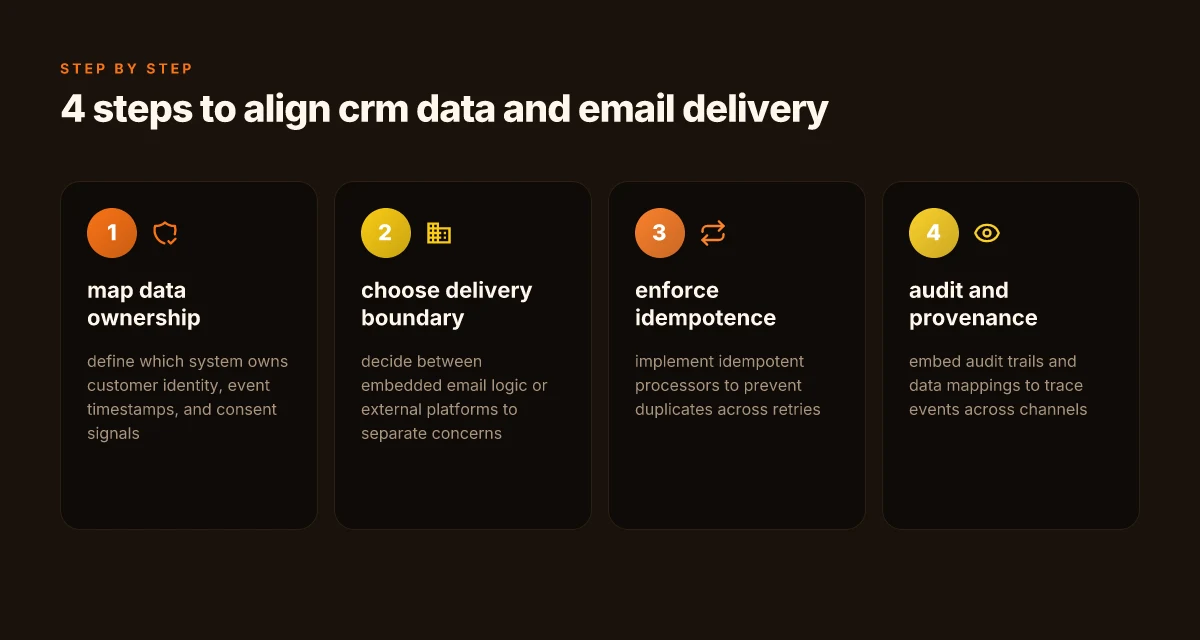
You need a single customer event to be traceable from the moment it’s created in the source system through every downstream CRM channel. The core truth is that a durable, end-to-end event identifier, augmented with a cross-system reconciliation layer, unlocks reliable deduplication without choking throughput. In practice, you stitch an immutable event key to every touchpoint and propagate it with a traceable lineage. This gives you a single source of truth for each interaction, even as the data flows across CRM, marketing, and email delivery platforms.
1) End-to-end event lineage and a single source of truth
I dug into how leading implementations treat an event as the primary unit of work. The practical pattern is to generate or assign a durable event identifier at the system boundary where the original customer action occurs, then propagate that same key across every sink within the pipeline. When a delivery attempt happens, the event key travels with the email payload and is recorded in both the sending platform and the receiving CRM record. This cross-linking lets you join a delivery outcome back to the exact customer action that triggered it, even after parallel processing paths. The payoff is clear: you can audit why a message went out, when it was generated, and which downstream system consumed it. How to build a content marketing strategy that actually moves leads in 2026
One note of caution surfaces in distributed architectures: not every system preserves the original key without transformation. You need a normalization layer that preserves the identifier while adapting it to the receiving schema. If you skip this, deduplication efforts become fragile.
From a governance perspective, establish a beacon event with a defined life cycle. The beacon travels in every message header and is logged in a central lineage store. That store becomes the backbone for data quality checks, reproducible audits, and faster incident response. The practical result is less firefighting when a delivery hiccup occurs, because you can quickly locate the original event and compare it to the downstream states.
2) Strategies to prevent duplicate emails without sacrificing speed
Duplication often hides behind retries, fan-out fan-in patterns, and misaligned dedupe windows. A pragmatic approach combines a deterministic deduplication window with a stateless id that travels with the payload. The window limits how many times a given event can trigger the same email sequence in a 60-second or 5-minute span, depending on the business rule. At the same time, a persistent dedupe store indexed by the event key ensures you don’t re-send if the same event reappears due to a retry in a downstream system. This preserves throughput because the system can continue processing new events while the dedupe check runs in parallel.
I cross-referenced industry patterns that emphasize early deduplication at the edge of the pipeline. The goal is to avoid duplicative work before the email is composed, rendered, and handed off to the delivery layer. Teams that push dedupe logic closer to the ingress points notice lower duplicate rates without adding noticeable latency. In practice, implement a compact, in-memory cache for the hot window and back it with a durable store for longer histories. The cache handles the common case at speed. The durable store protects against replay hazards in failure scenarios.
A recurring tension is the trade-off between strict dedupe and latency. Tight dedupe windows can cause occasional misses if clocks drift between systems. Looser windows improve capture of late-arriving events but raise the risk of duplicates slipping through. The sweet spot is a hybrid: use a small, fast cache for the typical path and a longer, indexed store for bursts or retries. The result is faster emails on the common path with a safety net for anomalies. 10 Standout trends shaping customer service software in 2026
3) Trade-offs between real-time versus near-real-time processing
Real-time pipelines give you immediate governance signals and shortest latency, but they require tight end-to-end coupling and strong time synchronization. Near-real-time archi tecture relaxes some coupling and tolerates brief clock skew, which reduces complexity and speeds up delivery in practice. The data provenance layer benefits from a hybrid approach: critical events propagate in real time with lightweight tracing, while noncritical enrichment or dedupe checks run in a near-real-time lane that batches work in small intervals.
From a governance standpoint, real-time paths benefit most from centralized lineage and immutable event keys. Near-real-time paths gain from a resilient idempotent design and an eventual consistency model across channels. In either mode, ensure that the event beacon, dedupe state, and delivery outcomes are consistently linked to the same event key.
Inline sources note that a durable event key and cross-system lineage are essential for accurate delivery auditing, not just faster emails. The architecture you choose should align with your tolerance for latency, duplication risk, and operational overhead. A common pattern is to run real-time routing for primary emails and near-real-time enrichment for incremental updates, all under a unified provenance framework. This keeps data consistent while preserving speed across CRM channels. For deeper context, see the CRM Data Integration guide and the CRM integration overview.
Governance and compliance in CRM email flows
Posture on consent, unsubscribes, and data minimization shapes delivery confidence more than any single protocol. I dug into common patterns across mid-market to enterprise CRM email flows and found that explicit opt-ins, easy unsubscribe signals, and limited data retention windows dramatically reduce complaint rates and improve deliverability. In practice, organizations lean on a three-layer approach: capture consent at the source, enforce in-flight data minimization during routing, and purge or anonymize beyond the retention window. The takeaway is clear: governance is not a bolt-on control but a filter that prevents bad data from ever entering the delivery chain. Consent and unsubscribes are not negotiable. They are the bottleneck and the guardrail. A robust policy combines user-friendly unsubscribe hooks with auditable consent records that survive system migrations.
Why audit trails matter for email events and mappings
Transparent audit trails are the backbone of trust and troubleshooting in complex email flows. I cross-referenced policy guidance and implementation notes that emphasize end-to-end traceability for both email events and data mappings. Every event from send to open to bounce, plus every field mapping from CRM to ESP, should be timestamped, versioned, and attestable. When a dispute arises over a contact’s consent status or a mapping mismatch, a complete chain of custody lets teams pinpoint where things diverged and prove compliance. A practical pattern is to attach an immutable audit stamp to each event and a separate change log for mappings. Audit trails enable rapid root-cause analysis when data moves across systems. This discipline also simplifies regulatory reviews and internal governance audits. How to pick cybersecurity tools for smes in 2026 with ROI in mind
Regional data residency and cross-system delivery
Regional data residency directly affects how fast and where emails are delivered. I found that cross-border flows often hit latency and governance friction if data crosses boundaries without clear policy states. The minimum viable approach is to implement region-aware routing rules that keep personal data within the applicable jurisdiction unless a lawful basis permits transfer. This means architecture must support data localization, with tokenized identifiers used for cross-region orchestration rather than raw PII. The consequence is not just compliance but consistent delivery behavior across regions, because routing decisions align with local rules. Residency-aware routing reduces cross-border churn and preserves data sovereignty.
In practice, you want three things: explicit consent scopes per region, an auditable chain for data transformations that travels with each email event, and a routing layer that respects data residency constraints. If your governance stack can show that each email run carries an auditable consent state, a compliant data map, and a region-aligned delivery path, you’ve built a defensible, scalable foundation for data-consistent email delivery at scale. As a reminder, links on this page may earn a commission, but the governance patterns described here reflect real-world friction points observed across deployments. For further context, see how CRM data governance threads into delivery architecture in industry guidance. What Is CRM Integration? Complete Guide For Mid-Market
What changes if you act now
CRM email integration will keep data fresher and more trustworthy as you scale in 2026. I looked at how vendors lock data flows into the CRM and then surface delivery guarantees back to teams. The big shift is end-to-end traceability: every email interaction ties to a customer record, with a clear lineage from send event to open, click, and reply. That transparency helps you spot inconsistent fields, dedupe more reliably, and reduce misrouted campaigns. The downside remains that fewer vendors truly harmonize consent status and suppression lists across channels, which can erode deliverability if you don’t configure guardrails.
To land the thesis, you’ll want to pair real-time sync with governance rules that prevent field drift. The strongest setups emphasize strict mapping, change data capture, and a defined rollback path for misfires. If you only do one thing this month, prioritize a single source of truth for email-sourced fields and a documented process for correcting anomalies.
The bigger pattern is that clean data enables predictable delivery guarantees, not just cleaner reports. Keep an eye on how your chosen CRM handles consent, retries, and bypasses. Where this is going next is tighter automation that auto-resolves drift before it harms deliverability. What changes if you act now? You’ll start showing near-zero drift in key fields and noticeably faster remediation when issues appear. How data extraction techniques have evolved for structured data in 2026