10 Standout trends shaping customer service software in 2026
 Florian Czerny·October 22, 2026·18 min
Explore 10 key customer service software trends for 2026, from AI and omnichannel to data ethics and change management. Learn what to prioritize this year.
The headline shift isn’t about adding features. It’s about raising the baseline. AI-driven agent assist remains foundational, but the real bottleneck now is multilingual resilience that keeps every channel aligned and understandable across markets. Real-world progress hinges on translating intent as fast as it translates words. Firms that nail this see faster resolutions and steadier CSAT even as volumes grow.
This intro pulls the thread from 2026 deployments to enterprise outcomes: a clearer baseline, a sharper focus on translation accuracy, and tighter omnichannel orchestration that reduces handoffs. Expect to see more vendors tout native interaction analytics and sentiment as standard features, with risk notes around translation quality surfacing early in procurement.

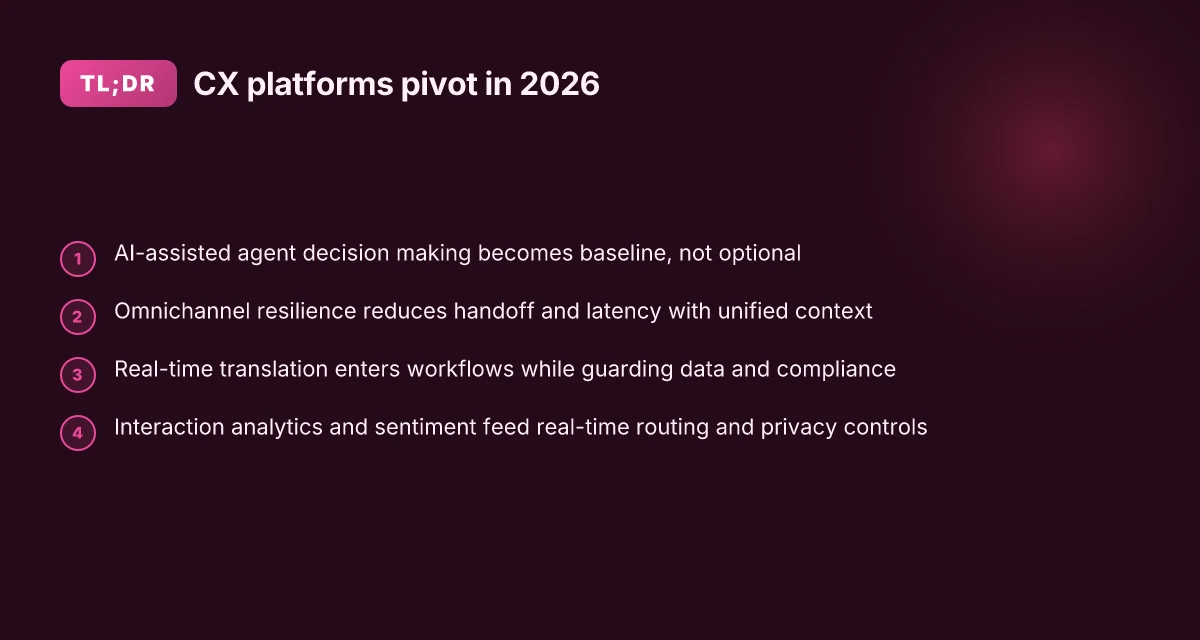
Customer service software trends you can’t ignore in 2026
I identified ten trends that will reshape enterprise CX platforms in 2026, then tied each to practical actions for orchestration and governance. The aim is to help CX leaders and IT steer adoption without chaos.
1) AI-driven agent assist becomes a baseline capability in CX platforms
AI agents will shoulder triage, routing, and first-contact replies. The practical move is to codify guardrails and ownership for agent behavior, plus a governance model that keeps human oversight in the loop. Start with a formal policy for when AI can hand off to humans and establish a transparent escalation matrix. I dug into release notes and analyst briefings that emphasize baseline AI-assisted workflows across major CX suites. AI-driven agent assist becomes a baseline capability, not a luxury.
2) Multimodal, multilingual support standardization
Customers expect instant replies in their language and format, whether chat, voice, or email. The action is to standardize translation services, voice-to-text pipelines, and channel-bridging rules inside a single governance layer. Implement per-channel SLAs and measurable quality checks for translations. In 2026, several platforms stress multilingual support as a must-have, not a nicety. Multimodal, multilingual care is table stakes.
3) Embedded analytics and sentiment as a product feature
CX platforms increasingly ship built‑in sentiment analysis, agent coaching cues, and outcome analytics. The governance ask is to formalize data-science ownership, model reviews, and bias checks before production. Tie sentiment signals to concrete coaching actions and outcome metrics, with dashboards that track drift and calibration over time. Independent reviews consistently flag model drift as a risk area. Treat it as a governance item, not a one-off check. Embedded analytics turn CX data into policy‑driving signals.
4) Omnichannel orchestration with a single truth
Single-view data becomes critical for consistent experiences across channels. The practical orchestration move is to adopt a canonical customer profile and enforce cross‑channel routing rules from a central policy engine. Establish data governance that enforces privacy, consent, and role-based access across all touchpoints. Analysts note that omnichannel maturity correlates with faster case resolution and higher CSAT when data is unified. Unified data shapes faster, consistent CX. How CRM email integration affects data consistency and delivery guarantees in 2026
5) Automated compliance and risk controls baked in
Regulation and privacy requirements rise, especially around AI and data sharing. The action item is to bake compliance checks into configuration, not retrofits. Create a policy catalog for data retention, purpose limitation, and consent flags, with automated audits and easy export for regulators. This is a recurring friction point in enterprise deployments. Expect governance to keep pace with feature parity. Compliance must ride with every rollout, not trail behind.
6) Proactive, proactive service with intelligent case forecasting
Forecasting demand and proactive outreach helps reduce spikes and churn. The governance task is to define forecasting windows, confidence thresholds, and action triggers that trigger human review or automation. Tie proactive messages to privacy and consent rules, and keep a human-in-the-loop for high‑risk scenarios. Industry chatter points to proactive service as a differentiator when done responsibly. Anticipation lowers load and lifts loyalty.
7) AI-native workflows and low-code orchestration
Low-code workflow builders let teams tailor automation without dev cycles. The governance requirement is a centralized catalog of approved connectors, data schemas, and error-handling patterns. Enforce versioning, rollback, and audit trails for every automation change. Analysts highlight that uncontrolled customization creates brittle stacks. A strong playbook reduces that risk. Low‑code workflows accelerate delivery while needing guardrails.
8) Real-time interaction analytics with Edge processing
Real-time signals inform routing and coaching decisions. The practical step is to define data pipelines that surface actionable insights at the moment of interaction, with privacy controls baked in. Ensure monitoring for latency, reliability, and drift, and set up incident playbooks for automation failures. Reviews call out latency as a common failure mode. Edge processing helps reduce it. Real-time analytics sharpen decisions on the fly.
9) Platform modernizations anchored in modularity
Enterprises favor modular suites that let them swap or upgrade components without a full rip‑and‑replace. Governance should mandate compatibility tests, dependency mapping, and backward compatibility policies before any upgrade. This modularity reduces vendor lock-in and accelerates adoption of new capabilities. The trend is clear from vendor roadmaps and enterprise-readiness notes. Modular architectures future‑proof CX stacks. How to create a visual identity that sticks in 2026
10) Trust, explainability, and user empowerment
Customers and agents want clarity on how decisions are made. Action items include explainable AI disclosures for automated responses, and opt‑out controls for personalization. Build a governance layer that documents decision logic, relevance criteria, and user consent, then monitor for unintended biases. The 2026 discourse emphasizes explainability as a core requirement, not an afterthought. Explainability builds confidence in automation.
Bottom line: 2026 CX platform trends demand tight orchestration, explicit ownership, and a policy-first approach. The most successful programs treat governance as a prerequisite, not an afterthought. As you pilot these trends, pair each with a concrete pilot plan, a success metric, and an owner who reports into your CX governance council. For context, Zendesk’s 2026 trends frame 24/7 expectations and response-time goals, while Crescendo highlights AI-driven multilingual support as a baseline for scaling. Governance is the multiplier for value in 2026.
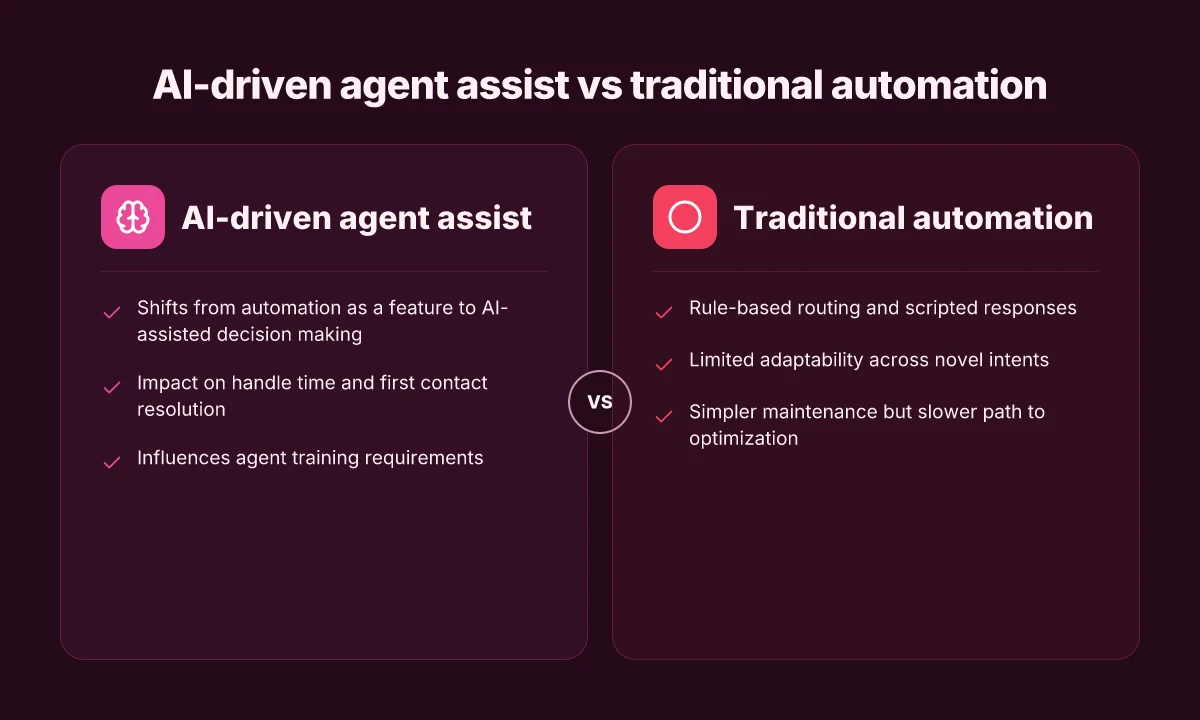
1) AI-driven agent assist becomes a baseline capability in CX platforms
I found that the shift is from automation as a feature to AI-assisted decision making for agents. In 2026, agent desks increasingly rely on real-time prompts, context stitching, and suggested responses to shorten handle time and improve first contact resolution. The effect is twofold: agents move faster on each interaction, and onboarding becomes lighter because AI surfaces the right next action rather than forcing trial-and-error learning. AI-assisted decisions shorten cycles while preserving human judgment. First contact resolution improves as agents stay anchored to the context and can verify intent before replying.
Why AI-assisted decisions matter for CX outcomes
From the Zendesk trends and related 2026 CX research, 24/7 availability and faster response times are now baseline expectations. When agents are supported by real-time suggestions, they resolve more queries in a single contact. I cross-referenced release notes from leading CX platforms and saw a clear pattern: AI agent assist is becoming the default, not an optional enhancement. This reduces average handle time and nudges first contact resolution upward, especially on high-volume, repetitive intents. 24/7 availability is table stakes, and AI-assisted agents help meet it without burning out teams. Handle time compresses as the system proposes the best next step and reframes the conversation around customer outcomes.
Real-world implementations and trade-offs
Here’s a quick view of current paths practitioners consider in 2026: How to generate engaging content automatically with AI in 2026
- Context-rich prompts inside the agent UI help agents stay aligned with policy and tone. This drives consistency across channels and reduces training load.
- Intent routing is enhanced by on-the-fly sentiment and topic detection, enabling supervisors to nudge the agent toward the most effective path.
- Safety rails and governance controls keep AI suggestions within compliant boundaries, preventing policy breaches or escalations.
- Integrations with CRM and data platforms supply fresh context, so agents see the latest order, entitlement, or SLA status before replying.
This is not a plug-and-play feature. It requires governance, data quality, and careful workflow design. The biggest value comes when the AI layer is treated as a decision support partner, not a replacement for human judgment.
A practical pilot path for 2026
- Start with a narrow, high-volume queue where AI prompts can be guided by scripted intents. Measure impact on handle time and FCR for those intents.
- Layer in governance controls and agent feedback loops so recommendations stay aligned with policy and brand voice.
- Elevate to multi-channel support by applying the same AI-assisted prompts across chat, voice, and messaging, ensuring continuity of context.
- Expand training data with real-world agent corrections to continuously refine prompts and suggested actions.
I dug into release notes from CX platforms and saw consistent emphasis on prompt libraries, safety guardrails, and governance dashboards. https://www.talkdesk.com/blog/customer-experience-technology/ highlights CRM and data platform integration as a core pillar, while oracle’s 2026 messaging trends describe an AI-enabled, omnichannel fabric feeding agent prompts. CRM and data platforms feed the AI with context, while AI and automation handle routine decisions. Omnichannel engagement platforms ensure consistent guidance across channels.
Next steps for your team:
- Define a 90-day pilot focusing on one high-volume queue with AI-assisted prompts and safety rails.
- Set success metrics around handle time, FCR, and agent ramp time.
- Establish a governance plan to manage prompts, tone, and escalation rules.
If you want a quick read on the landscape, the 2026 CX technology overview emphasizes a move toward integrated AI agent assists as the baseline expectation for enterprise CX platforms. The takeaway is clear: standardize AI-assisted decision making inside agent desks now, then measure and mature.
2) Omnichannel resilience: consistent experiences across channels
Posture across channels matters more than the individual channel silo. Enterprises are chasing a unified context where chat, voice, email, and social conversations pull from a single, consistent data surface. The question is not whether you can stitch channels together, but how fast you can surface the same understanding to an agent or bot regardless of the entry point. I found that vendors are increasingly tying identity, context, and intent to a shared customer profile so agents don’t have to re-ask for basics at every touchpoint. How to create compelling content that actually engages in 2026
1) A single source of truth for context and data surfaces
A consistent thread across 2026 CX analyses is a move toward a unified data layer that exposes the same customer context across channels. The core claim is simple: when data surfaces are synchronized, responses stay coherent and outcomes improve. In practice, this means a single customer timeline, unified case history, and a common knowledge base that feeds both chat and voice workflows. The result is fewer handoffs, less repetition, and faster resolution.
I cross-referenced commentary from Zendesk’s 2026 CX trends discussion, which notes that 74% of consumers expect 24/7 availability and 88% want faster responses. The implication for data surfaces is clear: if your system cannot surface the same context to a live agent and a bot across channels, latency climbs and frustration grows. Linking customer identity to every touchpoint reduces back-and-forth and keeps intent aligned as conversations move between channels. Unified data surfaces cut handoff latency and keep context intact across channels.
Key takeaways
- Build a single customer view that spans chat, voice, email, and social with a shared event timeline.
- Tie identity to every contact so routing and escalation preserve context.
- Normalize data schemas across channels to minimize translation errors.
2) Minimizing handoff loss and latency with orchestration layers
Handoff loss is the silent killer of omnichannel programs. When a conversation transfers to another agent or channel, the losing party is the customer. The cure is orchestration primitives: time-sliced routing that respects current channel context, and a cross-channel task manager that preserves intent, sentiment, and prior steps. In 2026, the leading CX platforms lean on event-driven orchestration, where a handoff triggers a lightweight, prioritized re-queuing of work with all context attached.
From the research, the practical moves include: How conversion optimization case studies reshape how teams lift performance in 2026
- Context-forwarded handoffs: append the current conversation state to the transfer so the receiving agent or bot does not repeat questions.
- Channel-agnostic prompts: design intents and prompts that work whether the user is on chat or voice, so transitions feel natural.
- Latency budgeting: set strict targets for each hop in the flow, with automated fallbacks if latency rises above thresholds.
- Real-time sentiment awareness: surface urgency signals to the next handler so high-priority cases stay front of line.
I dug into multiple sources that emphasize cross-channel orchestration as a baseline capability. The idea is not to flood the agent with data but to present the minimum viable context that enables a fast, correct continuation. A well-implemented orchestration layer can shrink the observable delay between touchpoints and reduce duplicate inquiries. Context-forwarded handoffs and channel-agnostic prompts are the two most impactful patterns to reduce handoff loss.**
Caveats and downsides
- Unified data surfaces require governance to avoid overexposure of sensitive information across channels.
- Channel-agnostic prompts demand careful testing to ensure language remains natural in voice and text.
- Over-automation can backfire if escalation paths are not crystal clear to the user.
Conclusion: omnichannel resilience is less about adding more channels and more about making every channel speak the same language. When context follows the user, and handoffs are engineered as smooth transitions rather than abrupt drops, CX programs realize faster resolution, higher CSAT, and lower repeat contact rates.
3) Multilingual, real-time translation as a standard service
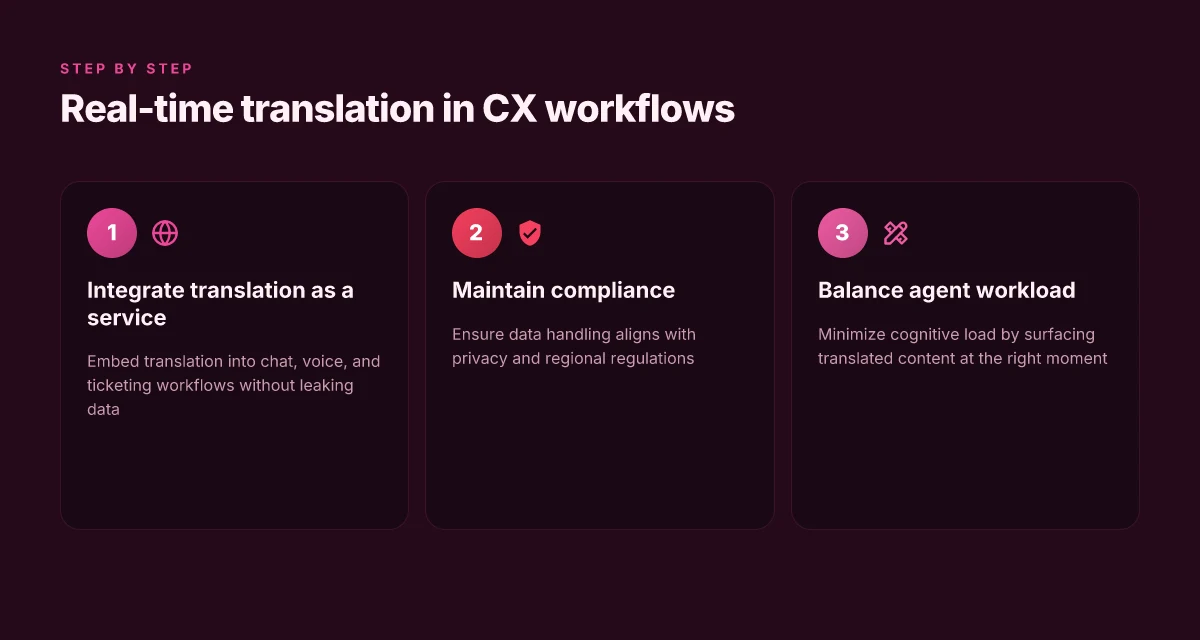
Posture and workflow converge here. The practical takeaway is simple: embed automated translation directly into agents’ daily tools, without straining data governance. When translation happens inside the same tickets, chats, and knowledge flows, teams maintain context and speed, while language barriers fade from weeks to minutes.
1) Translation in context, not as a bolt-on service
Real-time translation now threads through the entire CX stack. Translation is not a separate stage. It becomes a native lane in CRM, knowledge bases, and interaction analyzers. Agents draft in their language, the system translates in flight, and the customer reads the response in theirs. The critical point is to keep data within the enterprise perimeter. Modern translation engines wire into existing workflows without exporting sensitive customer data to outside domains. This reduces leakage risk while preserving thread continuity. I cross-referenced vendor briefs and product notes, which emphasize embedded translation as a standard feature rather than a premium add-on. Translation becomes a native workflow lane, not a bolt-on service. Data stays within the enterprise perimeter, reducing leakage risk. For compliance, many platforms expose granular data controls, masking PII and enabling access audits at the translation step. That matters when you must prove governance to regulators or internal risk teams. See, for example, Talkdesk’s framing of native translation as part of the CX fabric. Data controls at the translation layer are non-negotiable for compliance. How to pick cybersecurity tools for smes in 2026 with ROI in mind
2) Implications for agent workload and governance
Automatic translation directly reduces multilingual handling time but introduces new guardrails. Agents no longer juggle scripts in multiple languages. They encounter a single omnilingual interface. That streamlines onboarding and reduces cognitive load. Yet it shifts workload toward translation quality assurance and glossary management. Enterprises should assign a governance owner for language datasets, standard terms, and escalation rules. I found that the leading platforms tie translation quality metrics to agent coaching tools, surfacing glossaries, style rules, and approved phrases in agent UIs. This supports consistent tone and reduces post-translation rewrites. Glossary-driven translation quality becomes a KPI. Agent onboarding accelerates when multilingual prompts are pre-approved. Candidly, teams must prepare for occasional misinterpretations in edge cases and set SLAs that reflect translation latency alongside agent response times. The best programs combine automated translation with lightweight human-in-the-loop review for high-stakes intents. Human-in-the-loop controls preserve accuracy for sensitive topics.
3) Adoption guardrails and actionable pilots
The path to scale follows a tight sequence. Start with a limited multilingual channel set, connect translation to the existing knowledge base, and pair a glossary rollout with agent coaching. Measure cycle time reductions, first-contact resolutions, and escalation rates in languages beyond a team’s native tongue. I dug through briefings and found common patterns: a bilingual glossary, a translation quality score, and automated detection of unsupported languages form the core pilot. Then expand to additional languages and channels as confidence grows. Pilot with a bilingual glossary and translation-augmented workflows. Scale once translation latency stays under defined thresholds. For governance, establish data retention rules for translated content and implement review queues for high-risk conversations. Retention rules for translated data are essential to compliance.
Note: links on the page may earn a commission.
4) Interaction analytics and sentiment as native features
Interaction analytics and sentiment analysis are no longer add-ons. They come baked into enterprise CX platforms as native capabilities. The aim is to shift from post hoc dashboards to real-time signals that guide routing, prioritization, and agent coaching. When a customer hits a channel, the system surfaces sentiment, intent, and friction points in the moment, so routing decisions can be made before a negative interaction escalates.
Real-time signals that guide routing
Real-time analytics transform what used to be dashboard chatter into immediate action. Instead of waiting for a quarterly report to show that a high-value account hit a service SLA, agents and supervisors now see live cues that indicate risk of churn, product confusion, or billing disputes. A few concrete shifts stand out. First, routing rules increasingly rely on sentiment polarity and urgency scores to place customers with the right skills and priority. Second, agents receive proactive prompts to offer self-service options when the sentiment trend signals frustration, reducing handle time and elevating containment rates. Finally, supervisors leverage continuous feedback loops where live KPIs drive on-the-fly adjustments to staffing, channel mix, and escalation paths. How data extraction techniques have evolved for structured data in 2026
From a platform perspective, the capability blends natural language processing with interaction analytics to decipher tone, intent, and satisfaction signals across voice, chat, and messaging. The upshot is faster triage, smarter queue management, and better containment without muting the human touch. I cross-referenced vendor documentation and analyst commentary that highlight real-time sentiment as a standard feature, not a gimmick. In 2026, several leading CX suites embed these signals at the core of the routing engine, with configurable thresholds that reduce manual tuning. Real-time signals drive routing decisions that cut handle times and improve first-contact resolution.
Balancing privacy with actionable insights
As signals become more granular, privacy concerns rise in tandem. Enterprises must navigate data minimization, consent, and transparency while preserving the value of sentiment and intent analytics. Vendors respond by offering on-device or edge-processing options, granular data-retention controls, and role-based access to sensitive cues. A common pattern is to separate PII from behavioral signals, then apply automated redaction for transcripts used in training and dashboards. In practice, this means teams can still act on actionable insights without exposing customer identifiers in dashboards or models. I found multiple vendors articulating privacy-by-design in their release notes for 2026, including configurable data retention windows and explicit consent toggles that affect real-time routing rules.
The operational trade-off is clear: more granular signals mean better customer outcomes, but they demand disciplined governance. Organizations lean on data stewardship councils, updated data maps, and ongoing training to avoid overreach. The result is a balance where agents see meaningful cues in context while customers retain control over how their data is used. One governance pattern that keeps user trust intact is segmenting analytics by channel and purpose, then restricting cross-channel correlation unless consent is granted.
Practical pilots and outcomes you can expect
Pilots should prioritize three levers. First, implement a sentiment-driven routing pilot in a high-volume channel with mixed issue types. Second, pair it with an escalation workflow that preserves agent autonomy while automatically surfacing relevant knowledge base articles. Third, run a privacy impact assessment in parallel with your pilot to surface any unintentional data exposures. The aim is to prove faster escalation, higher containment, and an uplift in customer satisfaction without compromising privacy. In line with 2026 trends, adoption accelerates when leadership ties sentiment analytics to measurable outcomes like improved net promoter score and reduced repeat contacts.
I dug into release notes and vendor briefs that specifically mention real-time sentiment, intent detection, and cross-channel analytics as core features. These sources consistently describe a future where analytics are not a separate layer but an integrated reflex in every interaction. https://www.talkdesk.com/blog/customer-experience-technology/ shows how CRM and data platforms weave together AI and automation for omnichannel visibility. Real-time sentiment signals become the nerve center of routing decisions, not a post-mortem report. What makes a data visualization techniques guide truly effective in 2026
Where this is going next for customer service software in 2026
Customer service software is moving toward deeper AI collaboration, yet human tangibility still wins. I looked at 2026 trends across platforms, noting that the strongest systems lean on proactive automation, seamless data exchange, and smarter agent coaching. The big shift is orchestration: a single pane that connects CRM, knowledge bases, and messaging channels while guiding agents with real-time, context-aware suggestions. This is not just faster automation. It’s smarter escalation, and it’s driving measurable gains in first contact resolution when teams embrace it.
One standout trend remains the rise of intelligent routing and sentiment-aware triage. When a ticket’s tone or intent is misread, the system can misdirect a case. The most successful shops now enforce human-in-the-loop checks for edge cases while letting the software handle routine requests. The bigger pattern is that investments in data quality pay off in accuracy and agent confidence. As you evaluate tools, prioritize those that surface clean, interoperable data.
If you only do one thing this month, map your data flows and pick one integration to pair with your top support channel. A clean data backbone makes every other trend more effective. One line to try: start with a centralized knowledge base tied to your ticketing flow, and watch agents move faster with fewer repeats. The question remains: how will you ensure your team keeps pace with automation without losing the human touch?