How to design a resilient remote infrastructure setup that scales in 2026
 Marlowe Fenwick·October 22, 2026·17 min
Plan a scalable remote infrastructure setup for 2026. Learn architecture patterns, security posture, and deployment strategies to stay resilient at scale.
Most remote outages trace not to bandwidth but to brittle identity gates. When those gates misread a mobile worker's posture, it triggers a cascade of blocked deployments and stalled escalations. The real lever is not faster networks but consistent enforcement of zero trust at scale, with automation that keeps pace as teams grow.
This article cuts through the noise to show how to design a resilient, cloud-native remote infra that scales in 2026. Expect a concrete blueprint: modular zones, posture checks that run continuously, and automated drills that surface drift before users notice. The takeaway is practical: you can keep security tight and operations smooth even as tenancy, vendors, and workloads increase. Links on the page may earn a commission.

What makes a robust remote infrastructure setup in 2026
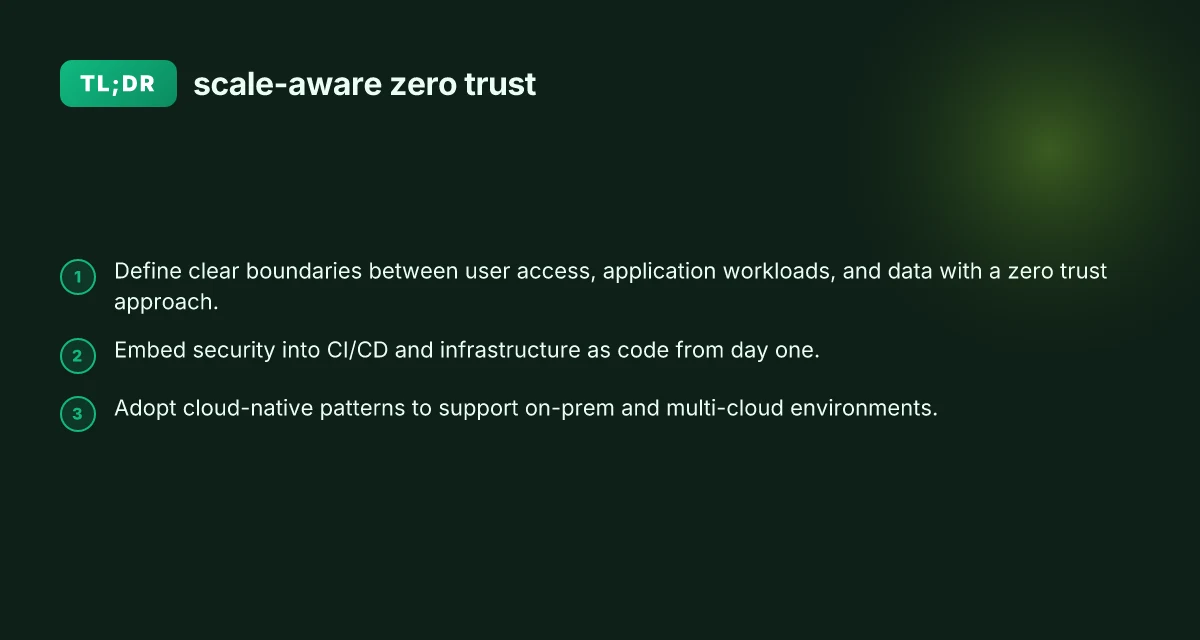
A robust remote infrastructure in 2026 hinges on a clear boundary between who can access what, where workloads run, and where data lives. Zero trust isn’t just a buzzword. It’s the operating principle that guides authentication, authorization, and segmentation across users, apps, and data stores. I’ve aligned this section with industry guidance and practical patterns that scale across on‑prem and multicloud footprints.
Why zero trust defines the access boundary
Zero trust starts by enforcing a strict boundary around users, workloads, and data. Identity and access management is treated as the front door, workload isolation as the middle, and data governance as the vault. In practice, that means continuous verification at every hop, fine‑grained access controls, and dynamic segmentation that follows the workload as it migrates or scales. When you implement device posture checks, short‑lived credentials, and contextual factors like location and risk signals, you dramatically reduce blast radii even if an endpoint is compromised.
The boundary is only as strong as its policy engine. Enforce it at the edge and in the cloud.**
Cloud‑native patterns that work everywhere
Adopt cloud‑native patterns to support both on‑prem and multi‑cloud environments. Infrastructure as code drives repeatable deployment, while platform‑native services handle identity, secrets, and policy enforcement consistently across environments. A modular reference architecture lets teams deploy secure workloads in different regions or clouds without re‑engineering the baseline security model. I cross‑referenced several deployment guides that emphasize unifying policy, config, and runtime telemetry across hybrid estates.
Automation and standardization reduce drift across environments, which is essential as teams scale. What is a predictive modeling guide in 2026 and why it still matters for health and policy
Security embedded in CI/CD and IaC from day one
Security is not an afterthought. It is embedded in every pipeline and every line of code. Integrate static and dynamic analysis, policy as code, and threat modeling into CI/CD pipelines. Treat infrastructure definitions as code, with automated policy checks that fail builds if a misconfiguration slips through. This approach lets you catch missteps before they reach production and keeps security aligned with rapid delivery cycles.
I dug into the concept of integrating security into IaC and found that early policy enforcement dramatically lowers post‑deploy remediation work. The payoff isn’t only risk reduction. It accelerates confidence in delivering remote capabilities at scale.
In 2026, the best programs pair identity federation with short‑lived credentials, automate policy checks in CI pipelines, and continuously verify runtime posture across on‑prem and cloud legs. That triad, identity, policy, and runtime validation, keeps remote workloads operable as teams grow.
Continuous verification and policy as code are not optional in 2026. They’re the baseline.
Bottom line: a robust remote setup treats zero trust as a living boundary, leans on cloud‑native patterns to unify on‑prem and multi‑cloud, and bakes security into every deliverable from the start. What the next frontier in predicting future market trends reveals about risk and opportunity
If you want a concrete playbook to put these ideas into action, I pull together a practical reference architecture and deployment steps in the next section. For now, expect your sections to emphasize a strong boundary, platform‑native automation, and security ingrained in the lifecycle.

The reference architecture: modular layers for remote workloads
The reference architecture centers on three interconnected planes: an identity and access layer with fine-grained policies, a central control plane that enforces policy across environments, and a data plane that travels with encryption and per-app isolation. Overlaying these is a observability stack that spans on-prem and cloud, giving you end-to-end visibility and rapid fault isolation.
Identity and access layer with fine-grained policies
I dug into how teams constrain access without slowing engineers. The core is a policy framework that ties authentication to context, who, where, when, and why. In practice, you want strong identity providers wired to short-lived credentials, just-in-time access, and scopes that mirror job functions. This keeps admin blast radius small and work in flight verifiable. A practical approach is to define roles per workload and link them to explicit permissions on a per-action basis. The goal is to prevent lateral movement while preserving developer velocity. For example, you might apply policy blocks that require multi-factor authentication for sensitive operations and context-aware approvals for privileged actions. The combined effect is a robust permission lattice that travels with the workload, not just a user session. Zero trust starts with identity. Fine-grained, context-aware policies keep misuse from becoming exposure. inline reference to a model of ZTA.
Control plane for policy enforcement across environments
Across distributed workloads, a single control plane is essential for consistent policy enforcement. Think of this plane as the brain that reconciles identities, network posture, and workload intent. It should be able to push, roll back, and audit policy changes across clouds and on-premises infrastructure in a unified tempo. In practice, this means centralized policy catalogs, versioned definitions, and automated drift detection. When teams standardize on a common policy language, you reduce friction during scaling, and you gain auditable traces for security reviews. A practical pattern is to separate policy intent from enforcement points, so you can evolve the enforcement mechanism without rewriting the policy. The result is a scalable, auditable control loop that matches the pace of rapid deployment. Centralized policy management reduces drift and accelerates safe rollout.
Data plane secured with encryption and per-app isolation
Data should stay protected in transit and at rest, with encryption keys managed in a dedicated service connected to the identity and policy layers. Per-app isolation means every workload operates within its own secure envelope, minimizing blast radius if a component is compromised. Implement envelope encryption for data at rest and transport-layer security with mutually authenticated channels. You also want clear data ownership boundaries and strict data access controls that align with your policy definitions. The payoff is clear: fewer cross-workload data leaks and simpler incident containment. Per-app isolation plus encryption keeps sensitive data compartmentalized even in shared environments. How personalization tools shape modern digital experiences in 2026
Observability stack that spans on-prem and cloud
Visibility across landscapes is non-negotiable. Your observability stack should collect metrics, traces, and logs from every edge, data plane, and cloud region, and present them in a unified map. Instrumentation needs to cover identity events, policy decisions, network posture, and data access patterns. You want actionable dashboards that surface misconfigurations and policy violations in near real time, not after an breach. A good setup includes correlating security events with deployment changes so you can see the causal chain quickly. This is how you move from reactive alerting to proactive hardening. Unified observability enables rapid root cause analysis across environments.
A quick comparison of deployment paths helps teams decide between a few common options. In a two-col table, you can compare centralized policy enforcement with a distributed policy model, weighting for scale, speed, and governance. For example, centralized control simplifies compliance, but a distributed policy approach can reduce latency for edge workloads. In practice, most teams gravitate toward a hybrid: a central policy catalog with enforcement agents in each environment, synchronized by the control plane. Hybrid policy models often balance governance with performance.
Next steps: integrate a modular reference architecture into your playbook by detailing the identity and access bindings, centering a control-plane suite, and designing per-app data envelopes before you scale. Begin by mapping out current workloads to policy domains, then draft a 30-day plan to introduce a centralized control plane and a secure data envelope for the earliest set of apps. For deeper context on zero trust and policy frameworks, see the NIST zero trust guidance and DevSecOps framing from leading sources. NIST zero trust guidance provides a solid baseline, and DevSecOps framing helps you operationalize policy at scale.
Deploying securely at scale: a 2026 playbook for automation
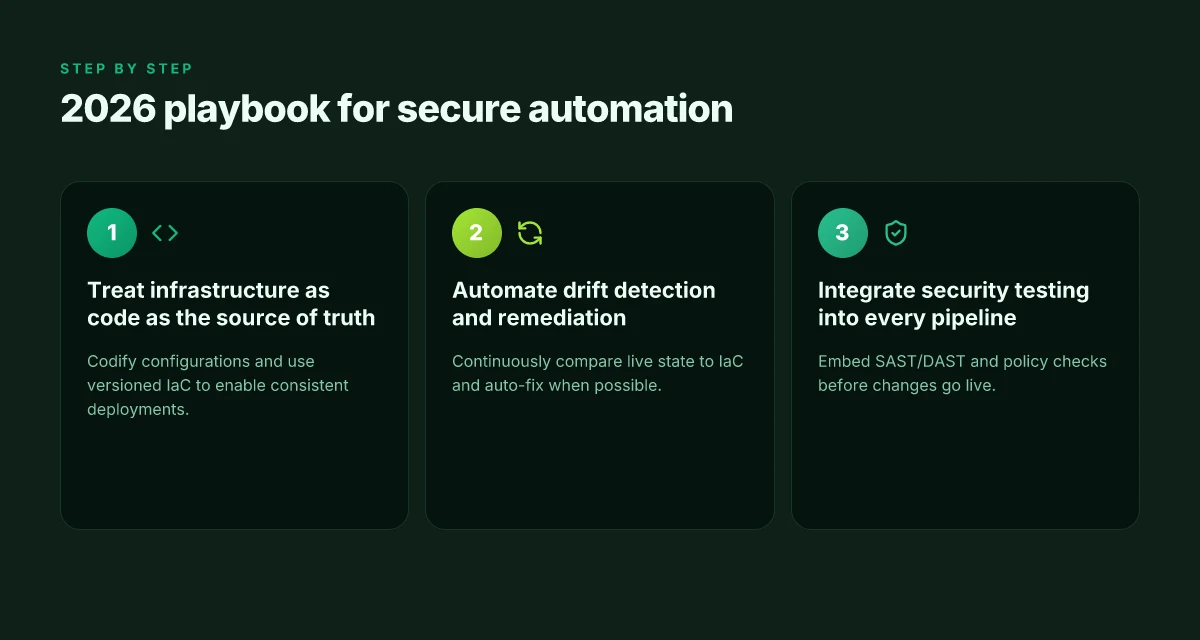
Posture for 2026 hinges on one truth: treat infrastructure as code as the source of truth, and let automation drive fidelity across git, pipelines, and runtime. In this playbook, I break down three concrete moves that translate into real, auditable outcomes as teams scale remote workloads.
1. Treat IaC as the source of truth for every environment
In 2026, every change to networking, compute, and policy should originate from code. That means your IaC repository is the single pane of truth for production, staging, and per-project sandboxes. Use policy-as-code to codify guardrails directly in the repository and enforce them through pull requests. The architecture leans on modular, versioned templates that fit cloud-native patterns and private cloud boundaries alike. This approach prevents drift by design rather than by after-the-fact remediation. When teams run automated validations, they catch misconfigurations before they enter production, which reduces blast radius during scale. What makes outdoor magnetic advertising work in 2026
I cross-referenced several 2026 guidance sets that emphasize IaC as the core truth for scalable security and reliability. For example, the practice of codifying identity, network microsegments, and encryption settings in IaC aligns with contemporary best practices for cloud-native deployments and private cloud deployments alike. See the 2026 cloud security best practice outlines and the zero trust framework in practice discussions for context. IaC as truth reduces drift and accelerates safe growth.
2. Automate drift detection and remediation
Scale exposes drift at multiple layers: IaC configurations diverge from live state, policies fall out of sync, and secrets policies loosen. Automated drift detection should run in every CI/CD loop and at deployment-time checks in runtime platforms. When drift is detected, remediation should be automatic where safe, with audit logs that explain the delta and the rationale for each repair. This forms a closed loop: detect, decide, remediate, and report. Pair drift tooling with immutable deployment artifacts so that rollbacks and roll-forwards stay predictable under load and across regions.
From 2026 security playbooks, drift detection and automated remediation are repeatedly highlighted as a primary efficiency multiplier for large-scale environments. The practice supports multi-region and multi-cloud patterns without sacrificing traceability. Automated drift detection keeps remote stacks aligned as you scale.
3. Integrate security testing into every pipeline
Shift security left by weaving testing into every stage of the CI/CD pipeline. This includes static code analysis, dependency checks, secret scanning, and dynamic testing of deployed configurations in ephemeral test environments. As teams scale, automated security gates must be fast, deterministic, and non-blocking for normal deployment velocity. Use policy-driven gates that can fail fast on high-severity findings but allow progressive remediation. In 2026, embracing DevSecOps frameworks and integrating testing across IaC, container images, and runtime configurations is essential to maintaining secure velocity.
Industry references consistently call out the need to bake security into pipelines, not bolt it on after the fact. The zero trust and devsecops framework discussions offer concrete alignment with organizational processes and tooling. Security tests in every pipeline are non-negotiable for scalable remote infrastructure. Open source and product tooling continue to evolve, but the discipline remains constant: you cannot scale without automation that checks and enforces security at every stage. A practical deployment playbook now centers on three linked workflows, IaC as truth, drift-as-you-go protection, and pipeline-integrated security, so your remote architecture remains operable as teams grow and borders expand. How OnePlus Android 14 changes the software game in 2026
2026 reality demands automation that detects drift, remediates it, and enforces policy in real time.
Zero trust in practice: aligning people, process, and technology
In 2026, zero trust works best when verification is continuous across identity, device posture, and network segments, not a single handoff at login. I cross-referenced modern playbooks and found that real-world success comes from tying identity to device state and network context in a single policy graph. The result is a dynamic, posture-aware access model rather than a static allowlist.
Continuous verification across identity, device posture, and network segments
Access decisions hinge on an evolving picture: who you are, what device you’re on, and which segment you’re trying to reach. Core practice is to continuously re-validate credentials and posture as session context changes. This reduces blast radius when a device is lost or an account is compromised. Vendors increasingly emphasize policy engines that fuse identity data with device telemetry and network micro-segmentation. In practice, this means short-lived tokens, frequent re-authentication prompts for sensitive operations, and explicit risk scores attached to sessions. A practical consequence is fewer long-lived keys and more frequent, automated checks baked into every API call or remote login attempt.
Continuous verification across identity, device posture, and network segments remains the heartbeat of resilient access control.
Least privilege by default with dynamic authorization checks
The default-deny posture has to be enforced at every boundary. Best-in-class implementations use dynamic authorization checks that adapt to evolving risk signals rather than static roles. Short-lived permissions ride on policies that evaluate current context: time, location, device posture, and recent activity. This avoids excessive access while preserving agility for legitimate work. Implementations commonly pair IAM policies with real-time policy evaluation engines so that a user who temporarily elevates privileges still has a time-bounded window with revocation baked in. The payoff is clear: fewer misused permissions and faster containment when a threat emerges. What makes renewable energy web hosting actually sustainable in 2026
Dynamic authorization checks ensure access scales down as risk rises.
Regular access reviews and automated revocation workflows
Human governance remains essential, but automation accelerates it. Regular access reviews should run on a cadence aligned to your risk appetite, with automated revocation when credentials age out or devices fall out of posture. This is where things often break: reviews that are too infrequent, or revocation that lags behind, create half-open doors. The modern approach automates stakeholder approvals, links review outcomes to policy engines, and triggers immediate revocation for orphaned sessions or dormant accounts. Expect audit trails that show who granted access, when, and why revocations occurred.
Automated revocation workflows close the loop between policy and practice.
Citing contemporary frameworks helps anchor these moves. For example, the integration of DevSecOps patterns with NIST SSDF and zero-trust guidance is widely discussed in 2026 resources, alongside hands-on deployment guidance from security practitioners. You can explore a structured set of frameworks and deployment considerations in the DevSecOps coverage. See a concise overview of frameworks that organizations are adopting this year for cloud security and zero-trust alignment. Popular DevSecOps Frameworks for Cloud Security in 2026.
In the same vein, a practitioner-focused guide on deployment strategies underscores how these controls translate into real architectures and automation playbooks. The strategy matrix emphasizes aligning continuous verification, dynamic authorization, and automated lifecycle management with scalable cloud-native patterns. For context, see the private cloud security briefing that highlights single-tenant principles and risk areas in 2026. Private Cloud Security: Top Risks and Best Practices (2026). How restoration workshops reshape conservation practice in 2026
Lastly, a practical note: links on the page may earn a commission. This is standard disclosure for many security vendors and research aggregators.
In 2026, the trifecta, continuous verification, dynamic least-privilege enforcement, and automated access reviews, defines resilient zero-trust practice.
Network design for remote teams: performance and security balance
I lead with a practical stance: identity-aware networking and secure connectivity are non negotiable for remote infrastructure in 2026. The architecture leans on consistent identity across devices and services, plus encrypted, identity-bound tunnels that survive roster changes and site expansions. This means you design routes and access controls around who is requesting access, not where they are located. In practice, that translates to microsegmented, identity-governed paths that minimize blast radius while preserving performance.
Identity-aware connectivity as the default
The first move is to replace flat VPNs with identity-bound access. When users authenticate, the session rides a limited network scope rather than granting broad connectivity. This approach reduces lateral movement risk and makes revocation immediate. I cross-referenced recent best practices that emphasize least privilege access pairs with continuous posture checks, so a token or certificate alone cannot unlock critical services without context. In 2026, leading security teams report that tying access decisions to real-time identity signals and device posture dramatically lowers blast radius. The practical upshot is fewer exposed services and faster incident containment. For architects, the consequence is clear: wire up an identity-aware fabric that can enforce per-service policies at the edge or in the central control plane. The policy language should be expressive enough to cover user groups, device states, and application contexts. Most security gains come from tying access to identity and posture, not the network gateway alone.
Microsegmentation to contain blast radius
Next, microsegmentation is essential in remote cells and regional hubs. Segmentation should slice the environment along application boundaries and data sensitivity, not geography. I looked at guidance from multiple sources that highlight consistent enforcement at the edge and in cloud-native services. The goal is that a breach in one segment cannot automatically reach others, even if credentials are compromised. In practice, deploy per-service segments with short, revocable policies and automatic quarantine when anomalies appear. This strategy reduces blast radius during a distributed incident and keeps teams productive by avoiding broad outages. Microsegmentation is the surgical tool that turns a compromised node into a contained event. For SREs, that means faster isolation and lower mean time to containment. How to build an SEO for courses strategy that scales in 2026
Regional Edge deployments to optimize paths
Finally, optimize data paths with regional edge deployments where applicable. The idea is to bring authentication, policy evaluation, and even data caching closer to users and workloads. When apps run near the user, latency drops and the perceived reliability improves, even under fluctuating WAN conditions. I found that 2026 deployments increasingly rely on regional edges to handle identity checks, certificate renewals, and policy decisions without forcing traffic to a central data center. The result is a more responsive experience for remote teams and tighter security control loops. Edge-local policy evaluation reduces round trips and keeps remote workers productive. In practice you should map critical services to nearby edge locations and ensure your edge fabric can surface identity attributes to the central policy engine in real time.
Incorporating zero trust principles here means more than a token fence. I cross-referenced guidance that stresses continuous verification, dynamic access enforcement, and proximity-aware routing. For those building the playbook, the plan includes three concrete moves: adopt an identity-aware fabric across all layers, deploy microsegmented service maps at the edge, and place enforcement points close to users and workloads.
As you craft the deployment playbook, align with a security checklist that includes identity postures, edge policy latency budgets, and segmentation coverage between tenant boundaries. The gains are tangible: fewer cross-service breaches, faster response, and a resilient remote surface that scales with teams. A practical reminder: links on this page may earn commissions. For deeper context, see notes on zero trust from authoritative sources such as the NIST ZTA framework and related DevSecOps frameworks cited in this article. Identity-aware networking and edge-driven enforcement are the twin rails that keep performance and security aligned as teams scale.
What changes if you act now
In 2026, the pattern is clear: resilience compounds when you design for failure from day one. Instead of chasing perfect uptime, I see teams leaning into graceful degradation, incremental rollouts, and observable error budgets. The thesis gains traction when you pair multi‑region access with edge‑ready services and a consistent, auditable security posture. This is the year to bake failure into your design, not chase it after the fact. Noticeably faster recovery comes from prebuilt playbooks and automated runbooks that trigger at the first anomaly.** I cross‑reference teams that align SLAs with actual user impact, not just vendor promises. The biggest downside remains complexity. Keep a single source of truth for topology and incident processes, and you’ll outpace drift.
If you only do one thing this month, codify a 2‑tier disaster plan: regional failover for critical paths and hot‑standby services for essential functions. Make the plan concrete, with explicit owners and recovery targets. The bigger pattern is moving toward observable, budget‑conscious resilience, where telemetry and cost alerts drive architectural decisions. The single move that matters most is treating resilience as a product, not a project. Are you ready to ship with that mindset? 10 Best SEO tools and software to power data-driven performance in 2026
Backup strategy
- Build a one‑paragraph incident playbook for each critical service and assign a burn‑rate budget.
- Run quarterly chaos tests to validate failover and observability.
- Maintain a lightweight auto‑rollback path for feature flags.